Table of Contents
- 1. What Is ISKCON Gaura Aarti?
- 2. Gaura Aarti — Complete Lyrics, All 7 Verses with Translation
- 3. Who Appears in Gaura Aarti?
- 4. Spiritual Significance of Gaura Aarti
- 1. Lord Caitanya — Who Is Gaura?
- 2. The Jahnavi (Ganges) — Setting of the Vision
- 3. "Attracting All Minds in the Universe" — Jaga-Mana-Lobhā
- 4. The Pancha Tattva — The Five Truths
- 5. Spiritual Benefits of Attending ISKCON Gaura Aarti
- 6. FAQs — Everything About ISKCON Gaura Aarti
Introduction
What Is ISKCON Gaura Aarti?
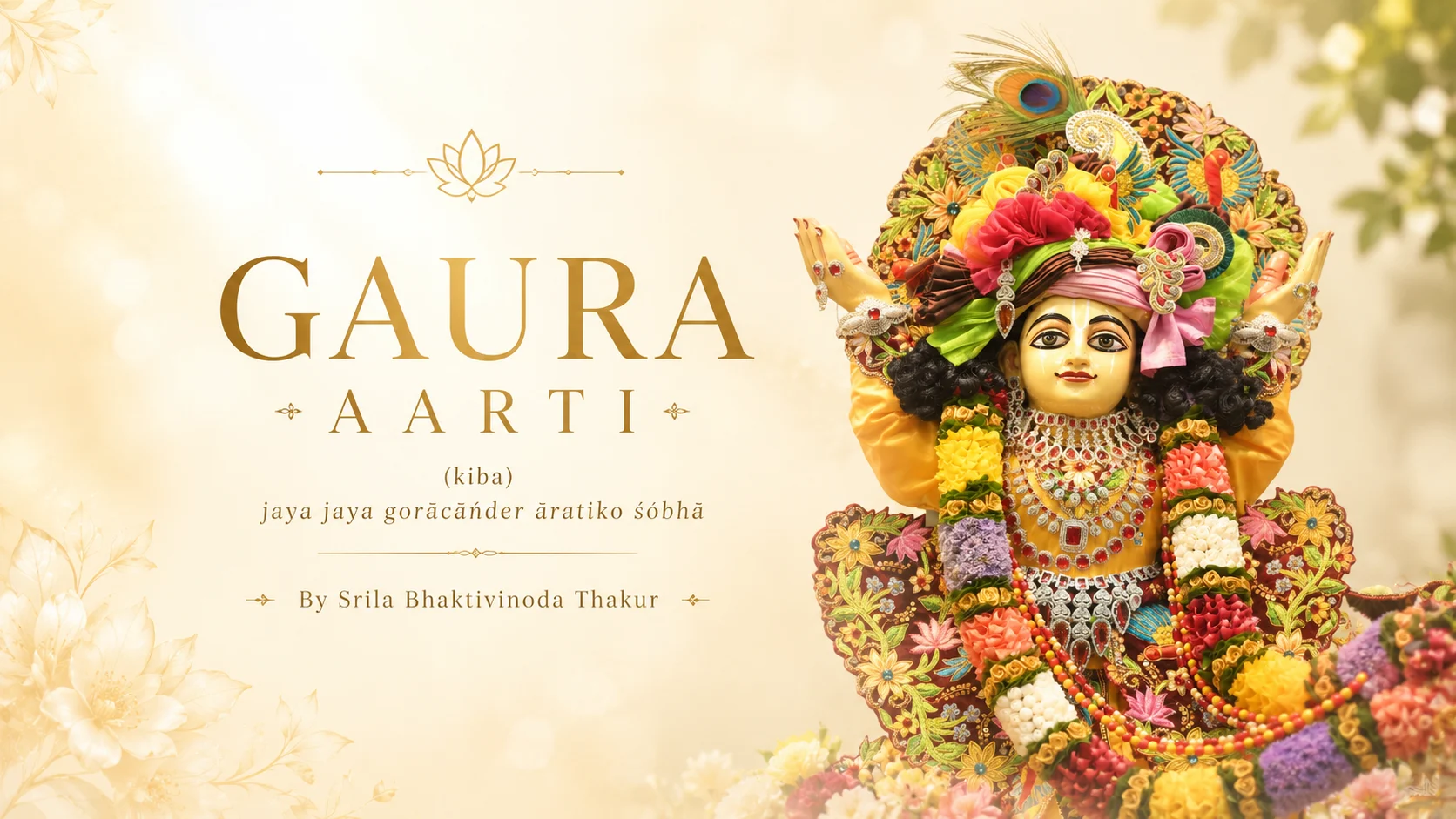
ISKCON Gaura Aarti is the celebrated evening lamp-offering ceremony performed every day in ISKCON (International Society for Krishna Consciousness) temples worldwide, dedicated to Lord Sri Caitanya Mahaprabhu — affectionately called Gaura, meaning "the golden one." The word aarti refers to the ritual of waving a ghee lamp before the deity as an act of worship and surrender.
What makes the ISKCON Gaura Aarti extraordinary — and unmistakable among all Vaishnava ceremonies — is its song: "Jaya Jaya Gorācāṅder Āratiko Śobhā", composed by the great 19th-century Vaishnava saint and scholar Thakura Bhaktivinoda. In seven luminous verses, this song paints a vivid, ecstatic vision of Lord Caitanya's aarti on the banks of the River Ganges (Jahnavi), surrounded by His intimate associates and glorified by the greatest saints of the universe.
Sacred Text
Gaura Aarti — Complete Lyrics, All 7 Verses with Translation
Below is the complete, authoritative text of the ISKCON Gaura Aarti song — "Jaya Jaya Gorācāṅder Āratiko Śobhā" — as sung in ISKCON temples worldwide. Each verse is presented with its romanised transliteration and full English translation, as established by Srila Prabhupada and the ISKCON tradition.
jāhnavī-taṭa-vane jaga-mana-lobhā
jaga jana-mana-lobhā
Translation: All glories, all glories to the beautiful aarti ceremony of Lord Caitanya. This Gaura-aarti is taking place in a grove on the banks of the Jahnavi (Ganges) and is attracting the minds of all living entities in the universe.
nikaṭe advaita, śrīnivāsa chatra-dhara
Translation: On Lord Caitanya's right side is Lord Nityananda and on His left is Sri Gadadhara. Nearby stands Sri Advaita, and Srivasa Thakura is holding an umbrella over Lord Caitanya's head.
ārati koren brahmā-ādi deva-gaṇe
Translation: Lord Caitanya has sat down on a jeweled throne, and the demigods, headed by Lord Brahma, perform the aarti ceremony.
sañjaya-mukunda-bāsu-ghoṣ-ādi gāya
Translation: Narahari Sarakara and other associates of Lord Caitanya fan Him with camaras, and devotees headed by Sanjaya Pandita, Mukunda Datta, and Vasu Ghosa sing sweet kirtana.
madhura mṛdańga bāje parama rasāla
Translation: Conchshells, bells, and karatalas resound, and the mrdangas play very sweetly. This kirtana music is supremely sweet and relishable to hear.
gala-deśe bana-mālā kore jhalamala
Translation: The brilliance of Lord Caitanya's face conquers millions upon millions of moons, and the garland of forest flowers around His neck shines brilliantly.
bhakativinoda dekhe gorāra sampada
Translation: Lord Siva, Sukadeva Gosvami, and Narada Muni are all there, and their voices are choked with the ecstasy of transcendental love. Thus Thakura Bhaktivinoda envisions the glory of Lord Sri Caitanya.
Who Appears in Gaura Aarti?
Gaura Aarti presents a divine vision where Lord Caitanya is surrounded by His intimate associates, great sages, demigods, and devotees — all absorbed in ecstatic service.
This is not an ordinary ceremony — it is a glimpse of the highest spiritual assembly.
Philosophy & Theology
Spiritual Significance of Gaura Aarti
1. Lord Caitanya — Who Is Gaura?
The subject of the Gaura Aarti is Sri Krishna Caitanya Mahaprabhu — who appeared in Navadvipa, Bengal in 1486 CE. Gaudiya Vaishnava scripture and the direct statement of Srila Prabhupada identify Lord Caitanya as Krishna Himself, appearing in the role of His own devotee, to experience the bliss of devotional love from within and to freely distribute that love to the world. He is golden-complexioned — hence the name Gaura — having taken on the golden colour and the mood of Srimati Radharani.
2. The Jahnavi (Ganges) — Setting of the Vision
Bhaktivinoda Thakura describes the Gaura Aarti as taking place "in a grove on the banks of the Jahnavi" — that is, the banks of the River Ganges at Navadvipa, West Bengal, where Lord Caitanya spent His early life and initiated the sankirtana movement. This specific setting is not accidental. The Ganges is considered the most sacred river in Vedic tradition, flowing from the heavenly planets, and a grove on its bank is a natural temple — the most auspicious possible setting for divine worship.
3. "Attracting All Minds in the Universe" — Jaga-Mana-Lobhā
The phrase jaga-mana-lobhā — attracting the minds of all living entities in the universe — is one of the most theologically profound statements in the song. It asserts that Lord Caitanya's aarti is not merely a local, earthly event. It is a cosmic spectacle visible from all planes of existence, drawing the attention of even celestial beings, demigods, sages, and liberated souls. When ISKCON devotees perform Gaura Aarti each evening, they are not merely imitating this vision — they are participating in the same eternal ceremony in a different dimension of reality.
4. The Pancha Tattva — The Five Truths
Verse 2 of the Gaura Aarti describes the Pancha Tattva — the five divine personalities who together constitute the complete manifestation of the Absolute Truth in the age of Kali: Lord Caitanya (Krishna Himself), Lord Nityananda (the Original Spiritual Master), Sri Advaita (the incarnation), Sri Gadadhara (the potency), and Srivasa (the pure devotee). Their simultaneous presence in the aarti vision signifies the totality of transcendental reality assembled to glorify the Supreme.
🌊 Three Layers of Meaning in Gaura Aarti
- Historical layer: Bhaktivinoda Thakura is describing an actual historical event — the aarti ceremonies that took place in Navadvipa during Lord Caitanya's lifetime (1486–1534 CE), attended by His intimate associates.
- Visionary layer: The song is simultaneously a mystical vision — the poet seeing with the eyes of transcendental love a scene that transcends time, taking place eternally in the spiritual world.
- Active layer: When devotees sing Gaura Aarti each evening, they are actively recreating this vision in consciousness — turning every ISKCON temple hall into the grove on the banks of the Jahnavi, with Lord Caitanya present on His jeweled throne.
Why Attend?
Spiritual Benefits of Attending ISKCON Gaura Aarti
-
01Direct Association with Lord Caitanya's Mercy Lord Caitanya appeared specifically to distribute love of God freely — without discrimination. His aarti is described as attracting "all minds in the universe." Simply being present in the congregation during Gaura Aarti places one in the direct line of that mercy.
-
02Purification Through Sacred Sound (Shabda-Brahman) The Gaura Aarti song, when sung with devotion, is not material sound — it is shabda-brahman, the Absolute Truth in the form of sound vibration. Hearing and singing it purifies accumulated karma and gradually awakens dormant love for God.
-
03Cultivation of the Ecstatic Mood (Bhava) Verse 7 describes even Lord Siva and Narada Muni with voices "choked with ecstasy." Regularly entering this mood — even in aspiration — gradually cultivates the spiritual emotion (bhava) that leads to pure devotional love.
-
04Meditation on the Pancha Tattva Verse 2 names and positions all five members of the Pancha Tattva around Lord Caitanya. Meditating on their arrangement during the song is a complete form of spiritual practice — a visulaisation of the Absolute Truth in its five-fold manifestation.
-
05Connection to the Eternal Aarti in Navadvipa Bhaktivinoda Thakura presents Gaura Aarti as an eternal reality — not merely a historical event. By participating each evening, devotees connect to this eternal ceremony and transcend the limitations of time and space.
-
06Community, Sangha & Collective Elevation Gaura Aarti is a collective ceremony — its power multiplies with the number of sincere participants. The ISKCON sangha (devotional community) gathered for evening Gaura Aarti creates a spiritual vortex that elevates all present, regardless of their individual level of advancement.
-
07Learning Through Beauty — Rasa Unlike dry philosophical study, Gaura Aarti teaches through aesthetic experience — through rasa (divine taste). The image of Lord Caitanya's face outshining millions of moons, His forest flower garland shining brilliantly, is not merely decorative; it draws the mind naturally toward the contemplation of transcendental beauty.
-
08Accumulation of Devotional Merit (Bhakti-Sukriti) Even inadvertent presence during the Gaura Aarti — even if one does not know the words or understand the philosophy — accumulates sukriti (devotional merit) that gradually ripens into active interest in Krishna consciousness, as confirmed throughout the Srimad Bhagavatam.
Common Questions
FAQs — Everything About ISKCON Gaura Aarti
ISKCON Gaura Aarti is the evening lamp-offering ceremony dedicated to Lord Sri Caitanya Mahaprabhu (Gaura), performed daily at approximately 7:00 PM in ISKCON temples worldwide. The song sung during this ceremony — "Jaya Jaya Gorācāṅder Āratiko Śobhā" — was composed by Thakura Bhaktivinoda and describes a divine vision of Lord Caitanya's aarti on the banks of the Ganges, attended by the Pancha Tattva and the greatest saints of the universe.
ISKCON Gaura Aarti is performed at 7:00 PM daily in most Indian ISKCON temples. International temples (London, New York, etc.) may adjust this slightly by 30–60 minutes depending on the season and local sunset time. It is also commonly referred to as the Sandhya Aarti (twilight aarti) or evening aarti.
The Gaura Aarti song — "Jaya Jaya Gorācāṅder Āratiko Śobhā" — was composed by Srila Saccidananda Bhaktivinoda Thakura (1838–1914), the pioneering Gaudiya Vaishnava saint, scholar, and magistrate who is considered the father of the modern Gaudiya Vaishnava renaissance. The song appears in his devotional collection Gitavali.
Mangal Aarti is the pre-dawn ceremony at 4:30 AM — the first aarti of the day, performed to wake the deities. It is dedicated to Sri Sri Radha-Krishna. Gaura Aarti is the evening ceremony at 7:00 PM — the sixth aarti of the day, specifically dedicated to Lord Caitanya Mahaprabhu. Mangal Aarti uses the Sri Gurvashtakam; Gaura Aarti uses Bhaktivinoda Thakura's "Jaya Jaya Gorācāṅder." Both are essential parts of the ISKCON daily programme.
The Gaura Aarti song — "Jaya Jaya Gorācāṅder Āratiko Śobhā" — has seven verses. Each verse is prefaced with the word (kiba), a Bengali exclamation of wonder. All seven verses are sung in full during the ISKCON evening Gaura Aarti ceremony. The seventh verse is the poet's signature — Bhaktivinoda Thakura identifies himself as the visioner of the scene he has described.
Jaya (also spelled Jaya) is a Sanskrit and Bengali word meaning "all glories to," "victory to," or "praise." It is a devotional exclamation used to glorify a deity or exalted person. Gorācāṅder is an affectionate form of address for Lord Caitanya — combining Gora (golden one) with cāṅd (moon) and the honorific suffix er. Together: "All glories to the golden moon, Lord Caitanya."
Absolutely. ISKCON Gaura Aarti is completely open to people of all faiths, backgrounds, and nationalities. You do not need to be a Hindu, a Vaishnava, or a formal devotee to attend. Simply arriving at the temple around 6:45 PM, removing your shoes, dressing modestly, and standing with the congregation is sufficient. Many visitors report that their first experience of Gaura Aarti — even without understanding the words — was deeply moving and spiritually affecting.
In Vaishnava aesthetic theology, the beauty of the Lord is expressed through comparison with the most beautiful things in the material world — and then shown to infinitely exceed them. The moon is the most beautiful light in the night sky; but Lord Caitanya's golden face, radiating with the ecstasy of transcendental love, makes even millions of moons pale in comparison. This is not poetic exaggeration — it is a deliberate theological statement that the beauty of God is categorically beyond material imagination.