Table of Contents
- 1. Who is Sri Madhvendra Puri?
- 2. His Lineage and Position
- 3. Appearance and Early Life
- 4. The Meeting with Nityananda Prabhu
- 5. The Discovery of Sri Gopala at Govardhana
- A Stranger Arrives at Govinda Kund
- Gopala Reveals Himself in a Dream
- The Village Gathers, The Deity Emerges
- 6. The Pasttime of Gopinath's Stolen Kheer
- The Kheer of Gopinath
- Gopinath Steals the Kheer
- 7. The Journey to Jagannath Puri and the Sandalwood
- Gopala's Surprising Message
- 8. His Importance in the Gaudiya Vaishnava Sampradaya
- 9. His Disciples and the Living Legacy
Who is Sri Madhvendra Puri?
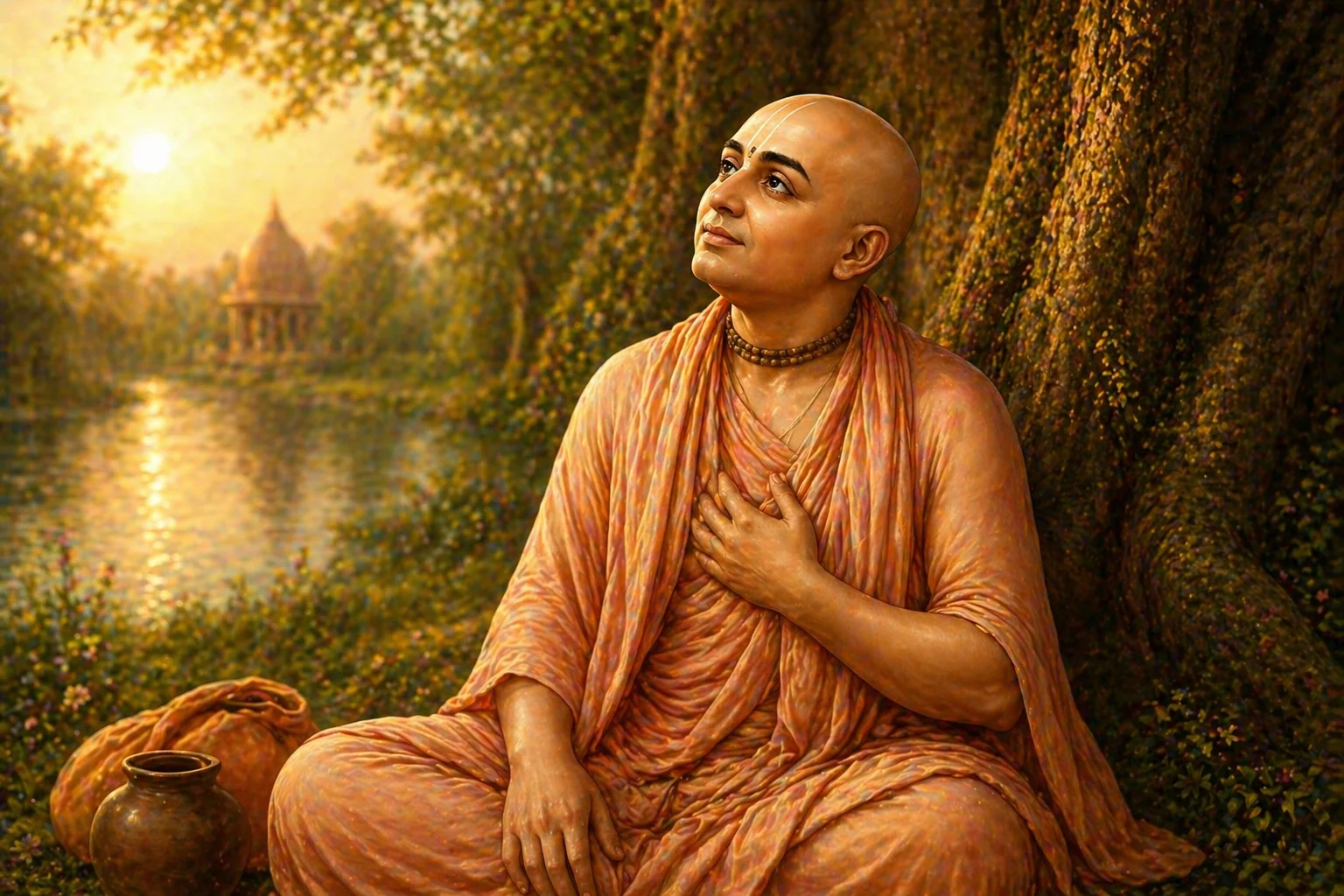
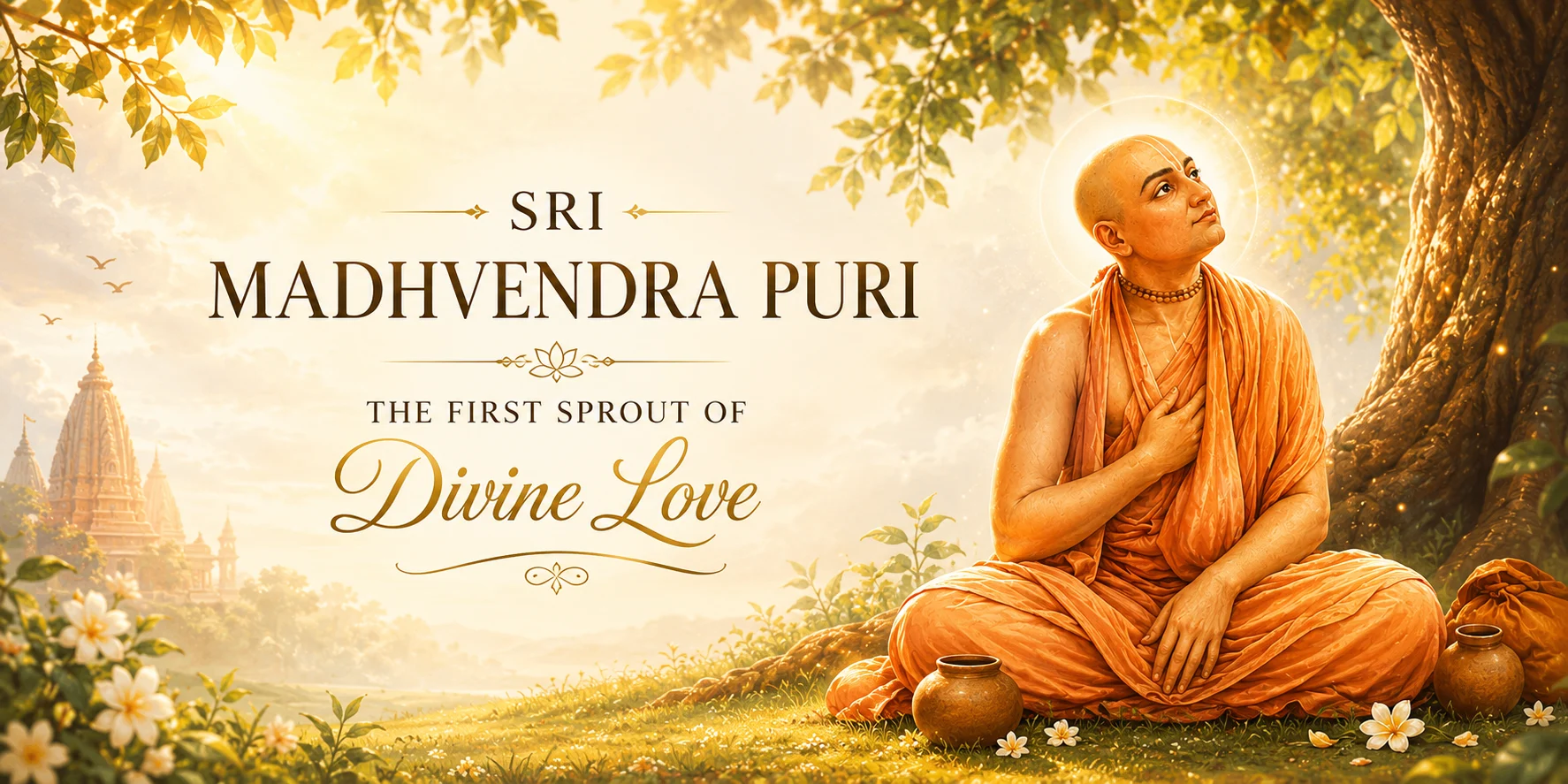
In the vast tree of Gaudiya Vaishnavism, Sri Madhvendra Puri holds a place that is both ancient and tender. He is described by Sri Chaitanya Mahaprabhu himself as the very first sprout of the great tree of divine love — the one through whom the seed of Krishna-prema first broke the soil of this world.
Long before Mahaprabhu appeared in Navadvipa to flood the world with sankirtana, Madhvendra Puri was quietly wandering the forests of Vrindavana, bathing at Govinda Kund, and weeping in separation from Krishna. His love was raw, wild, and unprecedented. He did not follow a well-trodden path. He was the one who made the path.
For any devotee in the Gaudiya Vaishnava tradition — and especially for those connected to Nandgram Dham — understanding Madhvendra Puri is understanding where it all truly began.
His Lineage and Position
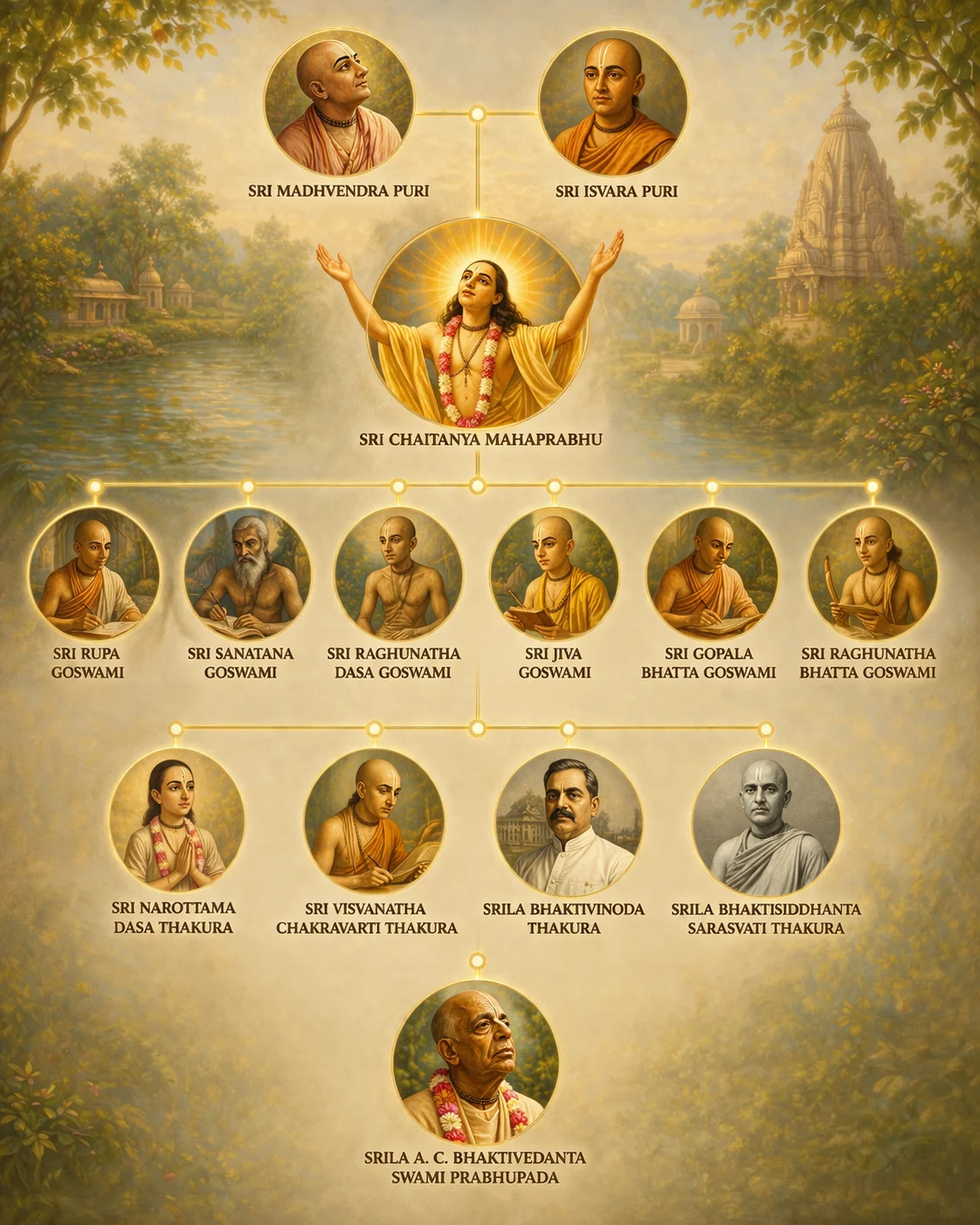
Sri Madhvendra Puri belonged to the line of Sri Madhvacharya, the great proponent of the pure Dvaitavada (dualistic) philosophy. He was initiated in the Madhva school and became one of its most celebrated acharyas.
Yet his significance goes beyond any single school. He is considered the connecting link between the Madhva Sampradaya and what would become the Gaudiya Sampradaya. Both traditions acknowledge this bridge. The Madhva Vaishnavas revere him, and the Gaudiya Vaishnavas receive their entire lineage through him — for it was Madhvendra Puri who initiated Ishvara Puri, and Ishvara Puri who initiated Sri Chaitanya Mahaprabhu himself.
The disciplic succession flows: Madhvendra Puri → Ishvara Puri → Sri Chaitanya Mahaprabhu → Rupa Goswami, Sanatana Goswami → ... → Srila Prabhupada → ISKCON devotees worldwide. Every Gaudiya Vaishnava today carries the blessings of Madhvendra Puri in their spiritual bloodline.
Appearance and Early Life
Very little is known about the early years of Sri Madhvendra Puri. He appeared in the 14th century, and the scriptures are deliberately quiet about the details of his birth and childhood. What we know is drawn mostly from the Chaitanya Charitamrita and the Chaitanya Bhagavata — and what those texts describe is not a biographical timeline, but a soul already burning with love for Krishna.
By the time we meet him in the sacred texts, he is already a wandering sannyasi — a renounced monk who has given up everything and roams freely across the sacred tirthas of Bharata. He has no fixed home except the forest of Vrindavana, no fixed companion except Krishna's name on his lips, and no fixed agenda except finding that one thing he cannot live without: the direct experience of divine love.
The Meeting with Nityananda Prabhu
During one of Nityananda Prabhu's journeys to all the holy places of India, he happened to encounter Madhvendra Puripada somewhere in western India. What followed was one of the most touching meetings described in Vaishnava literature.
When Nityananda Prabhu saw Madhvendra Puri, his transcendental body became completely still — frozen, as if suspended in time. And at the same moment, Madhvendra Puri forgot himself entirely and fainted in ecstasy. Gradually, both of them returned to external consciousness. They embraced each other, put their arms around each other's necks, and wept tears of overwhelming joy.
"Today I have received the fruit of all my travels to the holy places. In seeing the feet of Madhvendra Puri, I have received the treasure of love of God, and thus my life has become blessed."— Sri Nityananda Prabhu, Chaitanya Bhagavata Adi 9
Ishvara Puri, Brahmananda Puri, and the other disciples of Sri Madhvendra Puri who were present that day were also completely overwhelmed by Nityananda Prabhu's presence. The two great souls spent several days together, and Nityananda — though himself a great acharya — always maintained the attitude of a disciple in Madhvendra Puri's presence, honoring him as a guru.
Madhvendra Puri's love of God was extraordinary. Simply seeing a dark raincloud in the sky would cause him to fall down unconscious, overwhelmed by feelings of separation from Shyamasundara. Day and night, he was intoxicated on the wine of Krishna-prema — sometimes laughing, sometimes weeping, sometimes raising a tumultuous cry that had nothing to do with this world.
The Discovery of Sri Gopala at Govardhana
This is perhaps the most famous of all Madhvendra Puri's pastimes — and it is not merely a miracle story. It is the story of how the first major Vaishnava temple of Vrindavana came to be, and how the Lord himself chose to reveal his presence to a devotee whose heart was ready.
A Stranger Arrives at Govinda Kund
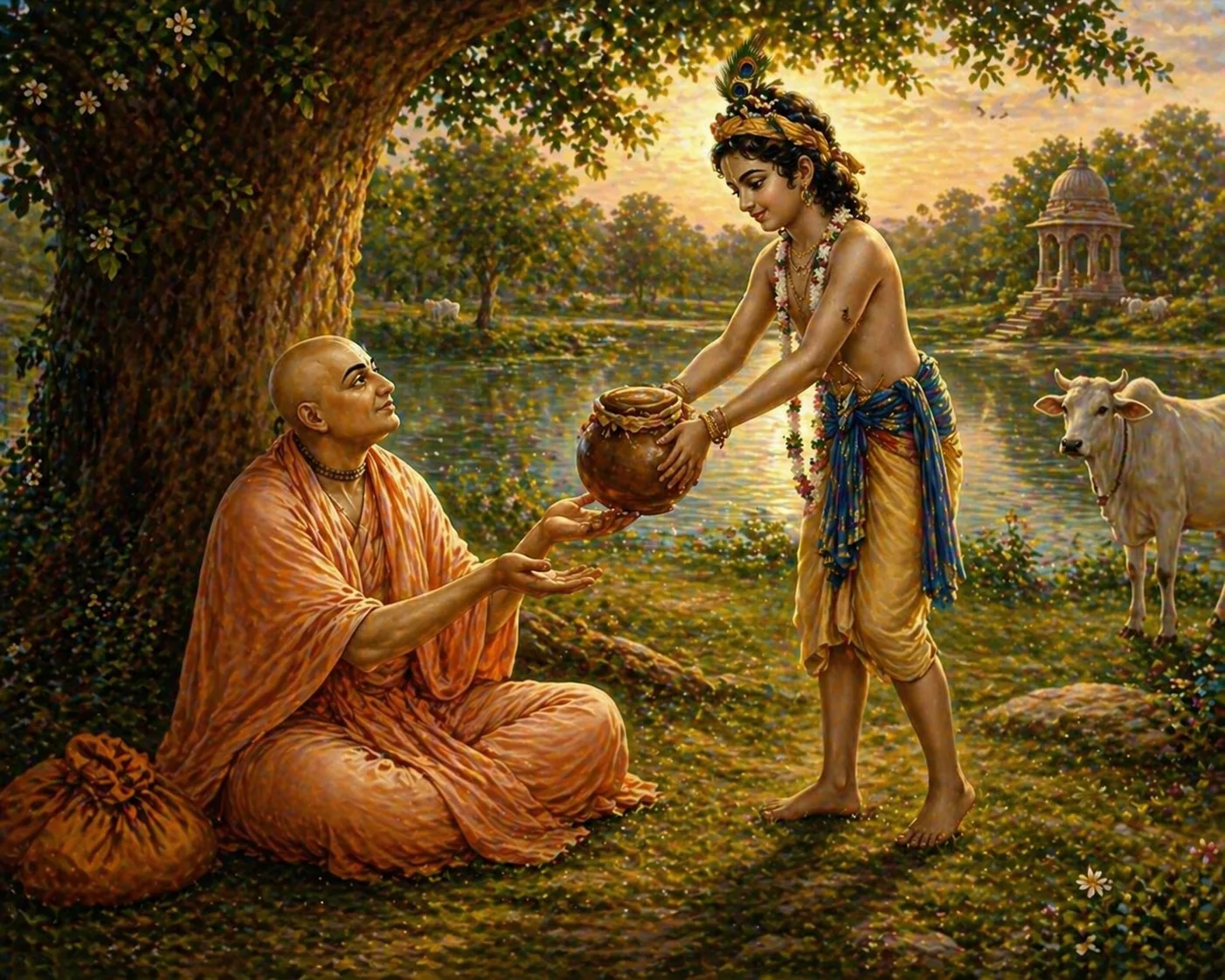
Madhvendra Puri had arrived at Govardhana Hill in a state of deep spiritual ecstasy — not even aware whether it was day or night, morning or evening. After circumambulating Govardhana, he sat beneath a tree near Govinda Kund to rest for the night.
Suddenly, a beautiful young cowherd boy appeared before him carrying a pot of milk. The boy placed it before the elderly sannyasi and spoke with a smile: "Why are you sitting here without eating anything? What kind of meditation keeps you from even begging for food?"
Madhvendra Puri looked at the boy and was immediately struck by his extraordinary beauty. Something in him went still. He drank the milk the boy had brought, and when he looked up to thank him — the boy was gone. No footprints, no sound, no trace. He never came back for the pot.
Gopala Reveals Himself in a Dream
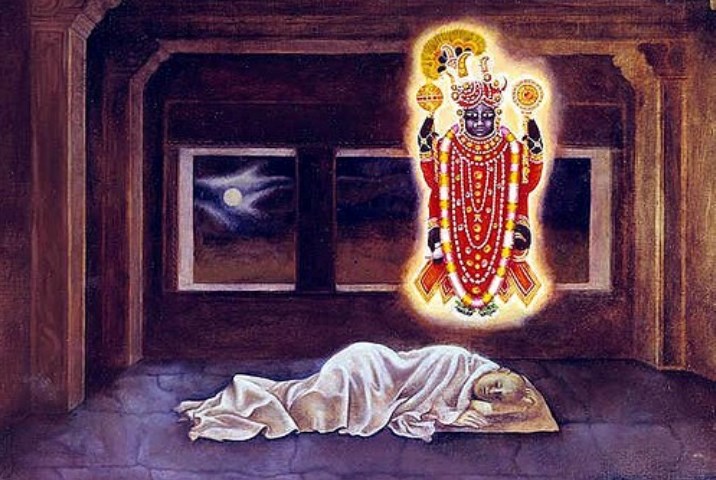
Madhvendra Puri washed the pot and sat down to chant the holy name. As the night deepened, he fell into sleep — and in that sleep, the same cowherd boy appeared again. But this time, his identity became clear.
The boy took Madhvendra Puri by the hand and led him into a nearby jungle. He pointed to a thick bush and said words that Madhvendra Puri would never forget:
"I am living in this bush, and I am suffering very much from the scorching heat, cold, wind, and rain. Please bring the people of this village together and take me out of here. Establish me on top of the hill, build me a temple, and then bathe me with large quantities of cool water."— Sri Gopala, in the dream of Madhvendra Puri
Madhvendra Puri woke up. He understood immediately — the cowherd boy was none other than the Lord himself, Sri Gopala, who had been waiting in that forest for centuries for a devotee pure enough to install him properly.
The Village Gathers, The Deity Emerges
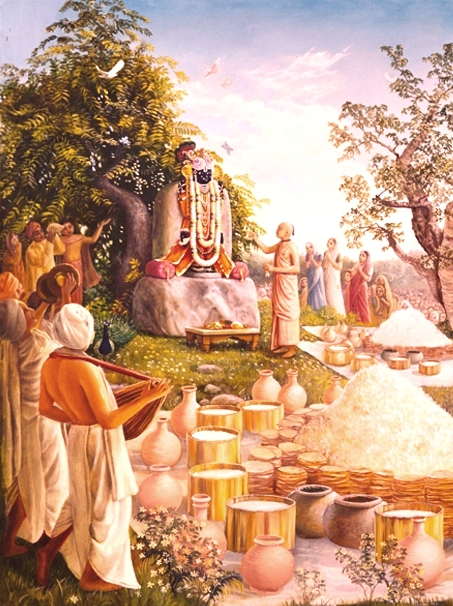
Madhvendra Puri gathered the people of the surrounding village and told them of the dream. They went into the forest, found the deity of Sri Gopala hidden beneath the overgrown bush, and with great care and joy, they brought him out. The deity was exquisitely beautiful — ancient, yet as fresh as if carved that very day.
Sri Gopala was installed on top of Govardhana Hill. Madhvendra Puri arranged a great feast for everyone in the village. The worship of Sri Gopala began, and the Annakuta festival was celebrated with tremendous enthusiasm — this is in fact the very origin of the Govardhan Annakuta celebration that Vaishnavas observe to this day.
The temple of Sri Gopala at Govardhana, established through the effort and love of Madhvendra Puri, is one of the oldest and most sacred Vaishnava temples in Vrindavana Dham. It stands as a monument to what pure devotion can accomplish.
The Pasttime of Gopinath's Stolen Kheer
Some time after Gopala was installed and the temple was established, Madhvendra Puri received another dream instruction from Sri Gopala. The Lord's divine body, he was told, still felt warm — the heat of his time spent hidden in that bush had not fully cooled. He asked Madhvendra Puri to travel to Jagannath Puri and bring back sandalwood and camphor to cool and soothe him.
Madhvendra Puri immediately set out on foot for Puri — a journey of hundreds of miles. And it was on this journey that one of the most beloved pasttimes in all of Gaudiya Vaishnava literature unfolded.
The Kheer of Gopinath
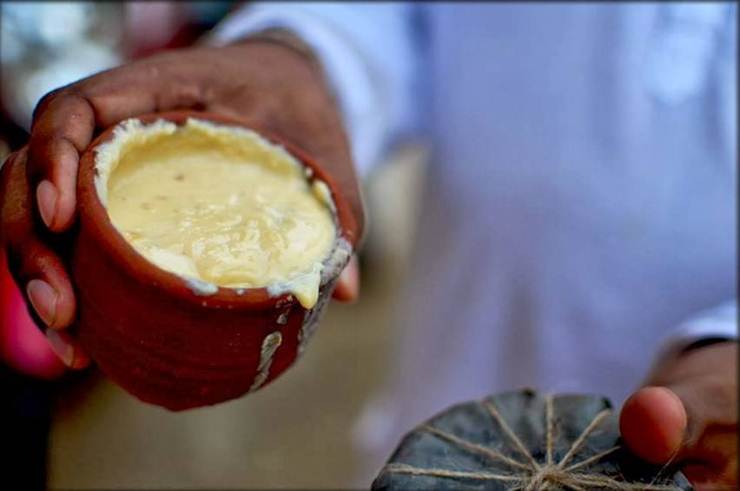
On his way to Jagannath Puri, Madhvendra Puri passed through the village of Remuna in Orissa, where the beautiful deity of Sri Gopinath resides. The moment he entered the temple and saw Gopinath — he was overwhelmed. He stood in the courtyard and began to sing and dance in complete ecstasy, forgetting where he was or why he had come.
When he collected himself, he heard that the temple offered a special sweet rice (kheer) to the deity every evening — a preparation so extraordinary that it was known as Amrita Keli (the sport of nectar). Twelve earthen pots of this sweet rice were offered every day, and it was said to be unlike anything found elsewhere.
A quiet wish arose in Madhvendra Puri's heart: "If I could taste just a little of this offering, I could recreate it for Sri Gopala back in Vrindavana." And then — the very next moment — he was horrified at himself. He had desired the food meant for the Lord before it was even offered. He felt he had committed a terrible offense.
Gopinath Steals the Kheer
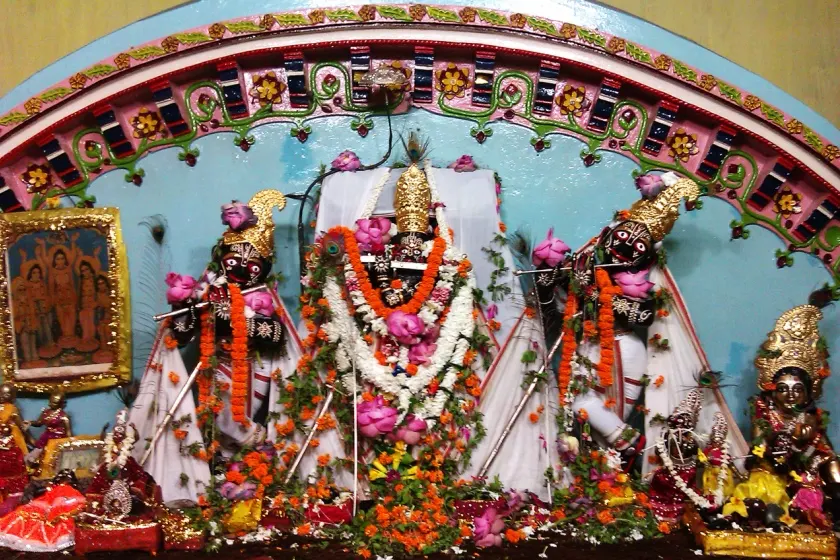
Without saying a word to anyone, Madhvendra Puri quietly slipped away from the temple. He went to a vacant marketplace and sat down alone, chanting the holy name, overcome with shame and guilt. He considered himself an offensive wretch — not a great devotee, but a foolish beggar who had coveted the Lord's prasadam before it was offered.
That night, the head pujari of the Gopinath temple had a remarkable dream. Gopinath himself appeared and spoke:
"Wake up and open the temple door. I have hidden one pot of sweet rice behind my cloth curtain — set it aside just for that sannyasi sitting alone in the marketplace. His name is Madhvendra Puri. Go find him."— Sri Gopinath, in the dream of the temple pujari
The pujari woke up, went into the temple, reached behind the curtain — and there it was. One earthen pot of sweet rice, hidden in a place no one had touched. He was struck with wonder. He ran to the marketplace, calling out Madhvendra Puri's name.
When the pot was placed in Madhvendra Puri's hands, he understood everything. The Lord himself had stolen away a pot of kheer from his own evening offering — just for this one devotee who had not even dared to ask.
This pasttime shows something profound about how Krishna responds to a pure devotee's unspoken desire. Madhvendra Puri never asked. He never requested. He suppressed the desire the very moment it arose, thinking it an offense. And yet Krishna, the indweller of all hearts, noticed that one flicker of a wish — and fulfilled it magnificently, hiding a pot of kheer behind his own curtain so that no one else could touch it. This is the reciprocal love between God and his devotee. The devotee tries to hide his desires out of reverence, and the Lord conspires to fulfill them anyway. This pasttime is celebrated in Gaudiya Vaishnavism as a perfect example of "apaharana lila" — the pasttime of the Lord stealing to serve his devotee.
After receiving and eating the sweet rice, Madhvendra Puri broke the earthen pot into small pieces and wrapped them in his cloth to carry with him — a tangible reminder of this extraordinary moment of grace. He then continued his journey to Jagannath Puri.
The Journey to Jagannath Puri and the Sandalwood
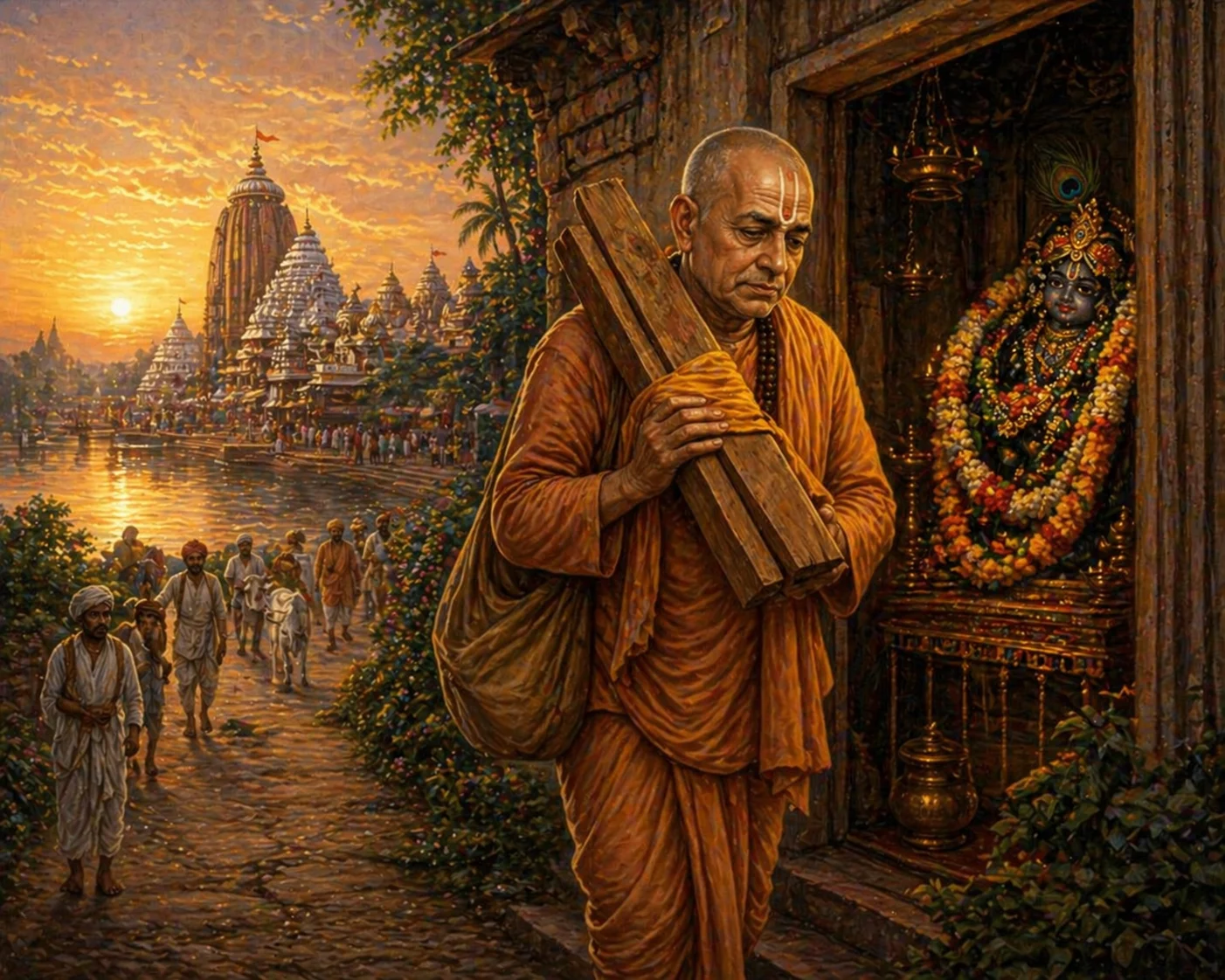
When Madhvendra Puri arrived at Jagannath Puri, his reputation as a great saint had somehow preceded him. Every town and village he had passed through on the way had celebrated his arrival, and the devotees of Puri already knew who he was. He was greeted and honored by the priests and devotees at the great temple.
Madhvendra Puri wanted to flee from all this attention — he wanted to remain unknown, hidden, just another wandering monk. But the love of Godhead that radiated from him was impossible to conceal. As the Chaitanya Charitamrita says, a devotee's reputation for genuine love of God follows him the way a lamp illuminates whatever room it enters. You cannot hide a lamp inside a lamp holder and expect the room to stay dark.
Madhvendra Puri explained his mission to the temple authorities — the dream, the sandalwood, Sri Gopala's request. The devotees at Puri were moved and immediately began arranging for large quantities of sandalwood and camphor. A brahmin and a servant were assigned to carry the precious cargo back to Vrindavana with him.
Gopala's Surprising Message
On his return journey, Madhvendra Puri stopped again at Remuna to pay his respects to Sri Gopinath. He took rest there, and toward the end of the night, he had one more dream. This time, Sri Gopala himself appeared — radiant, smiling — and delivered a message that surprised everyone who would later hear it:
"O Madhvendra Puri, I have already received all the sandalwood and camphor. The Gopala of Vrindavana and the Gopinath of Remuna are one and the same. Simply have the sandalwood ground here at Remuna and smear it on the body of Gopinath — this is the same as smearing it on my body."— Sri Gopala, in the dream of Madhvendra Puri at Remuna
Madhvendra Puri woke up and wept. He understood the deeper teaching — there is no difference between Gopala and Gopinath, between Vrindavana and Remuna, between this temple and that temple. The Lord is one. All the forms of the Lord are the same supreme personality. He had the sandalwood ground right there at the Gopinath temple, and it was applied to the body of Gopinath — who is none other than Gopala, none other than Krishna himself.
His Importance in the Gaudiya Vaishnava Sampradaya
Sri Madhvendra Puri's contribution to the Gaudiya tradition cannot be overstated. He was not just a saint who lived a beautiful life. He was a pivotal soul through whom the entire trajectory of Vaishnava devotion shifted.
First Sprout of Prema
Sri Chaitanya Mahaprabhu personally called him the first sprout of the tree of divine love — the one who introduced the mood of vipralambha (loving separation) into the world.
Sampradaya Bridge
He bridged the Madhva and Gaudiya lines, ensuring the unbroken chain of initiation through which Chaitanya Mahaprabhu received his spiritual name and diksha.
Founded Gopala Worship
His discovery and installation of Sri Gopala at Govardhana established one of the first major Vaishnava temples in Vrindavana — the seed from which the six Goswamis later built a complete tradition of temple worship.
Introduced Vipralambha
The mood of loving separation — considered the highest form of devotional feeling — was first embodied in his life. His verse of separation, "Ayi Dina Dayardra Natha", moved Sri Chaitanya to tears.
"Ayi dina-dayardra natha he mathura-natha kadavalokyase
Hrdayam tvad-aloka-kataram dayita bhramyati kim karomy aham"
This verse — composed in his final hours, yearning for Krishna with a love that consumed him — is the highest expression of vipralambha bhakti. Sri Chaitanya Mahaprabhu, upon hearing it, would enter into states of deep ecstasy. He said that the entire essence of Madhvendra Puri's life and realizations was condensed into this one verse.
His Disciples and the Living Legacy
Sri Madhvendra Puri's most prominent disciples were Ishvara Puri and Brahmananda Puri — both of whom became great acharyas in their own right. It was Ishvara Puri who later came to Navadvipa and initiated Sri Chaitanya Mahaprabhu — and through that initiation, the entire world received the gift of the sankirtana movement.
Sri Madhvendra Puri
14th century. Wandering sannyasi. Establisher of Gopala worship. First soul to experience vipralambha bhava. The origin point of the Gaudiya stream.
Sri Ishvara Puri
Direct disciple. Later traveled to Navadvipa and accepted the young scholar Nimai (Sri Chaitanya Mahaprabhu) as his disciple, giving him the mantra that would soon be heard around the world.
Sri Chaitanya Mahaprabhu
15th century. Accepted Ishvara Puri's initiation. Spread the sankirtan movement across India. All Gaudiya Vaishnavas trace their lineage to him.
The Six Goswamis of Vrindavana
Rupa, Sanatana, Raghunatha Dasa, Raghunatha Bhatta, Gopala Bhatta, and Jiva Goswami. They systematized the theology, established the temples, and wrote the books — all at Mahaprabhu's instruction.
Srila Prabhupada and ISKCON
20th century. Through an unbroken chain of disciplic succession stretching back to Madhvendra Puri, Srila Prabhupada brought the same love and wisdom to every corner of the world.
Today, the Annakuta festival celebrated at Nandgram Dham and ISKCON temples worldwide traces its origins directly to Madhvendra Puri's installation of Sri Gopala. The sweet rice offering at the Gopinath temple in Remuna is still performed every evening. And the verse he composed in loving separation is still sung in Gaudiya temples across the globe.
His life is not a story from the distant past. It is a living current that continues to flow through every prayer, every kirtan, every offering made in every temple that traces its roots to Vrindavana.
Read more: a much fuller biography of Srila Madhavendra Puri — his life among the Tattvavadi sannyasis, his discovery of the Gopala Deity at Govardhana, the famous night the Gopinatha Deity of Remuna stole condensed sweet rice for him, and his place as the root of the Gaudiya Vaishnava tradition's own line of loving devotion — is told across several pages in our Acharyas biography section, including his chief disciple Srila Ishvara Puri, who went on to become Sri Chaitanya Mahaprabhu's own initiating spiritual master.