Table of Contents
- What is Ram Stuti? — The Basics
- Ram Stuti — Full Lyrics with Meaning (Verse by Verse)
- How to Chant Ram Stuti at Home — Simple Steps
- Step 1 — Pick Your Time
- Step 2 — Set Up a Simple Space
- Step 3 — Chant with Feeling
- Benefits of Chanting Ram Stuti Every Day
- Best Days to Chant Ram Stuti — Maximum Benefit
- People Also Ask — Ram Stuti FAQs
Have you ever heard the words "Shri Ramachandra Kripalu Bhajman" and felt something shift inside you? That's not a coincidence. This prayer — called the Shri Ram Stuti — has been touching hearts for over 500 years.
Written by the great saint Goswami Tulsidas, the Ram Stuti is a short but incredibly powerful devotional hymn dedicated to Lord Ram. It describes his divine form, his compassion, and his power to remove all fear from your life.
In this blog, we break down every verse of the Ram Stuti in the simplest possible words — so whether you're hearing it for the first time or have chanted it a thousand times, you'll understand exactly what you're saying and why it matters.
📖 What You Will Find in This Blog
Full Ram Stuti lyrics (Hindi + Roman script)
• Simple word-by-word meaning
• Why each verse is special
• How and when to chant
• Benefits of daily recitation
What is Ram Stuti? — The Basics
Ram Stuti simply means a prayer of praise to Lord Ram. The most famous Ram Stuti — the one everyone knows — is:
"Shri Ramachandra Kripalu Bhajman"
श्री रामचन्द्र कृपालु भज मन
This Ram Stuti was written by Goswami Tulsidas — the same saint who wrote Ramcharitmanas and Hanuman Chalisa. It comes from his book called Vinaya Patrika, which means 'Petition of Humility.' In this book, Tulsidas poured his heart out to Lord Ram in the most humble and loving way.
📋 Quick Facts about Ram Stuti
Author: Goswami Tulsidas
Book: Vinaya Patrika
Language: Sanskrit + Awadhi (easy to understand)
Total Verses: 5 main verses (dohas)
Best Time to Chant: Morning, evening puja, or any time you need peace
Ram Stuti — Full Lyrics with Meaning (Verse by Verse)
🔱 Verse 1
श्री रामचन्द्र कृपालु भज मन, हरण भवभय दारुणम्।
नव कंज लोचन, कंज मुख कर कंज, पद कंजारुणम्॥
Shri Ramachandra Kripalu Bhaj Mana, Harana Bhavabhaya Darunam,
Nava Kanja Lochana, Kanja Mukha Kara Kanja, Pada Kanjarunam.
Meaning
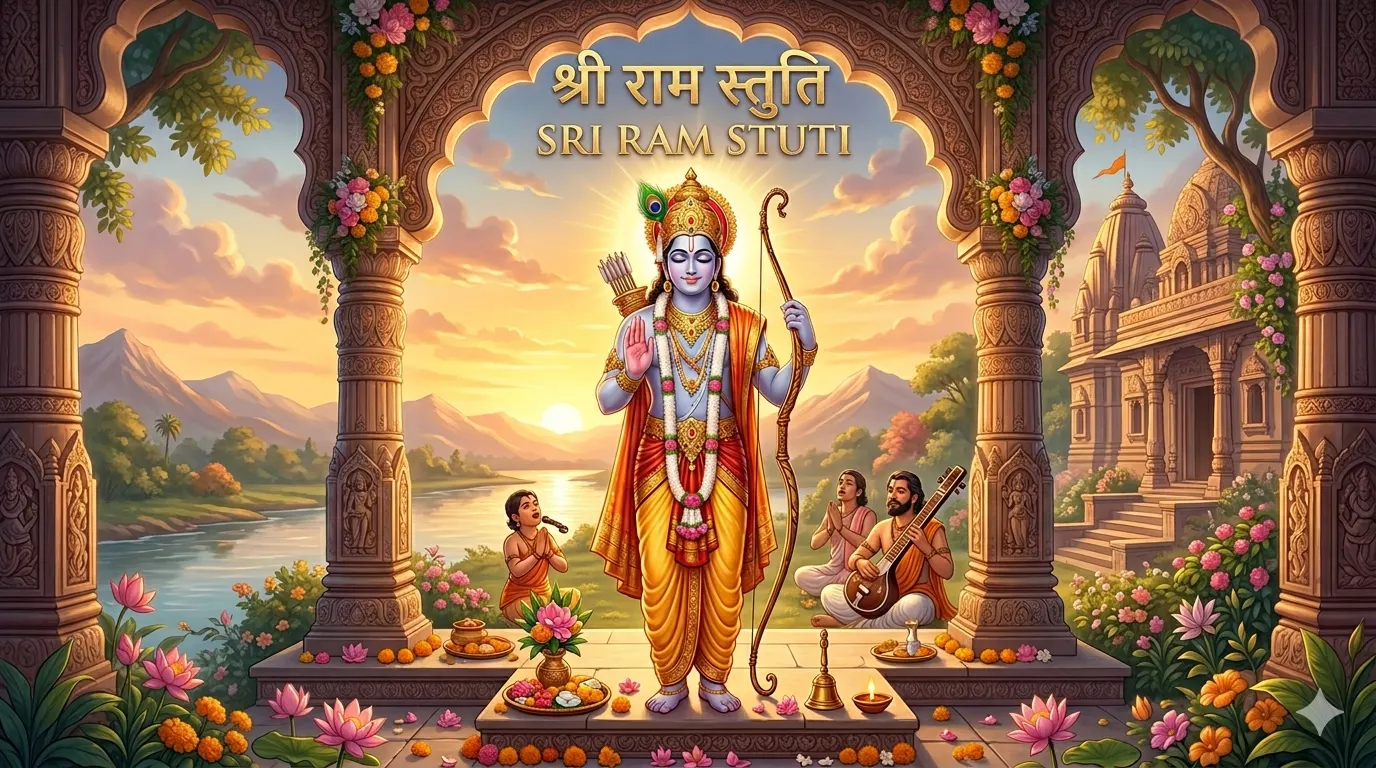
O my mind! Always remember the kind and merciful Lord Ramachandra. He is the one who removes the biggest fears of life — fear of death, fear of the world, fear of suffering. His eyes are like fresh lotus flowers. His face shines like a lotus. His hands and feet glow like a reddish lotus in the morning sun.
🔱 Verse 2
कन्दर्प अगणित अमित छवि, नव नील नीरद सुन्दरम्।
पट पीत मानहु तड़ित रुचि शुचि नौमि जनक सुतावरम्॥
Kandarp Aganit Amit Chhavi, Nava Neel Neerad Sundaram,
Pat Peet Manahu Tadit Ruchi Shuchi Noumi Janak Sutavaram.
✨ Meaning
Lord Ram is so beautiful that even a million Kamadevas (the god of beauty and love) put together cannot match him. His skin is dark blue like a fresh rain cloud. And he is wearing bright yellow clothes — which glow on his dark body like lightning flashing in the sky. I bow to this beautiful Ram, who is the husband of Sita (daughter of King Janak).
🔱 Verse 3
भजु दीन बंधु दिनेश दानव, दैत्य वंश निकन्दनम्।
रघुनन्द आनंद कन्द कौशल चन्द्र दशरथ नन्दनम्॥
Bhaju Deen Bandhu Dinesh Danav, Daitya Vansh Nikandanam,
Raghunanda Ananda Kanda Kaushal Chandra Dashrath Nandanam.
✨ Meaning
O mind — sing praises of Ram, the true friend of the poor and the helpless. He is like the sun for his royal clan. He is the one who destroyed the entire race of demons and evil forces. He is the joy of the Raghu family. He is the moon of his mother Kaushalya's heart. He is the beloved son of King Dashrath.
🔱 Verse 4
शिर मुकुट कुण्डल तिलक चारु, उदारु अंग विभूषणम्।
आजानु भुज शर चाप धर, संग्राम जित खरदूषणम्॥
Shir Mukut Kundal Tilak Charu, Udaru Ang Vibhushanam,
Aajanu Bhuj Shar Chaap Dhar, Sangraam Jit Khar Dushanam.
✨ Meaning
Ram wears a beautiful crown on his head, earrings on his ears, and a shining tilak on his forehead. His whole body is decorated with divine ornaments. His arms are so long they reach down to his knees — a sign of a great hero. He holds a bow and arrow in his hands. He is the same Ram who won the battle against the powerful demons Khar and Dushan.
🔱 Verse 5
इति वदति तुलसीदास शंकर, शेष मुनि मन रंजनम्।
मम हृदय कुंज निवास कुरु, कामादि खल दल गंजनम्॥
Iti Vadati Tulsidas Shankar, Shesh Muni Man Ranjanam,
Mum Hridaya Kunj Nivas Kuru, Kamadi Khal Dal Ganjnam.
✨ Meaning
This is what Tulsidas prays — O Ram, you are the one who fills Lord Shiva's heart with joy. The great serpent Sheshnag is enchanted by you. Saints and sages love you beyond words. Now please — come and make your home in the lotus of my heart. And destroy all the bad things inside me — desire, anger, greed, ego — and all their companions.
How to Chant Ram Stuti at Home — Simple Steps
You don't need to be a pandit or know Sanskrit to chant the Ram Stuti. Here is the easiest way to start:
Step 1 — Pick Your Time
• Early morning (before sunrise) is the best — your mind is fresh and calm
• Evening during sunset or aarti time also works beautifully
• Anytime during Ram Navami, Diwali, or Ekadashi
• Honestly — any time you feel anxious, fearful, or need clarity
Step 2 — Set Up a Simple Space
• Sit in a clean spot, facing east if possible
• Light one diya (ghee lamp) — that's enough
• Keep a photo or small idol of Lord Ram in front of you
• No photo? Just close your eyes and picture his lotus-eyed face
Step 3 — Chant with Feeling
1. Say 'Jai Shri Ram' 3 times with folded hands
2. Start the Ram Stuti — slowly, verse by verse
3. Don't rush. Focus on the meaning as you chant each line
4. End with a quiet moment — just sit with Ram in your heart
💛 Golden Rule of Chanting
Tulsidas himself said: Ram does not care about perfect pronunciation. He cares about the feeling in your heart. Even if you make mistakes while chanting — sincere devotion always reaches Lord Ram.
Benefits of Chanting Ram Stuti Every Day
These are not just religious claims — millions of devotees across generations have experienced these changes through daily Ram Stuti chanting:
• 😌 Fear goes away — The very first verse promises this. Daily chanting calms a fearful, anxious mind
• 🧠 Mental clarity — When the mind is addressed directly (as Tulsidas does), it slowly learns to focus and settle
• 💪 Inner strength — Verse 4 reminds you Ram is a warrior. That same strength becomes yours through devotion
• ❤️ Feeling of peace and love — The Ram Stuti is ultimately a love song to God. Love always brings peace
• 🧹 Purification from within — Verse 5 asks Ram to remove kama, krodha, and lobha. Regular chanting supports this
• 🌅 Better mornings — Starting your day with Ram Stuti sets a gentle, clear, purposeful tone for everything after
• 🎯 Spiritual connection — Over time, Ram stops being a concept. He becomes a presence. That is the real benefit
Best Days to Chant Ram Stuti — Maximum Benefit
While Ram Stuti can be chanted every single day, these occasions are especially powerful:
• 🎉 Ram Navami — Lord Ram's birthday. The holiest day to recite his stuti
• 🏹 Dussehra / Vijayadashami — Celebrating Ram's victory over Ravana
• 🪔 Diwali — Marking Ram's return home after 14 years
• 🌙 Ekadashi — The 11th lunar day, sacred to Lord Vishnu (Ram is his avatar)
• 🌅 Every single morning — Even 5 minutes of Ram Stuti daily changes you over time
• 😔 Days when you feel low, scared, or lost — Ram Stuti is made for exactly these moments
People Also Ask — Ram Stuti FAQs
Q: What is the Ram Stuti?
Q: Who wrote Ram Stuti?
Q: Can anyone chant the Ram Stuti?
Q: What does 'Kripalu' mean in Ram Stuti?
Q: How many times should I chant Ram Stuti?
Q: Is Ram Stuti the same as Ram Aarti?
Jai Shri Ram 🙏