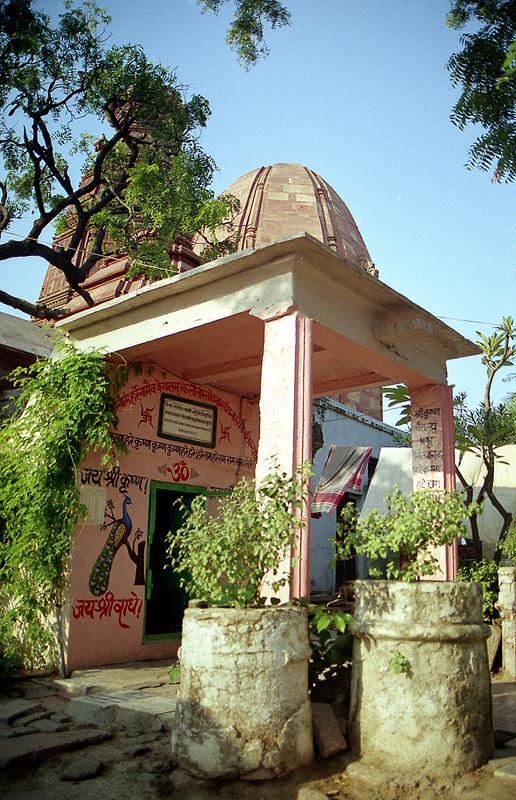
In March 1981, after a serious illness, Krishna Dasa Babaji asked the devotees caring for him to take him to Nandagrama - the part of Vraja where Krishna, in His childhood pastimes, was brought by Nanda Maharaja for safety from Kamsa's agents. On its edge lies Pavana Sarovara, a lake where Srila Sanatana Gosvami himself is remembered to have performed extended bhajana centuries earlier. It was to Sanatana Gosvami's own bhajana-sthali there, now the site of a small Gaudiya Math temple, that Krishna Dasa Babaji chose to spend whatever time remained to him.
Life at the Bhajana-Sthali #
Devotees who arranged his last months there described a man who had, by then, almost nothing left to set down. He wore a single simple white cloth, kept no other possessions, and continued the same practice he had followed his whole life - hearing and chanting the holy names, bathing daily in Pavana Sarovara, and sitting for long hours in remembrance of Krishna's pastimes in the surrounding fields. When devotees asked him, more than once, whether he had any final instruction to leave them, his answer stayed the same every time: he would laugh and say that his only instruction was to chant Hare Krishna, and that there was nothing more to it than that.
A Small Songbook #
He kept no diary of his life, but he did keep a small songbook in which he wrote occasional notes. Near his bed at Pavana Sarovara, on what turned out to be the last page he ever filled, he wrote that the chanting of Krishna's holy name is the true nectar, and that the holy name is like honey - closing, as he had closed so much of his life, with the maha-mantra itself written out in full.
Passing and Samadhi #
Krishna Dasa Babaji disappeared from this world on 12 April 1982, at about eight in the evening, at Pavana Sarovara. One devotional account of his final period - again from Srila B.B. Govinda Maharaja's memoir, and offered here plainly as devotional memory rather than as clinical record - describes a doctor examining his heart near the end of his life and hearing, in place of an ordinary heartbeat, the sound of the maha-mantra itself. Whatever one makes of that account, it captures how the devotees who knew him chose to remember a man whose entire adult life really had narrowed to that one sound. His samadhi remains today within the small Gaudiya Math temple at Sanatana Gosvami's bhajana-sthali on the bank of Pavana Sarovara, in Nandagrama.
A Grave Without a Following #
Unlike Bhaktisiddhanta Sarasvati Thakura, who built the Gaudiya Math into a mission spanning dozens of temples, or Srila Prabhupada, who carried the same message worldwide and initiated thousands of disciples, Krishna Dasa Babaji left no temple, no publishing house and no formal disciples of his own. What he left instead was the memory his godbrothers and their disciples kept of him - memories collected decades later in Babhru Dasa's full-length biography, Divine Intoxication: The Life and Love of Srila Akincana Krishna Dasa Babaji Maharaja. For a man who spent his whole life trying to own nothing, it is a fitting kind of legacy: no institution bearing his name, only the sound of a name that was never his own to begin with, still chanted at the samadhi where he is remembered.