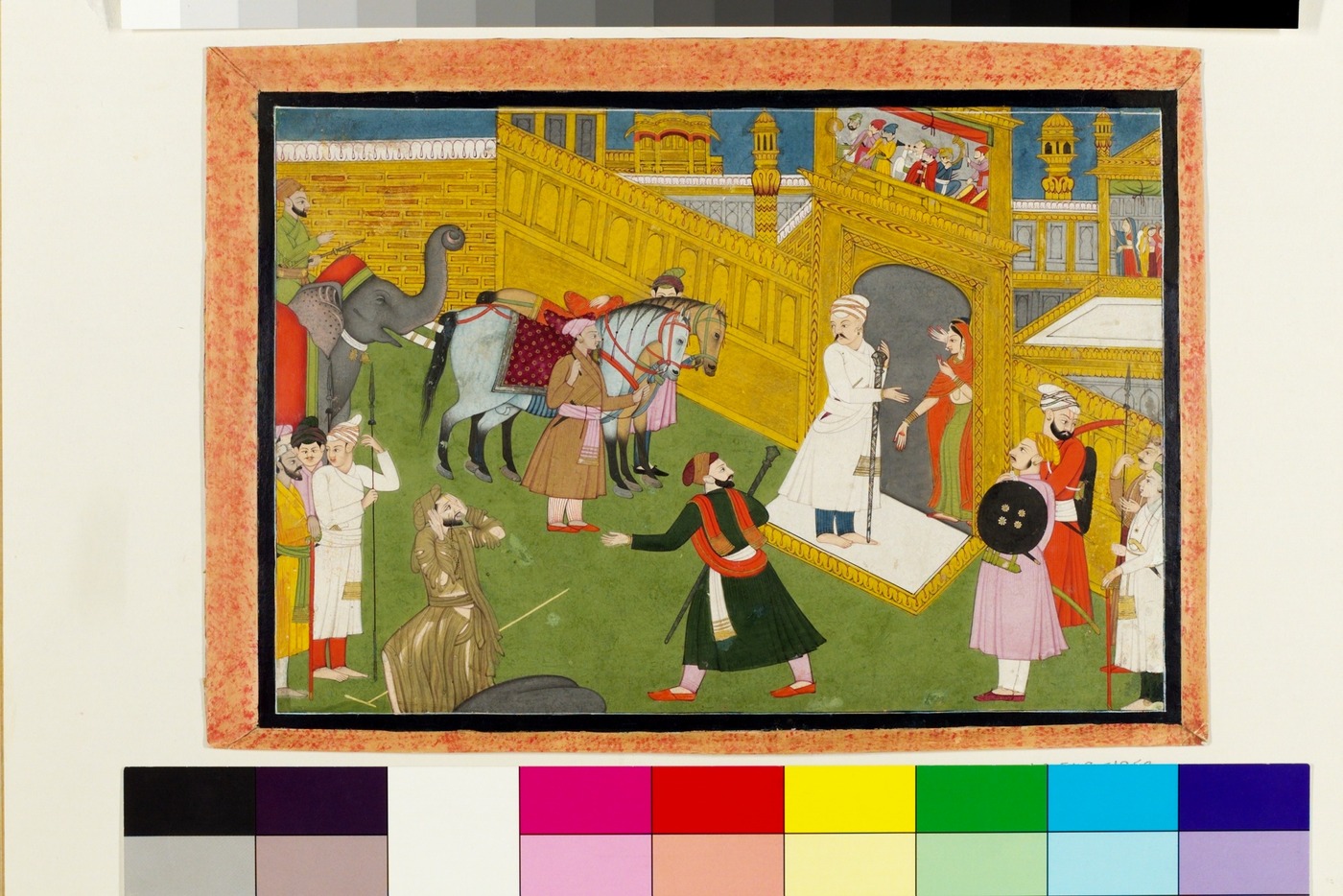
A Brahmana's Arrival #
Chaitanya-mangala's Madhya-khanda opens this story with a prayer to Gadadhara, Gauranga, and Narahari. It promises that whoever hears this pastime will easily attain love for Krishna. The text begins only its more remarkable episodes in this way. The scene it goes on to describe took place one ordinary day in Navadvipa. Mahaprabhu was sitting at home with His intimate associates, His face bright, speaking words of nectar to the assembly. Into that gathering came a brahmana named Vanamali, who had arrived from East Bengal with his son. He was visibly relieved simply to have found the Lord and His devotees at last.
Chaitanya-mangala gives Vanamali's own thoughts as he stood there: "I became poor and lost my purity, so I've come here seeking the Lord's help. I'm sure that Vishvambhara is none other than God Himself. By seeing Him, the abode of all transcendental knowledge, my heart is pacified and I've attained perfection. As one gets healthy by drinking nectar, similarly, my sufferings have vanished simply by seeing Lord Gauranga." As far as anyone could see, Vanamali had only just met the Lord, so this is a striking thing for him to say. It also tells us plainly what kind of poverty Vanamali had really travelled to escape.
Krishna-Prema for a Poor Brahmana and His Son #
Mahaprabhu looked on the brahmana and his son with compassion. He sang the glories of Hari, and, Chaitanya-mangala says simply, gave them the treasure of Krishna-prema. Vanamali and his son danced in ecstasy on the spot. Within a moment, the text records, their suffering had disappeared entirely. Chaitanya-mangala ends this half of the episode with what it takes to be the real point. Gauranga is the ocean of mercy and the best friend of the poor. To a man who had arrived owning almost nothing, He freely gave what no ordinary wealth could buy.
Later, Sri Gaura Ganoddesa Dipika identified Vanamali with Sudama. Sudama was Krishna's own poor brahmana friend, who received wealth from the Lord's hand without asking for it, in a much older story. This identification gives the scene a deeper meaning, which Chaitanya-mangala's own audience would likely have recognized at once. In another age, this man's life had already been marked by poverty that Krishna's mercy transformed. Now, in Gaura-lila, he was living out the same story again.
Golden Plow, Golden Club #
What followed the next day went further still. Mahaprabhu, whom Chaitanya-mangala calls Gaura-nataraja, the king of dancers, danced joyfully in the midst of His sankirtana party. Vanamali and his son found themselves witnesses to something neither could have expected. Gauranga appeared before them as a beautiful young boy with a complexion like a monsoon cloud, dressed in bright yellow cloth, with a flute in hand and a peacock feather in His hair. It was the form of Krishna Himself. Every devotee around Him took on the appearance of a cowherd boy of Vraja. Vanamali saw Radharani and Shyamasundara together in the innermost pleasure groves of Vrindavana. He saw Govardhana Hill, the Yamuna, and the named forests of Vraja, such as Bahulavana, Bhandiravana and Madhuvana. He saw their cows, gopas, gopis, and Gopala Himself. It was as though the whole of Krishna's own land had quietly come into Navadvipa for that one moment. Overcome, Vanamali and his son fell flat on the ground. Then Vanamali, still in the same ecstasy, tucked up his dhoti and ran about roaring "Krishna! Krishna! Krishna!" At last Mahaprabhu broke off His own dance and had someone gently restrain him.
Sri Chaitanya-charitamrita also sums up this scene, in its list of the branches of the Chaitanya tree. It puts the same vision into a single memorable picture: Vanamali Pandita, the thirty-fifth branch of the tree, "saw a golden club and plow in the hands of the Lord". These are the weapons of Balarama, Krishna's elder brother, which appeared in Mahaprabhu's own hands as He danced. Srila Prabhupada's purport to that verse points to yet another biography, noting that it is "described vividly in the Caitanya-bhagavata, Antya-khanda, chapter nine." So two texts, describing the same day from two different points of view, name the same devotee and the same golden weapons.
What Remains Unrecorded #
Beyond these two connected days - the granting of Krishna-prema and the vision that followed it - nothing further is recorded of Vanamali, or of the son who witnessed all of it beside him. No name for the son survives, no account of what became of either of them afterward, and no writing or verse of Vanamali's own beyond the words Chaitanya-mangala places in his mouth on arrival. What the tradition preserves instead is a single, complete arc: a man who came to Navadvipa with nothing, and briefly saw the whole of Krishna's Vraja open in front of him before the ordinary world closed back over it.
