Everywhere Chaitanya Mahaprabhu stopped on His tour of South India, He turned His host into a devotee. At Kurmakshetra His host was a brahmana named Kurma. Srila Bhaktisiddhanta Sarasvati Thakura later identified this pilgrimage town as present-day Srikurmam, near Srikakulam in Andhra Pradesh. Mahaprabhu spent a day and a night at Kurma's house and accepted alms there. He instructed Kurma in almost the same terms He used at house after house on this journey: chant, follow the teachings of the Bhagavad-gita and Srimad-Bhagavatam, and on that basis help others toward the same goal. Kurma followed Him some distance the next morning before being sent back home. The Chaitanya-charitamrita repeats this kind of scene so often on this tour that Krishnadasa Kaviraja Goswami eventually says he could fill a whole book with such meetings alone. This particular one, however, was not quite finished.
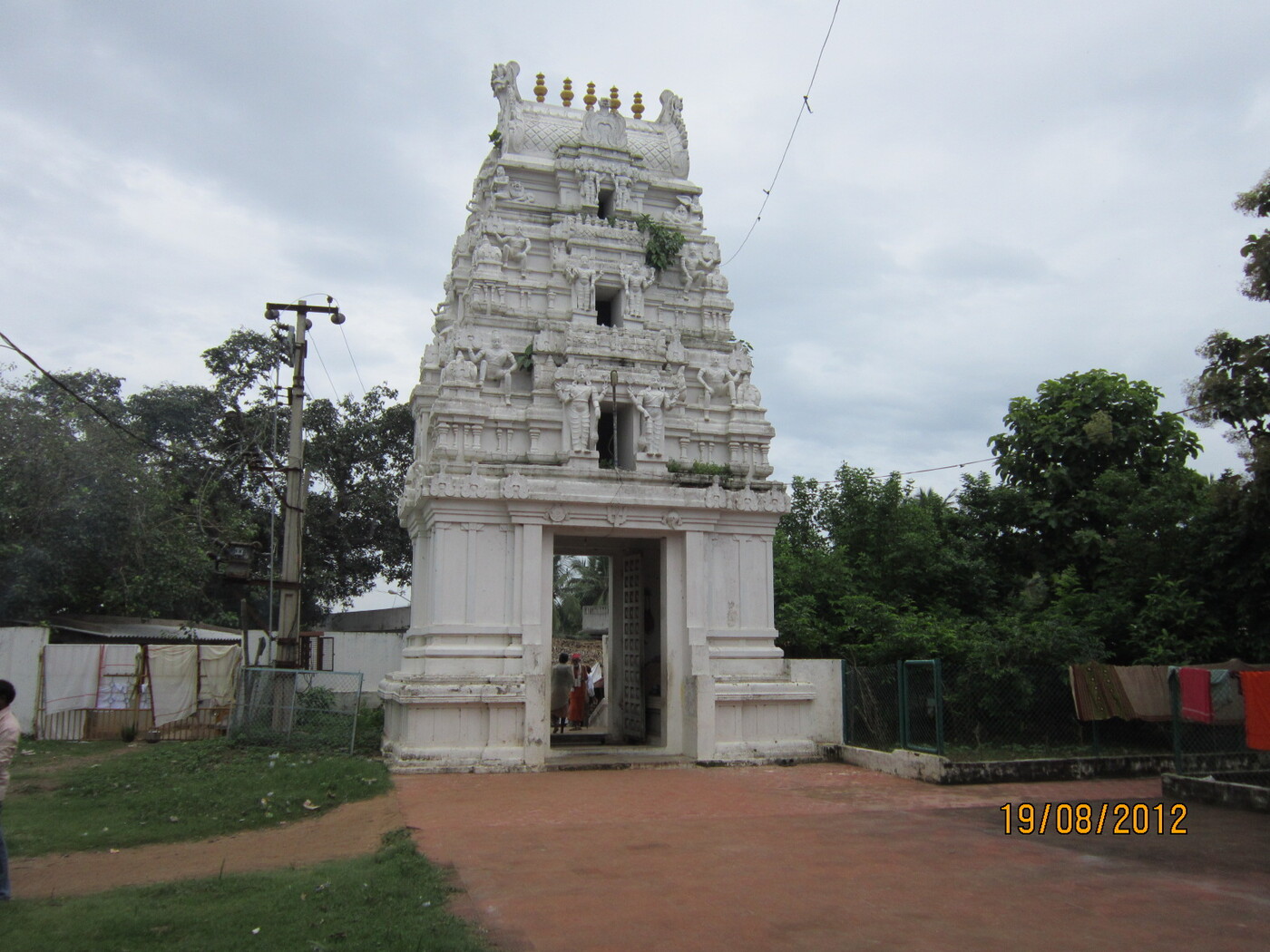
Photograph of the gopuram (tower gateway) of the Kurmanatha Swamy temple at Srikurmam, Andhra Pradesh - the site Srila Bhaktisiddhanta Sarasvati Thakura identified as the Kurmakshetra of Chaitanya Mahaprabhu's South India tour, where Basudeva Vipra was healed.Wikimedia Commons · Public domain
Somewhere nearby lived another brahmana, Basudeva Vipra. He was a man of real spiritual depth, and his body had been ravaged by leprosy so advanced that his open wounds were full of worms. He is remembered for a single, striking habit: if a worm fell out of one of his sores, he would pick it up with his own hand and place it back, unwilling even to let a worm starve on his account. When word reached him one night that a sannyasi singing the Lord's names was passing through, and that this was no ordinary sannyasi, Basudeva Vipra set out for Kurma's house at once. His body could barely carry him. He walked where he could and sat when he had to. Every account says that he crawled the rest of the way. He moved in any way still left to him, toward a chance to see the Lord.
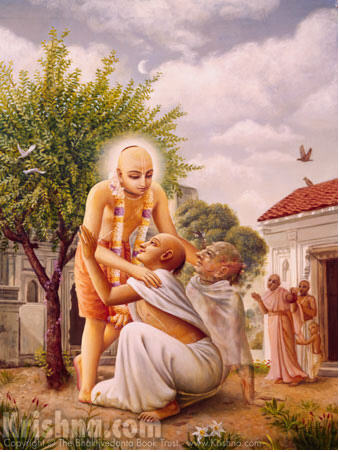
When he arrived, he was told that Mahaprabhu had already left. The disappointment broke him. Basudeva Vipra fell to the ground and lost consciousness. He had given everything he had left to reach a glimpse of the Lord, and now he mourned that lost glimpse. At that same moment, some distance away, Mahaprabhu stopped mid-stride, as if listening for something no one else could hear. He turned around and walked back. The Chaitanya-charitamrita says He went so fast that He seemed to cover the distance instantly. He reached the spot where Basudeva Vipra lay and lifted him up in His own arms. He did not hesitate at all, and He showed no concern for what touching an untouchable leper's wounds might mean.
The touch did what nothing else could. The leprosy and the grief both left him in the same instant, and Basudeva Vipra's body was transformed. The wounds were gone, and his form was made whole and beautiful. Overwhelmed, he fell at Mahaprabhu's feet and spoke a verse from the Srimad-Bhagavatam. These were the same words the poor brahmana Sudama once used before Krishna at Dvaraka. In them he said that he was nothing but a sinful, unworthy friend of a brahmana, while the person embracing him was the Supreme Personality of Godhead Himself, full in six opulences. Only this comparison, taken from the Lord's own earlier pastimes, seemed to fit what had just happened to him.
Basudeva Vipra's next reaction says as much about him as the cure itself. He grew afraid. As long as his body had marked him as untouchable, he reasoned, he had had no room for pride, and that humility was exactly what had let him reach the Lord in the first place. Now that he had a beautiful body, he worried that he would lose that humility, and with it everything he had just been given. Mahaprabhu was moved by the honesty of his fear. He told him that a devotee of his standing would never be overtaken by false pride. Then, in place of a warning, He gave him a task: chant the holy names without pause, and preach Krishna consciousness to whomever he could reach. That, Mahaprabhu said, was how Krishna would come to accept him fully. It would not be a reward kept back for later. It would be the natural next step for a man who had already shown where his heart stood.
With that instruction given, Mahaprabhu disappeared from the spot as suddenly as He had returned to it. Kurma and Basudeva Vipra, the two brahmanas the Lord had touched in that single day, found each other, embraced, and wept together over what they had just witnessed. Krishnadasa Kaviraja Goswami ends the episode by noting that this act alone earned Chaitanya Mahaprabhu a new name among His devotees - Vasudevamrita-prada, the giver of nectar to Vasudeva - preserved, he adds, in verses written by Sarvabhauma Bhattacharya himself. Nothing further is recorded of Basudeva Vipra's life afterward: whether he did in fact spend his remaining years preaching, where he lived, or when he passed from this world. The Chaitanya-charitamrita, having made its point, simply moves on to the next house on the road.
āra eka: another; vipra-śreṣṭha: best of brahmanas; nāma: named; vāsudeva: Vasudeva; mahā-mahāśaya: a great personality; kuṣṭhī: a leper; kīḍā: worms; yāra deha: whose body.
There was also a brahmana named Vasudeva, who was a great person but was suffering from leprosy. Indeed, his body was filled with living worms.
aneka prakāra: various kinds; vilāpa: lamentation; karite lāgilā: began to do; sei-kṣaṇe: immediately; āsi': coming back; prabhu: Sri Chaitanya Mahaprabhu; tāṅre: him; āliṅgilā: embraced.
When Vasudeva, the leper brahmana, was lamenting due to not being able to see Chaitanya Mahaprabhu, the Lord immediately returned to that spot and embraced him.
The central action of the pastime - Mahaprabhu turning back on His own to embrace a collapsed, unconscious leper.
prabhu-sparśe duḥkha-saṅge kuṣṭha dūre gela ānanda sahite aṅga sundara ha-ila
Word for word
prabhu-sparśe: by the touch of Sri Chaitanya Mahaprabhu; duḥkha-saṅge: along with his unhappiness; kuṣṭha: the infection of leprosy; dūre gela: went to a distant place; ānanda sahite: with great pleasure; aṅga: whole body; sundara ha-ila: became beautiful.
When Sri Chaitanya Mahaprabhu touched him, both the leprosy and his distress went to a distant place. Indeed, Vasudeva's body became very beautiful, to his great happiness.
kva aham: who am I; daridraḥ: poor; pāpīyān: sinful; kva kṛṣṇaḥ: who is Krishna; śrī-niketanaḥ: the transcendental form of all opulence; brahma-bandhuḥ: the unqualified friend of a brahmana; iti sma aham: thus I; bāhubhyām parirambhitaḥ: embraced by His two arms.
"Who am I? A sinful, poor friend of a brahmana. And who is Krishna? The Supreme Personality of Godhead, full in six opulences. Nonetheless, He has embraced me with His two arms."
From the purport: Purport excerpt: "This verse was spoken by Sudama Brahmana in Srimad-Bhagavatam (10.81.16), in connection with his meeting Lord Krishna."
prabhu kahe: the Lord said; kabhu: at any time; tomāra: your; nā: not; habe: there will be; abhimāna: pride; nirantara: incessantly; kaha: chant; tumi: you; kṛṣṇa kṛṣṇa nāma: the holy name of Lord Krishna.
To protect the brahmana, Sri Chaitanya Mahaprabhu advised him to chant the Hare Krishna mantra incessantly. By doing so, he would never become unnecessarily proud.
Mahaprabhu's direct answer to that fear: constant chanting of the holy name as the safeguard against pride.
kṛṣṇa upadeśi' kara jīvera nistāra acirāte kṛṣṇa tomā karibena aṅgīkāra
Word for word
kṛṣṇa upadeśi': instructing about Krishna; kara: just do; jīvera nistāra: the liberation of all living entities; acirāte: very soon; kṛṣṇa: Lord Krishna; tomā: you; karibena aṅgīkāra: will accept.
Sri Chaitanya Mahaprabhu also advised Vasudeva to preach about Krishna and thus liberate living entities. As a result, Krishna would very soon accept him as His devotee.
From the purport: Purport excerpt: "Indeed, the only return the Lord wanted was that Vasudeva preach the instructions of Krishna and liberate all human beings."
Our editorial team comprises trained devotees and researchers of the Hare Krishna Movement, Kota, who follow this same disciplic tradition in daily practice. Every biography is carefully researched, fact-checked against Vedic scriptures, and cites its sources.
Reviewed by
Temple & Scriptural Research Team
Each biography undergoes a detailed review by our senior devotees and scriptural researchers to verify factual accuracy and ensure alignment with Vaishnava philosophy and Srila Prabhupada's teachings.