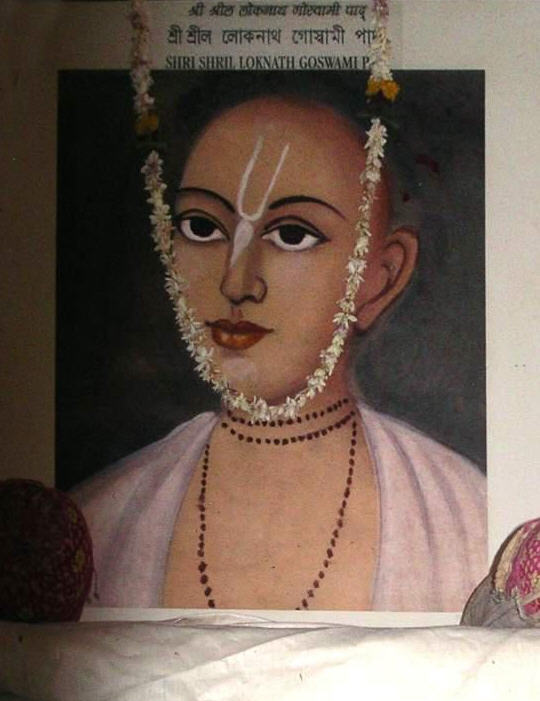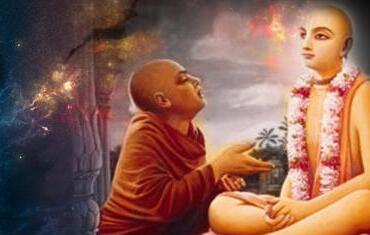
Srila Sarvabhauma Bhattacharya
The Royal Pandit Converted by Sri Chaitanya Mahaprabhu
Also known as Vasudeva Sarvabhauma, Vasudeva Bhattacharya, Sarvabhauma Bhattacarya
“Let me take shelter of the Supreme Personality of Godhead, Sri Krishna, who has descended in the form of Lord Chaitanya Mahaprabhu to teach us real knowledge, His devotional service and detachment from whatever does not foster Krishna consciousness. He has descended because He is an ocean of transcendental mercy. Let me surrender unto His lotus feet.”
One of two verses Sarvabhauma Bhattacharya composed on a palm leaf soon after his conversion; Chaitanya Mahaprabhu tore up the leaf out of humility, but the devotees had already copied the verses from the wall (Chaitanya-charitamrita, Madhya-lila 6.254).
Long before he ever saw Sri Chaitanya Mahaprabhu, Sarvabhauma Bhattacharya was already one of the most famous men in eastern India. He was chief pandit of the Jagannatha Puri royal court and, by common consent, the finest Vedanta scholar and logician of his generation. In early 1510 a young sannyasi collapsed in ecstasy before the Deity of Jagannatha, and it was Sarvabhauma who carried Him home and nursed Him back to consciousness. Within a few months, the same man who had planned to correct this promising but over-emotional young monk was falling at His feet. He was convinced that he had been in the presence of Krishna Himself. Few conversions in the history of Gaudiya Vaishnavism are as fully recorded, and few had such far-reaching results. Through Sarvabhauma the sankirtana movement gained its first firm footing in Odisha. Through him it was also introduced to Ramananda Raya, and in time it won the devotion of Maharaja Prataparudra himself.
| Detail | Description |
|---|---|
| Position | Chief royal pandit of Vedanta at the Jagannatha Puri court of Maharaja Prataparudra |
| Identity | Incarnation of Brihaspati, the learned scholar of the heavenly planets (Gaura-ganoddesha-dipika 119; Chaitanya-charitamrita Adi 10.130 purport) |
| Training | Nyaya logic under Pakshadhara Mishra at Mithila; Vedanta in the line of Sankaracarya |
| Turning point | Seven days of Vedanta discourse with Sri Chaitanya Mahaprabhu at Jagannatha Puri, early 1510 |
| Literary works | The Sarvabhauma-shataka (also called the Chaitanya-shataka) and the Advaitashtakam |
| Disappearance | Not recorded; he lived out his life at Jagannatha Puri |
A Householder Scholar in the Court of Puri #
Sarvabhauma was born Vasudeva Bhattacharya at Vidyanagara, a village a short distance from Nabadwip in the Nadia district of Bengal. His father was a respected scholar named Mahesvara Visarada. Tradition says Vasudeva travelled to Mithila in Bihar, then India's leading centre for nyaya, the discipline of formal logic. There he studied under its head professor, Pakshadhara Mishra. He is said to have memorised the entire body of texts taught there. He is also said to have passed a famously difficult oral examination, explaining a hundred manuscript leaves one after another. That is where the title Sarvabhauma ("lord of the whole earth," in the sense of a master of all learning) came from. Not every scholar accepts this journey as fact. The historian Dinesh Chandra Bhattacharya has argued that it is legend. In his view, Vasudeva Sarvabhauma actually learned the new logical method, navya-nyaya, from his own father and never left Bengal. Either way, he returned to Nabadwip and opened a school of logic that drew students from across the region. Among them, by some accounts, was the celebrated logician Raghunatha Shiromani. In effect, that school shifted the centre of Indian nyaya studies from Mithila to Nabadwip, and the town still carries that reputation. Maharaja Prataparudra later brought him to Jagannatha Puri as the court's chief pandit in Vedanta. Sarvabhauma was a householder, not a renounced monk. But he took a personal vow called kshetra-sannyasa, never to set foot outside the holy district of Puri again. There he taught Sankaracarya's impersonalist reading of the Vedanta-sutra to a following that included many sannyasis of his own Sankara order.
The Unconscious Sannyasi at His Door #
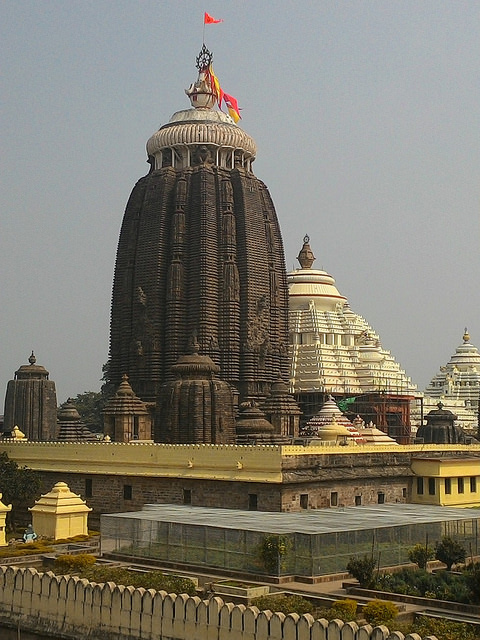
Sarvabhauma's own household was drawn into the middle of Gaudiya Vaishnavism's most important meeting almost by accident. When the newly renounced Krishna Chaitanya reached Puri, He fell unconscious before Lord Jagannatha. Sarvabhauma happened to be present. He recognised the trance as something beyond ordinary experience, and had Him carried to his own house. There Sarvabhauma learned that this sannyasi was the grandson of Nilambara Chakravarti, a family his own father had respected. This made him feel even more responsible for the young man's welfare. It also led to a mistaken but well-meant plan to correct Him, described in full in The Fall at the Temple Gate.
Seven Days That Undid a Lifetime of Logic #
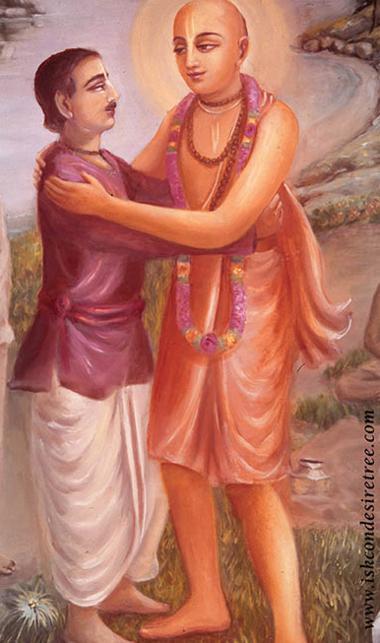
Sarvabhauma thought the Lord was showing too much raw emotion. His remedy was to recite Vedanta philosophy to Him until renunciation took firm hold. For seven days Chaitanya Mahaprabhu listened without a single question. When Sarvabhauma finally asked whether He was understanding anything, he received an answer that turned teacher into student. The sutras were as clear as sunlight, the Lord said, but Sarvabhauma's own commentary had covered them over like a cloud. What followed was a direct, step-by-step argument for a personal, energetic Absolute Truth, against the formless, powerless Brahman of Mayavada philosophy. It was the fullest statement Chaitanya Mahaprabhu ever gave of the teaching later called achintya-bheda-abheda-tattva, the inconceivable, simultaneous oneness and difference of the soul and the Supreme. The exchange is told in detail in Seven Days of Silence.
From Mayavada to a Devotee's Surrender #
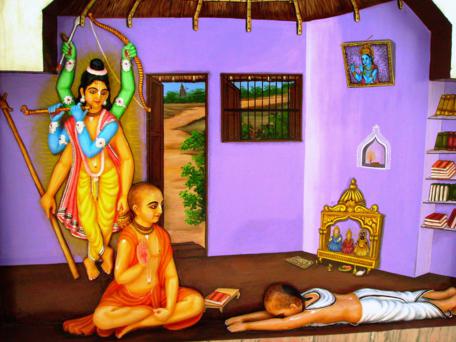
The debate turned, unexpectedly, on a single verse of the Srimad-Bhagavatam describing even self-satisfied sages as drawn to Krishna's devotional service. Sarvabhauma explained it nine ways with all the resources of his training; Chaitanya Mahaprabhu, without touching any of his explanations, gave eighteen more. That display broke something in the old logician. He confessed himself an offender blinded by his own learning, and was shown, in quick succession, the four-armed form of Vishnu and the two-armed form of Krishna with a flute at His lips. That same darshan is still commemorated in a six-armed image at his old house in Puri. In a matter of minutes he composed a hundred Sanskrit verses in praise of the Lord, faster than the sages say even Brihaspati, priest of the demigods, could manage. That whole scene is narrated in The Atmarama Verse Explained Eighteen Ways.
A New Kind of Scholarship #
What came after mattered as much as the conversion itself. Sarvabhauma began composing devotional Sanskrit verses. These included the palm-leaf verses he tried to keep private. The devotees copied them down before Chaitanya Mahaprabhu could tear them up, as told in The Two Verses on the Palm Leaf. He went on to write the hundred-verse Sarvabhauma-shataka (also known as the Chaitanya-shataka) in praise of the Lord, and the Advaitashtakam in praise of Sri Advaita Acharya. He continued as a working scholar and a family man. His wife, remembered in the Chaitanya-charitamrita as Sathi's mother, fed the Lord in their home. His son Chandaneshvara guided the newly arrived Bengali devotees to their first darshan of Jagannatha. And his household, with all its disputes, remained closely involved in the Lord's daily life at Puri, as told in Teaching Vedanta as a Vaishnava. It was Sarvabhauma who insisted that Chaitanya Mahaprabhu meet Ramananda Raya on the road to South India. It was also Sarvabhauma who, over years of patient effort, brought Maharaja Prataparudra into the Lord's mercy, despite a sannyasi's strict rule against meeting kings. Years later Chaitanya Mahaprabhu would tell Paramananda Puri's godbrother Vallabha Bhatta that it was Sarvabhauma, more than anyone, who had taught Him the real extent of devotional service.
An Unrecorded Ending #
No source gives a year for Sarvabhauma Bhattacharya's disappearance. The standard traditions about his birth year also do not agree closely enough for a date to be stated as fact here. One Vaishnava reference work places his birth in the first half of the fourteenth century of the Shaka calendar. An unrelated Wikipedia article gives an impossible thirteenth- or fourteenth-century date. It evidently confuses him with a philosopher of the same name and title from a different region and period. Some things are certain. He never left Jagannatha Puri again after his kshetra-sannyasa vow. He taught, wrote and served there for the rest of his life. His house beside the Sweta Ganga tank near the Jagannatha temple survives today and is still visited, as told in The House That Remembers Him. Gaudiya Vaishnava tradition, following the Gaura-ganoddesha-dipika, identifies him as an incarnation of Brihaspati, the priest of the demigods, sent to support Chaitanya Mahaprabhu's pastime of defeating Mayavada philosophy with its own weapons. Sri Chaitanya Mahaprabhu's own view of him has lasted longer than every dispute about dates. Late in His Puri years, He said that Sarvabhauma Bhattacharya, master of six philosophical systems, was among His most exalted devotees.
The identification with Brihaspati comes from verse 119 of Kavi Karnapura's Gaura-ganoddesha-dipika:
bhaṭṭācāryaḥ sārvabhaumaḥ purāsīd gīṣpatir divi
"Sarvabhauma Bhattacarya had formerly been Brhaspati, the foremost scholar in the heavenly planets." (Gaura-ganoddesha-dipika 119)
Srila Prabhupada cites the same verse in his purport to Chaitanya-charitamrita Adi 10.130: "The Gaura-gaṇoddeśa-dīpikā (119) states that Sārvabhauma Bhaṭṭācārya was an incarnation of Bṛhaspati, the learned scholar from the celestial planets."
Scriptural evidence
Quoted in the text above:
- Verse 119 Gaura-ganoddesha-dipika
Further verses:
I offer my respectful obeisances unto Lord Gauracandra, the Supreme Personality of Godhead, who converted the hardhearted Sarvabhauma Bhattacharya, the reservoir of all bad logic, into a great devotee.
Krishnadasa Kaviraja Goswami's own opening verse of the chapter narrating Sarvabhauma's conversion, showing how starkly the tradition frames his pre-conversion character.
Sarvabhauma Bhattacharya perfectly knows the six philosophical theses. He is therefore the spiritual master of the entire world in teaching the six paths of philosophy. He is the best of devotees. Sarvabhauma Bhattacharya has shown Me the limit of devotional service. Only by his mercy have I understood that devotional service to Krishna is the essence of all mystic yoga.
Chaitanya Mahaprabhu's own later assessment of Sarvabhauma, spoken to the scholar Vallabha Bhatta years after the conversion.
- Sri Chaitanya-charitamrita, Madhya-lila 6 (The Liberation of Sarvabhauma Bhattacharya), via vedabase.io
- Sri Chaitanya-charitamrita, Madhya-lila 7 (The Lord Begins His Tour of South India), via vedabase.io
- Sri Chaitanya-charitamrita, Antya-lila 7, via vedabase.io
- Sarvabhauma Bhattacharya - Gaudiya History (ISKCON Desire Tree)
- Sarvabhauma-shataka - Wisdomlib
Frequently asked
When was Srila Sarvabhauma Bhattacharya born?
Srila Sarvabhauma Bhattacharya appeared c. 15th century (exact year unrecorded; sources disagree) in Vidyanagara, near Nabadwip, Nadia, Bengal.
When and where did Srila Sarvabhauma Bhattacharya disappear?
Srila Sarvabhauma Bhattacharya disappeared Not recorded at Jagannatha Puri, Odisha (never left after his kshetra-sannyasa vow).
What are the main pastimes of Srila Sarvabhauma Bhattacharya?
The pastimes covered here include: The Logician of Nabadwip and Mithila, The Fall at the Temple Gate, Seven Days of Silence, The Atmarama Verse Explained Eighteen Ways, The Two Verses on the Palm Leaf, Teaching Vedanta as a Vaishnava, The House That Remembers Him.