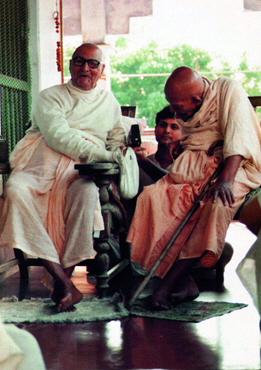
By his own math's account, Bhaktisiddhanta Sarasvati Thakura had asked Pranavananda Brahmachari to accept the renounced order of sannyasa even during his own lifetime, sometime around 1936, and that the disciple had declined out of humility - a detail some sources record and others omit, which is itself a small example of how differently even his own godbrothers and later biographers remembered the same years. What every source agrees on is what happened next: in 1942, five years after his guru's disappearance, Bhaktisiddhanta Sarasvati Thakura appeared to him in a dream, gave him the sannyasa mantra directly, and instructed him to take the vow formally. He did so several years later - in August 1946 by most accounts, though his own math's published biography gives 1947 - receiving tridandi-sannyasa from his godbrother Srila Bhakti Gaurava Vaikhanasa Maharaja at the Gaura-Gadadhara temple in Champahati. From this point he was known as Srila Bhakti Promode Puri Goswami Maharaja.
Sannyasa did not send him into isolation from his godbrothers - if anything the opposite. The circle of disciples Bhaktisiddhanta Sarasvati Thakura had initiated numbered in the hundreds, and among them Puri Goswami Maharaja kept particularly close, lifelong ties with three men whose own later lives took very different institutional paths: Srila Bhakti Rakshaka Sridhara Deva Goswami Maharaja, who would go on to found Sri Chaitanya Saraswat Math and become one of the most quoted Gaudiya Vaishnava teachers of the twentieth century; Srila Bhakti Prajnana Keshava Maharaja, founder of Sri Gaudiya Vedanta Samiti; and Srila Akincana Krishna Dasa Babaji Maharaja, the wandering renunciant whose entire practice was chanting and who is remembered on this site's own page as one of the gentlest and most single-minded of that generation of godbrothers. What is worth stating clearly, in the same spirit as that page: these were relationships among equals, disciples of the same guru who went on to lead separate Gaudiya Math institutions after Bhaktisiddhanta Sarasvati Thakura's disappearance - not a chain of authority running from one to another.
In the 1950s Puri Goswami Maharaja withdrew for a period into a much quieter mode of practice, living in a small cottage on the banks of the Ganges at Ambika Kalna, worshiping a home Deity in relative solitude after years of public editorial and temple work. That withdrawal ended, in a sense, by outside initiative rather than his own: in 1958, on the appearance day of Srimati Radharani, the King of Burdwan - moved, by his own math's account, by respect for his simplicity - presented him with the historic Ananta Vasudeva temple in Kalna, a roughly three-hundred-year-old shrine that needed a qualified Vaishnava caretaker. He accepted the charge and, in doing so, stepped back from solitary bhajana into the same kind of institutional temple service that had defined his early life under Bhaktisiddhanta Sarasvati Thakura - deity worship, temple management, and, before long, the editorial work that would occupy him for the rest of his exceptionally long life.
Sannyasa never slowed him down the way it does most renunciants as they age. By his own godbrothers' account he undertook Vraja-mandala parikrama - the traditional circumambulation on foot of the whole of Vrindavana's sacred land, a demanding walk of several weeks - at the age of eighty-five, decades after most sannyasis of his generation had settled into a single fixed residence. That combination, a body kept moving by disciplined practice and a mind kept at its desk by the same discipline, is what carried him into the final and most public chapter of his life. That work, and his final decades building a math of his own, are told on The Cornerstone and a Math of His Own.