For most of the fourteen years he spent as Pranavananda Brahmachari, Srila Bhakti Promode Puri Goswami Maharaja's service was almost entirely a service of the pen. He worked in Bhaktisiddhanta Sarasvati Thakura's publication department, editing and proofreading the weekly Gaudiya Patrika and helping produce the books that carried the Gaudiya Math's teachings across Bengal. In 1926 his guru put him in charge of Dainika Nadiya Prakasa, by every account the world's only daily Vaishnava newspaper, and for roughly two years - sources differ on whether the run ended in 1928 or 1929 - he saw to it that Bhaktisiddhanta Sarasvati Thakura's daily discourses reached print each morning alongside articles by fellow godbrothers. Bhaktisiddhanta Sarasvati Thakura later honored this work with two titles, maha-mahopadesaka ("great instructor") and pratna-vidyalankara ("ornamented with knowledge of the ancient scriptures") - formal recognitions, but ones that undersell what the work actually meant: a very large share of Bhaktisiddhanta Sarasvati Thakura's own lectures and conversations survive today only because a young editor sat close enough, day after day, to take them down.
He kept at this while also supporting his family back in Bangladesh, working for a time at the Calcutta Port Commission before giving up the job entirely in 1925 to serve full-time. According to his own math's account he was, by instruction, kept deliberately anonymous - his name left off the books and articles he worked on - a detail that fits a man remembered throughout his life for avoiding personal credit. The relationship with his guru was not only formal. Several sources preserve small moments of ordinary affection: Bhaktisiddhanta Sarasvati Thakura is remembered joking to other godbrothers, "Pranab belongs to Jessore, and the people of Jessore like to eat molasses - give him lots of molasses and make him happy!" - the kind of remark that only survives in the memory of someone who was genuinely fond of a disciple, not simply directing him.
That fondness showed itself again, more gravely, in December 1936, as Bhaktisiddhanta Sarasvati Thakura's health failed. Devotional accounts from his own math describe Pranavananda Brahmachari being called close during those final weeks, and record that at one point his guru rested his feet on the young disciple's chest - a gesture of the deepest intimacy in this tradition - and that when someone nearby asked what would become of the mission after he was gone, Bhaktisiddhanta Sarasvati Thakura answered only, softly, "Pranab, Krishna, Krishna, Krishna." Bhaktisiddhanta Sarasvati Thakura passed from this world on 1 January 1937, and Pranavananda Brahmachari was one of two disciples - the other being his godbrother Bhakti Gaurava Vaikhanasa Maharaja - chosen to conduct the samadhi ceremony at Sri Mayapur Dham. It should be said plainly that these deathbed details come from devotional biographies written within his own institutional lineage, not from an independently verifiable contemporary record; they are reported here as his own tradition remembers them, not as established historical fact beyond dispute.
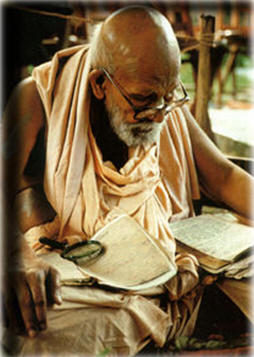
The habit of editorial service that had defined these years never left him. Decades later he would still be found at a writing table surrounded by manuscripts, and it was this same instruction - never to give up "the service of the pen" - that his own later disciples remembered him repeating as his defining piece of guidance from Bhaktisiddhanta Sarasvati Thakura. What that instruction cost him personally, and how he carried it forward into a very different chapter of his life as a sannyasi, is told on A Dream Command and the Saffron Cloth.