Sri Vidyanidhi
Guru of Rajendra Tirtha in the Gaudiya List
The complete life, on one page: The main biography and every pastime page, in order, in one place
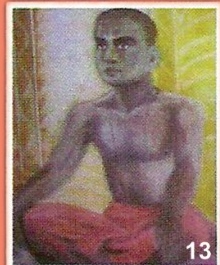
Introduction
Sri Vidyanidhi holds the thirteenth position in the traditional Gaudiya guru-parampara list. He is named as the disciple of Dayanidhi and, in turn, as the guru of Rajendra Tirtha. This Vidyanidhi should not be confused with Srila Pundarika Vidyanidhi, the guru of Gadadhara Pandit and a contemporary of Sri Chaitanya Mahaprabhu. Pundarika Vidyanidhi was a completely different and unrelated person. If this list's own dates are right, he lived generations after the Vidyanidhi described here.
Scriptural evidence for the introduction (4)
tāhā hoite dayānidhi, tāra dāsa vidyānidhi, rājendra hoilo tāhā ha'te
Word for word
taha hoite dayanidhi -- from him came Dayanidhi; tara dasa vidyanidhi -- his servant was Vidyanidhi; rajendra hoilo taha ha'te -- Rajendra appeared from him
From him [Jnanasindhu] came Dayanidhi; his servant was Vidyanidhi; Rajendra appeared from him.
From the purport: Purport excerpt: "The acharyas coming from Madhva are Padmanabha, Nrhari, Madhava, Akshobhya, Jayatirtha, Jnanasindhu, Dayanidhi, Vidyanidhi, Rajendra, Jayadharma, Purushottama, Brahmanya-tirtha, Vyasatirtha, Lakshmipati, and Madhavendra Puri."
The one point of full agreement between this project's two Gaudiya-tradition sources for this stretch of the list: both place Vidyanidhi immediately before Rajendra Tirtha, whatever they call the name one link earlier.
From the purport: Purport excerpt: "(16) Vidyadhiraja, 1190; (17) Kavindra, 1255; (18) Vagisha, 1261; (19) Ramacandra, 1269; (20) Vidyanidhi, 1298."
Already used and verified on the Rajendra Tirtha page (see /acharyas/rajendra-tirtha/vidyanidhi-or-vidyadhiraja/); reused here rather than re-fetched, since vedabase.io's page for this verse could not itself be retrieved by this research pass (a client-rendered page that returns no readable text to an automated fetch). This numbered list places a separate 'Vidyanidhi' four names and roughly a century after Vidyadhiraja Tirtha, in a different branch, the reading discussed without resolving in the cross-reference section here.
From the purport: "...is to some extent, defective. The names of Jnanasindhu and Dayanidhi are nowhere to be found among the successors of Jayatirtha. Vidyanidhi is evidently a mistake for Vidyadhiraja and Jayadharma a variant of Jayadhvaja."
B. N. K. Sharma's own explicit, independent (non-Gaudiya) reading of the identification reported here, found during a deeper research pass by searching the full OCR text of his book.
From the purport: Sri Jayateertha - Sri Vidyadhiraja Tirtha - Sri Kavindra Tirtha - Sri Vagisha Tirtha - Sri Ramachandra Tirtha - Sri Vidyanidhi Tirtha - Sri Raghunatha Tirtha - ...
The matha's own official, numbered guru-parampara page, the institutional backbone for both the Vidyadhiraja identification here and the report of a second, later Vidyanidhi Tirtha (11th).
Chapter 1
Vidyadhiraja Tirtha: The Fuller Record
If Vidyanidhi really is Vidyadhiraja Tirtha under a Gaudiya name, here is the fuller record of the man himself, taken from the sources.
Here is the fuller record of Vidyadhiraja Tirtha, drawn from independent sources. He was the seventh pontiff, or head, of the Uttaradi Matha. Two Gaudiya-tradition compilations, and B. N. K. Sharma's academic history, identify him with Vidyanidhi. None of this proves the identification. It remains a reasoned reading, not a documented fact. But if the identification holds, this is who the Gaudiya tradition's "Vidyanidhi" actually was.
| Detail | Description |
|---|---|
| Position | Seventh pontiff of the Uttaradi Matha; immediate disciple and successor of Jayatirtha |
| Birth name | "Krishna Bhat" / "Krsnabhatta" per the matha's own tradition and the Sarvajna-Kasi-stotra; "Nrsimha Sastri" per the older Gurucharya |
| Family background | Badaganadu Karnataka Brahmin family of South India, per the Gurucharya; ordained directly from brahmacharya (celibate student life), already learned in the shastras |
| Ordained by | Jayatirtha, about one year before Jayatirtha's own passing |
| Pontifical dates | Traditional matha lists: 64 years' rule (rejected by Sharma as implausible). Gurucharya/Gurucharita: 3 years, 9 months, 13 days (rejected by Sharma as too short). Sharma's own revised estimate: c. 1388-1412 CE, roughly 24 years |
| Works | Chandogya-Bhashya-Tika (attested only indirectly); Gita-Vivrti, a commentary on the Bhagavad-gita (2 mss., Mysore Oriental Library); Vishnu-sahasranama-Bhashya, the earliest known Dvaita commentary on that text (1 ms., Mysore Oriental Library, c. 1,650 verses) |
| Epigraphic record | A Madras Presidency inscription (Udupi taluk, no. 241) records a land grant of 200 cents to him from the Vijayanagara ruler Devaraja Maharaya |
| Disciples | Ordained Rajendra Tirtha first; later ordained Kavindra Tirtha, whose line became the Uttaradi Matha proper |
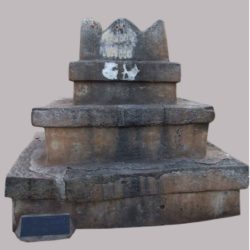
| Burial (brindavana) | Ergola / Yaragola, near Malkhed, on a lake embankment, also the burial site, generations later, of Ramachandra Tirtha and of a different, later pontiff also named Vidyanidhi Tirtha (see A Second Vidyanidhi in the Uttaradi Line) |
A Disputed Name, A Disputed Length of Rule #
Even within the Dvaita tradition's own sources, Vidyadhiraja Tirtha's identity is not perfectly settled. The matha's present-day official biography and the older Sarvajna-Kasi-stotra tradition give his name before sannyasa as Krishna Bhat. The Gurucharya is an older source that Sharma judges more reliable for personal details of his life. It gives the name instead as Nrsimha Sastri, and places his family among the Badaganadu Karnataka Brahmins. Both traditions agree that he was ordained directly by Jayatirtha. He did not pass through the in-between stage that some other Madhva sannyasis went through. Both also agree that this took place about a year before Jayatirtha's own passing.
How long he was head is even more disputed. The matha's own later Carama-sloka verses give him a rule of sixty-four years. These are ceremonial memorial verses, said to have been composed by each pontiff's immediate successor. B. N. K. Sharma rejects this figure outright. Sharma explains that at some point the matha's succession lists pushed Madhvacharya's own birth date back by two full sixty-year calendar cycles. This opened a gap of roughly 120 years between the earlier and later pontiffs. The tradition then closed the gap by quietly giving unrealistically long "rules" of sixty-plus years to one or two pontiffs. Vidyadhiraja was one of them. As it happens, a different, later Vidyanidhi Tirtha was another (see below). From the opposite direction, the older Gurucharya and Gurucharita texts give Vidyadhiraja only three years, nine months and thirteen days. Sharma judges this too short for a career that, by his own account, included "ceaseless disputation with Advaitins" and produced at least three separate scholarly works. After weighing the evidence, Sharma proposes his own estimate of roughly twenty-four years. This dates Vidyadhiraja's time as pontiff to approximately 1388-1412 CE, and the dates shown for him on this site use this figure. But this is Sharma's own reasoned reconstruction, not a fact that everyone accepts.
A Legend on the River Bhima #
The matha's own official biography preserves one specific legend from Vidyadhiraja's travels. While touring in North India, he intended to travel to Kashi for a holy bath in the Ganges. But the goddess Ganga appeared to him in a dream and told him this was unnecessary. She would appear in the river Bhima the very next day instead. The legend says she did so, and Vidyadhiraja and his disciples performed worship and bathed in the Bhima in her honor. We give this as the matha's own devotional memory of him, not as history that can be checked independently.
Three Works, One Genuinely Pioneering #
Three works are credited to Vidyadhiraja Tirtha. The first is a sub-commentary on the Chandogya Upanishad. It is known only through a brief mention by a later author. Sharma notes that this mention may actually refer to a different author with a similar name, so it is uncertain whether Vidyadhiraja wrote it. His commentary on the Bhagavad-gita, the Gita-Vivrti, survives in two manuscripts held by the Mysore Oriental Library. Sharma personally examined one of them. He describes it as following Madhva's own Gita-Bhashya closely, and in places as "little more than a rechauffe" of it, meaning a reworking of old material. But he also compares its style to Jayatirtha's own, for its simplicity and directness. It is also cited by the historian of Indian philosophy Surendranath Dasgupta in his own multi-volume history.
His third and most significant work is a commentary on the Vishnu-sahasranama, the thousand names of Vishnu. It survives in a single Devanagari manuscript of roughly 1,650 verses, also in the Mysore Oriental Library. Both Sharma's academic history and the matha's own official website, each on its own, describe this as the earliest known Dvaita-tradition commentary on the Vishnu-sahasranama. In Sharma's assessment, it pays close attention to the etymology, that is the origin and meaning, of each of the thousand names. But it shows comparatively little interest in how each name is formed grammatically. The Vishnu-sahasranama is held in very high regard within Madhva's own theology. So this is arguably Vidyadhiraja's most lasting individual contribution to Dvaita literature. This stays true however the separate question of his identity with "Vidyanidhi" is finally settled.
The Two Disciples, and a Family Detail #
The first split of the Madhva mathas took place at the end of Vidyadhiraja's life. This is the episode that makes his time as head important, beyond his own writings. The matha's own account and B. N. K. Sharma's academic account agree on the main events but differ in a few details. In the matha's own version, Vidyadhiraja first ordained Rajendra Tirtha as his intended successor during an illness. Then he recovered and did not immediately install him. When a second illness struck and Rajendra Tirtha could not be found in time, Vidyadhiraja ordained a second disciple, Kavindra Tirtha. He handed the entire samsthana (institutional seat, deities, and properties) over to Kavindra Tirtha instead. In Sharma's version, drawn from the Gurucharya, Vidyadhiraja ordained Rajendra Tirtha first, in the cyclic year Hevilambi. Later, as his health began failing, Vidyadhiraja sent word for Rajendra Tirtha to return. But Rajendra Tirtha was on tour at the time and did not make it back soon enough. No successor had been formally installed, so Vidyadhiraja ordained Kavindra Tirtha instead. Both versions agree that Rajendra Tirtha was ordained first and was senior in years to Kavindra Tirtha. The matha's own later Carama-sloka verse for Kavindra makes this seniority unclear, in a way Sharma calls "misleading" and "unfortunate."
The matha's own official biography of Kavindra Tirtha is the only source for one detail, and Sharma's book does not have it. It says that Kavindra Tirtha was Rajendra Tirtha's own brother in worldly life (purvashrama), before either took sannyasa. If this is accurate, the split was not simply an accident of timing within the matha. In effect, it was a decision that chose between two brothers. One of them went on to found the line that became the Vyasaraja Matha at Sosale. The other founded the line that became the Uttaradi Matha itself. This detail comes from only the one source, and it should be read with that in mind.
Vidyadhiraja Tirtha died at Ergola (also spelled Yaragola or Yaragol), some four miles from Nalvar on the Wadi-Raichur railway section, where his remains are entombed. B. N. K. Sharma visited the site personally on 28 February 1975. He recorded that only the tombs of Ramachandra Tirtha and a later Vidyanidhi Tirtha could still be clearly identified among those then visible on the raised bank of a lake there. In his view, Vidyadhiraja's own tomb, and those of Rajendra Tirtha and others, were likely lying within the ruins of the old town nearby.
Scriptural evidence for this chapter (3)
From the purport: "VIDYADHIRAJA was the immediate disciple and successor of Jayatirtha on the Pitha. The S.A. gives his former name as Krsnabhatta. But the Gurucarya gives it as Nrsimha Sastri...I have therefore thought it fit to revise his Pontifical date as 1388-1412 A.D."
Sharma's own critical biographical treatment of Vidyadhiraja Tirtha, including his name variants, the disputed length of his tenure, and Sharma's own revised chronology.
From the purport: "His initial name was Krishna Bhat before he was initiated to Sanyasa by Shri JayaTeertha... The Goddess Ganga told him in a dream that he need not travel all the way to Ganges and that she would appear to him in the river Bhima itself the very next day."
The matha's own official devotional biography, including the Ganga-in-the-Bhima legend and its own account of the split with Kavindra Tirtha.
From the purport: "Shri Kavindra Teertha happens to be brother of Shri Rajendra Teertha in his poorvashrama (before being initiated to sainthood)."
A genuinely new detail found only in the matha's own official biography of Kavindra Tirtha.
Chapter 2
A Second Vidyanidhi in the Uttaradi Line
Sri Uttaradi Math's own official succession names a real, separate and later pontiff "Vidyanidhi Tirtha". He is not the Vidyanidhi of the Gaudiya list, but he is perhaps the answer to a puzzle left open on Rajendra Tirtha's page.
Sri Uttaradi Matha's own official, numbered guru-parampara page lists its pontiffs in unbroken order. Reading from Jayatirtha: Sri Jayateertha (6th), Sri Vidyadhiraja Tirtha (7th), Sri Kavindra Tirtha (8th), Sri Vagisha Tirtha (9th), Sri Ramachandra Tirtha (10th), Sri Vidyanidhi Tirtha (11th), Sri Raghunatha Tirtha (12th), and onward. By an unlucky coincidence, that eleventh name is exactly the same as Vidyanidhi of the Gaudiya guru-parampara list. But he is a different man, in a different generation. There is no documented connection between him and Vidyadhiraja, Dayanidhi, or Rajendra Tirtha at all.
| Detail | Description |
|---|---|
| Position | Eleventh pontiff of Sri Uttaradi Matha; disciple and successor of Ramachandra Tirtha (10th) |
| Predecessor | Sri Ramachandra Tirtha |
| Successor | Sri Raghunatha Tirtha |
| Installed | c. 1430 CE, according to B. N. K. Sharma, a date he ties to the second division of the original matha, under Ramachandra Tirtha |
| Length of rule | Carama-sloka tradition: 68 years (rejected by Sharma as a figure added later to fill a gap in the dates). Gurucharya: 7 years, 9 months, 13 days |
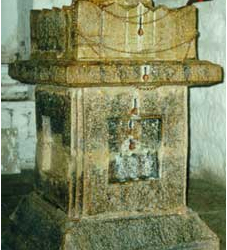
| Burial (brindavana) | Yaragola / Ergola, Yadgir taluk, Gulbarga district, the same general site where Vidyadhiraja Tirtha himself, and Ramachandra Tirtha, were also entombed |
The Pooja-Box Story #
The matha's own official biography of this Vidyanidhi Tirtha tells a specific succession story. Ramachandra Tirtha fell seriously ill. He first ordained a disciple named Kambhaluri Narasimhacharya to sannyasa and renamed him Vibhudendra Tirtha. He intended to install him as the next pontiff. But instead of handing over the matha's deities and ritual implements at once, he sent him on tour to teach Madhva philosophy, saying he would send for him when the time came. When Ramachandra Tirtha's health failed again at Yaragola, he sent for Vibhudendra Tirtha, who could not return in time. So Ramachandra Tirtha, before entering his own final rites, ordained a second disciple as Vidyanidhi Tirtha. He told the villagers of Yaragola to bury the matha's pooja box (holding its worship implements) in a pit. The box was to be given to Vibhudendra Tirtha only if he returned within six months. Otherwise it was to go to Vidyanidhi Tirtha. Vibhudendra Tirtha did not return within six months (the matha's own biography of Vidyanidhi Tirtha says he waited an extra eleven days beyond that out of caution). But just as the villagers prepared to dig up the box for Vidyanidhi Tirtha, Vibhudendra Tirtha finally arrived and asked for it for himself. The villagers did not want to simply decide between the two claimants, so they proposed a contest. Each would pray in turn. The saint whose prayer made the earth over the buried box visibly shift would be accepted as the rightful successor. Vibhudendra Tirtha, as the senior of the two, prayed for three days without effect. On the fourth day, Vidyanidhi Tirtha prayed. According to the matha's account, he recited a portion of the fifth canto of the Bhagavata Purana. His prayer caused the ground to shift, and the villagers installed him as pontiff. Vibhudendra Tirtha went on to found a separate institution. It later came to be known as the Raghavendra Swami Matha of Mantralaya, named after its sixth successor in that line.
We give this story as the matha's own devotional memory of the event, not as history that can be checked independently. No source outside the matha's own tradition confirms the specific details of the pooja-box test.
The Same Chronological Patch B. N. K. Sharma Rejects for Vidyadhiraja #
This Vidyanidhi Tirtha's own Carama-sloka verse credits him with a sixty-eight-year rule as pontiff. This is very close to the unlikely sixty-four years the same tradition gives Vidyadhiraja Tirtha. B. N. K. Sharma's academic history treats both figures the same way. In his judgment, both of these too-long figures serve to cover over the same gap of roughly 120 years in the dates. That gap was created when the matha's own lists pushed Madhvacharya's traditional birth date back by two sixty-year cycles. Instead, Sharma accepts the Gurucharya's figure of seven years, nine months and thirteen days for this Vidyanidhi Tirtha's actual rule. He also states separately that Vidyanidhi Tirtha became head of the matha in 1430 CE. In Sharma's own words, this date is reached from "the second bifurcation of the original Mutt under Ramacandra Tirtha." The matha's own official biography adds more details. During his time as head, the matha received extensive land grants near Raichur, which it still holds today. He traveled across India and had a recorded darshan of Lord Varaha Narasimha Swamy at Simhachalam. He was honored by a king of Anegundi, and he was known for his explanation of the Nyaya-Sudha. But unlike Vidyadhiraja Tirtha, no written work of his own has survived, and neither the matha nor Sharma credits any work to him.
A Possible, Not Certain, Answer to an Open Question #
Sri Rajendra Tirtha's own pastime page, Vidyanidhi or Vidyadhiraja, discusses Srila Prabhupada's purport to Chaitanya-charitamrita, Madhya 9.245. It reports that the purport lists Vidyadhiraja Tirtha as the sixteenth name in its own numbered succession. Then, in what the purport describes as "another disciplic succession" branching off after him, it lists "(17) Kavindra, (18) Vagisha, (19) Ramacandra, (20) Vidyanidhi," and gives this Vidyanidhi a birth year of Shaka 1298 (c. 1376 CE). That is roughly a century after Vidyadhiraja's own traditional birth year. That page reports this as an open problem. If this later "Vidyanidhi" is a real, separate figure, he cannot be the same man as Vidyadhiraja Tirtha. That would weaken the identification of Vidyanidhi with Vidyadhiraja, which is reported as reasonable on Vidyanidhi's own page.
The sequence of names in that purport (Vidyadhiraja, then Kavindra, then Vagisha, then Ramacandra, then Vidyanidhi) is identical, name for name and in the same order, to Sri Uttaradi Matha's own official succession from its seventh through eleventh pontiffs. No source states outright that Prabhupada's purport and the matha's own official list are describing the very same men. The purport gives Shaka-era birth years that the matha's own website does not repeat. It also cannot be confirmed independently that the purport's compiler used the same records as this page. But the names and their order both match, in two sources with no clear connection to one another, and this is hard to explain as chance. If the two really are describing the same succession, then Prabhupada's own purport is not naming a rival candidate for Rajendra Tirtha's guru at all. Its "later Vidyanidhi" would simply be this eleventh pontiff of Sri Uttaradi Matha, a real person who is recorded separately. He would be correctly placed after Vidyadhiraja Tirtha because he really did rule after him, a few decades later by Sharma's dates. And he would belong to an entirely different line of succession from Rajendra Tirtha's own.
This reading is a conclusion drawn from comparing two independent numbered lists. It is not a fact stated outright by either source. Even if it is correct, it would not prove that Vidyanidhi really is Vidyadhiraja Tirtha. That identification rests on the separate grounds discussed in Vidyadhiraja Tirtha: The Fuller Record and on Vidyanidhi's own main biography. But if this reading holds, it would remove one specific piece of evidence that had seemed to make that identification harder to accept. It would show that Prabhupada's own "later Vidyanidhi" most likely refers to someone else entirely. He would be a real man, correctly named, who simply lived a few decades later and in a different branch of the same institution.
Scriptural evidence for this chapter (3)
From the purport: "Shri Vidyanidhi Teertha succeeded the throne of the Vedanta Samrajya of the Uttaradi Matha after Shri Ramachandra Tirtha and ruled for a very long period... Shri Ramachandra Tirtha, therefore was compelled to ordain Shri Vidyanidhi Tirtha as his possible successor."
The matha's own official biography of this entirely separate, later Vidyanidhi Tirtha, disciple and successor of Ramachandra Tirtha, not of Dayanidhi, including the pooja-box succession story.
From the purport: "The 'Caramasloka' of the Uttaradi Mutt, assigns sixty-eight years of Pontifical rule to Vidyanidhi! which is contradicted by the clear evidence of the Gurucarya which assigns to him but seven years, nine months and thirteen days' rule... ever since the time of Vidyanidhi Tirtha, the first Head of the Mutt after the second bifurcation of the original Mutt under Ramacandra Tirtha, in 1430 A.D."
Sharma's critical rejection of the inflated 68-year figure for this Vidyanidhi Tirtha, and his own dating of this Vidyanidhi Tirtha's accession to 1430 CE, the figure the cross-referencing with Prabhupada's purport (below) relies on.
From the purport: Purport excerpt: "(16) Vidyadhiraja, 1190; (17) Kavindra, 1255; (18) Vagisha, 1261; (19) Ramacandra, 1269; (20) Vidyanidhi, 1298."
The same five-name sequence, in the same order, as Sri Uttaradi Math's own official 7th-11th pontiffs, the basis for inferring that the purport's 'later Vidyanidhi' is this eleventh pontiff, not a rival candidate for the pontiff profiled here.
Closing
Agreement On the Position, If Not On Everything Before It #
Unlike the disputed name right before him (see Dayanidhi), Vidyanidhi's own position is not disputed between the two main Gaudiya-tradition sources for this list. Srila Bhaktisiddhanta Sarasvati Thakura's devotional song "Sri Guru-parampara" states: "taha hoite dayanidhi, tara dasa vidyanidhi, rajendra hoilo taha ha'te", "from him [Jnanasindhu] came Dayanidhi; his servant was Vidyanidhi; Rajendra appeared from him." Kavi Karnapura's older *Sri Gaura-Ganoddesha-dipika* (Text 22), even though it names a different figure ("Mahanidhi") one link earlier, agrees exactly on this link: "Mahanidhi's disciple was Vidyanidhi. Vidyanidhi's disciple was Rajendra." Both sources place him right before Rajendra Tirtha.
| Detail | Description |
|---|---|
| Position in the Gaudiya list | Disciple of Dayanidhi (or Mahanidhi); guru of Rajendra Tirtha, agreed by both Gaudiya-tradition sources checked |
| Possible independent identity | Two Gaudiya-tradition compilations state directly that he is Vidyadhiraja Tirtha. If so, he was the seventh pontiff of the original Udupi matha, recorded in independent sources, and was born Krishna Bhatt around 1269 CE |
| Guru, if identified with Vidyadhiraja | Jayatirtha directly, per independent sources and B. N. K. Sharma's academic history, leaving no documented room for Jnanasindhu or Dayanidhi as separate pontiffs in between |
| Disciple | Rajendra Tirtha, in every reading checked |
| Not to be confused with | Srila Pundarika Vidyanidhi, guru of Gadadhara Pandit, a later, unrelated contemporary of Sri Chaitanya Mahaprabhu |
An Identification With Vidyadhiraja Tirtha #
Two independent Gaudiya-tradition compilations go further than simply naming Vidyanidhi. Both identify him as Vidyadhiraja Tirtha, the seventh pontiff, or head, of the original Madhva matha at Udupi. The Vedic Encyclopedia's own numbered guru-parampara list gives this position as "13. Vidyadhiraja (Vidyanidhi) Tirtha," and gaudiyahistory.iskcondesiretree.com's own page on this figure treats "Vidyanidhi" and "Vidyadhiraja" as two names for one person throughout. Read this way, Vidyanidhi is not a separate figure with no other record at all. He is simply this tradition's own name for a real pontiff whose life is also recorded in independent sources. That pontiff was born Krishna Bhatt and was ordained by Jayatirtha. He is credited with a commentary on the Bhagavad-gita. According to Dvaita tradition, he is also credited with the first recorded Dvaita commentary on the Vishnu-sahasranama. He is also remembered for the historic split of the Madhva mathas. His serious illness, and a message that reached his intended successor too late, led directly to that split. It divided the mathas into what became the Uttaradi Matha and the line that later took the name Vyasaraja Matha.
But this identification does not fit easily with the very record it draws on. Independent sources name Vidyadhiraja Tirtha's teacher simply as Jayatirtha, with no pontiff in between. B. N. K. Sharma's academic history of the Dvaita school also leaves no room in the recorded succession for a Jnanasindhu or a Dayanidhi to have held the seat between the two of them. If Vidyanidhi really is Vidyadhiraja, then neither Jnanasindhu nor Dayanidhi, the two names standing between Jayatirtha and him in the Gaudiya list, can have been a pontiff of that matha line. At most they were other disciples of Jayatirtha who are honored in devotional memory but never occupied the seat themselves. The Vedic Encyclopedia's own compiler raises this possibility directly.
- Krishna Hoite Caturmukha (Sri Guru-Parampara) by Srila Bhaktisiddhanta Sarasvati Thakura, from Songs of the Vaishnava Acharyas (BBT, 1972 ed.)
- Guru-parampara, page 1 -- Vedic Encyclopedia (veda.harekrsna.cz), quoting Kavi Karnapura's Sri Gaura-Ganoddesha-dipika, Text 22, and B. N. K. Sharma
- Sripad Vidyanidhi Tirtha -- Gaudiya History (ISKCON Desire Tree)
- B. N. K. Sharma, History of the Dvaita School of Vedanta and Its Literature (1961/1981), full text via Internet Archive
- Rajendra Tirtha: Vidyanidhi or Vidyadhiraja (this website)
- B. N. K. Sharma, History of the Dvaita School of Vedanta and Its Literature, p. 525 ("Influence on Bengal Vaisnavism") and pp. 195-198, 451-453 (Vidyadhiraja Tirtha biography and chronology) -- full text via Internet Archive
- Guru Parampara -- Sri Uttaradi Math (official website, full numbered succession list)
- Sri Vidyadhiraja Tirtha -- Sri Uttaradi Math (official biography page)
- Sri Kavindra Tirtha -- Sri Uttaradi Math (official biography page)
- Sri Vidyanidhi Tirtha -- Sri Uttaradi Math (official biography page, the matha's own eleventh pontiff)
