Table of Contents
- 1. When is Radha Ashtami 2026?
- 2. What Is Radha Ashtami?
- 3. Who Is Srimati Radharani?
- 4. Radha Ashtami Story: The Appearance of Radharani
- 5. Where Did Srimati Radharani Appear — Rawal or Barsana?
- 6. Why Is Radha Ashtami Celebrated?
- 7. Radha Ashtami Vrat Vidhi: How to Observe the Fast and Puja
- Radha Ashtami Fasting Rules in ISKCON
- 8. How Is Radha Ashtami Celebrated?
- 9. How Radha Ashtami is Celebrated Across India
- 10. Radha Ashtami in Gaudiya Vaishnavism
- Why Do Gaudiya Vaishnavas Seek Srimati Radharani's Mercy?
- 11. What Srila Prabhupada Taught About Srimati Radharani
- 12. Conclusion
- 13. Frequently Asked Questions
- References
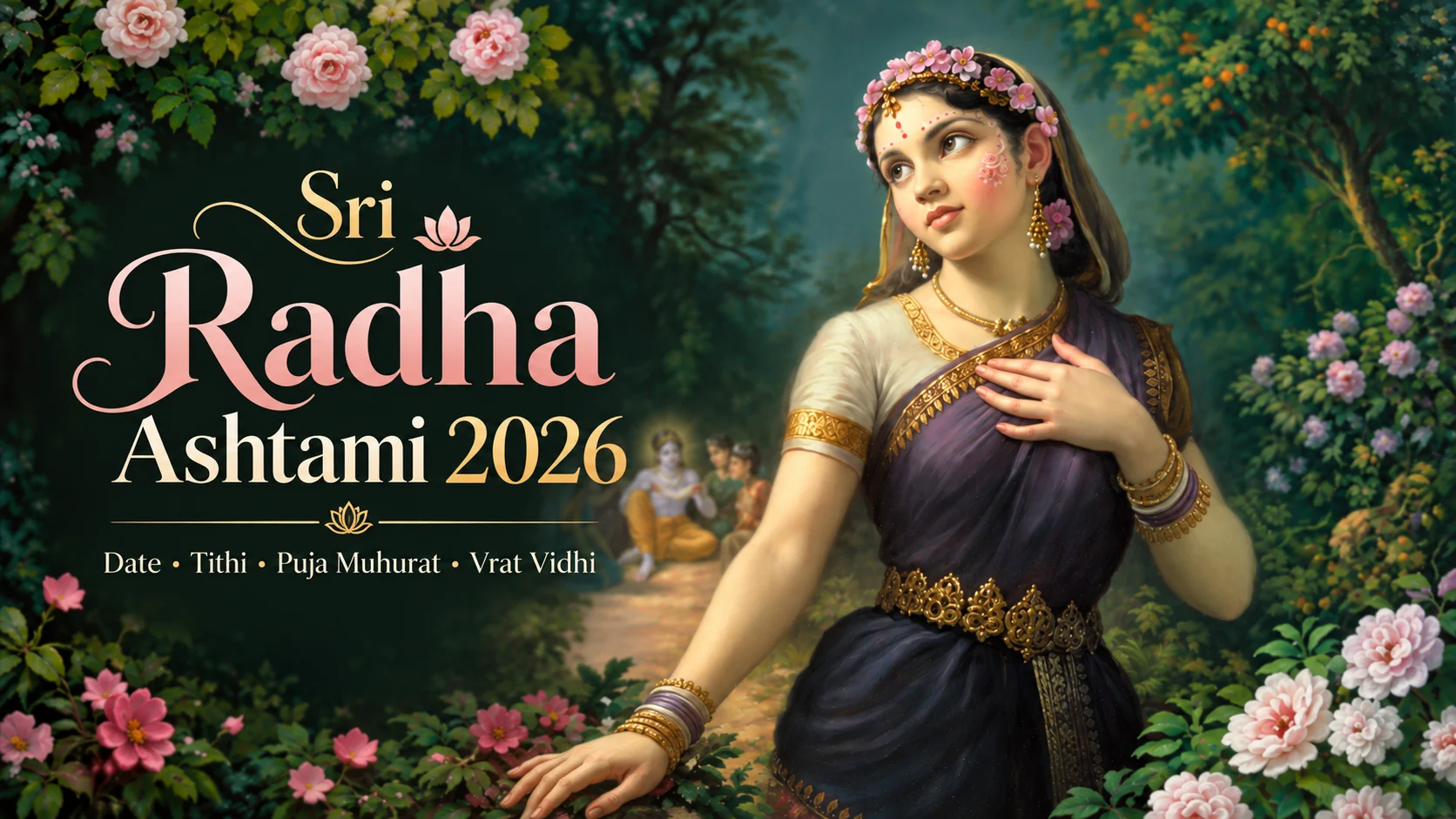
Once a year, the devotional calendar turns toward Srimati Radharani, the eternal beloved of Lord Krishna and, in Gaudiya Vaishnava theology, the personal manifestation of His internal pleasure potency, or Hladini Shakti. That day is Radha Ashtami.
Observed on the Shukla Paksha Ashtami of Bhadrapada, Radha Ashtami comes fifteen days after Janmashtami. In 2026, the festival falls on Saturday, September 19.
For devotees, the day is more than a celebration of Radha's appearance — it is a quiet invitation to pause and reflect on the highest ideal of divine love, devotion, and selfless service.
When is Radha Ashtami 2026?
Radha Ashtami 2026 falls on Saturday, September 19, 2026, during Bhadrapada Shukla Ashtami. The Ashtami Tithi begins at 1:00 PM on September 18 and ends at 3:26 PM on September 19.
The exact tithi and puja timings can vary slightly by location, since Panchang calculations are location-specific. The details below are calculated for Kota, Rajasthan; devotees elsewhere should confirm timings against their local Panchang.
Radha Ashtami 2026 — Key Details (Kota, Rajasthan)
| Festival | Radha Ashtami |
| Also Known As | Radhashtami, Radha Jayanti |
| Date | Saturday, September 19, 2026 |
| Tithi | Bhadrapada Shukla Ashtami |
| Ashtami Tithi Begins | September 18, 2026 — 1:00 PM |
| Ashtami Tithi Ends | September 19, 2026 — 3:26 PM |
| Madhyahna Puja Muhurat (Kota) | 11:07 AM – 1:34 PM |
| Appearance Time | Madhyahna (midday) |
| Location for Muhurat | Kota, Rajasthan |
| ISKCON Fasting | Until noon |
| Significance | Appearance Day of Srimati Radharani |
| Tradition | Gaudiya Vaishnavism / ISKCON |
Madhyahna Puja Muhurat is calculated for Kota, Rajasthan. Devotees outside Kota should consult their local Panchang, as this window shifts by location.
What Is Radha Ashtami?
Radha Ashtami is the sacred appearance day of Srimati Radharani, observed on Bhadrapada Shukla Ashtami — the eighth lunar day of the bright fortnight of Bhadrapada, fifteen days after Janmashtami.
In Gaudiya Vaishnavism, Radharani is understood as Krishna's Hladini Shakti, His internal pleasure potency, and the embodiment of Mahabhava, the highest development of divine love. Because the two festivals fall a fortnight apart, devotees often observe them together as the appearance days of Krishna and Radha.
Radha Ashtami vs Janmashtami at a Glance
| Aspect | Janmashtami | Radha Ashtami |
|---|---|---|
| Celebrates | Appearance of Lord Krishna | Appearance of Srimati Radharani |
| Paksha | Krishna Paksha | Shukla Paksha |
| Tithi | Ashtami | Ashtami |
| Main Worship Time | Nishita (midnight) | Madhyahna (midday) |
| 2026 Date (Kota) | Friday, September 4, 2026 | Saturday, September 19, 2026 |
| ISKCON Fasting | Per Janmashtami observance (till Nishita puja, parana next morning) | Generally until noon |
| Main Focus | Krishna's divine appearance | Sri Radha's divine appearance and devotion |
Who Is Srimati Radharani?
In Gaudiya Vaishnavism, Srimati Radharani is the eternal consort of Lord Krishna and the fullest manifestation of His Hladini Shakti, or internal pleasure potency. She is described as the embodiment of Mahabhava, the highest development of divine love for Krishna — a concept later systematized by Srila Rupa Gosvami, one of the principal Goswamis of Vrindavan, in his classical works on Krishna-bhakti rasa theology.
She is the daughter of King Vrishabhanu and his wife Kirtida Devi, and the queen of Vrindavan. She is the supreme devotee, the one whose love for Krishna is considered the highest and most perfect love that has ever existed, in any world, in any age.
The scriptures describe her with one key phrase: Hladini Shakti — the bliss-giving potency of Lord Krishna.
"Radha and Krishna are one and the same, but They have assumed two bodies. Thus They enjoy each other, tasting the mellows of love."
"Krishna is the energetic, and Radharani is the energy... Just like energy and energetic, you cannot separate. Fire and the heat you cannot separate. Wherever there is fire there is heat, and wherever there is heat there is fire. Similarly, wherever there is Krishna there is Radha, and wherever there is Radha there is Krishna. They are inseparable."
— Srila Prabhupada, Radhastami Lecture, Montreal, August 30, 1968
Her name itself carries meaning. In Sanskrit, Radha (राधा) derives from the root radh — "to succeed, to accomplish, to propitiate" — and as a noun means prosperity and success (Monier-Williams Sanskrit-English Dictionary). She is also called:
These are not distant titles reserved for scripture — devotees call out to her by these names every day, in kirtan and in quiet personal prayer, as simple expressions of affection and longing.
Gaudiya Vaishnava theology identifies Srimati Radharani as Krishna's Hladini Shakti, His internal pleasure potency, alongside His Sandhini (existential) and Samvit (cognitive) potencies. This is systematically explained in Sri Caitanya-caritamrta (Adi-lila 4.60), which traces the three-potency doctrine to the Vishnu Purana and credits Srila Rupa Gosvami and Srila Jiva Gosvami with its Gaudiya elaboration. The Padma Purana, Brahma Vaivarta Purana, and Garga Samhita contribute the traditional narratives of Radha's appearance, exalted status, and pastimes with Krishna, rather than this specific technical terminology. She is not a human devotee who attained closeness to God through practice. She is the divine potency itself, appearing in the form of a cowherd girl in Vrindavan.
Radha Ashtami Story: The Appearance of Radharani
The Radha Ashtami story, or Radha Ashtami Vrat Katha, is listened to or read by devotees on Radha Ashtami as part of the observance.
King Vrishabhanu was a good-hearted and prosperous king who lived near Mathura. One day, he went to the banks of the Yamuna River to perform a sacred ritual. As he looked into the water, he saw a golden light beneath the surface. When he reached into the water, he found a lotus flower, and resting on that lotus was a newborn baby girl, radiant, beautiful, and utterly peaceful.
He and his wife Kirtida took the child home, their hearts filled with joy. But there was something unusual about her. Her eyes were closed. She did not cry. She simply lay there, peaceful and luminous. No one could explain why she would not open her eyes.
Word spread throughout Braj, and eventually it reached Nanda Maharaja and Mother Yashoda in Gokul, who brought the infant Krishna to visit the royal household. The moment baby Krishna was brought near the baby girl and looked at her, the baby girl's eyes opened. They had been closed for the entire world. They opened only for him.
From that moment, their divine bond was sealed. Their pastimes in Vrindavan, the forests, the riverbanks, the fields of wildflowers, the music and the dance, are described throughout the Vedic scriptures as the most beautiful and spiritually significant events in the history of creation.
This is the vrat katha of Radha Ashtami. Reading or listening to this story on the day of the festival is considered deeply auspicious — and devotees who have heard it many times over still find it moving, a gentle reminder of how completely Radha and Krishna belong to one another.
Where Did Srimati Radharani Appear — Rawal or Barsana?
Rawal near Gokul is traditionally revered as Srimati Radharani's appearance place, while Barsana is especially associated with her childhood, family residence, worship, and major Radhashtami celebrations.
Because of this, both Rawal and Barsana are important pilgrimage places connected with Radharani. Barsana is especially famous for its Shri Radha Rani Temple, where Radha Ashtami is celebrated on a grand scale every year.
Why Is Radha Ashtami Celebrated?
Radha Ashtami is celebrated to honour the divine appearance of Srimati Radharani and to remember her unparalleled devotion to Krishna.
Radha Ashtami Vrat Vidhi: How to Observe the Fast and Puja
Radha Ashtami Vrat is first and foremost an act of love, not a competition of strictness. The exact observance varies across traditions and families. If you follow a particular sampradaya or temple tradition, follow its instructions. The broad traditional understanding is shared below.
The Night Before
Clean the home and puja area. Set up a picture or deity of Radha-Krishna. Arrange flowers, fruits, incense, a lamp, and milk. Spend the evening in bhajan, reading, or quiet reflection.
On the Day
Wake up before sunrise and bathe. Wear clean clothes — yellow, white, or pink are traditionally auspicious. Place the Radha-Krishna deity or image on the altar and decorate with fresh flowers. Lotus, jasmine, and rose are especially dear to Radharani. Offer Tulasi leaves where appropriate to your tradition.
The Main Puja
Offer puja items, flowers, fruits, cow's milk, homemade sweets, incense, and a ghee lamp. In many traditions, the deity is given Panchamrit Abhisheka (milk, curd, honey, ghee, and sugar), followed by pure water, and then dressed in fresh clothes. Follow what your sampradaya or family tradition prescribes.
The most auspicious time for the main puja is Madhyahna Kaal, 11:07 AM to 1:34 PM on September 19 (Kota timing), as Radharani's appearance is traditionally celebrated at midday. Try to complete the principal worship within this window; devotees outside Kota should confirm against their local Panchang.
हरे राम हरे राम, राम राम हरे हरे
Read or hear the Radha Ashtami Vrat Katha, and the story of Radharani's appearance. Perform aarti with a ghee lamp and spend the rest of the day in kirtan, satsang, or devotional reading.
Fasting Options (Family & Other Sampradaya Traditions)
Outside ISKCON, traditions vary widely. Some observe a full Nirjala Vrat (no food or water), others take Phalahar (fruits, milk, nuts, water), and some follow a simple sattvic diet before sunset. All are valid. Follow what your family or sampradaya prescribes and what your health allows. The focus is devotion, not rigidity.
How to Open the Fast
Complete the Madhyahna puja and aarti first. Offer bhoga to the Lord, prepared with devotion, without tasting. Once offered, that food becomes prasad. Break the fast by receiving the prasad with both hands, sitting quietly, and eating with the awareness that this is the Lord's own grace, not ordinary food.
If you are following a sunset fast, complete the evening aarti and offering first, and then honour the prasad. The first food after the fast should always be what was offered to Radharani.
Radha Ashtami Fasting Rules in ISKCON
In ISKCON, devotees traditionally observe a fast until noon on Sri Radhashtami. After the appearance-day worship and offerings to Sri Sri Radha-Krishna, devotees honour prasadam.
"Radhashtami, birthday of Srimati Radharani. This day the function is observed by fasting up to twelve noon, and then offer prasadam to the Deity, and generally in the evening, we should hold meeting discussing the Radha-Krishna pastimes, especially the glories of Radharani... Radharani's fasting is up to twelve noon and after that you can take prasadam, feasting."
— Srila Prabhupada, Conversation, Calcutta, September 2, 1970
In practice, this means:
- Fast until noon — devotees abstain from food (and, in stricter observance, water) until the Madhyahna appearance-day worship is complete.
- Appearance-day worship — a special puja and abhisheka is offered to Sri Sri Radha-Krishna at Madhyahna, the traditional time of Radharani's appearance.
- Prasadam after worship — once the Deities have been offered bhoga, devotees honour prasadam and the day continues with kirtan, discourses on Radharani's glories, and a feast.
- Individual temple instructions may differ slightly — some ISKCON temples and devotees observe a stricter or more relaxed fast; follow your local temple's guidance.
- Health considerations should be respected — devotees with health conditions should adapt the fast responsibly rather than risk their health; the vrat is meant as an act of devotion, not hardship.
- Other traditions may observe differently — as noted above, family and sampradaya practices outside ISKCON range from a Nirjala fast to a simple sattvic diet.
None of this is meant to be a burden. The vrat exists to draw the mind toward Radharani, not to test endurance — so approach it gently, and let devotion, not discomfort, be the point.
How Is Radha Ashtami Celebrated?
Radha Ashtami is celebrated with special puja, deity decoration, kirtan, and devotional activities in Braj and at Radha-Krishna temples worldwide.
Common observances include special darshan, abhisheka, shringara, floral decorations, bhajan and kirtan, Radha Ashtami katha, scripture recitation, aarti, and prasada distribution. In places such as Barsana and Vrindavan, the celebrations are especially elaborate, attracting large numbers of devotees.
How Radha Ashtami is Celebrated Across India
Travel through Braj during Radha Ashtami and you will notice the festival wears a slightly different face in every town — yet the same warmth and devotion runs through all of them.
Radha Ashtami in Gaudiya Vaishnavism
In the Gaudiya Vaishnava tradition, Radha Ashtami is not simply a birthday festival. It is the celebration of the very essence of bhakti itself. Srimati Radharani is understood in this tradition not as a human devotee who attained closeness to God through years of practice, but as the Hladini Shakti, the internal pleasure potency of Lord Krishna, who is eternally inseparable from him.
"The essence of the hladini potency is love of God, the essence of love of God is emotion [bhava], and the ultimate development of emotion is mahabhava. Sri Radha Thakurani is the embodiment of mahabhava. She is the repository of all good qualities and the crest jewel among all the lovely consorts of Lord Krishna."
Why Do Gaudiya Vaishnavas Seek Srimati Radharani's Mercy?
Gaudiya Vaishnavas seek Srimati Radharani's mercy because she is regarded as Krishna's foremost devotee and the fullest embodiment of pure loving service to Him. Approaching Krishna through her recommendation is considered the natural way a devotee's service is accepted.
"Radharani is hari-priya, very dear to Krishna. So if we approach Krishna through Radharani, through the mercy of Radharani, then it becomes very easy. If Radharani recommends that, 'This devotee is very nice,' then Krishna immediately accepts, however fool I may be. Because it is recommended by Radharani, Krishna accepts."
— Srila Prabhupada, Radhastami Lecture, London, August 29, 1971
What makes the Gaudiya understanding of Radha Ashtami particularly distinctive is its emphasis on following in Radharani's footsteps, not by imitating her eternal pastimes, but by aspiring to develop her quality of love. Sri Chaitanya Mahaprabhu himself is understood in this tradition as Krishna appearing in the mood of Radharani, experiencing the world through her eyes, feeling her love, and distributing that love to everyone without exception.
For this reason, ISKCON's Radha Ashtami celebrations are not simply devotional holidays but deeply theological occasions, days on which disciples and devotees reflect on what it means to love the Lord the way Radharani did: without condition, without calculation, and without any thought of personal benefit.
It is a high standard, and most of us are still learning to live up to it — but perhaps that is exactly why her example continues to matter, year after year.
What Srila Prabhupada Taught About Srimati Radharani
Srila Prabhupada, founder-acharya of ISKCON, taught extensively on Srimati Radharani's position across his books, lectures, and conversations. A few of his direct teachings:
Conclusion
Radha Ashtami is a sacred occasion to remember Srimati Radharani, her devotion to Krishna, and the ideal of selfless divine love. Whether observed through fasting, puja, kirtan, or simply remembering Radha and Krishna, the heart of the festival is sincere devotion.
For Gaudiya Vaishnavas, Radha Ashtami is especially significant because Sri Radha is understood as Krishna's Hladini Shakti, the embodiment of divine love. As devotees celebrate her appearance, they are also reminded to cultivate humility, devotion, and loving service in their own spiritual lives.
Frequently Asked Questions
1. When is Radha Ashtami 2026?
Radha Ashtami 2026 will be celebrated on Saturday, September 19, 2026. It falls on Bhadrapada Shukla Ashtami.
2. Is Radha Ashtami the same as Radha Jayanti?
Yes. Radha Jayanti is another name for Radha Ashtami, referring to the same appearance day of Srimati Radharani observed on Bhadrapada Shukla Ashtami.
3. Is fasting compulsory on Radha Ashtami?
No. Fasting is commonly observed, but the rules vary by sampradaya and family tradition. Devotees may follow a strict, fruit-based, or sattvic fast according to their practice.
4. What time does the ISKCON Radha Ashtami fast end?
In ISKCON, the fast traditionally ends at noon, as taught by Srila Prabhupada. Devotees complete the Madhyahna appearance-day worship and then honour prasadam.
5. What should I chant on Radha Ashtami?
Devotees may chant Radha-Krishna's holy names, Radhe Radhe, and, in Gaudiya Vaishnava practice, the Hare Krishna Maha-mantra.
6. What is Hladini Shakti?
Hladini Shakti is Krishna's internal pleasure potency in Gaudiya Vaishnava theology, explained in Sri Caitanya-caritamrta. Srimati Radharani is understood as its fullest personal manifestation.
7. Can Radha Ashtami puja be performed at home?
Yes. Devotees can worship Radha-Krishna at home with flowers, suitable bhoga, a lamp, chanting, prayer, and devotional reading according to their tradition.
8. Why is Radharani worshipped at Madhyahna?
Srimati Radharani's appearance is traditionally held to have occurred at Madhyahna (midday), so the main Radha Ashtami puja is performed during this window rather than at night, as with Krishna Janmashtami.
9. What if I cannot keep a full or nirjala fast on Radha Ashtami?
Fasting practices vary by family, sampradaya, and temple tradition. Those who cannot observe a strict or waterless (nirjala) fast may follow a suitable fruit-based or sattvic fast instead. The purpose of the vrat is devotional remembrance, not physical hardship.
10. What can I eat during Radha Ashtami fasting?
Permitted foods vary by tradition. Devotees who do not observe a strict fast may take fruits, milk, and other foods permitted within their fasting practice. Avoiding grains and other restricted foods may also be part of some traditions.
11. How can I celebrate Radha Ashtami if I don't have a Radha-Krishna idol at home?
You can worship using a picture of Radha-Krishna, chant their names, offer prayers and flowers, hear Radha Ashtami katha, and engage in devotional reading or kirtan.
12. Can children observe Radha Ashtami fast?
Children do not need to follow an adult's strict fasting rules. Parents can instead encourage age-appropriate practices such as hearing Radha-Krishna stories, chanting, offering flowers, and participating in puja.
13. How do I break the Radha Ashtami fast?
The method and timing of ending the fast vary by tradition. Some devotees end the fast around midday after Radha-Krishna worship, while others follow specific temple or sampradaya instructions. It is best to follow the practice prescribed by your tradition rather than using a universal rule.
14. Was Srimati Radharani born in Rawal or Barsana?
Rawal, near Gokul, is traditionally revered as her birthplace, while Barsana became her family home and the centre of her worship after her father, Vrishabhanu Maharaja, relocated there.
15. What did Srila Prabhupada teach about Radharani?
Srila Prabhupada taught that Radharani is Krishna's pleasure potency (hladini-shakti), inseparable from Krishna as energy is from the energetic, and the embodiment of mahabhava, the highest love for Krishna. See the dedicated section above for exact teachings and sources.
16. Why is Radha Ashtami celebrated 15 days after Janmashtami?
Radha Ashtami falls 15 days after Janmashtami because both are observed on Ashtami Tithi in opposite lunar fortnights. Janmashtami falls on Krishna Paksha Ashtami, while Radha Ashtami falls on Shukla Paksha Ashtami, placing them one lunar fortnight apart. In Vaishnava tradition, this also corresponds to the belief that Radharani appeared fifteen days after Krishna.
References
- Sri Caitanya-caritamrta, Adi-lila 4.56 — A.C. Bhaktivedanta Swami Prabhupada — Vedabase
- Sri Caitanya-caritamrta, Adi-lila 4.60 — A.C. Bhaktivedanta Swami Prabhupada — Vedabase
- Sri Caitanya-caritamrta, Adi-lila 4.68–69 — A.C. Bhaktivedanta Swami Prabhupada — Vedabase
- Srimad-Bhagavatam 2.3.23, Purport — A.C. Bhaktivedanta Swami Prabhupada — Vedabase
- Radhastami: Srimati Radharani's Appearance Day — Lecture, Montreal, August 30, 1968 — Srila Prabhupada — Vanisource
- Radhastami Lecture, London, August 29, 1971 — Srila Prabhupada — Vaniquotes
- Teachings of Lord Caitanya, Chapter 31: The Supreme Perfection — Srila Prabhupada — Vaniquotes
- Radhastami — Conversation, Calcutta, September 2, 1970 — Srila Prabhupada — ISKCON Sri Mayapur Dhama
- Sri Radhashtami — ISKCON Bangalore
- Lalita Devi, the Guru of All Gopis — ISKCON News (Mayapur Communications)
- Birthplace of Radharani: Raval Dham — The Gaudiya Treasures of Bengal
- Radha Ashtami 2026 Date & Muhurat, Kota — Drikpanchang
- Rādhā — Sanskrit Etymology — Monier-Williams Sanskrit-English Dictionary (via Wisdom Library)
- Padma Purana (Gita Press) — narrative source for Radha's appearance
- Brahma Vaivarta Purana (Gita Press) — narrative source for Radha's exalted status
- Garga Samhita — narrative source for Radha-Krishna pastimes