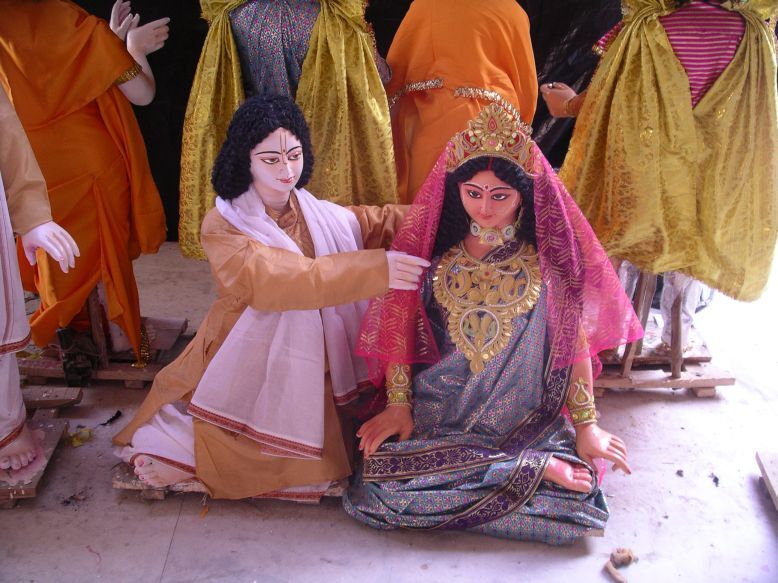
Buddhimanta Khan is remembered mostly for money he quietly spent: a wedding funded, medicine paid for, food carried to Puri. Only one scene breaks that pattern. In it he has a real part of his own to play in Mahaprabhu's household pastimes. It happened at the house of Chandrashekhara Acharya in Navadwip. Vrindavana Dasa Thakura later described that day at some length in Chaitanya-bhagavata.
A Sudden Decision To Perform Vraja-Lila #
By this point in His householder life, Sri Chaitanya Mahaprabhu had already begun showing His devotees glimpses of the ecstatic moods that would later define His Puri years. He danced, wept, and lost outward awareness during kirtana. On this particular day He decided to go further. He decided to stage scenes from Krishna's pastimes in Vraja, with His own devotees as the cast. He Himself would not play Krishna. He would take the roles of Krishna's own feminine energies, Durga, Lakshmi and others. This was not really the revival of a formal theatrical tradition. It was an ecstatic urge that Mahaprabhu wanted acted out immediately, that same day, at Chandrashekhara Acharya's home.
The Order Given By Name #
A production like that needed costumes and decorations at short notice, and Mahaprabhu did not leave the task to chance. Chaitanya-bhagavata records Him calling out directly: 'Buddhimanta Khan! Go quickly and arrange for costumes, for today I shall dance.' Bhakti-ratnakara, written generations later, repeats the same scene almost as a settled part of the tradition. It names Buddhimanta Khan and a devotee called Sadashiva as the two men entrusted with the job. Being singled out by name for a task like this, in front of the assembled devotees, was itself a mark of trust. Mahaprabhu was not asking a stranger to run an errand. He was asking a householder who, He already knew, would not hesitate.
Unlimited Joy Over An Errand #
The text does not stress how hard the task was. It stresses the feeling behind it. When Buddhimanta Khan and Sadashiva received the order, they are described as returning home full of a joy that the text calls unlimited. This was not the unwilling obedience of a servant given work. It was the eagerness of a devotee who had been handed a chance to serve. They put up an awning of bamboo and cloth at the house, and under it began dressing the devotees who would play the various roles. Buddhimanta Khan himself is recorded as personally dressing Mahaprabhu. He brought the costumes and decorations and placed them before the Lord, so that the performance could go forward exactly as He wished.
A Small Scene, Kept For Five Hundred Years #
Nothing about this episode is dramatic in the way a conversion story or a theological debate is dramatic. No one is arrested, no one argues scripture, no one is transformed. And that is exactly why it is valuable for understanding who Buddhimanta Khan was. Everything recorded about his relationship with Mahaprabhu is made of this same kind of readiness. He paid for what needed paying for and arranged what needed arranging. He always acted the moment he was asked, and, so far as the record shows, he never needed to be asked twice. Chaitanya-charitamrita's own summary of him is that he was ājanma ājñākārī, that is, a follower of the Lord's orders from birth. It would be hard to find a more exact example of those words than this single afternoon of costumes and decorations at Chandrashekhara Acharya's house.
