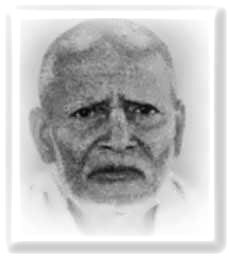
Krishna Dasa Babaji's Krishna consciousness began, by every account that survives, in college in East Bengal - a detail almost none of the sources expand on, leaving his family background, his given name before initiation, and even his exact birth year unrecorded. What is recorded is where that early attraction led him: into the Gaudiya Math, the preaching mission Srila Bhaktisiddhanta Sarasvati Thakura was building out of Sri Chaitanya Mahaprabhu's own sankirtana movement, and from there to diksha initiation at Bhaktisiddhanta Sarasvati Thakura's own hand.
A Service of Chanting Alone #
A Gaudiya Math temple of that period ran on many kinds of service - deity worship, cooking and temple maintenance, editing and printing the mission's journals, preaching tours, distributing books. Krishna Dasa Babaji took on none of it. His engagement, from the time he joined until the end of his life decades later, was chanting the Hare Krishna maha-mantra, whether alone on his beads or leading kirtana with mridanga and karatalas, for as many of his waking hours as he could manage. To some of his godbrothers, busy with the mission's many practical departments, this looked less like devotional service and more like a young man avoiding work. They brought the complaint to Bhaktisiddhanta Sarasvati Thakura directly.
The Guru's Reply #
Bhaktisiddhanta Sarasvati Thakura's answer, as later devotees recalled it, was to tell the complaining godbrothers that Krishna Dasa's chanting was entirely fine as it stood, and that instead of correcting him they should encourage him in it. According to one account - the memoir of Srila B.B. Govinda Maharaja, an ISKCON sannyasi who knew devotees from that generation - Bhaktisiddhanta Sarasvati Thakura went a step further and had a newspaper notice placed, inviting any sincere man willing to chant Krishna's name all day and night to come join the Gaudiya Math on that basis alone. A handful of men answered the notice, tried the life, and left within a short time; Krishna Dasa Babaji alone stayed with it. Bhaktisiddhanta Sarasvati Thakura then instructed his managers to see that the babaji was given every facility he needed. This account comes down through a single named source rather than a document from Bhaktisiddhanta Sarasvati Thakura's own hand, and is presented here as the devotional memory it is, not as verified institutional history - but it is the story every later account of Krishna Dasa Babaji's life repeats as the reason his singular, service-free devotion was never again questioned within the mission.
Wandering with the Holy Name #
With that question settled, Krishna Dasa Babaji spent the following decades essentially as a wandering chanter, moving between Sri Chaitanya Mahaprabhu's two great holy places, Mayapur and Vrindavana, as the seasons turned. One American disciple who knew him in the late 1960s recalled that he would spend four or five months at a stretch, through the hot season, at Srila Bhakti Vilas Tirtha Maharaja's Vrindavan Gaudiya Math, sleeping little, chanting through the night on the rooftop, and leading the temple's kirtana every morning from 4:30 before Deities of Lord Chaitanya, Sri Govinda and Srimati Radharani. Winters he passed in Navadvipa. Devotees who heard him remembered a man who wept openly while singing without ever losing his voice, and who, despite an old and increasingly frail body, could still play mridanga with real mastery whenever kirtana began. He was known to repeat often, in his own quiet way, the closing instruction of the Srimad-Bhagavatam itself - to chant Krishna's name and offer obeisances to the Lord - and before he sang he would first glorify the previous acharyas in the parampara.
The 1968 Govardhana Parikrama #
One particularly detailed account comes from Richard Shaw Brown, an American devotee who spent time at Vana Maharaja's ashram in the late 1960s and later wrote down his memories of Krishna Dasa Babaji for gaudiyahistory.iskcondesiretree.com. In 1968, travelling to Govardhana Hill on his own guru's order, Brown found himself accompanied by Krishna Dasa Babaji, who wanted to make the same trip. The two stopped for a week at Nandagrama, staying at Sanatana Gosvami's own bhajana-sthali - the same site where Krishna Dasa Babaji would spend his final year over a decade later - begging madhukari from local villagers and exploring the fields associated with Nanda Maharaja's home. From there they went on to Varshana, then walked the full circuit of Govardhana Hill barefoot, bathing first in Shyama-kunda and Radha-kunda, carrying their own bedding and chanting the whole way. Brown recalled a man who barely spoke through the entire journey - his replies to almost anything were a laughing "Hare Krishna!" - except once, when he broke his own silence to correct Brown's poor pronunciation of the holy name with a single instruction: "Ucharan koro," pronounce it properly.
A Glimpse of the Future #
One particular kirtana stood out in his own later retelling. On 17 September 1959, at the Kesavaji Gaudiya Math in Mathura, Krishna Dasa Babaji performed kirtana at the sannyasa initiation of a Gaudiya Math godbrother who would soon be known as A.C. Bhaktivedanta Swami - the sannyasa given to him that day by Srila Bhaktiprajnana Kesava Maharaja. During the ceremony, the newly sannyasa Bhaktivedanta Swami told Krishna Dasa Babaji to chant more. Krishna Dasa would later say that it was in that moment he first sensed this particular godbrother would go on to carry the holy name across the entire world - a recognition that, within two decades, would prove exactly right.