Almost nothing is recorded about Ishan Thakur's own life before he entered the household of Jagannatha Mishra and Sachi Devi in Nabadwip. No known source gives a birthplace, a father's name, or an approximate age for when his story begins. What survives instead is a handful of specific memories, often repeated, from the years he spent as a household servant in the home where Sri Chaitanya Mahaprabhu was born and raised. These memories are exact enough, and agree closely enough across the sources, to be worth reading carefully instead of being quickly summed up.
Holding the Newborn Lord #
When Sachi Devi gave birth to the child who would be called Nimai, sometime around 1486, Ishan Thakur was already settled in Jagannatha Mishra's house. The devotional history Bhakti-ratnakara records that he was given the privilege of taking the newborn onto his own lap and holding Him. The text treats this as a mark of unusual spiritual fortune, not an ordinary chore. It says plainly that only "an eternal associate of the Supreme Lord" could have the good fortune to offer personal service of that kind inside the Lord's own family home.
Every Childish Demand, Patiently Met #
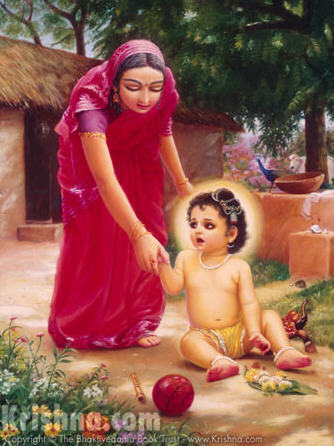
As Nimai grew from an infant into an unusually mischievous small boy, Ishan Thakur's role in the household only deepened. Bhakti-ratnakara records that the child would not go anywhere without him, and that Ishan Thakur met every one of Nimai's demands and pranks with patience. In its own words: how can one really understand the activities of Ishan Thakur, whom Nimai used to lovingly call "father"? In His childhood, Nimai was very naughty, and He would make all kinds of capricious demands that Ishan would do his best to fulfill. Later Vaishnava writers kept returning to this detail of the nickname. A servant, however beloved, does not ordinarily hear himself called a child's father. The text offers it without further comment, as though its strangeness were itself the point: an extraordinary child's own private way of returning an ordinary man's extraordinary devotion.
A Devotion the Household Itself Recognized #
None of this went unnoticed inside the family. Gaudiya tradition remembers Sachi Devi as Mother Yashoda in her own eternal identity. Sachi Devi is described as having shown Ishan Thakur special affection because he served her and her son so steadily. A verse from Bhakti-ratnakara, offered as a direct salutation to him, shows the household's own view of him better than any outside description could: obeisances with folded hands to Ishan Das, for Sachi Thakurani was very affectionate towards him. In another passage, an unnamed brahmana from outside the family marvels at the same thing. He calls Ishan Thakur's good fortune impossible to fully describe, even for someone who had witnessed it firsthand.
Nearly everything known of Ishan Thakur comes from Bhakti-ratnakara, so the book itself needs a few words of introduction. Narahari Chakravarti Thakura compiled it generations after these events. It is one of Gaudiya Vaishnavism's major devotional histories. It gathered up memories passed down by word of mouth and earlier written fragments about figures too minor, or too much a part of household life, for Krishnadasa Kaviraja Goswami's Sri Chaitanya-charitamrita or Vrindavana Dasa Thakura's Chaitanya-bhagavata to record at length. Ishan Thakur is exactly this kind of figure. Each of the two earlier texts, which carry more authority, gives him only a single verse or a single scene. He is preserved in any fuller form only because a later writer thought a servant's devotion was worth setting down.
What This Chapter Does Not Answer #
Nothing survives about Ishan Thakur's place in the household during the years when Nimai grew into a married scholar and began leading nightly kirtana nearby at Srivasa Thakura's house. That was a separate household in the same town, and this servant is not recorded as having belonged to it. The next clearly dated episode in his life comes only after Jagannatha Mishra's death. By then the household had narrowed to Sachi Devi alone, and Ishan Thakur now served in a home facing a very different kind of grief. That chapter is told in The Last Guardian of Nabadwip.
