Srila Pradyumna Mishra
The Brahmana Sri Chaitanya Mahaprabhu Sent to Learn Krishna-Katha from Ramananda Raya
The complete life, on one page: The main biography and every pastime page, in order, in one place
Introduction
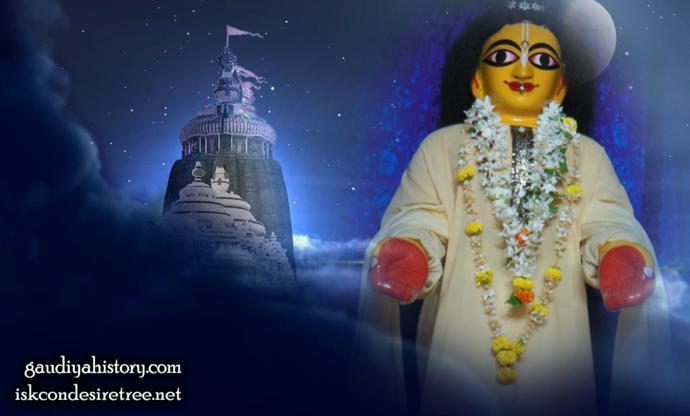
Srila Pradyumna Mishra was a brahmana householder living in Sri Chaitanya Mahaprabhu's circle at Jagannatha Puri. Today he is remembered mainly for one episode. Mahaprabhu personally sent him to Ramananda Raya to hear krishna-katha. What followed became one of the clearest statements in Sri Chaitanya-charitamrita of who is actually qualified to speak about Krishna. Krishnadasa Kaviraja Goswami named an entire chapter of the Antya-lila for him: "How Pradyumna Mishra Received Instructions from Ramananda Raya."
| Detail | Description |
|---|---|
| Home | Srihatta (Sylhet) by one tradition, Orissa by another (sources disagree) |
| Era | Jagannatha Puri, during Sri Chaitanya Mahaprabhu's Nilachala years |
| Title | Called "Dasa," a mark of respect among Orissan brahmanas rather than the low-caste title the same word carries in Bengal |
| Known for | Being sent by Mahaprabhu to hear krishna-katha from Ramananda Raya |
| Central source | Sri Chaitanya-charitamrita, Antya-lila, Chapter 5 |
| Standing among Puri devotees | Sixth in the list of associates Mahaprabhu was overjoyed to meet (Adi-lila 10.131) |
Chapter 1
Seeking Krishna-Katha from Ramananda Raya
Pradyumna Mishra's first visit to Ramananda Raya's home, and the unusual scene he found there.
Pradyumna Mishra came to Sri Chaitanya Mahaprabhu one day the way a sincere student comes to a teacher, offering respects, asking with great submission for exactly one thing. "I wish to hear topics concerning Lord Krishna constantly," he said. "Be merciful unto me and kindly tell me something about Krishna."
A Teacher Who Points Elsewhere #
Mahaprabhu's answer was not what a visitor might expect. He did not simply begin speaking. Instead He said, "I do not know about topics concerning Lord Krishna. I think that only Ramananda Raya knows, for I hear these topics from him." He praised Pradyumna Mishra's taste for krishna-katha as rare good fortune, then quoted a verse from Srimad-Bhagavatam: a person who performs his religious duties correctly but never develops attachment for Krishna, or a taste for hearing and chanting about Him, is simply laboring without result. Then He sent Pradyumna Mishra on his way, to the home of Ramananda Raya, who was then living at the Jagannatha-vallabha gardens near the temple.
This point is important. According to the tradition's own understanding, Mahaprabhu is Krishna Himself in the mood of His own devotee. Yet here He does not let the sincere seeker hear from Him directly. He sends him instead to a householder governor, whose social position, in ordinary terms, was well below that of a learned brahmana. This is the first hint of the lesson that the whole episode is meant to teach. That lesson is explained fully on The Lord's Teaching on Hearing about Krishna.
Waiting at Ramananda Raya's Home #
Pradyumna Mishra went straight to Ramananda Raya's house. There a servant seated him properly. When his master did not appear, the servant explained why. Two exceptionally beautiful and gifted young devadasis, dancing girls attached to the Jagannatha temple, were with Ramananda Raya in a secluded part of the garden. He was training them for a drama he had composed. He taught them the songs and the dance that would go with them. With his own hands he also prepared them for their performance before the Deity. He bathed them, massaged them with oil, and dressed and decorated them, exactly as the service required. Verse by verse, he also taught them how to show the continuous, natural and transitional symptoms of ecstatic love through the movements of their eyes and faces. In this way the emotion of his own compositions would show plainly to Lord Jagannatha when the drama was finally performed.
Chaitanya-charitamrita does not pass over this quickly. It describes the details carefully. It says plainly that while doing all this, Ramananda Raya's mind never changed in the slightest, "like a person touching wood or stone." Within, in his own eternal identity, he considered himself a maidservant of the gopis, and he considered the two girls he trained to be gopis themselves. Only outwardly did he appear to be a man doing something unusual and, on the surface, questionable. Krishnadasa Kaviraja calls the whole scene proof that "the greatness of the devotees of Sri Chaitanya Mahaprabhu is exceedingly difficult to understand," and he also tells how the day ended. Once the training was over, Ramananda Raya fed the two girls a full meal and sent them home, unseen by anyone else. Only then did Ramananda Raya turn his attention to his waiting guest.
An Apology, and a Bow #
Once the training was finished, Ramananda Raya learned that a guest had been waiting. He hurried to the assembly room and offered Pradyumna Mishra full respect. He apologized for the delay as though he himself were at fault: "Sir, you came here long ago, but no one informed me. Therefore I have certainly become an offender at your lotus feet. My entire home has been purified by your arrival." Pradyumna Mishra's answer was brief and formal: "I came simply to see you. Now I have purified myself by seeing Your Honor." Seeing that the day had grown late, Pradyumna Mishra said nothing further about krishna-katha. He took his leave and went home. He had still not heard the teaching he had come for.
In other words, he had watched something remarkable and left with real doubts about what he had seen. But he had not heard a single word of the talk about Krishna that he had actually come to hear. The next day he went back to Mahaprabhu. What he did then is where the central teaching of the episode appears. It is told on The Lord's Teaching on Hearing about Krishna.
Scriptural evidence for this chapter (1)
धर्मः स्वनुष्ठितः पुंसां विष्वक्सेनकथासु यः । नोत्पादयेद्यदि रतिं श्रम एव हि केवलम् ॥
dharmaḥ svanuṣṭhitaḥ puṁsāṁ
viṣvaksena-kathāsu yaḥ
notpādayed yadi ratiṁ
śrama eva hi kevalam
Word for word
dharmaḥ: occupation; svanuṣṭhitaḥ: executed in terms of one's own position; puṁsām: of humankind; viṣvaksena-kathāsu: in the message of the Personality of Godhead; yaḥ: what is; na utpādayet: does not produce; yadi ratim: if attraction; śramaḥ eva hi kevalam: is certainly only useless labor.
The occupational activities a man performs according to his own position are only so much useless labor if they do not provoke attraction for the message of the Personality of Godhead.
Sri Chaitanya Mahaprabhu quotes this verse to Pradyumna Mishra (Chaitanya-charitamrita, Antya-lila 5.10) just before sending him to Ramananda Raya, to explain why simply performing one's duties is not enough without a real taste for krishna-katha.
Chapter 2
The Lord's Teaching on Hearing about Krishna
What Sri Chaitanya Mahaprabhu told Pradyumna Mishra about Ramananda Raya, and what Ramananda Raya said in return.
The next day, when Pradyumna Mishra came again to Sri Chaitanya Mahaprabhu, the Lord asked directly: "Have you heard talks about Krishna from Sri Ramananda Raya?" Pradyumna Mishra described instead what he had seen, the devadasis, the bathing and dressing, all of it, without saying whether he had actually heard any krishna-katha at all. Mahaprabhu understood exactly what was troubling him, and what He said next is the heart of this whole episode.
Mahaprabhu Explains What Pradyumna Saw #
"I am a sannyasi," Mahaprabhu said, "and I certainly consider Myself renounced. But what to speak of seeing a woman, if I even hear the name of a woman, I feel changes in My mind and body. Therefore who could remain unmoved by the sight of a woman?" Having admitted this about Himself, He turned to defend Ramananda Raya in the strongest terms. Even while Ramananda Raya touched the young dancers, his mind never changed at all. Mahaprabhu said that this was proof that his body had been completely transformed into a spiritual entity, not a material one. He also said that "the authority for such acts is the prerogative of Ramananda Raya alone" and that no one else could dare to imitate it. Ramananda Raya alone, and no one else, could understand the true position of his own mind.
A Bhagavatam Verse on Hearing about Krishna #
Mahaprabhu did not simply state this. He supported it with the teaching of Srimad-Bhagavatam about rasa-lila, Krishna's dance with the gopis of Vraja. On the surface, these pastimes sound just as intimate as what Pradyumna Mishra had just watched. The verse He quoted says that a sober, transcendentally situated person who hears or describes these pastimes with genuine faith attains the highest devotional service. It also says that the lusty desires that are the disease of the material heart are quickly and completely destroyed (Srimad-Bhagavatam 10.33.39). When they are heard properly, from a realized soul, with faith, even Krishna's most confidential pastimes have a purifying effect, not a polluting one. But heard from anyone else, in any other spirit, the same words could do real harm. Ramananda Raya, Mahaprabhu said, was situated exactly on that level of spontaneous love. And so He simply added, "I also hear topics about Krishna from Ramananda Raya. If you want to hear such topics, go to him again." He told Pradyumna Mishra to use His own name as an introduction, and to go quickly, while Ramananda Raya was still in the assembly room.
Ramananda Raya's Full Discourse #
Pradyumna Mishra went straight back. This time Ramananda Raya, overjoyed to hear Mahaprabhu Himself had sent this guest, took him to a secluded place and asked what krishna-katha he wished to hear. Pradyumna Mishra, now speaking as a humble disciple rather than a curious visitor, asked for the same subjects Ramananda Raya had once discussed at Vidyanagara, the very conversations, in fact, that Ramananda Raya had shared with Mahaprabhu Himself during His South Indian tour. Ramananda Raya began speaking, posing questions and answering them himself, and the discourse continued without either man noticing the day pass, until a servant finally told them evening had come. Pradyumna Mishra returned home fully satisfied, "drowned," as he put it to Mahaprabhu that evening, "in a nectarean ocean of talks about Krishna."
Not the Speaker, but the Instrument #
One more detail from that meeting mattered enough for Pradyumna Mishra to repeat it word for word. Ramananda Raya had told him: "Do not consider me the speaker in these talks about Krishna. Whatever I speak is personally spoken by Lord Sri Chaitanya Mahaprabhu. Like a stringed instrument, I vibrate whatever He causes me to speak." Krishnadasa Kaviraja comments directly on this. He says it is not really possible to describe Ramananda Raya's talks in ordinary language, because "he is not an ordinary man" and his words are themselves absorbed in krishna-bhakti-rasa.
In his purport on this verse, Srila Prabhupada explains the wider principle behind it. A genuine spiritual master must never be regarded as an ordinary human being. When such a person speaks, the Supreme Personality of Godhead is understood to be speaking through him within the parampara system. Krishnadasa Kaviraja goes further still. He connects the whole episode to something Mahaprabhu did on purpose in His preaching. To break the false pride of renounced people and scholars, the Lord spreads real religious teaching even through someone the world would call lowborn. In his outer position, Ramananda Raya was a householder of the fourth social class. Yet he became the instructor, and both Sri Chaitanya Mahaprabhu Himself and a purified brahmana, Pradyumna Mishra, became his listeners.
Scriptural evidence for this chapter (2)
विक्रीडितं व्रजवधूभिरिदं च विष्णोः श्रद्धान्वितोऽनुशृणुयादथ वर्णयेद्यः । भक्तिं परां भगवति प्रतिलभ्य कामं हृद्रोगमाश्वपहिनोत्यचिरेण धीरः ॥
vikrīḍitaṁ vraja-vadhūbhir idaṁ ca viṣṇoḥ
śraddhānvito 'nuśṛṇuyād atha varṇayed yaḥ
bhaktiṁ parāṁ bhagavati pratilabhya kāmaṁ
hṛd-rogam āśv apahinoty acireṇa dhīraḥ
Word for word
vikrīḍitam: the sporting; vraja-vadhūbhiḥ: with the young women of Vrindavana; idam ca viṣṇoḥ: this, of Lord Vishnu; śraddhā-anvitaḥ: faithfully; anuśṛṇuyāt: hears; atha varṇayet yaḥ: or one who describes; bhaktim parām bhagavati pratilabhya: achieving supreme devotion unto the Lord; kāmam hṛd-rogam: lust, the disease of the heart; āśu apahinoti acireṇa dhīraḥ: a sober person quickly gives up without delay.
Anyone who faithfully hears or describes the Lord's playful affairs with the young gopis of Vrindavana will attain the Lord's pure devotional service. Thus he will quickly become sober and conquer lust, the disease of the heart.
From the purport: Purport excerpt: "The extraordinary power of Lord Krishna's conjugal pastimes is clearly revealed here. Qualitatively, the Lord's spiritual, loving pastimes are the diametric opposite of material, lusty affairs, so much so that simply by hearing about the Lord's pastimes a devotee conquers sex desire."
Sri Chaitanya Mahaprabhu quotes this exact verse to Pradyumna Mishra (Chaitanya-charitamrita, Antya-lila 5.48) to explain why Ramananda Raya's mind stays undisturbed while training the temple dancers.
রামানন্দ রায়-কথা কহিলে না হয় । ‘মনুষ্য’ নহে রায়, কৃষ্ণভক্তিরসময় ॥
rāmānanda rāya-kathā kahile nā haya
'manuṣya' nahe rāya, kṛṣṇa-bhakti-rasa-maya
Word for word
rāmānanda rāya-kathā: the speeches of Ramananda Raya; kahile nā haya: is not possible to describe; manuṣya nahe rāya: Raya is not an ordinary human being; kṛṣṇa-bhakti-rasa-maya: he is absorbed in the mellows of devotional service to Krishna.
"I cannot properly describe the discourses of Ramananda Raya, for he is not an ordinary human being. He is fully absorbed in the devotional service of the Lord."
From the purport: Purport excerpt: "One is forbidden to accept the guru, or spiritual master, as an ordinary human being... A spiritually advanced person who is authorized to act as the spiritual master speaks as the Supreme Personality of Godhead dictates from within."
Pradyumna Mishra's own verdict on Ramananda Raya after finally hearing him speak on Krishna; Srila Prabhupada's purport here states the general principle behind the whole episode.
Chapter 3
Legacy
What later tradition remembers about Pradyumna Mishra beyond his day with Ramananda Raya.
Apart from the Ramananda Raya episode, very little about Pradyumna Mishra has come down to us. We report it as it is and do not add anything to fill the gap. A few scattered verses show where he stood among Mahaprabhu's associates in Puri. One line in Gaura-ganoddesha-dipika gives his place in the tradition's larger picture of who was who. And Srila Prabhupada's own purports keep the central teaching of the story alive for readers today.
Chief Among the Vaishnavas of Puri #
When Sri Chaitanya Mahaprabhu returned to Nilachala from South India, Sarvabhauma Bhattacharya introduced the assembled devotees to Him one by one. Pradyumna Mishra was singled out with special praise: "chief of all the Vaishnavas," a great servitor of Lord Jagannatha, bearing the respectful title "Dasa" (Chaitanya-charitamrita, Madhya-lila 10.43). This title needs a short explanation. In Bengal, "Dasa" as a family name usually marks a shudra household. But in Orissa brahmana families used it too, as a mark of devotional humility, not caste. The confusion is understandable, but the sources are clear that Pradyumna Mishra remained a brahmana throughout. Chaitanya-bhagavata, for its part, remembers him in even warmer language. It calls him an ocean of love for Krishna, and it names him, together with Kashishvara Pandit and Bhagavan Acharya, as chief among the loving devotees of the Lord.
Sixth Among the Branches #
Earlier in the Adi-lila, Krishnadasa Kaviraja gives a roll call of the devotees of Jagannatha Puri whose company gave Mahaprabhu the greatest joy. Pradyumna Mishra is named sixth, right after Kashi Mishra and just before Bhavananda Raya, Ramananda Raya's own father (Adi-lila 10.131). He appears once more, briefly, in a later list of devotees who came together to see the Lord alongside Haridasa Thakura (Madhya-lila 25.229). Neither verse tells a story. Both simply confirm that his name appears again and again among Mahaprabhu's closest associates in Puri over the years, long before and long after the single day he spent hearing krishna-katha at the Jagannatha-vallabha gardens.
A Note in Gaura-Ganoddesha-Dipika #
Gaura-ganoddesha-dipika is the traditional text that connects devotees of Gaura-lila with their identities in Krishna-lila. It contains a verse naming a divine avirbhava, or full manifestation, in Nakula Brahmachari, paired with an avesha, a partial manifestation, in Pradyumna Mishra (verses 73-74). Some later writers have applied this same verse to a different associate with a similar name, Pradyumna Brahmachari. But the two are not the same person, and Gaudiya historians have taken care to clear up this confusion. Even when the verse is applied to the right person, it gives no further detail about Pradyumna Mishra's identity in Krishna-lila, and no other source adds more. So it is recorded here as the tradition states it, without additions or invented explanation.
No Recorded Disappearance #
Nothing in the sources shows when or where Pradyumna Mishra passed from this world. They also do not show who, if anyone, initiated him. No guru is named for him anywhere in the sources that have come down to us. The last long passage about him is in Chaitanya-charitamrita, Antya-lila, Chapter 5. For him, the story ends there, with his satisfaction at having finally heard krishna-katha from Ramananda Raya. After that, the tradition simply moves on to other events of Mahaprabhu's years in Puri.
Why This Story Still Matters #
More than any other detail, it is the teaching itself that lasts, and Srila Prabhupada kept bringing his readers back to it. His purport on the moment when Pradyumna Mishra realizes that Ramananda Raya "is not an ordinary man" states the principle clearly and firmly. One is forbidden to regard a genuine spiritual master as an ordinary human being. This is because such a person speaks as the Supreme Personality of Godhead directs from within. So what is heard from him is understood to come, through the parampara, from the Lord Himself. Sri Chaitanya Mahaprabhu built the entire episode to teach this same lesson. A Vaishnava's qualification to speak of Krishna has nothing to do with birth, caste, or social rank. It has everything to do with the purity of his devotion. Pradyumna Mishra's own part in the story was simply to ask, to wait, to doubt for a moment, and then to listen. This ordinary sincerity is exactly what allowed the lesson to take hold.
Scriptural evidence for this chapter (3)
সন্ন্যাসী পণ্ডিতগণের করিতে গর্বনাশ । নীচ-শূদ্র-দ্বারা করেন ধর্মের প্রকাশ ॥
sannyāsī paṇḍita-gaṇera karite garva nāśa
nīca-śūdra-dvārā karena dharmera prakāśa
Word for word
sannyāsī: persons in the renounced order; paṇḍita-gaṇera: of the learned scholars; karite garva nāśa: to vanquish the pride; nīca-śūdra-dvārā: through a lowborn, fourth-class man; karena dharmera prakāśa: He manifests real religious principles.
To vanquish the false pride of so-called renunciants and learned scholars, He spreads real religious principles, even through a shudra, or lowborn, fourth-class man.
From the purport: Purport excerpt: "When a man is greatly learned in the Vedanta-sutras, he is known as a pandita, or learned scholar. Generally this qualification is attributed to brahmanas and sannyasis."
Krishnadasa Kaviraja's own summary of why Mahaprabhu engineered the whole Pradyumna Mishra episode this way: to check the false pride that birth or renounced status can bring.
প্রদ্যুম্নমিশ্র ইঁহ বৈষ্ণব প্রধান ।
জগন্নাথের মহা-সোয়ার ইঁহ 'দাস' নাম ॥ ৪৩ ॥
pradyumna-miśra iṅha vaiṣṇava pradhāna
jagannāthera mahā-soyāra iṅha 'dāsa' nāma
Word for word
pradyumna-miśra: Pradyumna Mishra; iṅha: this person; vaiṣṇava pradhāna: chief of the Vaishnavas; jagannāthera: of Lord Jagannatha; mahā-soyāra: great servitor; iṅha 'dāsa' nāma: his name is Dasa.
"This is Pradyumna Mishra, who is chief of all Vaishnavas. He is a great servitor of Jagannatha, and his name is Dasa."
Sarvabhauma Bhattacharya's introduction of Pradyumna Mishra to Sri Chaitanya Mahaprabhu, on Mahaprabhu's return to Puri from South India.
কাশীমিশ্র, প্রদ্যুম্নমিশ্র, রায় ভবানন্দ ।
যাঁহার মিলনে প্রভু পাইলা আনন্দ ॥ ১৩১ ॥
kāśī-miśra, pradyumna-miśra, rāya bhavānanda
yāṅhāra milane prabhu pāilā ānanda
Word for word
kāśī-miśra: Kashi Mishra; pradyumna-miśra: Pradyumna Mishra; rāya bhavānanda: Bhavananda Raya; yāṅhāra milane: by meeting whom; prabhu pāilā ānanda: the Lord obtained happiness.
"In the list of devotees at Jagannatha Puri, Kashi Mishra was the fifth, Pradyumna Mishra the sixth and Bhavananda Raya the seventh. Lord Chaitanya took great pleasure in meeting them."
Krishnadasa Kaviraja Goswami's roll call of the Puri devotees whose company gave Mahaprabhu the greatest joy; Pradyumna Mishra is named sixth, between Kashi Mishra and Bhavananda Raya (Ramananda Raya's father).
Closing
At a Glance #
- A clearly learned brahmana who still went as a student to a Vaishnava of lower social birth, without protest.
- Named sixth among the devotees of Puri whose company gave Mahaprabhu the greatest pleasure.
- Sarvabhauma Bhattacharya called him "chief of all the Vaishnavas" and a great servitor of Lord Jagannatha.
- The whole episode survives because Pradyumna Mishra reported it back to Mahaprabhu in his own words, which Krishnadasa Kaviraja then recorded almost word for word.
A Brahmana Between Two Traditions #
Gaudiya sources disagree on a few small points, and one of them is where Pradyumna Mishra actually came from. The Gaudiya Vaishnava Abhidhana describes him as a resident of Srihatta, in what is now Sylhet, who later settled near Jagannatha Puri. Srila Bhaktisiddhanta Sarasvati Thakura, in his Anubhashya commentary on Chaitanya-charitamrita Adi-lila 10.131, states plainly that Pradyumna Mishra was an Orissan by birth. Vrindavana Dasa Thakura says the same in Chaitanya-bhagavata. Both traditions agree that he was a clearly learned and sincerely devoted brahmana. They differ only on his birthplace, and this difference is left open here, not settled in favor of one side.
His standing once he reached Puri is not disputed. Krishnadasa Kaviraja's famous image of the Chaitanya tree pictures Sri Chaitanya Mahaprabhu Himself as the tree, and Pradyumna Mishra is counted among its branches. He was one of the resident devotees whose company Mahaprabhu treasured, alongside such figures as Kashi Mishra and Bhavananda Raya. Chaitanya-bhagavata even describes him, in a single striking phrase, as a man whose body was "solidified prema": love of Krishna given physical form.
Among the Devotees of Jagannatha Puri #
When Mahaprabhu returned to Nilachala after His long tour of South India, Sarvabhauma Bhattacharya introduced Him to the assembled residents of Puri one by one, the way a host introduces old friends to a returning traveler. Of Pradyumna Mishra, Sarvabhauma Bhattacharya said simply that he was "chief of all the Vaishnavas" and a great servitor of Lord Jagannatha, carrying the name Dasa (Chaitanya-charitamrita, Madhya-lila 10.43). Among Orissan brahmana families this name was a mark of devotional humility. It was not the caste marker that the same name would suggest in Bengal. Some accounts describe his temple service as connected with Jagannatha's kitchen. It was one of the many quiet forms of service that filled the daily life of Puri's resident devotees.
Earlier still, in the list of Puri devotees given in Adi-lila 10.131, Pradyumna Mishra is named sixth. He comes directly after Kashi Mishra and just before Bhavananda Raya, Ramananda Raya's own father. This was honored company for a householder brahmana. It is also a sign of how central he already was to Mahaprabhu's Puri circle, years before the episode that made him famous. He appears again, briefly, in a later list of devotees who came to see the Lord together with Haridasa Thakura (Madhya-lila 25.229). It is a small detail, but it is one more sign that he was part of the ordinary, everyday life of Mahaprabhu's Nilachala years.
- Sri Chaitanya-charitamrita, Antya-lila, Chapter 5 (vedabase.io)
- Sri Chaitanya-charitamrita, Adi-lila 10.131 (vedabase.io)
- Sri Chaitanya-charitamrita, Madhya-lila 10.43 (vedabase.io)
- Pradyumna Mishra — Gaudiya History (ISKCON Desire Tree)
- Pradyumna Brahmachari — Gaudiya History (disambiguation note on Gaura-ganoddesha-dipika 73-74)
