Sri Rajendra Tirtha
Founder of the Matha Line That Became Vyasaraja Matha
The complete life, on one page: The main biography and every pastime page, in order, in one place
Introduction
Most Gaudiya Vaishnavas meet the name Sri Rajendra Tirtha only as one more link in a long list of Sanskrit titles in the guru-parampara. This part of the list is a chain of names between Sri Madhvacharya and Sri Madhavendra Puri. As Madhvacharya's own page already notes, this chain is not fully confirmed by the Madhva sampradaya's own separately kept succession records. Rajendra Tirtha's case is an unusually good example of this question. But it also involves a real, well-recorded event in Dvaita Vedanta history. He stands at the center of a genuine split among the Madhva mathas, and this split gave rise to the institution known today as Vyasaraja Matha.
| Detail | Description |
|---|---|
| Guru (independent Dvaita sources) | Vidyadhiraja Tirtha, seventh pontiff of the original Madhva matha at Udupi |
| Guru (Gaudiya parampara list) | Named as Vidyanidhi Tirtha, a name examined below |
| Matha founded | Rajendra Tirtha Matha, also called Poorvadi Matha, later renamed Vyasaraja Matha after his fourth successor, Vyasa Tirtha |
| Approximate dates | Born around Shaka 1254 (about 1332 CE); headed his own matha roughly 1402-1440 CE (B. N. K. Sharma) |
| Disciples | Jayadharma (Vijayadhvaja Tirtha) in the main succession; also Vishnudasacharya, a dialectician active in North India |
| Samadhi | Traditionally at Ergola, near Malkhed, Karnataka |
Scriptural evidence for the introduction (1)
From the purport: Purport excerpt: "After the sixteenth acharya (Vidyadhiraja Tirtha), there was another disciplic succession, including Rajendra Tirtha, 1254; Vijayadhvaja; Purushottama; Subrahmanya; and Vyasa Raya, 1470-1520."
The single clearest Gaudiya-side source naming Rajendra Tirtha directly and placing him at the head of the exact five-name chain this research wave is documenting, drawn from the South Kanada Manual and Bombay Gazette.
Chapter 1
Guru and the Division of the Madhva Mathas
A message that arrived too late split the original Udupi matha into two lines that both still exist today.
The best-recorded single fact about Rajendra Tirtha's life is also the most important one. The Madhva sampradaya's monastic succession had been unbroken for over a century after Madhvacharya. Rajendra Tirtha is the reason it split into two separate branches, and both branches continue to this day.
| Detail | Description |
|---|---|
| Guru | Vidyadhiraja Tirtha, seventh pontiff of the original Udupi matha, in descent from Madhvacharya through Jayatirtha |
| Rival successor | Kavindra Tirtha, ordained in Rajendra Tirtha's absence |
| Resulting branches | Uttaradi Matha (Kavindra Tirtha's line) and Rajendra Tirtha Matha, later Vyasaraja Matha (Rajendra Tirtha's own line) |
| Key source | B. N. K. Sharma, History of the Dvaita School of Vedanta (1961), page 452 |
An Absence at the Wrong Moment #
According to the account preserved by Dvaita-tradition historians, Vidyadhiraja Tirtha had already settled on Rajendra Tirtha, his senior and most trusted disciple, as his intended successor. When Vidyadhiraja fell gravely ill, he sent word for Rajendra Tirtha to return at once for a formal installation. Rajendra Tirtha was traveling and teaching elsewhere at the time, and the message reached him only after it was too late. With his own death near, Vidyadhiraja ordained the disciple who happened to be present instead, a monk named Kavindra Tirtha, simply so that the matha would not be left without a recognized head.
Two Lines From One Split #
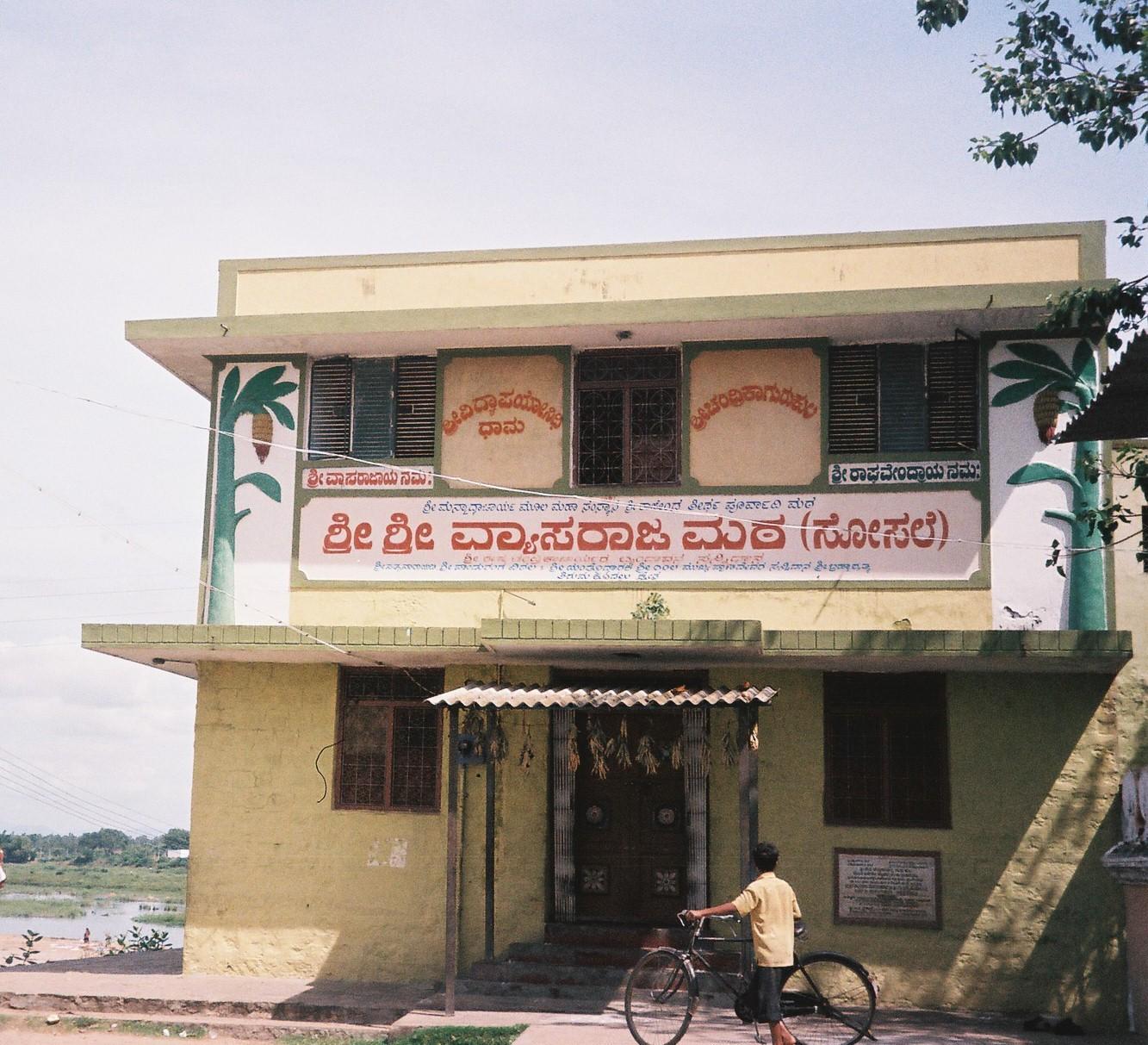
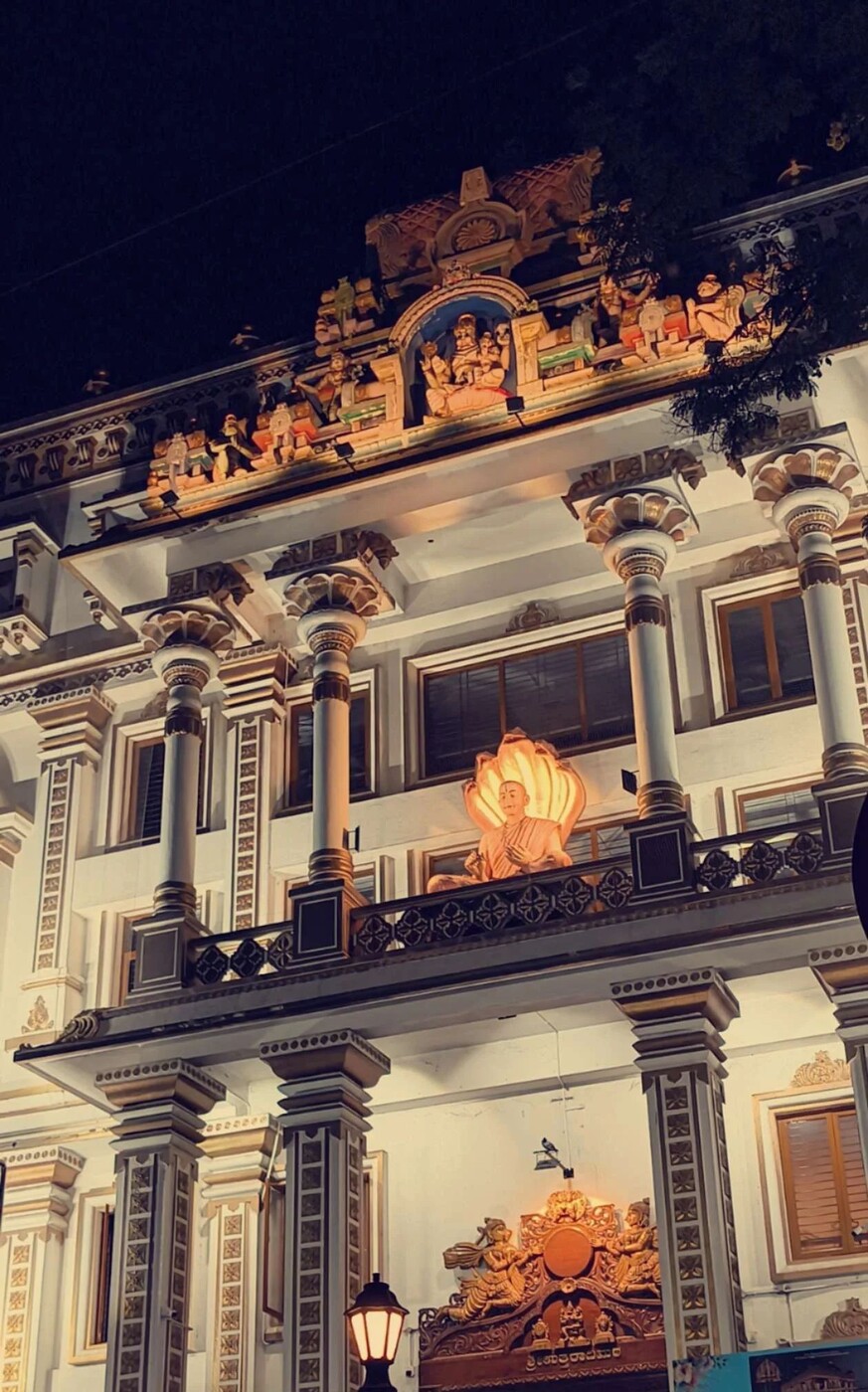
Kavindra Tirtha's branch of the succession became Uttaradi Matha. Today it is one of the three institutions still counted among the premier pontifical lines of Dvaita Vedanta. Raghavendra Matha is another. Rajendra Tirtha, for his part, did not simply accept being left out. He went on to found and head his own separate matha, at the time called the Rajendra Tirtha Matha, also known as Poorvadi Matha. That matha continued as an independent line of teachers. Generations later, it was renamed after its most celebrated later pontiff, Sri Vyasa Tirtha, the sixteenth-century royal guru. Today it is known as Vyasaraja Matha, and it is now centered at Sosale on the banks of the Kaveri river.
An Honest Question About the Reason #
Even the standard scholarly account of this event admits real uncertainty about why it happened the way it did. We report this honestly instead of smoothing it over. B. N. K. Sharma's History of the Dvaita School of Vedanta remains the standard academic reference for this period. He wrote plainly that "it is not possible to ascertain now what precisely was the reason for the second ordination," and he added that "the reason of the disciple's absence during the guru's illness given for the bifurcation is not convincing," pointing out that an interim arrangement could easily have been made instead. Such an arrangement was reportedly made during a later, similar split under a different teacher, Ramachandra Tirtha. Sharma's own best guess is that a single missed message was not the main cause. The real cause was more likely the practical, growing needs of an expanding tradition that had outgrown a single center. Whatever the exact cause, the result is not disputed. Two lines, both tracing back through Vidyadhiraja Tirtha to Madhvacharya himself, have continued side by side from that point onward. Each has given its own teachers and its own body of Dvaita scholarship down to the present day.
Where He Is Remembered #
Rajendra Tirtha received his own sannyasa ordination at a place called Hevilambi. Tradition places his samadhi, along with that of his guru Vidyadhiraja Tirtha, at Ergola, near the old town of Malkhed (Manyakheta) in present-day Karnataka. A site visit recorded by B. N. K. Sharma in 1975 found Ergola itself largely in ruins, and the exact tombs could no longer be clearly identified. This is a small reminder that, even for a well-recorded Dvaita-tradition figure, much of the physical trace has simply not survived the centuries between his life and ours.
Chapter 2
Vidyanidhi or Vidyadhiraja
The Gaudiya parampara list and the Madhva sampradaya's own records may not be naming the same man as Rajendra Tirtha's guru.
On one detail, sources from two traditions do not agree: the name of Rajendra Tirtha's guru. We report this plainly here, instead of quietly choosing one side.
| Detail | Description |
|---|---|
| Gaudiya parampara list's claim | Rajendra Tirtha's guru was Vidyanidhi Tirtha |
| Independent Dvaita-tradition sources | Rajendra Tirtha's guru was Vidyadhiraja Tirtha, seventh pontiff of the Udupi matha |
| Gaudiya-tradition harmonization | gaudiyahistory.iskcondesiretree.com treats "Vidyanidhi" and "Vidyadhiraja" as two names for one person |
| A complication | Srila Prabhupada's own purport to CC Madhya 9.245 separately lists a "Vidyanidhi" four generations later, in a different branch |
Two Names, One Purport #
The traditional Gaudiya guru-parampara list names Rajendra Tirtha's guru as Vidyanidhi Tirtha. As Madhvacharya's own page notes, this list is not fully confirmed by the succession records that the Madhva sampradaya has kept independently. Every independently documented Dvaita-tradition source available names his guru as Vidyadhiraja Tirtha, the seventh head of the original Udupi matha. Vidyadhiraja Tirtha's serious illness, and the missed handover to Rajendra Tirtha that resulted from it, are described on Guru and the Division of the Madhva Mathas.
gaudiyahistory.iskcondesiretree.com is a research site written from inside the Gaudiya tradition. It explains the apparent mismatch by treating the two names as belonging to the same person. At one point it says, "Shripad Rajendra Tirtha was Vidyanidhi's (Vidyadhiraj's) first disciple." Read in this way, there is no real conflict at all. There are simply two names in use for one teacher. This is common enough among sannyasis, who are given a new name at initiation but may still be known elsewhere by an earlier title. Two Gaudiya-tradition compilations also support this same identification independently, and so does B. N. K. Sharma's own academic history. This is explained in full on Vidyanidhi's own page.
A Complication From Prabhupada's Own Purport #
This question needs its own page, not just a short footnote, because of Srila Prabhupada's own purport to Chaitanya-charitamrita, Madhya 9.245. That purport cites the South Kanada Manual and the Bombay Gazette. At first it appears to go against the explanation above instead of supporting it. The purport gives a long, numbered list of Madhva-sampradaya teachers by birth year. Vidyadhiraja Tirtha appears there as the sixteenth name, born in Shaka era 1190 (about 1268 CE). After the disciplic line splits into Kavindra Tirtha's branch, the purport separately lists a name "Vidyanidhi" as the twentieth figure in that branch. Three other teachers come between Vidyadhiraja and him, and he comes roughly a century later. He was born in Shaka era 1298 (about 1376 CE).
If we take this list at face value, Vidyanidhi would be a different and later man. He would not be Vidyadhiraja under another name, but a teacher four generations after him. He would stand in the rival Uttaradi line, not in Rajendra Tirtha's own line. He would also have been born some four decades after Rajendra Tirtha's traditional birth year. So, going by the dates, it would be hard for this later Vidyanidhi to have been Rajendra Tirtha's guru at all.
A Second Vidyanidhi Emerges #
Sri Uttaradi Matha's own official succession records are reported in full on Vidyanidhi's own page. A closer look at them turns up a real, separately documented pontiff also named "Vidyanidhi Tirtha". He was the matha's eleventh pontiff, installed roughly a century after Vidyadhiraja Tirtha, in a completely different generation. His place in the matha's own numbered list (7th Vidyadhiraja, 8th Kavindra, 9th Vagisha, 10th Ramachandra, 11th Vidyanidhi) matches the purport's own "(16) Vidyadhiraja... (20) Vidyanidhi" sequence above, name for name and in the same order. From this match we draw an inference, not a settled fact. The purport's "later Vidyanidhi" most likely refers to that real, documented eleventh pontiff. If that reading holds, he is not a rival candidate for Rajendra Tirtha's own guru. This would remove this particular problem from the identification reported here. But on its own, it does not make that identification certain. The fuller comparison is on A Second Vidyanidhi in the Uttaradi Line.
Left Open, Honestly #
We can say this much plainly. The specific guru-disciple link that the Gaudiya list claims for Rajendra Tirtha is well supported. It is supported by a direct explanation from within the Gaudiya tradition that treats the two names as one person, and also by an independent academic reading in B. N. K. Sharma's history. The one real problem that the purport raised also has a reasonable, though not certain, answer once the Uttaradi Matha's own eleventh pontiff is taken into account. It is also possible that two different historical figures really did carry similar-sounding titles. The Gaudiya parampara verses were composed generations after Rajendra Tirtha's own lifetime. So it is possible, too, that they picked up a name that later needed this kind of careful sorting out. Succession lists compiled centuries after the events do not always agree with themselves. This is not the only place in the guru-parampara where that has been found to be true.
A Third Angle, Cross-Referenced #
There is also research on the next three names in the Gaudiya guru-parampara list: Jnanasindhu, Dayanidhi, and Vidyanidhi. It comes to this same name from the opposite direction, working forward from Jayatirtha instead of backward from Rajendra Tirtha. That research finds two independent Gaudiya-tradition sources. Both directly identify the "Vidyanidhi" who comes just before Rajendra Tirtha in the list as Vidyadhiraja Tirtha. This gives real, independent support to the reading here, that the two names belong to one person. The complication from Prabhupada's purport is still resolved in the way described above. The fuller discussion is on Vidyanidhi's own page. It includes how that identification compares with the documented Pitha succession.
Scriptural evidence for this chapter (1)
From the purport: Purport excerpt: "(16) Vidyadhiraja, 1190; (17) Kavindra, 1255; (18) Vagisha, 1261; (19) Ramacandra, 1269; (20) Vidyanidhi, 1298."
The same purport's numbered succession list places Vidyadhiraja Tirtha (16th) and a separate name, Vidyanidhi (20th), four generations and roughly a century apart, in what appears to be the rival Kavindra Tirtha branch rather than Rajendra Tirtha's own, the source of the central honest uncertainty here about who Rajendra Tirtha's guru actually was.
Chapter 3
Disciples and the Line to Vyasa Tirtha
From a teacher in Karnataka to a master of debate in North India, and forward through four generations to one of Dvaita Vedanta's most famous names.
Little survives about Rajendra Tirtha's own teaching or personal character. But the record is unusually clear about who came after him. This is true both for his own main line of successors and for the disciples who carried his name far beyond Karnataka.
| Detail | Description |
|---|---|
| Main successor (Gaudiya-tradition sources) | Jayadharma, also called Vijayadhvaja Tirtha |
| Alternate genealogy (Mutt tables) | Some tables instead place Vijayadhvaja Tirtha in the Pejawara Matha, descending from Akshobhya Tirtha |
| Disciple in North India | Vishnudasacharya (c. 1390-1440), author of Vadaratnavali and other dialectical works |
| Fourth successor | Sri Vyasa Tirtha, whose fame later gave the whole matha line its present name |
Jayadharma, or a Different Line #
Both the Gaudiya parampara list and gaudiyahistory.iskcondesiretree.com's own research name Jayadharma, also known as Vijayadhvaja Tirtha, as Rajendra Tirtha's disciple and immediate successor in this line. Srila Prabhupada's own purport to Chaitanya-charitamrita, Madhya 9.245, records the same sequence directly from the South Kanada Manual. The purport gives it as "Rajendra Tirtha... Vijayadhvaja; Purushottama; Subrahmanya; and Vyasa Raya," naming the whole chain in one place. Little is documented about these six names, and this is a rare case of a Gaudiya source listing the chain in full.
But in fairness, not every source agrees. Some lineage tables of the Madhva mathas instead list Vijayadhvaja Tirtha as belonging to the Pejawara Matha. This was one of the eight original mathas founded directly by Madhvacharya at Udupi. In these tables Vijayadhvaja Tirtha descends from a disciple named Akshobhya Tirtha, not from Rajendra Tirtha's own line. This separate difference belongs more properly on Jayadharma's own page. We mention it here too, because it means that even Rajendra Tirtha's most basic claim, a named successor, is not completely free of dispute in the wider record.
A Student Who Went North #
Apart from the main succession, Dvaita-tradition sources credit Rajendra Tirtha with training at least one disciple, Vishnudasacharya. He is said to have taken Madhva teaching into North India nearly a century before Vyasa Tirtha's own much greater fame there. Vishnudasacharya is remembered for a handful of Sanskrit works of philosophical debate: Vadaratnavali, Khandana-Khandana and Vivarana Vidambana. These works reportedly made a real impression on the scholars of that time. He should not be confused with a different, later Vishnu Puri, who was a disciple of Jayadharma himself. This Vishnu Puri compiled a well-known collection of verses from Srimad-Bhagavatam called Bhakti-ratnavali. According to Vaishnava tradition, he presented it in his old age to Sri Chaitanya Mahaprabhu. Because their names are similar, the two are easy to mix up, and it is important to keep them apart.
Four Generations to Vyasa Tirtha #
The matha that Rajendra Tirtha founded continued as an independent line for roughly four generations of teachers. Then its most famous pontiff took the seat. This was Sri Vyasa Tirtha, also called Vyasaraya or Vyasaraja, the sixteenth-century royal guru at the court of the Vijayanagara Empire. The matha was later named after him, and it still carries that name today, Vyasaraja Matha. Much about Rajendra Tirtha's own life remains uncertain. But this much is not in doubt. The matha he built after a missed handover in the fourteenth century is still standing, on the banks of the Kaveri river at Sosale, more than six hundred years later.
Closing
A Passed-Over Successor #
According to Dvaita-tradition sources, Rajendra Tirtha was a senior and clearly much-loved disciple of Vidyadhiraja Tirtha. Vidyadhiraja was the seventh head of the original Madhva matha founded at Udupi by Madhvacharya himself. The matha had come down to Vidyadhiraja over several generations from Madhvacharya's own direct disciple Jayatirtha. When Vidyadhiraja fell seriously ill, he sent for Rajendra Tirtha to return and be formally installed as his successor. But Rajendra Tirtha was away, by most accounts on a teaching tour, and did not get the message in time. With his own death near, Vidyadhiraja instead ordained the disciple who happened to be present, a monk named Kavindra Tirtha. He did this simply to make sure the matha would have a successor at all.
That single accident of timing split the Madhva mathas in two. Kavindra Tirtha's branch became what is known today as Uttaradi Matha, one of the three main lines of matha heads that still continue in the Madhva sampradaya. Rajendra Tirtha, for his part, went on to found and head his own separate matha. At the time it was called the Rajendra Tirtha Matha, or Poorvadi Matha. It continued as an independent line. Generations later, it was renamed after its most celebrated head, Sri Vyasa Tirtha, the sixteenth-century royal guru at the Vijayanagara court. B. N. K. Sharma's own scholarly judgment, quoted at length by gaudiyahistory.iskcondesiretree.com, says openly that the traditional explanation for the split is weak. He calls the excuse of Rajendra Tirtha's absence "not convincing," and suggests the more likely cause was simply that the tradition was growing and needed more than one center in different regions.
Place in the Gaudiya Parampara List #
The traditional Gaudiya guru-parampara is the list handed down by Srila Bhaktisiddhanta Sarasvati Thakura. It is examined at length on Dvaita Vedanta and Achintya-Bhedabheda, one of the Madhvacharya pages. In this list, Rajendra Tirtha has a single, specific place. He is the disciple of Vidyanidhi Tirtha and the guru of Jayadharma, several names before the chain reaches Sri Madhavendra Puri. Madhavendra Puri was the acharya who first brought conjugal devotion into the Madhva tradition, which until his time had been more bound to ritual. Madhavendra Puri's page Life in the Madhva Sampradaya already explains why serious historians carefully check the Madhva sampradaya's own records for this specific chain of names. Rajendra Tirtha's case gives a clear, individual example of why this caution is needed. He was a real historical figure, at the center of a real and well-recorded split between mathas. But we cannot be fully sure that his own guru within that split matches the Gaudiya list's claim. Still, the balance of evidence, weighed carefully on Vidyanidhi's own page, leans toward that claim being correct.
