Table of Contents
- 1. Lord Jagannath’s Journey
- 2. Source-Confidence Note
- 3. Why the Origin Story Still Captivates Devotees
- 4. King Indradyumna’s Longing: A Palace Could Not Satisfy His Heart
- 5. The Hidden Lord: Nilamadhava in the Forest
- 6. Vidyapati Begins the Search
- 7. Vishwavasu’s Dilemma: Should the Hidden Lord Be Revealed?
- 8. The Mustard Seeds on the Path
- 9. Vidyapati’s Darshan of Nilamadhava
- 10. When King Indradyumna Arrived, Nilamadhava Had Disappeared
- 11. The Lord’s Promise: “You Will See Me”
- 12. The Sacred Wood: Daru Brahma Appears
- 13. Vishwakarma, the Divine Carpenter, and the Closed Door
- 14. The Appearance of Jagannath, Balabhadra & Subhadra
- 15. Why Lord Jagannath’s Form Looks Different
- 16. What Is Daru Brahma?
- 17. The People in the Story
- 18. The Spiritual Meaning of the Whole Story
- 19. How This Story Connects to Rath Yatra
- 20. Lessons from the Story for Devotees Today
- 21. Frequently Asked Questions
- 22. Conclusion: The Hidden Lord Who Came Out for Everyone
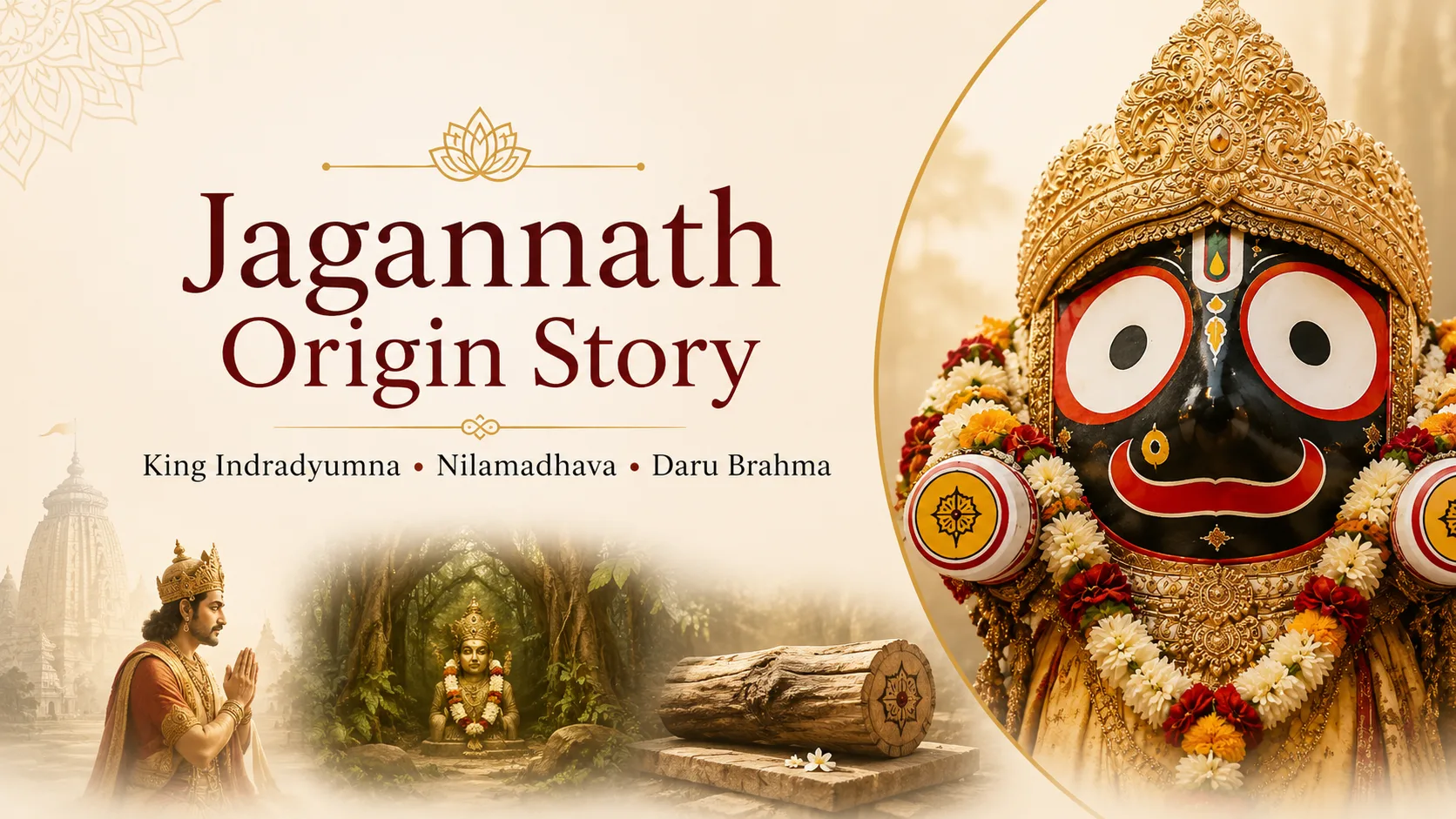
The origin story of Lord Jagannath tells how King Indradyumna longed to see the Supreme Lord, how Vidyapati discovered the hidden deity Nilamadhava worshiped by the Sabara chief Vishwavasu, and how the Lord later appeared in Puri as Jagannath, Balabhadra and Subhadra through sacred wood known as Daru Brahma. In the devotional tradition, this story shows that Lord Jagannath belongs to everyone: kings, priests, forest devotees, simple-hearted seekers, and all souls who approach Him with love.
Lord Jagannath’s Journey
Follow the path the way Vidyapati marked it — one seed at a time.
- 1
King Indradyumna desired to see and worship the Supreme Lord face to face.
- 2
He heard about a hidden deity named Nilamadhava, worshiped in a forest by Vishwavasu.
- 3
The king sent Vidyapati to search for Nilamadhava.
- 4
Vidyapati reached Vishwavasu’s home, married Lalita, and was eventually taken to the secret place of worship.
- 5
Vidyapati dropped mustard seeds along the path so he could later find the place again.
- 6
When King Indradyumna came, Nilamadhava had disappeared, and the king was heartbroken.
- 7
The Lord later appeared through sacred wood as Jagannath, Balabhadra, Subhadra and Sudarshana in Puri.
Source-Confidence Note
The origin story of Lord Jagannath is preserved through scripture, temple tradition, Odisha cultural memory, devotional narration, and later literary retellings. The most common story includes King Indradyumna, Nilamadhava, Vishwavasu, Vidyapati, Lalita, the mustard-seed path, and the appearance of Jagannath through sacred wood. Different versions may vary in small details — such as the exact role of Narada, Vishwakarma, Ananta Maharana, or the sacred log — but the devotional message remains the same: Lord Jagannath reveals Himself to sincere devotion and chooses to become accessible to everyone.
Odisha Review records the tradition that Jagannath was originally worshiped as Neela Madhab by the Savar chief Vishwavasu; that Nilamadhava appeared in a dream to King Indradyumna; that the king sent Vidyapati to find the deity; and that Vidyapati used mustard seeds to mark the way to the hidden place.
Why the Origin Story Still Captivates Devotees
Some stories are read once and forgotten. The story of Lord Jagannath is not like that. It begins with a king, but it does not glorify power. It enters a forest, but it does not treat the forest as ordinary. It speaks of a hidden deity, but the hidden deity does not remain hidden forever. It introduces a seeker named Vidyapati, a simple-hearted tribal devotee named Vishwavasu, and a woman named Lalita whose role quietly connects two worlds.
This is why the Jagannath story is so powerful. It is not only the origin story of a temple. It is the story of how the Lord comes from secrecy to public mercy. He is worshiped first in the intimate love of a forest devotee, then desired by a king, then revealed to the world in Puri, and finally carried outside the temple during Rath Yatra so that everyone can see Him.
In this one story, we can see the heart of Lord Jagannath: He accepts private worship, royal worship, tribal devotion, scriptural tradition, temple service, kirtan, prasadam, and the simple prayers of ordinary people. He is the Lord of the Universe, but He is also the Lord who lets Himself be searched for, missed, cried for, carved, dressed, fed, and loved.
Start here: the complete guide to Lord Jagannath’s meaning, form, devotees, Rath Yatra & spiritual significance →King Indradyumna’s Longing: A Palace Could Not Satisfy His Heart
The story begins with King Indradyumna, a great and pious king. He had the wealth of a kingdom, the respect of his people, and the power to command armies and servants. But the heart is not satisfied by outer success alone. A person may rule lands and still feel poor if he has not found the Lord.
King Indradyumna’s heart was restless for one reason: he wanted to see the Supreme Lord. Not in imagination. Not as a distant idea. He wanted direct darshan. He wanted to serve the Lord with his own hands, bow before Him with his own body, and offer his kingdom at the Lord’s feet.
This longing is the real beginning of the Jagannath story. The story does not begin with wood. It does not begin with a temple. It begins with longing. The Lord appeared because a devotee was searching with intensity.
One day, the king heard about a mysterious deity named Nilamadhava. The name itself was enchanting. Nila means blue or dark-hued, and Madhava is a beautiful name of Lord Vishnu or Krishna. The deity was not in a royal temple. He was not in a place known to the crowds. He was hidden in a forest, worshiped secretly by a devotee named Vishwavasu.
When the king heard this, his heart became fixed. If Nilamadhava was truly the Lord, he had to find Him. The royal palace no longer mattered. The journey had begun.
The Hidden Lord: Nilamadhava in the Forest
Nilamadhava was not worshiped with public ceremony. He was worshiped in secrecy. According to the traditional account, Vishwavasu, the Sabara chief, served the Lord in a forested region near the Blue Mountain, Nilachala. His worship was simple, intimate, and full of feeling.
This detail is very important. Lord Jagannath’s story honors a devotee who was not a king, not a royal priest, not a famous scholar, and not a public leader. Vishwavasu’s qualification was love. He knew where Nilamadhava was, but he did not treat that knowledge like information to be displayed. He treated it like a treasure.
Every day, Vishwavasu would go to worship the Lord. To outsiders, he might have looked like a forest dweller going into the woods. But inwardly, he was going to meet the Lord of his life.
The hidden worship of Nilamadhava teaches a beautiful lesson: the Lord is not discovered by curiosity alone. He is revealed through devotion. There are sacred things that cannot be understood by dry information. They must be approached with humility.
Vidyapati Begins the Search
King Indradyumna needed someone trustworthy to search for Nilamadhava. He sent Vidyapati, a learned and sincere brahmana. Vidyapati’s journey was not easy. He entered unfamiliar lands, asked questions, followed hints, and tried to understand where the Lord could be hidden.
A less patient seeker would have returned quickly. Vidyapati did not. The Lord’s path often tests sincerity. When something is truly sacred, it is not obtained cheaply. Vidyapati’s search required intelligence, patience, humility, and divine arrangement.
At last, Vidyapati came to the home of Vishwavasu. There he met Lalita, the daughter of Vishwavasu. In many retellings, Vidyapati married Lalita. Through this relationship, he became connected to Vishwavasu’s household and gradually came closer to the secret he was seeking.
This part of the story is gentle but meaningful. The Lord did not reveal Himself through force. Vidyapati did not conquer the forest. He entered through relationship, patience, and respect. The path to Jagannath is not a path of pride; it is a path of humility.
Vishwavasu’s Dilemma: Should the Hidden Lord Be Revealed?
Vishwavasu loved Nilamadhava deeply. To him, the Lord was not a public treasure. He was the protector of his tribe, the secret heart of his life, and the center of his worship. When Vidyapati expressed his desire to see the deity, Vishwavasu faced a painful dilemma.
If he revealed the Lord’s location, the intimate secret worship might be exposed. If he refused, he might disappoint a sincere guest and seeker. Devotional stories often show that great devotees are not mechanical. They feel deeply. Vishwavasu was not hiding the Lord out of selfishness; he was protecting what he loved.
Finally, after repeated requests, Vishwavasu agreed to take Vidyapati to the place where Nilamadhava was worshiped. But there was one condition: Vidyapati would be blindfolded. This condition protected the sacred location. It also gave the story one of its most memorable moments.
The Mustard Seeds on the Path
As Vishwavasu led Vidyapati through the forest, Vidyapati could not see the way. But he was intelligent. He carried mustard seeds and quietly dropped them along the path. Later, when the seeds sprouted, they would mark the route to the hidden place.
This moment is simple, almost small, but it has made the story unforgettable. The mustard seeds represent spiritual intelligence. Vidyapati did not break the trust openly, nor did he abandon the king’s mission. He used wisdom to preserve the path.
In devotional symbolism, those mustard seeds can also represent remembrance. When the path to the Lord seems hidden, even small seeds of devotion can later grow into a visible route. A little chanting, a little hearing, a little service, a little faith — all of these may seem small at first. But when watered by time and sincerity, they show the way back to the Lord.
At last, Vidyapati reached the hidden place of Nilamadhava. When the blindfold was removed, he saw the Lord. The search had become darshan.
Vidyapati’s Darshan of Nilamadhava
Imagine Vidyapati’s heart in that moment. He had travelled far. He had followed uncertain paths. He had waited, served, listened, and hoped. Now, before him, stood Nilamadhava.
The Lord was not an idea anymore. He was present. The forest was no longer merely a forest; it was a temple. The silence was no longer empty; it was full of divine presence. Vidyapati had found what the king longed for.
After receiving darshan, Vidyapati returned and informed King Indradyumna. The news was like life entering the king’s heart. The Lord existed. The Lord could be found. The king immediately prepared to go to Odisha and worship Nilamadhava. But the Lord’s plan was deeper than the king’s plan.
When King Indradyumna Arrived, Nilamadhava Had Disappeared
King Indradyumna came with great eagerness. He followed the route revealed through Vidyapati’s report and the sprouting mustard seeds. Every step must have increased his hope: soon he would see the Lord; soon his longing would be fulfilled. But when he reached the place, Nilamadhava was gone.
This is one of the most emotional moments in the story. The king had given his heart to a darshan he had not yet received. He had travelled with faith. He had believed the report. And now, the very Lord he had come to see had disappeared. Why would the Lord do this?
In devotional life, the Lord sometimes hides to deepen longing. He is not cruel; He is drawing out love. If King Indradyumna had seen Nilamadhava immediately, perhaps the story would have ended there. But Lord Jagannath did not want to remain hidden in the forest. He wanted to appear in a form that would bless the whole world.
The disappearance of Nilamadhava was not the end. It was the turning point. The king was devastated. Some accounts describe his resolve to fast and give up everything until the Lord revealed Himself. His longing became more intense. His devotion became prayer. His disappointment became surrender.
The Lord’s Promise: “You Will See Me”
When a devotee’s longing becomes pure, the Lord responds. According to the traditional narration, the king received divine assurance that he would see the Lord, but not in the same hidden form. The Lord would appear again in a new way. This is the heart of the origin story: Nilamadhava disappears, but Jagannath appears.
The Lord was teaching that His mercy was not limited to one cave, one forest, one devotee, or one community. He would appear in Puri in a form that brought together many streams of devotion: the forest worship of Vishwavasu, the royal longing of Indradyumna, the priestly search of Vidyapati, the sacred geography of Purushottama Kshetra, and the Lord’s own desire to bless the world.
The king was instructed to perform sacrifice and prepare for the Lord’s manifestation. In some versions, Narada guides him. In others, divine voices, dreams, or the Lord Himself direct the next steps. The details differ, but the message is consistent: the Lord had a plan beyond human imagination.
The Sacred Wood: Daru Brahma Appears
The next great sign was the appearance of sacred wood, known as Daru. Daru means wood, and Brahma refers to the Supreme spiritual reality. Daru Brahma means the Lord manifesting through sacred wood.
In the Jagannath tradition, this is not ordinary wood. It is the Lord’s chosen medium. The Lord who is beyond matter chooses to appear through matter, and by His presence that matter becomes spiritual. This is the mystery of deity worship: the Supreme Lord, who is unlimited, mercifully becomes accessible to limited human senses.
Odisha Review explains that the Lords are called Darubrahma, meaning Daru, or wood, containing Brahma, the Paramatma or Supreme Soul. It also connects the wooden bodies of the deities with the Nabakalebara tradition, in which the deities accept new wooden forms at special intervals.
The story of Daru Brahma also answers a common question: why is Lord Jagannath made of wood? The answer is not merely cultural. It is theological. The Lord chose to appear in wood to show that He is independent and merciful. He can appear in stone, metal, sound, scripture, the heart, or sacred wood. He is not limited by the material He chooses to spiritualize.
Vishwakarma, the Divine Carpenter, and the Closed Door
In many beloved retellings, the king needed someone to carve the sacred wood into the forms of the Lord. A mysterious carpenter appeared. Some traditions identify him as Vishwakarma, the divine architect, or as the Lord’s own arrangement in the form of a carpenter.
The carpenter agreed to carve the deities under one condition: no one should open the door until the work was complete. The king agreed. The work began behind closed doors. Days passed. The sound of carving continued. Then, at one point, the sound stopped. The queen or the king became anxious. Was the carpenter alive? Had something gone wrong? Unable to bear the silence, the door was opened before the agreed time.
Inside, the forms of Jagannath, Balabhadra and Subhadra were present, but they appeared unfinished: large eyes, broad faces, and no fully formed hands or legs in the usual human sense. The king was troubled. Had he made a mistake? Had impatience ruined the Lord’s form?
But the Lord’s form was not a mistake. It was mercy. The form of Jagannath is not incomplete. It is complete in a way that material eyes cannot immediately understand. The Lord chose that form. His large eyes show compassion. His simple body invites everyone. His unusual form breaks pride. He does not look like a king’s private deity. He looks like the Lord of everyone.
The Appearance of Jagannath, Balabhadra & Subhadra
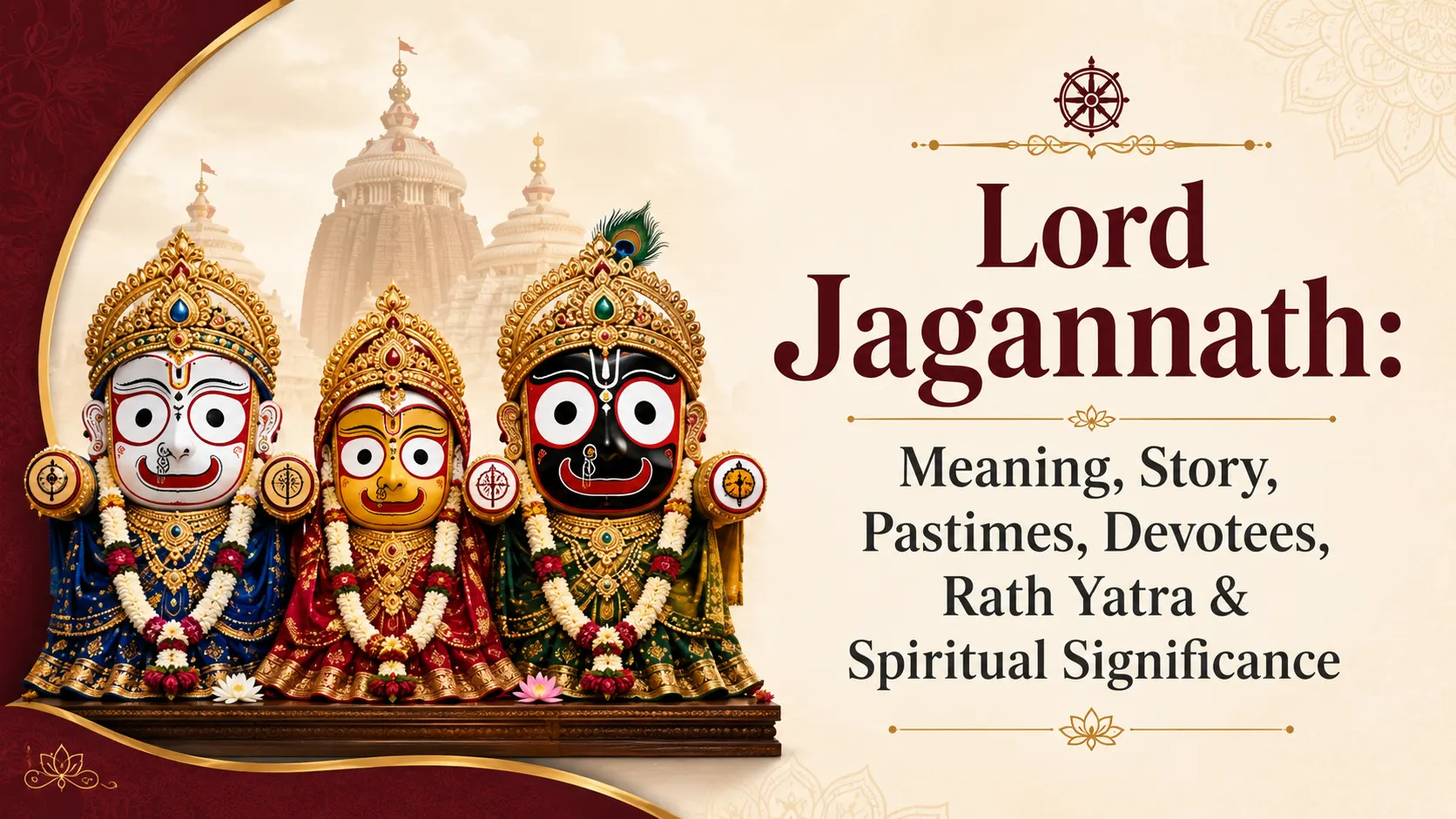
From the sacred Daru, the Lord manifested as Jagannath, Balabhadra, Subhadra and Sudarshana. The hidden Nilamadhava had now become the publicly worshiped Lord of Puri.
This transformation is the soul of the story. The Lord did not reject Vishwavasu’s worship. He expanded it. He did not reject King Indradyumna’s longing. He fulfilled it. He did not reject Vidyapati’s search. He used it. He did not reject the forest. He brought its sacredness into the temple. He did not reject the world. He came to bless it.
Lord Jagannath’s origin story is therefore not the replacement of one tradition by another. It is the meeting of many forms of devotion under the Lord’s own will. The Lord accepts the love of the forest devotee and the service of the king. He accepts the intelligence of Vidyapati and the faith of Lalita. He accepts temple worship and public festivals. He accepts the food offerings of His servitors and the tears of a pilgrim standing far away.
The Lord who was once hidden became the Lord who comes out. This is why the origin story leads naturally to Rath Yatra. During Rath Yatra, Lord Jagannath leaves the temple and comes onto the road. He does not remain only behind walls. He rides before everyone. What began as a hidden darshan becomes universal mercy.
Why Lord Jagannath’s Form Looks Different
Many people first ask: why does Lord Jagannath look so different? Why are His eyes so large? Why does He not have visible hands and legs like other deities?
The origin story gives one answer: the carving was interrupted before the forms were completed in the ordinary sense. But devotional understanding goes deeper. Lord Jagannath’s form is not merely unfinished wood. It is the Lord’s chosen form of ecstasy and compassion.
His eyes are large because He is always looking at His devotees. He does not blink in indifference. He sees everyone. No person is too small for His attention. His arms are not visible like ordinary arms, yet He embraces the whole universe. His hands are not seen, yet He accepts offerings from millions. His feet are not seen, yet He travels on His chariot to bless the world.
In Gaudiya Vaishnava understanding, Lord Jagannath is Krishna in a deep mood of separation and love. Sri Chaitanya Mahaprabhu’s ecstatic relationship with Lord Jagannath reveals that Jagannath is not merely a cultural deity of Odisha; He is Krishna, conquered by the love of His devotees. Srila Prabhupada’s purport to Sri Chaitanya-caritamrita Madhya 13.119 explains the inner Rath Yatra mood of Krishna, Radharani, Kurukshetra and Vrindavan.
What Is Daru Brahma?
Daru Brahma means the Supreme Lord manifesting through sacred wood. This concept is central to the Jagannath story. The Lord’s body is wooden, but not material in the ordinary sense. The deity is worshipable because the Lord chooses to be present there.
This helps us understand deity worship properly. Devotees do not worship a piece of wood as God. They worship God who has mercifully agreed to appear through sacred wood. Just as the holy name is sound but not ordinary sound, the deity is visible form but not ordinary form.
Daru Brahma also teaches that the spiritual can enter the material world without becoming material. The Lord remains unlimited, yet He becomes accessible. He remains the Lord of the Universe, yet He accepts bathing, dressing, food offerings, festivals, and loving service.
The People in the Story
Four souls carry this story forward — each one teaching a different way that the Lord accepts love.
Vishwavasu
Simple devotionThe Sabara chief who worshiped Nilamadhava in the forest. He represents simple devotion. He did not need public recognition, a grand temple, or a crowd’s approval — he had the Lord, and the Lord had him. Lord Jagannath accepted his worship before He became famous in Puri, which means the Lord sees the heart before the world sees the devotee. Begin with love, serve sincerely, protect your devotion.
King Indradyumna
Longing turns into serviceHe had the power to build, organize, and offer, but his greatest quality was not his kingship — it was longing. He wanted the Lord so deeply that even disappointment could not turn him back. When Nilamadhava disappeared, he surrendered more deeply. Spiritual disappointment can become spiritual depth: he wanted Nilamadhava, and the Lord gave him Jagannath.
Vidyapati
Intelligence in serviceHe was faithful, patient and clever — searching carefully, building relationships, and using mustard seeds to preserve the route. But his intelligence was used in service, not selfish gain. That is the difference between cleverness, which seeks control, and devotional intelligence, which seeks service. His seeds remind us we can leave small offerings — a story, a kirtan, a kind word — that later grow into someone’s path.
Lalita
The quiet bridgeSometimes mentioned only briefly, yet meaningful. She stands between Vidyapati and Vishwavasu — between the outside seeker and the hidden worship, between the king’s mission and the forest tradition. Devotional history is often carried by quiet bridges: hosts, family, guides, whose presence lets the Lord’s arrangement unfold. The Lord’s story moves through relationships, trust, and kindness.
The Spiritual Meaning of the Whole Story
The origin story of Lord Jagannath can be read as history, tradition, folklore, theology, and devotional meditation. But its deepest meaning is very simple: the Lord reveals Himself to love.
Vishwavasu had love, so the Lord accepted his forest worship. Indradyumna had longing, so the Lord arranged His appearance. Vidyapati had service intelligence, so the Lord allowed him to find the path. Lalita had relational trust, so the hidden story moved forward. The sacred Daru appeared because the Lord wanted to become visible. The unusual form appeared because the Lord wanted to break material expectations and attract hearts.
The story also teaches that Lord Jagannath is not limited. He is hidden and public. Forest Lord and temple Lord. King’s Lord and tribal devotee’s Lord. Krishna and Purushottama. Daru Brahma and Lord of the Universe. He is worshiped in Puri and remembered throughout the world.
How This Story Connects to Rath Yatra
The origin story and Rath Yatra are connected by one theme: the Lord becomes accessible. In the origin story, Nilamadhava moves from hidden worship to public manifestation as Jagannath. In Rath Yatra, Jagannath moves from the temple altar to the public road. In both cases, the Lord expands His mercy.
Srila Prabhupada explained that Jagannath means the master or proprietor of the moving world, and that Jagannath, Balabhadra and Subhadra come before people to reclaim them from material life.
This is why Rath Yatra is not merely a festival after the origin story. It is the continuation of the same mercy. The Lord who allowed Himself to be found by Vidyapati now allows Himself to be seen by millions.
Complete guide: Jagannath Rath Yatra 2026 — dates, chariots and spiritual meaning →Lessons from the Story for Devotees Today
- Longing is powerful. King Indradyumna’s longing brought the Lord’s mercy.
- The Lord sees simple devotion. Vishwavasu’s forest worship was accepted by the Lord.
- Small seeds matter. Vidyapati’s mustard seeds became the path back to Nilamadhava.
- The Lord may hide to reveal more. Nilamadhava disappeared so Jagannath could appear for everyone.
- God is not limited by form. The Lord appeared through sacred wood as Daru Brahma.
- Apparent incompleteness can be divine completeness. Jagannath’s unique form is full of mercy.
- Jagannath belongs to everyone. He accepts royal service, tribal devotion, priestly service, kirtan, prasadam and simple prayer.
Lord Jagannath’s origin story tells how King Indradyumna searched for the hidden deity Nilamadhava, who was secretly worshiped by Vishwavasu in the forest. Vidyapati found the deity with the help of Vishwavasu’s family and marked the path with mustard seeds. When the king arrived, Nilamadhava had disappeared, but the Lord later appeared through sacred wood known as Daru Brahma as Jagannath, Balabhadra and Subhadra in Puri.
Frequently Asked Questions
What is the origin story of Lord Jagannath?
The origin story of Lord Jagannath describes how King Indradyumna longed to see the Supreme Lord, how Vidyapati discovered the hidden deity Nilamadhava worshiped by Vishwavasu, and how the Lord later appeared through sacred wood as Jagannath, Balabhadra and Subhadra in Puri.
Who was King Indradyumna?
King Indradyumna was the pious king in the traditional Jagannath story who desired to see and worship the Supreme Lord. His intense longing led to the search for Nilamadhava and the eventual appearance of Lord Jagannath in Puri.
Who was Nilamadhava?
Nilamadhava was the hidden form of the Lord worshiped secretly in the forest by Vishwavasu. In the traditional story, Nilamadhava later disappeared and the Lord manifested as Jagannath, Balabhadra and Subhadra.
Who was Vishwavasu?
Vishwavasu, also written as Viswavasu, was the Sabara chief who worshiped Nilamadhava with deep devotion in the forest. His role shows that Lord Jagannath accepts sincere love beyond social status or external identity.
Who was Vidyapati?
Vidyapati, also written as Bidyapati, was the learned brahmana sent by King Indradyumna to find Nilamadhava. He reached Vishwavasu’s home, was taken to the secret place of worship, and marked the route with mustard seeds.
Why did Vidyapati drop mustard seeds?
Vidyapati dropped mustard seeds along the path while being taken blindfolded to Nilamadhava. When the seeds sprouted, they helped reveal the route to the hidden place.
Why did Nilamadhava disappear?
In the devotional tradition, Nilamadhava disappeared because the Lord had a greater plan. He did not want to remain hidden only in the forest; He wanted to appear as Jagannath in Puri and bless the world.
What is Daru Brahma?
Daru Brahma means the Supreme Lord manifesting through sacred wood. In Jagannath worship, the wooden form is not considered ordinary wood; it is the Lord’s merciful deity form.
Why is Lord Jagannath made of wood?
Lord Jagannath is made of sacred wood because He chose to appear as Daru Brahma. This teaches that the Lord can spiritualize matter and appear in a form accessible to human service and devotion.
Why does Lord Jagannath look unfinished?
One traditional explanation says the carving was interrupted before completion. Devotionally, however, Lord Jagannath’s form is complete and intentional. His large eyes, simple body and unusual form express mercy, divine ecstasy and accessibility.
Is Lord Jagannath Krishna?
Yes. In Vaishnava and Gaudiya Vaishnava understanding, Lord Jagannath is Krishna, the Supreme Lord, appearing in a uniquely merciful form.
How is the story connected with Rath Yatra?
The origin story shows the hidden Lord becoming publicly manifest, and Rath Yatra continues that mercy by bringing Lord Jagannath out of the temple to give darshan to everyone.
Conclusion: The Hidden Lord Who Came Out for Everyone
The story of Lord Jagannath begins in longing and ends in mercy. King Indradyumna longed for the Lord. Vidyapati searched for Him. Vishwavasu secretly worshiped Him. Lalita helped connect the worlds of forest devotion and royal seeking. Nilamadhava disappeared, but the Lord did not abandon His devotees. He appeared in a new form as Jagannath, Balabhadra and Subhadra.
This is the beauty of Jagannath. He is hidden, yet He reveals Himself. He is the Lord of the Universe, yet He accepts service from simple devotees. He appears in sacred wood, yet He is the Supreme Lord. He sits on the altar, yet He comes out in Rath Yatra. He may look unusual to the eyes, but to the heart He looks like mercy.
May Lord Jagannath, Balabhadra and Subhadra bless us with sincere longing, humble service and the desire to follow the path of devotion.
To continue exploring Lord Jagannath’s meaning, devotees, festivals and spiritual significance, read the complete pillar guide — and join satsang, kirtan, Bhagavad Gita study, prasadam and devotional festivals at Nandgram Dham.
- Dina Krishna Joshi. Lord Jagannath — The Tribal Deity. Odisha Review, June–July 2007 (records Neela Madhab, Vishwavasu, Indradyumna, Bidyapati/Vidyapati, Lalita, the blindfold and mustard-seed details). magazines.odisha.gov.in
- Odisha Review. The Legend of the Origin of Sri Jagannatha and His Temple, June 2017 (Purushottama Kshetra narrative including Narada and the divine carpenter tradition). magazines.odisha.gov.in
- ISKCON Desire Tree. The Complete Story of Lord Jagannatha’s Appearance in Puri (devotional retelling; secondary source). iskcondesiretree.com
- Odisha Review. Lord Jagannath — The Emblem of Cosmic Consciousness, June 2006 (explains Darubrahma and Nabakalebara). magazines.odisha.gov.in
- A.C. Bhaktivedanta Swami Prabhupada. Sri Chaitanya-caritamrita, Madhya-lila 13.119, Purport. prabhupadabooks.com
- A.C. Bhaktivedanta Swami Prabhupada. Ratha-yatra Festival Lecture, San Francisco, July 5, 1970. prabhupadabooks.com
Traditional pastimes of Lord Jagannath are drawn from scripture, Odisha temple tradition, cultural records, and devotional narration; details may vary across retellings.