Table of Contents
- 1. Who is Lord Narasimha?
- 2. Narasimha pranama: the prayer sung after arati
- 3. Narasimha kavacha: Prahlada's prayer for protection
- 4. Sri Narasimha Ashtottara: the 108 names of Lord Narasimha
- 5. Questions devotees ask
- Which Narasimha prayer is sung after arati in ISKCON temples?
- Who spoke the Narasimha kavacha?
- When is Narasimha Chaturdashi?
Devotees of Sri Krishna turn to Lord Narasimha, His half-man, half-lion form, whenever they need protection, whether the danger is outside or inside the heart. Three prayers to Him are used again and again: a short pranama (prayer of obeisance) sung in temples, the longer Narasimha kavacha, which tradition attributes to Prahlada Maharaja, and the list of His 108 names. This page explains where each one comes from and when devotees recite it. For the full texts with translations and recordings, it links to the pages of our Vaishnava song book.
Who is Lord Narasimha?
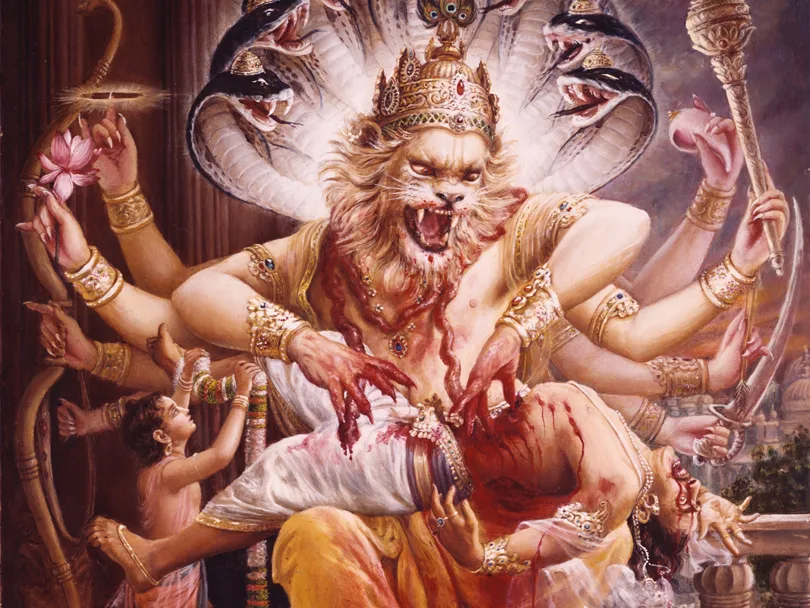
The story is told by Narada Muni to King Yudhishthira in the Seventh Canto of Srimad-Bhagavatam, chapters 8 to 10. Hiranyakashipu, king of the Daityas, had won from Lord Brahma a set of boons meant to make him impossible to kill. His son Prahlada, who had heard about the Lord from Narada Muni while still in his mother's womb, would not stop speaking about Lord Vishnu. When every attempt to kill the boy had failed, Hiranyakashipu mocked him: if this Lord is everywhere, "why is He not present before me in this pillar?" (SB 7.8.12)
A terrible sound came from the pillar, and the Lord stepped out of it in a form that was neither man nor lion. Srimad-Bhagavatam gives the reason: He came "to prove that the statement of His servant Prahlāda Mahārāja was substantial" (SB 7.8.17). He then kept every word of Brahma's boons. "Lord Nṛsiṁhadeva placed the demon on His lap, supporting him with His thighs, and in the doorway of the assembly hall the Lord very easily tore the demon to pieces with the nails of His hand." (SB 7.8.29) In his purport Srila Prabhupada points out how exact this was: the lap was neither land nor sky, the evening was neither day nor night, and the nails were not a weapon.
Even Brahma and Shiva did not dare to come near the angry Lord (SB 7.9.1). Brahma asked Prahlada to go forward, and when the boy bowed down, the Lord lifted him and placed His hand on his head, "because His hand is always ready to create fearlessness in all of His devotees" (SB 7.9.5). Prahlada's prayers fill the rest of chapter 9. One verse shows his mood: "I am not at all afraid of material existence, for wherever I stay I am fully absorbed in thoughts of Your glories and activities." (SB 7.9.43) Offered any boon he liked, he asked only that no material desire should remain in his heart (SB 7.10.7). The Lord told him that his father had been purified "along with twenty-one forefathers in your family" (SB 7.10.18).
Sri Caitanya Mahaprabhu had deep love for this form of the Lord. On His tour of South India He reached the Jiyada-nrsimha temple at Simhacalam, near Visakhapatnam, fell flat before the Deity, and danced and chanted there (Caitanya-caritamrta, Madhya 8.3-4). A verse quoted a little later in the same chapter, from Sridhara Svami's commentary on the Bhagavatam, explains why devotees are not frightened by the Lord's fierce face: "Although very ferocious, the lioness is very kind to her cubs. Similarly, although very ferocious to nondevotees like Hiraṇyakaśipu, Lord Nṛsiṁhadeva is very, very soft and kind to devotees like Prahlāda Mahārāja." (CC Madhya 8.6)
The Lord's appearance day, Narasimha Chaturdashi, falls on the fourteenth day of the bright fortnight of Vaishakha (April or May).
Narasimha pranama: the prayer sung after arati
In ISKCON temples it is the custom to end the arati kirtana with a few verses to Lord Narasimha. The first two verses come from the Nrsimha Purana, as Srila Prabhupada notes in his purport to Caitanya-caritamrta Antya 16.52. Krishnadasa Kaviraja Gosvami tells us that Sri Caitanya Mahaprabhu, going up to the Jagannatha temple in Puri, bowed to the Deity of Lord Narasimha that stands above the twenty-two steps and recited these two verses again and again (CC Antya 16.50-51).
namas te nara-siṁhāya
prahlādāhlāda-dāyine
hiraṇyakaśipor vakṣaḥ-
śilā-ṭaṅka-nakhālaye"I offer my respectful obeisances unto You, Lord Nṛsiṁhadeva. You are the giver of pleasure to Mahārāja Prahlāda, and Your nails cut the chest of Hiraṇyakaśipu like a chisel cutting stone."
Srila Prabhupada's translation, Sri Caitanya-caritamrta, Antya 16.52
ito nṛsiṁhaḥ parato nṛsiṁho
yato yato yāmi tato nṛsiṁhaḥ
bahir nṛsiṁho hṛdaye nṛsiṁho
nṛsiṁham ādiṁ śaraṇaṁ prapadye"Lord Nṛsiṁhadeva is here, and He is also there on the opposite side. Wherever I go, there I see Lord Nṛsiṁhadeva. He is outside and within my heart. Therefore I take shelter of Lord Nṛsiṁhadeva, the original Supreme Personality of Godhead."
Srila Prabhupada's translation, Sri Caitanya-caritamrta, Antya 16.53
The first verse remembers what the Lord did for Prahlada; the second turns that memory into shelter for the one who is praying. Temples usually add a third verse, from the hymn to the ten incarnations (pralaya-payodhi-jale) in Jayadeva Gosvami's Gita-govinda:
tava kara-kamala-vare nakham adbhuta-śṛṅgaṁ
dalita-hiraṇyakaśipu-tanu-bhṛṅgam
keśava dhṛta-narahari-rūpa jaya jagadīśa hare
In it Jayadeva praises Lord Keshava, who took the form of Narahari, for the wonderful pointed nails on His lotus hands, with which He tore apart Hiranyakashipu's body as if it were a bee (bhṛṅga). The whole hymn is on our page Pralaya Payodhi Jale.
The three verses, with word-for-word meanings, translations and eight recordings, among them one by Srila Prabhupada, are on our song page Namaste Narasimhaya. The song book also has the short refrain Jaya Narasimha Sri Narasimha, the words Sri Caitanya Mahaprabhu chanted before the Deity at Simhacalam (CC Madhya 8.5).
Narasimha kavacha: Prahlada's prayer for protection
A kavacha is a coat of armour. As a prayer, it asks the Lord to guard the person who recites it, part by part. The Narasimha kavacha is one of the best known of these prayers. Its first verse says it was spoken by Prahlada long ago (prahlādenoditaṁ purā), and its closing line, iti śrī-brahmāṇḍa-purāṇe prahlādoktaṁ śrī-nṛsiṁha-kavacaṁ sampūrṇam, names the Brahmanda Purana as its source and Prahlada Maharaja as its speaker. The text has four parts:
- Meditation (dhyana). Before reciting, one pictures the Lord seated on a golden throne, His mouth open, three-eyed and as bright as the autumn moon, with Lakshmi embracing His left side, four-armed, dressed in yellow, holding the conch and disc, while Garuda praises Him. Then one seats Him in the lotus of one's own heart (sva-hṛt-kamala-saṁvāsaṁ kṛtvā) and begins.
- The armour itself. Each line gives one part of the body to the Lord under a name that suits it. It starts with nṛsiṁho me śiraḥ pātu, "may Narasimha guard my head", and goes down to the feet, then round the eight directions. One line asks Nrhari to guard one's memory (smṛtiṁ me pātu nṛhariḥ). The last request is the one a devotee cares about most: saṁsāra-bhayataḥ pātu mṛtyor mṛtyur nṛ-keśarī, "may the man-lion, who is death even to death, guard me from the fear of birth and death".
- Results (phala-shruti). About ten verses list what the recitation brings, from freedom from sin and long life to protection from poison and evil spirits. These are the Purana's own statements, given here as the text gives them.
- A closing verse of obeisance to the roaring "divine lion" (divya-siṁhaṁ namāmi).
(The short English renderings of single lines above are our own word-for-word glosses.)
Devotees often recite the kavacha on Narasimha Chaturdashi and in times of fear or illness. The Bhagavatam's own picture of Prahlada is a good guide here. When the Lord offered him benedictions, Prahlada said that "one who desires some material benefit in exchange for devotional service cannot be Your pure devotee. Indeed, he is no better than a merchant who wants profit in exchange for service." (SB 7.10.4) So devotees recite his armour-prayer above all for protection of their devotion and their remembrance of the Lord.
The full 31 verses with an English translation and four recordings are on our song page Narasimha Kavacam, which also offers the text as a PDF or slides. The song book also has a different Narasimha kavacha, the Trailokya-vijaya kavacha.
Sri Narasimha Ashtottara: the 108 names of Lord Narasimha
An ashtottara-shata-namavali is a list of 108 names (ashta-uttara-shata, "a hundred and eight") used in worship. Each name is put in the dative case and framed by oṁ and namaḥ, so every line is a small offering of its own: oṁ nṛkesariṇe namaḥ means "oṁ, obeisances to the man-lion". The list can be chanted aloud, read slowly as a meditation, or used in home worship, offering a flower with each name.
Many of the names tell the pastime in a single word:
- stambha-ja (7): born from the pillar (SB 7.8.17)
- hiraṇyakaśipu-dhvaṁsin (35): the destroyer of Hiranyakashipu
- nakhāstra (65): He whose weapon is His nails, the weapon that was no weapon (SB 7.8.29)
- bhakta-vatsala (80) and śaraṇāgata-vatsala (82): loving to His devotees and to everyone who takes shelter of Him
- vaiśākha-śukla-bhūtottha (81): He who appeared in the bright fortnight of Vaishakha, the time of Narasimha Chaturdashi
- lakṣmī-nṛsiṁha (105): Narasimha with Lakshmi, the goddess of fortune, at His side
- prahlāda-pālaka (108): the protector of Prahlada, the name on which the list ends
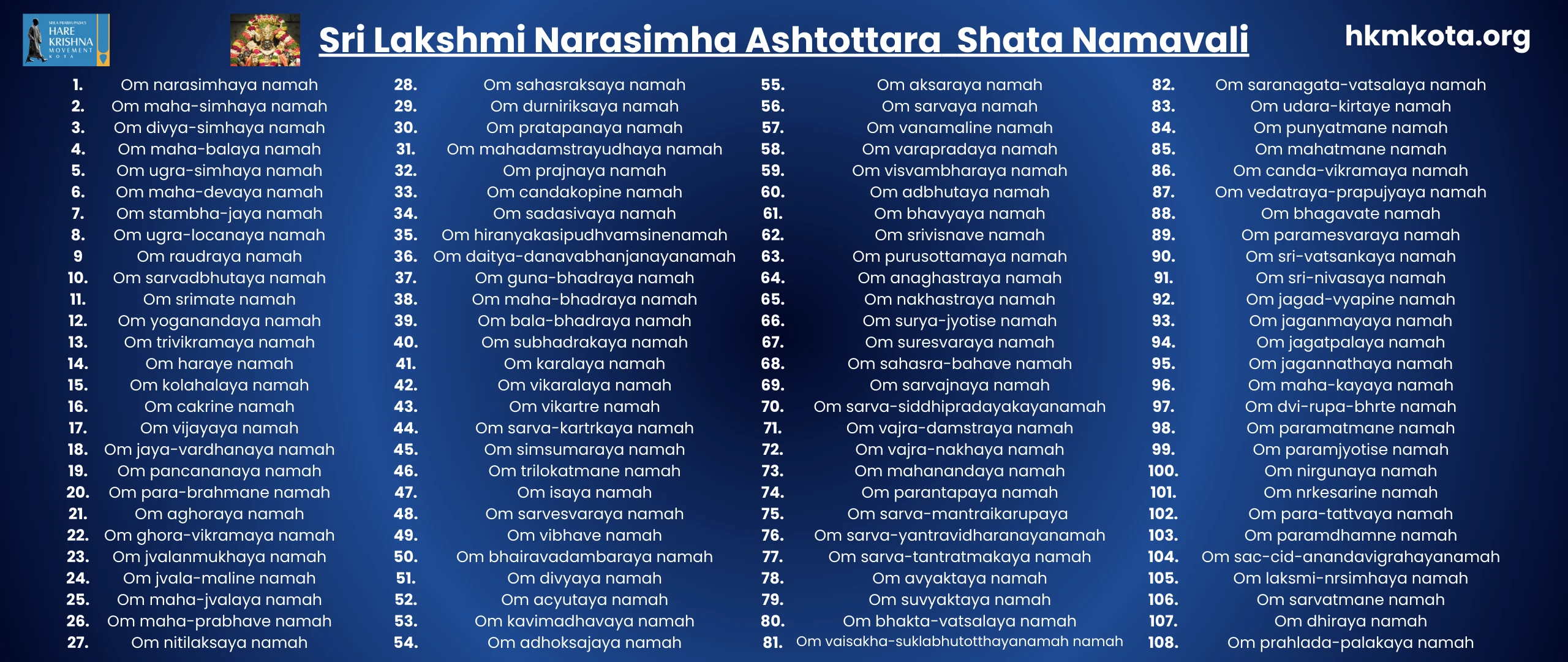
The list below is the traditional Sri Lakshmi-Narasimha Ashtottara-shata-namavali in the order and readings of ISKCON Bangalore's printed edition (Sri Nrsimha Ashtottara Shata Namavali, PDF), which is also the list on our temple's chart. The diacritics are ours.
- oṁ nārasiṁhāya namaḥ
- oṁ mahā-siṁhāya namaḥ
- oṁ divya-siṁhāya namaḥ
- oṁ mahā-balāya namaḥ
- oṁ ugra-siṁhāya namaḥ
- oṁ mahā-devāya namaḥ
- oṁ stambha-jāya namaḥ
- oṁ ugra-locanāya namaḥ
- oṁ raudrāya namaḥ
- oṁ sarvādbhutāya namaḥ
- oṁ śrīmate namaḥ
- oṁ yogānandāya namaḥ
- oṁ trivikramāya namaḥ
- oṁ haraye namaḥ
- oṁ kolāhalāya namaḥ
- oṁ cakriṇe namaḥ
- oṁ vijayāya namaḥ
- oṁ jaya-vardhanāya namaḥ
- oṁ pañcānanāya namaḥ
- oṁ para-brahmaṇe namaḥ
- oṁ aghorāya namaḥ
- oṁ ghora-vikramāya namaḥ
- oṁ jvalan-mukhāya namaḥ
- oṁ jvālā-māline namaḥ
- oṁ mahā-jvālāya namaḥ
- oṁ mahā-prabhave namaḥ
- oṁ niṭilākṣāya namaḥ
- oṁ sahasrākṣāya namaḥ
- oṁ durnirīkṣāya namaḥ
- oṁ pratāpanāya namaḥ
- oṁ mahā-daṁṣṭrāyudhāya namaḥ
- oṁ prājñāya namaḥ
- oṁ caṇḍa-kopine namaḥ
- oṁ sadā-śivāya namaḥ
- oṁ hiraṇyakaśipu-dhvaṁsine namaḥ
- oṁ daitya-dānava-bhañjanāya namaḥ
- oṁ guṇa-bhadrāya namaḥ
- oṁ mahā-bhadrāya namaḥ
- oṁ bala-bhadrāya namaḥ
- oṁ subhadrakāya namaḥ
- oṁ karālāya namaḥ
- oṁ vikarālāya namaḥ
- oṁ vikartre namaḥ
- oṁ sarva-kartṛkāya namaḥ
- oṁ śiṁśumārāya namaḥ
- oṁ trilokātmane namaḥ
- oṁ īśāya namaḥ
- oṁ sarveśvarāya namaḥ
- oṁ vibhave namaḥ
- oṁ bhairavāḍambarāya namaḥ
- oṁ divyāya namaḥ
- oṁ acyutāya namaḥ
- oṁ kavi-mādhavāya namaḥ
- oṁ adhokṣajāya namaḥ
- oṁ akṣarāya namaḥ
- oṁ śarvāya namaḥ
- oṁ vana-māline namaḥ
- oṁ vara-pradāya namaḥ
- oṁ viśvambharāya namaḥ
- oṁ adbhutāya namaḥ
- oṁ bhavyāya namaḥ
- oṁ śrī-viṣṇave namaḥ
- oṁ puruṣottamāya namaḥ
- oṁ anaghāstrāya namaḥ
- oṁ nakhāstrāya namaḥ
- oṁ sūrya-jyotiṣe namaḥ
- oṁ sureśvarāya namaḥ
- oṁ sahasra-bāhave namaḥ
- oṁ sarva-jñāya namaḥ
- oṁ sarva-siddhi-pradāyakāya namaḥ
- oṁ vajra-daṁṣṭrāya namaḥ
- oṁ vajra-nakhāya namaḥ
- oṁ mahānandāya namaḥ
- oṁ parantapāya namaḥ
- oṁ sarva-mantraika-rūpāya namaḥ
- oṁ sarva-yantra-vidāraṇāya namaḥ
- oṁ sarva-tantrātmakāya namaḥ
- oṁ avyaktāya namaḥ
- oṁ suvyaktāya namaḥ
- oṁ bhakta-vatsalāya namaḥ
- oṁ vaiśākha-śukla-bhūtotthāya namaḥ
- oṁ śaraṇāgata-vatsalāya namaḥ
- oṁ udāra-kīrtaye namaḥ
- oṁ puṇyātmane namaḥ
- oṁ mahātmane namaḥ
- oṁ caṇḍa-vikramāya namaḥ
- oṁ veda-traya-prapūjyāya namaḥ
- oṁ bhagavate namaḥ
- oṁ parameśvarāya namaḥ
- oṁ śrīvatsāṅkāya namaḥ
- oṁ śrī-nivāsāya namaḥ
- oṁ jagad-vyāpine namaḥ
- oṁ jagan-mayāya namaḥ
- oṁ jagat-pālāya namaḥ
- oṁ jagannāthāya namaḥ
- oṁ mahā-kāyāya namaḥ
- oṁ dvi-rūpa-bhṛte namaḥ
- oṁ paramātmane namaḥ
- oṁ paraṁ-jyotiṣe namaḥ
- oṁ nirguṇāya namaḥ
- oṁ nṛ-kesariṇe namaḥ
- oṁ para-tattvāya namaḥ
- oṁ paraṁ-dhāmne namaḥ
- oṁ sac-cid-ānanda-vigrahāya namaḥ
- oṁ lakṣmī-nṛsiṁhāya namaḥ
- oṁ sarvātmane namaḥ
- oṁ dhīrāya namaḥ
- oṁ prahlāda-pālakāya namaḥ
Questions devotees ask
Which Narasimha prayer is sung after arati in ISKCON temples?
The pranama verses namas te nara-siṁhāya and ito nṛsiṁhaḥ parato nṛsiṁho, usually followed by Jayadeva Gosvami's verse tava kara-kamala-vare. The words, meanings and recordings are on our song page Namaste Narasimhaya.
Who spoke the Narasimha kavacha?
By the text's own account, Prahlada Maharaja. Its closing line places it in the Brahmanda Purana. The full prayer with a translation is on our song page Narasimha Kavacam.
When is Narasimha Chaturdashi?
On the fourteenth day of the bright fortnight of the month of Vaishakha, which falls in April or May. This year's date and the full story are on our Narasimha Chaturdashi festival page.
Sources and credits. Srila Prabhupada's translations from Srimad-Bhagavatam and Sri Caitanya-caritamrta are quoted word for word from vedabase.io, © The Bhaktivedanta Book Trust International. The Sanskrit verses and the name list are traditional texts; the short English glosses of single lines are our own.
Related: Narasimha Chaturdashi festival | Narasimha Chaturdashi seva