Table of Contents
- 1. What Is Sri Venkateswara Stotram?
- 2. Sri Venkateswara Stotram Lyrics in English and Sanskrit
- 3. Verse-by-Verse Summary
- 4. Meaning and Spiritual Significance
- About Lord Venkateswara
- 5. Key Words in the Stotram
- 6. Benefits of Chanting Venkateswara Stotram
- 7. How to Chant Sri Venkateswara Stotram
- Simple pronunciation guide
- 8. Frequently Asked Questions
- 9. More Vaishnava Prayers and Aartis
- 10. Om Namo Venkateshaya
What Is Sri Venkateswara Stotram?
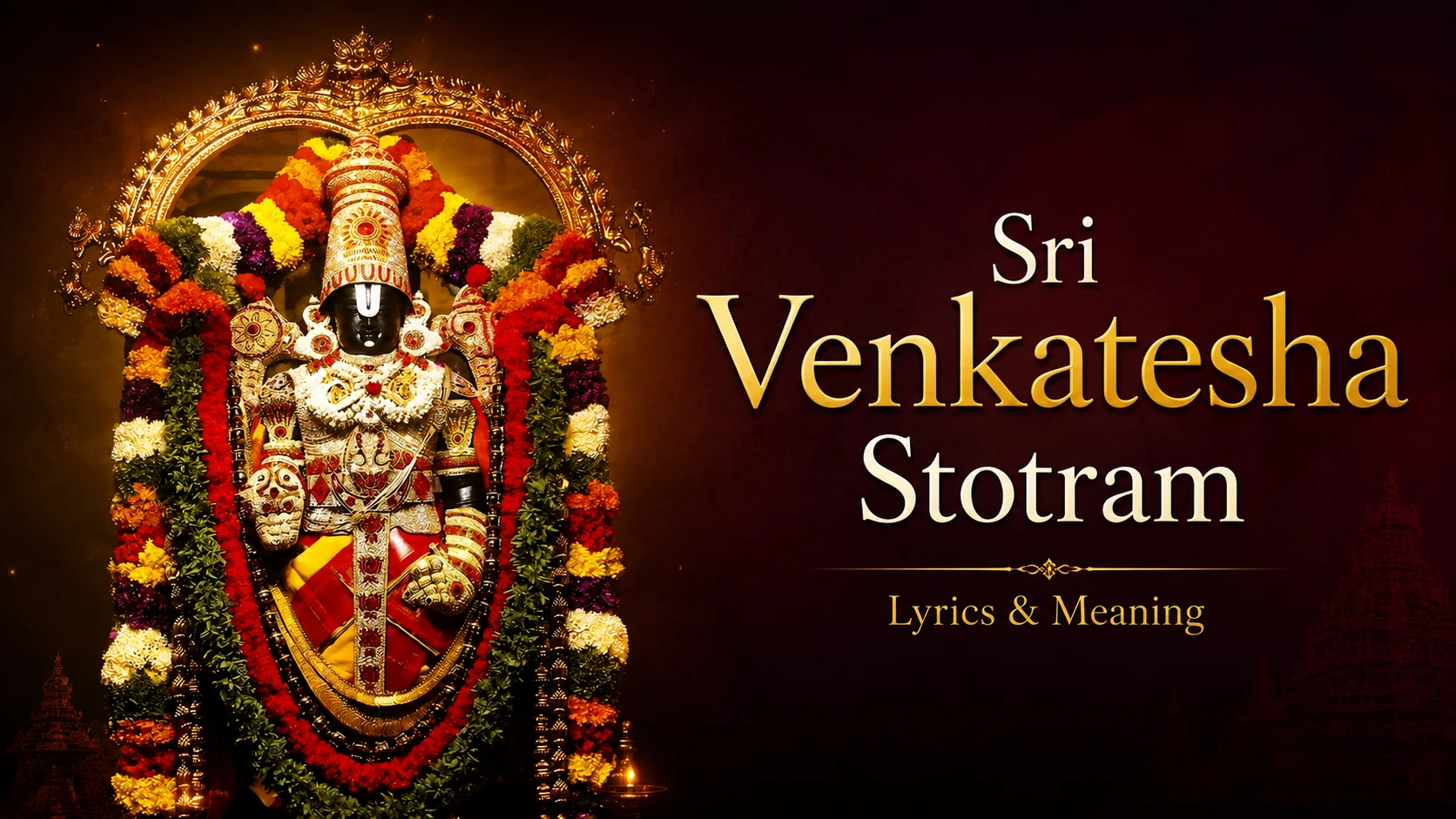
Sri Venkateswara Stotram (श्री वेङ्कटेश स्तोत्रम्), also spelled Sri Venkatesha Stotram and known by its first words Kamalākuca-cūcuka-kuṅkumato (कमलाकुचचूचुककुङ्कुमतो), is a Sanskrit hymn to Lord Venkatesha, the form of Lord Vishnu worshipped at Tirumala. It praises the Lord as Venkatesha, Krishna and Sri Rama.
The prayer moves step by step from praise to surrender. The devotee first sees the Lord’s beautiful form, then asks for protection, admits personal faults, and finally prays for the blessing of eternal service.
Sri Venkateswara Stotram Lyrics in English and Sanskrit
Each verse is shown in Devanagari, then in easy-to-read English letters (IAST transliteration), then with its English meaning. In IAST, a long vowel carries a bar: ā, ī, ū.
कमलाकुचचूचुककुङ्कुमतो
नियतारुणितातुलनीलतनो ।
कमलायतलोचन लोकपते
विजयी भव वेङ्कटशैलपते ॥ १ ॥
kamalākuca-cūcuka-kuṅkumato
niyatāruṇitātula-nīlatano |
kamalāyata-locana lokapate
vijayī bhava veṅkaṭa-śailapate || 1 ||
Meaning: O Lord whose incomparable dark-blue form is tinged red by the kuṅkuma adorning Goddess Lakshmi, whose eyes are broad like lotus petals, and who is the Lord of all worlds—may You be ever victorious, O Lord of Venkata Hill.
सचतुर्मुखषण्मुखपञ्चमुख
प्रमुखाखिलदैवतमौलिमणे ।
शरणागतवत्सल सारनिधे
परिपालय मां वृषशैलपते ॥ २ ॥
sa-caturmukha-ṣaṇmukha-pañcamukha-
pramukhākhila-daivata-mauli-maṇe |
śaraṇāgata-vatsala sāra-nidhe
paripālaya māṁ vṛṣa-śailapate || 2 ||
Meaning: O crown jewel among all the gods—including four-faced Brahma, six-faced Karttikeya and five-faced Shiva—O affectionate protector of those who surrender and treasury of all excellence, please protect me, O Lord of Vrishachala.
अतिवेलतया तव दुर्विषहैर्
अनुवेलकृतैर् अपराधशतैः ।
भरितं त्वरितं वृषशैलपते
परया कृपया परिपाहि हरे ॥ ३ ॥
ativelatayā tava durviṣahair
anuvela-kṛtair aparādha-śataiḥ |
bharitaṁ tvaritaṁ vṛṣa-śailapate
parayā kṛpayā paripāhi hare || 3 ||
Meaning: O Hari, Lord of Vrishachala, I am burdened with countless offences repeatedly committed against You. Please quickly protect me through Your supreme compassion.
अधिवेङ्कटशैलम् उदारमतेर्
जनताभिमताधिकदानरतात् ।
परदेवतया गदितान् निगमैः
कमलादयितान् न परं कलये ॥ ४ ॥
adhi-veṅkaṭa-śailam udāra-mater
janatābhimatādhika-dāna-ratāt |
para-devatayā gaditān nigamaiḥ
kamalā-dayitān na paraṁ kalaye || 4 ||
Meaning: I know no one higher than the beloved Lord of Kamala, who resides upon Venkata Hill, whose heart is most generous, who grants devotees more than they desire, and whom the Vedas proclaim as the Supreme Lord.
कलवेणुरवावशगोपवधू
शतकोटिवृतात् स्मरकोटिसमात् ।
प्रतिवल्लविकाभिमतात् सुखदात्
वसुदेवसुतान् न परं कलये ॥ ५ ॥
kala-veṇu-ravāvaśa-gopa-vadhū-
śata-koṭi-vṛtāt smara-koṭi-samāt |
prati-vallavikābhimatāt sukhadāt
vasudeva-sutān na paraṁ kalaye || 5 ||
Meaning: I know no one higher than Krishna, the son of Vasudeva, whose sweet flute enchants countless cowherd maidens, whose beauty equals millions of Cupids, and who gives joy to every devoted gopī.
अभिरामगुणाकर दाशरथे
जगदेकधनुर्धर धीरमते ।
रघुनायक राम रमेश विभो
वरदो भव देव दयाजलधे ॥ ६ ॥
abhirāma-guṇākara dāśarathe
jagad-eka-dhanur-dhara dhīra-mate |
raghu-nāyaka rāma rameśa vibho
varado bhava deva dayā-jaladhe || 6 ||
Meaning: O son of Dasharatha, reservoir of delightful qualities, unmatched bowman of the world and sober-minded Lord of the Raghu dynasty—O Rama, all-pervading Lord and ocean of mercy, kindly bestow Your blessings.
अवनीतनयाकमनीयकरं
रजनीकरचारुमुखाम्बुरुहम् ।
रजनीचरराजतमोमिहिरं
महनीयम् अहं रघुरामम् अये ॥ ७ ॥
avanī-tanayā-kamanīya-karaṁ
rajanī-kara-cāru-mukhāmburuham |
rajanī-cara-rāja-tamo-mihiraṁ
mahanīyam ahaṁ raghu-rāmam aye || 7 ||
Meaning: I take shelter of the glorious Lord Rama, who holds the charming hand of Sita, daughter of the earth; whose lotus face is beautiful like the moon; and who is like the sun that dispels the darkness of the king of the night-roaming demons.
सुमुखं सुहृदं सुलभं सुखदं
स्वनुजं च सुकायम् अमोघशरम् ।
अपहाय रघूद्वहम् अन्यम् अहं
न कथञ्चन कञ्चन जातु भजे ॥ ८ ॥
sumukhaṁ suhṛdaṁ sulabhaṁ sukhadaṁ
svanujaṁ ca sukāyam amogha-śaram |
apahāya raghūdvaham anyam ahaṁ
na kathañcana kañcana jātu bhaje || 8 ||
Meaning: Lord Rama is beautiful-faced, a true friend, easily approachable and the giver of happiness. He is accompanied by His noble younger brother and has a graceful form and unfailing arrows. Leaving aside Rama, the foremost of the Raghus, I will never, in any way, worship anyone else.
विना वेङ्कटेशं न नाथो न नाथः
सदा वेङ्कटेशं स्मरामि स्मरामि ।
हरे वेङ्कटेश प्रसीद प्रसीद
प्रियं वेङ्कटेश प्रयच्छ प्रयच्छ ॥ ९ ॥
vinā veṅkaṭeśaṁ na nātho na nāthaḥ
sadā veṅkaṭeśaṁ smarāmi smarāmi |
hare veṅkaṭeśa prasīda prasīda
priyaṁ veṅkaṭeśa prayaccha prayaccha || 9 ||
Meaning: Apart from Lord Venkatesha, I have no other master and no other shelter. I always remember Venkatesha. O Hari, O Venkatesha, please be gracious to me and grant that which is truly dear and beneficial.
अहं दूरतस् ते पदाम्भोजयुग्म
प्रणामेच्छयागत्य सेवां करोमि ।
सकृत्सेवया नित्यसेवाफलं त्वं
प्रयच्छ प्रयच्छ प्रभो वेङ्कटेश ॥ १० ॥
ahaṁ dūratas te padāmbhoja-yugma-
praṇāmecchayāgatya sevāṁ karomi |
sakṛt-sevayā nitya-sevā-phalaṁ tvaṁ
prayaccha prayaccha prabho veṅkaṭeśa || 10 ||
Meaning: I have come from afar with the desire to bow before Your two lotus feet and offer service. O Lord Venkatesha, through this single act of service, please grant me the fruit of serving You eternally.
अज्ञानिना मया दोषान्
अशेषान् विहितान् हरे ।
क्षमस्व त्वं क्षमस्व त्वं
शेषशैलशिखामणे ॥ ११ ॥
ajñāninā mayā doṣān
aśeṣān vihitān hare |
kṣamasva tvaṁ kṣamasva tvaṁ
śeṣa-śaila-śikhā-maṇe || 11 ||
Meaning: O Hari, due to ignorance I have committed unlimited faults. Please forgive me, please forgive me, O crest jewel of Shesha Hill.
Verse-by-Verse Summary
Use this table to find the verse you want, or to see how the prayer unfolds.
| Verse | Theme | In short |
|---|---|---|
| 1 | Praise | The devotee sees the Lord’s dark-blue form and prays for His victory. |
| 2 | Shelter | The Lord is the crown jewel of the gods and the protector of those who surrender. |
| 3 | Confession | The devotee admits countless offences and asks for quick protection. |
| 4 | Supremacy | The Vedas declare Venkatesha to be the Supreme Lord; there is no one higher. |
| 5 | Krishna | The devotee remembers Krishna, the flute-player who delights the gopis. |
| 6–8 | Rama | Rama’s qualities are praised, His form is meditated on, and the devotee vows to worship no one else. |
| 9 | Exclusive shelter | “Apart from Venkatesha I have no master.” This is the best-known verse. |
| 10 | Service | The devotee has come from afar to bow and asks for the fruit of eternal service. |
| 11 | Forgiveness | A humble prayer to forgive all faults committed through ignorance. |
Meaning and Spiritual Significance
The stotram is not only a request for material help. Its main movement is from admiration to surrender. The first verses praise the Lord’s beauty and supremacy. The middle verses remember Him as Krishna and Rama, showing that Venkatesha is worshipped as the same Supreme Lord who appears in different divine forms. The last verses speak of dependence, remembrance, service and repentance.
The famous line vinā veṅkaṭeśaṁ na nātho na nāthaḥ (verse 9) holds the heart of the prayer: “Apart from Venkatesha, I have no other shelter.” A devotee chants not only to receive blessings, but to deepen remembrance of the Lord and to awaken a sincere wish to serve Him forever.
About Lord Venkateswara
Lord Venkateswara is worshipped at the Sri Venkateswara temple on the Tirumala hills near Tirupati in Andhra Pradesh. Devotees know Him by many names, including Venkatesha, Srinivasa, Balaji and Govinda. This stotram calls the hill by several of its names: Venkata, Vrisha (Vrishachala) and Shesha.
The verses of Rama and Krishna fit well with the worship of Lord Vishnu’s other forms. You may like to read about the appearance day of Lord Sri Ramachandra, the Sri Rama Navami vrata and Sri Krishna Janmashtami.
Key Words in the Stotram
These Sanskrit words appear again and again. Knowing them makes the meanings easier to follow.
- Venkata-shaila-pati
- Lord of Venkata Hill, a name of Lord Venkatesha. The hill is also called Vrisha (Vrishachala) and Shesha in this stotram.
- Kamala / Kamalā
- Goddess Lakshmi (the word also means “lotus”).
- Lokapati
- Lord of all the worlds.
- Sharanagata-vatsala
- One who is affectionate to those who take shelter of Him.
- Dasharathi
- Son of Dasharatha, a name of Lord Rama.
- Natha
- Master and protector.
- Prayaccha
- “Please grant.” It is repeated in verses 9 and 10 for emphasis.
- Kshamasva
- “Please forgive.” It is repeated in the last verse.
Benefits of Chanting Venkateswara Stotram
Devotional scriptures often praise hearing and chanting the names and glories of Lord Vishnu. A sincere recitation of this stotram can support a regular spiritual practice in these ways:
The verses keep the mind absorbed in the Lord’s names, forms, qualities and mercy.
The prayer teaches us to depend on divine grace rather than on pride in our own ability.
The closing prayer honestly admits mistakes and asks the Lord for forgiveness.
Slow, attentive chanting can calm a restless mind and create a prayerful mood.
How to Chant Sri Venkateswara Stotram
Morning or evening is best, though you may chant whenever you can give your full attention.
Sit in a clean place before a picture or deity of the Lord and offer a simple prayer for devotion and focus.
Say each syllable with care. Your pronunciation improves naturally with regular listening and practice.
After each verse, pause for a moment and remember its mood: praise, shelter, service or forgiveness.
Simple pronunciation guide
- ā, ī, ū are held a little longer than a, i and u.
- ś sounds like “sh” in shine; ṣ is a deeper “sh” with the tongue curled back.
- ṅ sounds like “ng” in sing; ñ sounds like “ny”.
- ṭ, ḍ, ṇ are said with the tongue curled slightly back.
- ṁ is a soft nasal sound at the end of the syllable, and ḥ is a light breath after the vowel.
Frequently Asked Questions
What is Sri Venkateswara Stotram?
It is a Sanskrit devotional hymn in praise of Lord Venkateswara (also called Venkatesha), the form of Lord Vishnu worshipped at Tirumala. It praises His beauty, compassion and protection, remembers Him as Krishna and Rama, and ends with prayers for service and forgiveness.
How many verses does this stotram have?
The commonly recited Kamalakucha Choochuka version on this page has 11 verses. Other works with similar titles exist, so you may sometimes find a different text under the name “Venkatesha Stotram”.
When should Venkateswara Stotram be chanted?
You can chant it every day. Many devotees choose the morning or evening, and also Ekadashi, Dwadashi, Saturdays and other days connected with Lord Vishnu.
Can I chant it without knowing Sanskrit?
Yes. Read the English letters (transliteration) slowly, listen to a reliable recitation, and keep the meaning in mind. Sincerity matters more than speed.
What does “Vina Venkatesham na natho na nathah” mean?
It means “Apart from Venkatesha, I have no other master or protector.” The devotee keeps remembering the Lord and asks for His grace. It is verse 9 of this stotram.
Is Venkatesha the same as Balaji and Srinivasa?
Yes. Venkatesha, Venkateswara, Srinivasa and Balaji are widely used names for the form of Lord Vishnu worshipped at Tirumala.
Why does the stotram mention Rama and Krishna?
Verse 5 remembers Krishna, the son of Vasudeva, and verses 6 to 8 remember Rama, the son of Dasharatha. The devotee sees Lord Venkatesha as the same Supreme Lord who appears in these forms.
How long does it take to chant?
Chanted slowly, the 11 verses take roughly three to five minutes. Allow a little more time if you pause after each verse to think about its meaning.
Is this the same as Venkateswara Suprabhatam?
No. Suprabhatam is a different hymn, sung in the early morning to awaken the Lord at Tirumala. The Kamalakucha Choochuka stotram on this page is a separate prayer of praise, surrender and forgiveness.
Where is Lord Venkateswara’s temple?
The famous Sri Venkateswara temple is on the Tirumala hills near Tirupati in Andhra Pradesh, India.
More Vaishnava Prayers and Aartis
- Sri Rama Ashtottara – 108 names of Lord Rama, whom verses 6 to 8 remember
- Sri Narasimha Kavacha Mantra – a prayer for protection
- ISKCON Guru Vandana – lyrics, meaning and significance
- ISKCON Gaura Aarti and Mangal Aarti – daily temple aartis
- Tulsi Aarti – lyrics with meaning
- Hanuman Chalisa in English – with meaning and PDF
Om Namo Venkateshaya
May Lord Venkatesha bless us with sincere remembrance, humility, steady devotion and the wish to serve His lotus feet.