Tekari Rānī Mandira
टिकारी रानी मन्दिर Hindi name proposed
Also called Śrī Ṭīkārīrānī Ṭhākura-bāḍī, Ṭīkārī Rānī, Tekari Rānī Temple
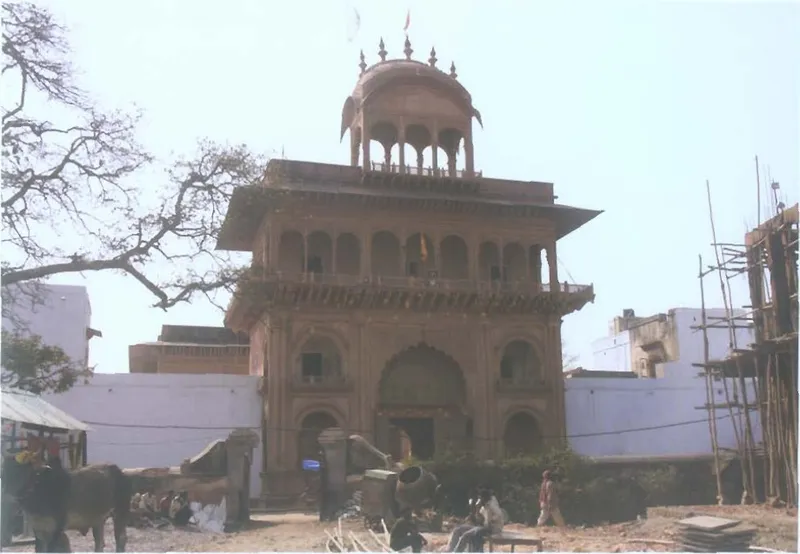
- What it is
- The Tekari Rānī Mandira is a large stone temple of Rādhā and Kṛṣṇa in the northern part of Vṛndāvana, near the Yamunā.
- Visiting
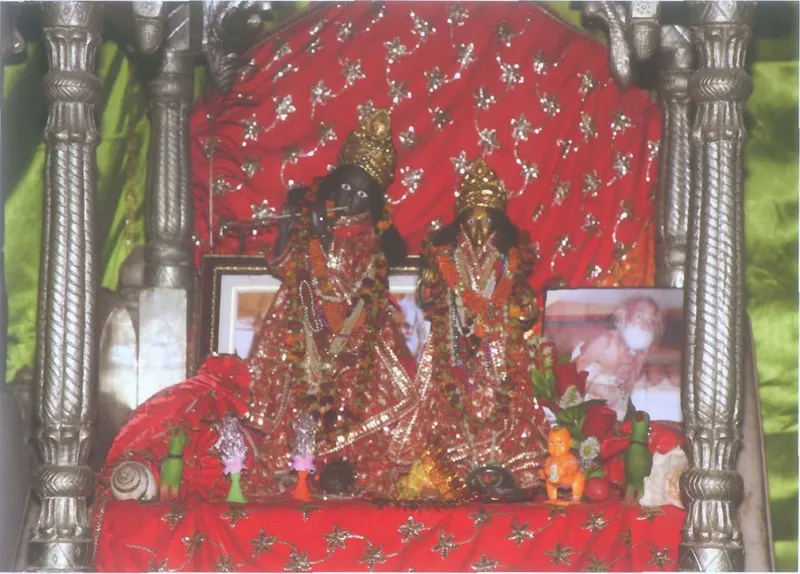
- The 2010 book calls the main Deities Rādhā-Rājendra-sarkar and shows the altar and a stone relief of Gopāla.
In short
The Tekari Rānī Mandira is a large stone temple of Rādhā and Kṛṣṇa in the northern part of Vṛndāvana, near the Yamunā. It was built by Rānī Indrajit Kunvar (Indrajīta-kumārī), the widowed queen of Tikari (Ṭīkārī) near Gayā in Bihār, and was completed in 1871.[1 +3] Śrī Vraja-maṇḍala Parikramā (2007) says that it was known for its hospitality.[2 +1]
Key facts
| Kind | temple |
|---|---|
| Region · area | Vṛndāvana |
Traditional accounts
According to Vṛndāvana, the Playground of God (2010), the queen's party of pilgrims was attacked by dacoits on the eastern side of the Yamunā. She fled with her Deity of Gopāla, swam across the river, which then flowed right past the present front door of the temple, and vowed to build a temple where she landed. The book names no source, and the older accounts of the temple's building do not tell the story, so it is not certain.[5]
Visiting today
The 2010 book calls the main Deities Rādhā-Rājendra-sarkar and shows the altar and a stone relief of Gopāla.[5 +1] The Color Guide (2000) lists a Tekari-ghāṭa built by "Tekari Rāni of Gaya" among the riverside ghāṭas, but does not say whether she is the queen of this temple; this may be so.[2 +6]
Location
| Where it is | where the queen landed; the Yamunā then flowed past its front door[13] |
|---|
Nearby places
Yamunā
Pictures
1 pictures
History
The building
F. S. Growse, a British district officer, recorded in 1883 that the temple was six years in building and was completed at the end of 1871, at a cost of three lakhs of rupees. He describes a square hall of about seventy feet, piers of four joined pillars cut from single stones of the Paharpur quarry in Bharatpur, and a gilt copper finial that alone cost 5,000 rupees. The district gazetteer of 1911 repeats his account.[1 +1]
The Bengali Vṛndāvana-kathā (1920) gives the same year and builder, but a cost of thirteen lakhs. It names three Deities, Rādhā-Kṛṣṇa, Rādhā-Gopāla and Laḍḍu-Gopāla, and says that 1,500 rupees a month were set aside for Their service and that sixty guests were fed every day.[4] Śrī Vraja-maṇḍala Parikramā (2007) names the same three Deities and calls the queen's husband Hitakāma Ṭhākura, a king of Ṭīkarī; it may follow the 1920 book.[2 +2] The Color Guide to Vṛndāvana (2000) also dates the temple to 1871.[7]
Later custody
The historian A. W. Entwistle (1987) reports that the temple was first in the care of members of the Nimbārka-sampradāya and was later given over to Rāmānandīs; he gives no date or source, so this is not certain.[8] Vṛndāvana, the Playground of God (2010) says that it was later given to a disciple of the sādhu Devarāha Bābā, whose disciples may still run it; it gives no date.[5 +1]
Where the sources differ
The name of the temple's Deities.
The name of the temple's Deities.[1 +1]
Accounts differ The name of the temple's Deities.
- Growse 1883 (p. 263); 1911 gazetteer (p. 248)The temple of Radha Indra Kishor.
- Vṛndāvana-kathā (1920, p. 246)Three Deities named Rādhākiṣaṇ, Rādhāgopāl and Lāḍḍugopāl.
- Vṛndāvana, the Playground of God (2010)Her Deities on the main altar are Rādhā-Rājendra-sarkar.
- Śrī Vraja-maṇḍala Parikramā (2007)Three Deities: Śrī Rādhā-Kṛṣṇa, Śrī Rādhā-Gopāla and Śrī Laḍḍū-Gopāla.
The name and rank of the queen's husband.[2 +1]
Accounts differ The name and rank of the queen's husband.
- F. S. Growse, Mathurá (1883), a historianGrowse names the founder as the widow of Het Kām, a brāhmaṇa landholder of Tikārī near Gayā.
- 1911 gazetteer (p. 248)'widow of Het Ram, a Brahman zamindar of Tikari near Gaya'.
- Vṛndāvana-kathā (1920, p. 246)Widow of Hitakāma Ṭhākura, ruler (adhipati) of the 'kingdom' (rājya) of Ṭīkāri in Gayā district.
- Śrī Vraja-maṇḍala Parikramā (2007)Her husband was Hitakāma Ṭhākura, 'a king of Ṭīkarī in the district of Gayā in Bihāra'.
What the temple cost.[4]
Accounts differ What the temple cost
- Growse 1883 (p. 263)'Its cost has been three lakhs.'
- 1911 gazetteer (p. 248)completed at the end of 1871 'at a cost of three lakhs'.
- Vṛndāvana-kathā (1920, p. 246)built in 1871 at a cost of 13 lakh rupees ('১৩ লক্ষ').
Who may have had charge of the temple since it was built.[8]
Accounts differ Who has had charge of the temple since it was built
- Entwistle (1987, p. 220)originally in the custody of members of the Nimbārka Sampradāya, later given over to Rāmānandīs (no date, no source).
- Vṛndāvana, the Playground of God (2010)later donated to a disciple of the sādhu Devarāha Bābā, whose disciples run it 'to this day' (no date).
Whether the temple stands on the Yamunā bank today.[2 +1]
Accounts differ Whether the temple stands on the Yamunā bank today.
- Śrī Vraja-maṇḍala Parikramā (2007)It is 'located in the northern part of Vṛndāvana on the bank of the Yamunā'.
- Vṛndāvana, the Playground of God (2010)The Yamunā 'at that time' (about 1870) flowed right past where the front door is now, implying that it no longer does.
References
13 references
- Mathurá (1883), F. S. Growse, B.C.S., M.A. Oxon., C.I.E. (as the title page gives him, p. 263
- Śrī Vraja-maṇḍala Parikramā (2007), PDF p. 337
- Śrī Vraja-maṇḍala Parikramā (2007), PDF p. 322
- Vṛndāvana-kathā, entry '৬ষ্ঠ—টীকারি-রাণীর ঠাকুরবাড়ী' (no. 6, the Ṭīkāri Rāṇī's ṭhākurbāḍī), printed p. 246
- Vṛndāvana, the Playground of God (2010), Bhakti Caitanya Svāmī, PDF p. 227
- Muttra (1911), D. L. Drake-Brockman, I.C.S. (edited and compiled), p. 248
- The Color Guide to Vṛndāvana (2000), Written and Photographed by Rājaśekhara dāsa Brahmacārī, PDF p. 132
- A. W. Entwistle, ch. 5 §37 (the Nimbārka Sampradāya in the nineteenth century), printed p. 220, Egbert Forsten, Groningen, 1987
- Vṛndāvana, the Playground of God (2010), Bhakti Caitanya Svāmī, PDF p. 228
- The Color Guide to Vṛndāvana (2000), Written and Photographed by Rājaśekhara dāsa Brahmacārī, PDF p. 31
- F. S. Growse, Mathurá: A District Memoir, 3rd ed
- Muttra: A Gazetteer
- Vṛndāvana, the Playground of God (2010), Bhakti Caitanya Svāmī, p. 227