Vṛndāvana
वृन्दावन
Also called Pañcakrośī Vṛndāvana
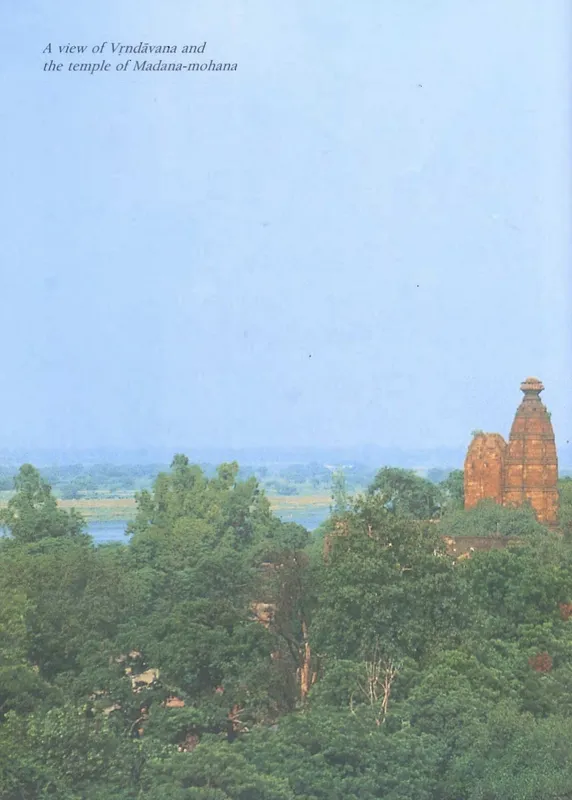
- What it is
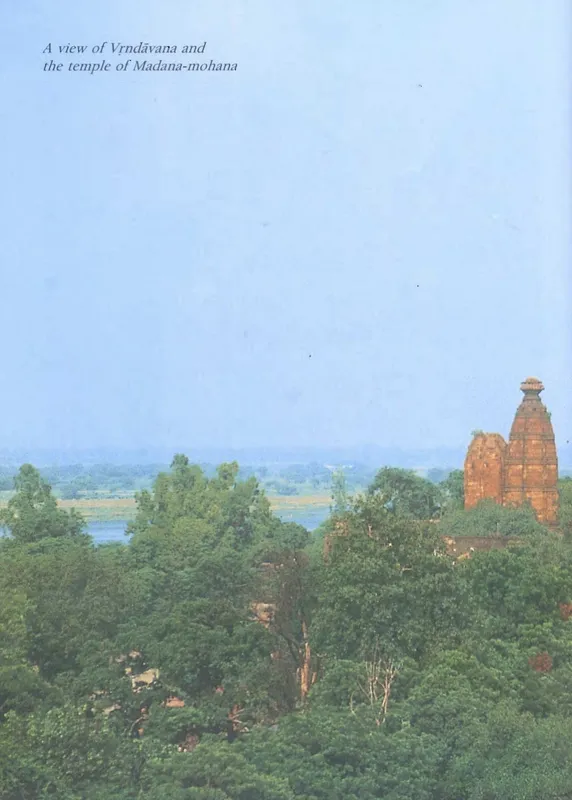
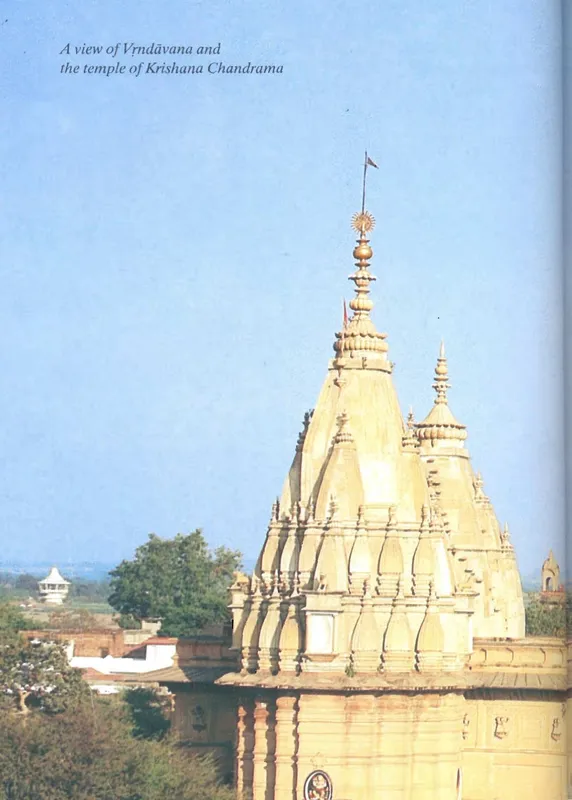
- Vṛndāvana is the forest on the bank of the Yamunā where Kṛṣṇa spent His childhood and youth, and the town of temples that stands in that forest today.
- Visiting
- Śrīla Prabhupāda gives Akrūra as the example for a pilgrim: think of the Lord's pastimes on the way, and smear the dust of Vṛndāvana on the body on reaching its boundary.
- Places here
- Bhātrola, Ramaṇa-reti (Vṛndāvana), Kāliya-damanavana, Gopālavana, Kevārivana +147 more
In short
Vṛndāvana is the forest on the bank of the Yamunā where Kṛṣṇa spent His childhood and youth, and the town of temples that stands in that forest today.[1 +10] Śrīmad-Bhāgavatam tells how the cowherds moved here from Mahāvana, how Kṛṣṇa herded the cows in this forest and how He danced the rāsa with the gopīs, the cowherd girls, on the Yamunā's bank; it names no particular spot.[12 +11] The Gosvāmīs teach that this Vṛndāvana is Kṛṣṇa's own eternal abode, which Kṛṣṇa, the son of Nanda, never leaves.[24 +8] Śrī Caitanya Mahāprabhu sent Śrīla Rūpa Gosvāmī and Śrīla Sanātana Gosvāmī here to uncover its lost holy places, and Śrīla Prabhupāda called Vṛndāvana his home.[33 +8]
Key facts
| Kind | town |
|---|---|
| Also part of | Vṛndāvana (forest) |
| Ācāryas | Śrī Caitanya Mahāprabhu, Śrīla Rūpa Gosvāmī, Śrīla Sanātana Gosvāmī, Śrīla Jīva Gosvāmī, Śrīla Raghunātha dāsa Gosvāmī |
Why it is glorified
When Brahmā woke from his bewilderment after stealing Kṛṣṇa's calves and friends, he looked around and saw Vṛndāvana, full of …
When Brahmā woke from his bewilderment after stealing Kṛṣṇa's calves and friends, he looked around and saw Vṛndāvana, full of trees and pleasant in every season. The Bhāgavatam calls it the abode of the Lord, where creatures that are enemies by nature live together as friends.[12 +5]
sapady evābhitaḥ paśyan diśo 'paśyat puraḥ-sthitam / vṛndāvanaṃ janājīvya- drumākīrṇaṃ samā-priyam … yatra naisarga-durvairāḥ sahāsan nṛ-mṛgādayaḥ / mitrāṇīvājitāvāsa- druta-ruṭ-tarṣakādikam
Vṛndāvana is the transcendental abode of the Lord, where there is no hunger, anger or thirst. Though naturally inimical, both human beings and fierce animals live there together in transcendental friendship.
Translation: Śrīla A.C. Bhaktivedanta Swami PrabhupādaOther verses of the Tenth Canto say that Kṛṣṇa and Balarāma made the land most holy with Their footprints, and a gopī says that Vṛndāvana spreads the glory of the earth because it has received Kṛṣṇa's lotus feet.[12 +10] Brahmā prays for any birth at all in "this forest of Gokula", which the commentators and Śrīla Prabhupāda's Kṛṣṇa book take as Vṛndāvana, and Uddhava prays to be born here as a bush or a creeper:[42 +6]
আসামহো চরণরেণুজুষামহং স্যাং বৃন্দাবনে কিমপি গুল্মলতৌষধীনাম্ ।
যা দুস্ত্যজং স্বজনমার্যপথঞ্চ হিত্বা ভেজুর্মুকুন্দপদবীং শ্রুতিভির্বিমৃগ্যাম্ ॥ ৪৭ ॥
āsām aho caraṇa-reṇu-juṣām ahaṁ syāṁ
vṛndāvane kim api gulma-latauṣadhīnām
yā dustyajaṁ sva-janam ārya-pathaṁ ca hitvā
bhejur mukunda-padavīṁ śrutibhir vimṛgyām
“ ‘The gopīs of Vṛndāvana have given up the association of their husbands, sons and other family members, who are very difficult to give up, and they have forsaken the path of chastity to take shelter of the lotus feet of Mukunda, Kṛṣṇa, which one should search for by Vedic knowledge. Oh, let me be fortunate enough to become one of the bushes, creepers or herbs in Vṛndāvana, for the gopīs trample them and bless them with the dust of their lotus feet.’
Translation: Śrīla A.C. Bhaktivedanta Swami PrabhupādaŚrīla Rūpa Gosvāmī's Upadeśāmṛta ranks the forest of Vṛndāvana above Mathurā because of the rāsa dance, and Govardhana and Rādhā-kuṇḍa, which lie within that forest, higher still.[4 +6] In his Bhakti-rasāmṛta-sindhu Kṛṣṇa says that no playground anywhere equals Vṛndāvana.[50 +5] Śrīla Svarūpa Dāmodara Gosvāmī says in the Caitanya-caritāmṛta that the natural opulence of Vṛndāvana is an ocean, beside which the opulence of Dvārakā and Vaikuṇṭha is not even a drop.[46 +1] In a verse of the Ādi-purāṇa that Śrīla Rūpa Gosvāmī and the Caitanya-caritāmṛta quote, Kṛṣṇa tells Arjuna that the earth is fortunate among the three worlds because the town of Vṛndāvana is on it.[42 +4]
The Purāṇas praise Vṛndāvana too. In the Padma Purāṇa Lord Śiva tells Pārvatī that Vṛndāvana is Kṛṣṇa's dearest and most secret abode, eternal and above the universe; Vaikuṇṭha is only a part of its portion, and on earth Vṛndāvana is that abode itself.[28 +1] The Garga-saṁhitā calls it the best of the forests of Mathurā-maṇḍala and greater than Vaikuṇṭha.[58] In the Varāha Purāṇa the Lord calls Vṛndāvana His own holy land, where He plays with the cows and the cowherd boys, and the place where Keśī was killed is in it.[59] The Nārada Purāṇa says that the very sight of Vṛndāvana gives liberation, and that whoever even says its name has devotion to Nanda's son.[10 +1] In the Bhāgavata-māhātmya, Bhakti, the goddess of devotion, becomes young again on reaching Vṛndāvana.[37 +2]
Kṛṣṇa's own abode
The Caitanya-caritāmṛta says that the highest abode, Śrī Gokula, is also called Vraja, Goloka and Vṛndāvana, and that by Kṛṣṇa's will it appears in this world, identical with the original:[24 +5]
চিন্তামণিভূমি, কল্পবৃক্ষময় বন ।
চর্মচক্ষে দেখে তারে প্রপঞ্চের সম ॥ ২০ ॥
cintāmaṇi-bhūmi, kalpa-vṛkṣa-maya vana
carma-cakṣe dekhe tāre prapañcera sama
The land there is touchstone [cintāmaṇi], and the forests abound with desire trees. Material eyes see it as an ordinary place.
Translation: Śrīla A.C. Bhaktivedanta Swami PrabhupādaŚrīla Jīva Gosvāmī explains Goloka as a special manifestation of this very Vṛndāvana.[27] Śrīla Viśvanātha Cakravartī Ṭhākura writes in his Vraja-rīti-cintāmaṇi that the place called Vṛndāvana, Gokula and Vraja is made of consciousness, though it seems to be something else, and is one place with many villages, forests and pastures (summarised here, not translated).[62]
The name and the extent
The commentators on the Bhāgavatam explain the name as "the forest of Vṛndā". Śrīla Sanātana Gosvāmī calls her a chaste lady favoured by the Lord, Śrīla Jīva Gosvāmī the goddess who prepared the forest for Kṛṣṇa's play, and Śrīla Baladeva Vidyābhūṣaṇa the goddess who protects it.[14 +1] The Purāṇas, a guidebook and Śrīla Prabhupāda explain the name in other ways:
Accounts differ After whom Vṛndāvana is named.
- Brahma-vaivarta Purāṇa, Kṛṣṇa-janma-khaṇḍa 17.198–205After Vṛndā, King Kedāra's daughter (a portion of Kamalā), who performed austerities there and obtained Kṛṣṇa (or because she sported there).
- Brahma-vaivarta Purāṇa, Kṛṣṇa-janma-khaṇḍa 17.206–212Because it is the place of the austerities of Tulasī, daughter of Kuśadhvaja.
- Śrī Vraja-maṇḍala Parikramā (2007)After the eternal Vṛndā-devī, the forest goddess and expansion of Rādhā; Kedāra's daughter and Tulasī are her portions.
- Varāha Purāṇa 153.48Gives no etymology but calls Vṛndāvana 'protected by Vṛndā' (vṛndayā parirakṣitam).
The forest is much larger than the town. Śrīla Prabhupāda writes that it reaches from the town of Vṛndāvana to Nandagrāma and Varṣāṇā, thirty-two miles, with the Pañcakrośī Vṛndāvana town inside it; the Garga-saṁhitā places Govardhana, Nandīśvara and Bṛhatsānu (Varṣāṇā) in the forest.[4 +5] In his translation of the Caitanya-caritāmṛta he calls the town "the village of Pañcakrośī Vṛndāvana", Vṛndāvana of five krośas (an old measure of distance).[8 +1] In The Nectar of Instruction he uses "the land of Vṛndāvana" for the whole of Vraja.[65] In the Varāha Purāṇa's list of the twelve forests of Vraja, Vṛndāvana is the twelfth, protected by Vṛndā; the lists of the twelve differ from book to book (see below).[66 +2]
Divine pastimes
The cowherds move to Vṛndāvana
At an assembly of the cowherds of Gokula, the elder Upananda said that they should leave, because disturbances kept coming there to kill Rāma and Kṛṣṇa. He proposed a forest named Vṛndāvana, which Śrīla Prabhupāda's translation places between Nandeśvara and Mahāvana:[1 +6]
vanaṃ vṛndāvanaṃ nāma paśavyaṃ nava-kānanam / gopa-gopī-gavāṃ sevyaṃ puṇyādri-tṛṇa-vīrudham
Between Nandeśvara and Mahāvana is a place named Vṛndāvana. This place is very suitable because it is lush with grass, plants and creepers for the cows and other animals. It has nice gardens and tall mountains and is full of facilities for the happiness of all the gopas and gopīs and our animals.
Translation: Śrīla A.C. Bhaktivedanta Swami PrabhupādaThe cowherds entered Vṛndāvana and camped with their bullock carts set in a half-moon. When Kṛṣṇa and Balarāma saw Vṛndāvana, Govardhana and the banks of the Yamunā, They were full of joy.[1 +6] The Bhāgavatam does not mention a crossing of the river, but its commentators do: for Śrīla Sanātana Gosvāmī the crossing was easy, for Śrīla Jīva Gosvāmī the cowherds tied their carts together as rafts, and for Śrīla Baladeva Vidyābhūṣaṇa the water was ankle-deep (summarised here, not translated).[71 +1] The Purāṇas give other reasons for the move, and the sources set the cowherds' camp in different places (see below).[1 +5] Read more: Nanda's family at Nandagrāma →
Kṛṣṇa in the forest
When Kṛṣṇa and Balarāma reached the age of six to ten, the cowherds let Them tend the cows, and They went everywhere in Vṛndāvana with Their friends.[12 +5] In summer the forest seemed like spring, because Kṛṣṇa lived there with Balarāma. In autumn He entered it dressed as the best of dancers, playing His flute:[12 +6]
Wearing a peacock-feather ornament upon His head, blue karṇikāra flowers on His ears, a yellow garment as brilliant as gold, and the Vaijayantī garland, Lord Kṛṣṇa exhibited His transcendental form as the greatest of dancers as He entered the forest of Vṛndāvana, beautifying it with the marks of His footprints. He filled the holes of His flute with the nectar of His lips, and the cowherd boys sang His glories.
Translation: Śrīla Prabhupāda's disciples (BBT)None of the verses that name Vṛndāvana names a particular spot.[12 +5] The places in the town that the ācāryas and guidebooks connect with the pastimes of Kāliya, Brahmā, the forest fire and Keśī, such as Kāliya-hrada, Brahma-kuṇḍa, Dāvānala-kuṇḍa and Keśī-ghāṭa, each have their own page.[12 +6]
In a hymn, Śrīla Rūpa Gosvāmī says that Kṛṣṇa showed the cowherds the highest spiritual world and led them home again, to show that no world is more charming than the forest of Vṛndāvana (summarised here, not translated).[74 +1] Read more: The cowherds' vision at Brahma-hrada →
The Bhāgavatam tells how the unmarried gopīs kept a vow to the goddess Kātyāyanī, bathed in the Yamunā at sunrise, and how Kṛṣṇa took their clothes and climbed a kadamba tree; it names no ghāṭa.[76 +1] The Color Guide to Vṛndāvana (2000) says that, according to Śrīla Jīva Gosvāmī, the Cīra-ghāṭa of this pastime is eight miles up the river, not the Cīra-ghāṭa of the town; in his commentary Śrīla Jīva Gosvāmī names only a ghāṭa of Vraja known by the goddess Ghaṭṭa-vāsinī's name, without a distance.[78 +2] Read more: The Kātyāyanī vow and the gopīs' clothes: the pastime and its places →
According to the Bhakti-ratnākara, the pastime took place at a Cīra-ghāṭa up the river between Gopī-ghāṭa and Nanda-ghāṭa. The sources differ:[81]
Accounts differ Where Kṛṣṇa stole the clothes of the gopīs after their Kātyāyanī vow (ŚB 10.22): at Vṛndāvana's Cīra-ghāṭa, at a Cīra-ghāṭa up the river, or elsewhere.
- Śrīmad-Bhāgavatam 10.22On the bank of the Yamunā (Kālindī), near a kadamba tree; no ghāṭa is named.
- The Color Guide to Vṛndāvana (2000), entry 46Some people claim Vṛndāvana's Chir Ghāṭa, 'but according to Jīva Gosvāmī, Cira-ghāṭa is eight miles up-river' (untraced).
- Bhakti-ratnākara, Fifth Wave (printed p. 269)At a Cīra-ghāṭa up the river, between Gopī-ghāṭa and Nanda-ghāṭa; at Vṛndāvana's Cīra-ghāṭa it tells a different clothes pastime of Rādhā and the sakhīs.
- Śrī Vraja-maṇḍala Parikramā (2007)At the Cīra-ghāṭa two miles west of Akṣayavaṭa (village Siyāro, temple of Kātyāyanī) and also at Vṛndāvana's Cīra-ghāṭa: both are Cīra-ghāṭa, the pastime recurring in different kalpas.
The rāsa dance
The Bhāgavatam sets the rāsa on the nights of autumn, on the sandy bank of the Yamunā to which Kṛṣṇa took the gopīs. During the search on that night the gopīs asked the creepers and trees of Vṛndāvana where He had gone.[18 +5] Later, in Kṛṣṇa's absence, a gopī asks Uddhava:[18 +5]
tāḥ kiṁ niśāḥ smarati yāsu tadā priyābhir vṛndāvane kumuda-kunda-śaśāṅka-ramye
reme kvaṇac-caraṇa-nūpura-rāsa-goṣṭhyām asmābhir īḍita-manojña-kathaḥ kadācit
Does He recall those nights in the Vṛndāvana forest, lovely with lotus, jasmine and the bright moon? As we glorified His charming pastimes, He enjoyed with us, His beloved girlfriends, in the circle of the rāsa dance, which resounded with the music of ankle bells.
Translation: Śrīla Prabhupāda's disciples (BBT)The Bhāgavatam names no spot of the rāsa.[18 +5] Śrīla Prabhupāda's Kṛṣṇa book says that, at the sound of the flute, the gopīs rushed towards the place known as Vaṁśīvaṭa, and that Kṛṣṇa wandered with them in the forest to the Yamunā's bank. The Color Guide to Vṛndāvana (2000) says that the present town marks the site of the rāsa, and Śrī Vraja-maṇḍala Parikramā (2007) that Kṛṣṇa danced it while the cowherds lived at Śakaṭīkarā.[22 +5] Read more: Where the autumn rāsa took place →
Kṛṣṇa leaves for Mathurā
After Ariṣṭa was killed, Nārada told Kaṁsa that Kṛṣṇa and Balarāma were the sons of Vasudeva, left in the care of his friend Nanda. Kaṁsa sent Keśī to kill Them, and then sent Akrūra to bring Them to Mathurā.[86 +6] As He left, Kṛṣṇa saw the gopīs' grief and sent them word that He would return.[86 +4] Later Nanda asked Uddhava whether Kṛṣṇa still remembered the cows, Vṛndāvana and the hill.[12 +5] Read more: Uddhava brings Kṛṣṇa's message to the gopīs →
Śrīla Prabhupāda explains in the Kṛṣṇa book (chapter 46), following the decision of expert devotees, that Kṛṣṇa did not break His promise to return:[93]
General teaching (does not name the place)“But when He failed to come back with Nanda Mahārāja, it appeared that He either cheated them or could not keep His promise. Expert devotees, however, have decided that Kṛṣṇa was neither a cheater nor a breaker of promises. Kṛṣṇa, in His original identity, returned with Nanda Mahārāja and stayed with the gopīs and Mother Yaśodā in His bhāva expansion.”
Śrīla Prabhupāda, Kṛṣṇa, the Supreme Personality of Godhead (Kṛṣṇa book), Chapter 46, 'Uddhava Visits Vṛndāvana' · vedabase.io
The Gosvāmīs teach that Kṛṣṇa, the son of Nanda, never leaves Vṛndāvana. Śrīla Rūpa Gosvāmī quotes a verse of the Yāmala:[30 +2]
tathā śrī-yāmala-vacanaṃ samudāharanti - kṛṣṇo'nyo yadu-sambhūto yaḥ pūrṇaḥ so'sty ataḥ param
vṛndāvanaṃ parityajya sa kvacit naiva gacchati //
“ ‘The Kṛṣṇa known as Yadu-kumāra is Vāsudeva Kṛṣṇa. He is different from the Kṛṣṇa who is the son of Nanda Mahārāja. Yadu-kumāra Kṛṣṇa manifests His pastimes in the cities of Mathurā and Dvārakā, but Kṛṣṇa the son of Nanda Mahārāja never at any time leaves Vṛndāvana.’ ”
Translation: Śrīla A.C. Bhaktivedanta Swami PrabhupādaThe commentators on the Bhāgavatam explain this in their own words (summarised here, not translated). Śrīla Sanātana Gosvāmī says that in one manifestation Kṛṣṇa always plays in Vṛndāvana and in another He set out for the city; Śrīla Jīva Gosvāmī reads the Bhāgavatam's "He stays" as "He plays there eternally", and quotes the Bṛhad-gautamīya Tantra, in which Kṛṣṇa calls the forest His own body and says He never leaves it. None of them names a place where the two manifestations parted.[15 +7] Read more: Kṛṣṇa's promise to return to Vraja, and Loṭhā Bābā of Pūñcharī →
Śrī Caitanya Mahāprabhu in Vṛndāvana
The Caitanya-caritāmṛta tells that Śrī Caitanya Mahāprabhu, seeing the crowds in Mathurā, stayed in a quiet place at Akrūra-tīrtha, and from there went to Vṛndāvana:[33 +9]
আর দিন আইলা প্রভু দেখিতে ‘বৃন্দাবন’ ।
‘কালীয়-হ্রদে’ স্নান কৈলা আর প্রস্কন্দন ॥ ৭১ ॥
āra dina āilā prabhu dekhite ‘vṛndāvana’
‘kālīya-hrade’ snāna kailā āra praskandana
The next day, Śrī Caitanya Mahāprabhu went to Vṛndāvana and took His bath at Kālīya Lake and Praskandana.
Translation: Śrīla A.C. Bhaktivedanta Swami PrabhupādaHe went to Vṛndāvana by day and came back to Akrūra for His meals, and when the people of Akrūra came to see Him in crowds, He went to Vṛndāvana to chant alone.[100 +3] The Bhakti-ratnākara calls His residence "the village of Akrūra", and Śrī Vraja-maṇḍala Parikramā (2007) names a village Akrūra-gaon beside Akrūra-ghāṭa.[104 +2] Śrīla Prabhupāda lists the places He saw every day: Kāliya-hrada, Dvādaśāditya-ghāṭa, Keśī-ghāṭa, the place of the rāsa, Cīra-ghāṭa and the tamarind tree of Imlītalā.[33 +5]
Traditional accounts
The Skanda Purāṇa's Bhāgavata-māhātmya says that after Kṛṣṇa's departure Vajranābha, helped by Parīkṣit and blessed by the sage …
The Skanda Purāṇa's Bhāgavata-māhātmya says that after Kṛṣṇa's departure Vajranābha, helped by Parīkṣit and blessed by the sage Śāṇḍilya, found and named the places of Kṛṣṇa's pastimes, founded villages, made ponds and wells, and installed Deities.[37 +1] According to The Colour Guide to Rādhā-kuṇḍa (1999), Vajranābha installed Madana-mohana, Govindajī, Gopīnātha, Sākṣi-gopāla, Vṛndā-devī and Gopīśvara in Vṛndāvana; this may be the book's own list, since the Purāṇa names only the forms of Govinda, Harideva and others.[37 +3]
Śrīla Raghunātha dāsa Gosvāmī describes how Paurṇamāsī, at Brahmā's command, bathed Rādhā with the waters of the Mānasa-gaṅgā and other rivers and marked Her tilaka as the great queen of the kingdom of Vṛndāvana.[111 +4] Śrīla Sanātana Gosvāmī and Śrīla Jīva Gosvāmī say that the Vṛndāvana Brahmā saw is dear to Śrī Rādhā; Śrīla Sanātana Gosvāmī gives as the reason the rule over it that the Lord gave Her.[116] According to Śrī Vraja-maṇḍala Parikramā (2007), Vṛndā-devī is the eternal goddess of the forest, who arranges the meetings of Rādhā and Kṛṣṇa in the groves and gave her kingdom to Rādhā, so that Rādhā is Vṛndāvaneśvarī, the queen of Vṛndāvana.[45 +1] The sources give the title to different persons:
Accounts differ Who is called Vṛndāvaneśvarī (queen / mistress of Vṛndāvana).
- Garga-saṁhitā Vṛndāvana-khaṇḍa 20.14The goddess Vṛndā, 'the queen of Vṛndāvana'.
- Śrīla Rūpa Gosvāmī, Ujjvala-nīlamaṇi 5.6; Padma Pātāla 77.17, 70.10; Śrīla Raghunātha dāsa, Muktā-caritaRādhā.
- Śrī Vraja-maṇḍala Parikramā (2007)Vṛndā-devī, the forest goddess, dedicated her kingdom to Rādhā, 'therefore Śrīmatī Rādhikā is truly Vṛndāvaneśvarī'.
The Gosvāmīs and ācāryas
- Śrīla Rūpa Gosvāmī lived in different parts of Vṛndāvana, with his headquarters at the Rādhā-Dāmodara temple, as Śrīla Prabhupāda writes (his bhajana-kuṭī). His Vṛndāvanāṣṭaka prays that the forest of Vṛndāvana be his shelter.[131 +1]
- Śrīla Sanātana Gosvāmī opens his commentary on the Tenth Canto by bowing to Śrī Kāśīśvara, Śrīla Lokanātha Gosvāmī and Śrī Kṛṣṇadāsa, dear to Vṛndāvana and sheltered at Śrī Govinda's feet (Śrī Kāśīśvara Paṇḍita's samādhi).[133]
- Śrīla Raghunātha dāsa Gosvāmī came to Vṛndāvana after Śrī Caitanya Mahāprabhu's disappearance, according to The Colour Guide to Rādhā-kuṇḍa (1999), and in his Vraja-vilāsa-stava vows that he will not live anywhere else, not even in the Lord's own city, but always in Vraja.[134 +1]
- Śrīla Kṛṣṇadāsa Kavirāja Gosvāmī tells in the Caitanya-caritāmṛta that he came to Vṛndāvana at the order of Śrī Nityānanda Prabhu in a dream and lived here by His mercy (his samādhi).[136 +1]
- Śrīla Lokanātha Gosvāmī and Śrīla Bhūgarbha Gosvāmī came together, in 1509 according to Govardhana Hill (2001); The Color Guide to Vṛndāvana (2000) names Śrīla Lokanātha Gosvāmī as the founder of the Rādhā-Gokulānanda temple.[119 +3]
- Śrīla Prabodhānanda Sarasvatī praises the sweetness of the Vṛndāvana forest in his Caitanya-candrāmṛta, and his Vṛndāvana-mahimāmṛta is a whole work in praise of Vṛndāvana (his samādhi).[119 +4]
- Śrī Subuddhi Rāya, a landholder of Bengal, met Śrī Caitanya Mahāprabhu in Vārāṇasī and was told to go to Vṛndāvana and chant the holy name; the Caitanya-caritāmṛta tells that he later took Śrīla Rūpa Gosvāmī to see the twelve forests (his samādhi).[143 +5]
- According to the Bhakti-ratnākara, Śrī Gopāla Bhaṭṭa Gosvāmī, Śrīla Bhūgarbha Gosvāmī, Śrīla Lokanātha Gosvāmī, Śrī Madhu Paṇḍita, Śrīla Jīva Gosvāmī and others came out to the place of Akrūra to receive Śrīla Jāhnavā-devī, and there Śrīla Jīva Gosvāmī told her that Śrī Caitanya Mahāprabhu used to take His meals in that quiet place.[149 +1]
- Śrīla Bilvamaṅgala Ṭhākura, Śrīla Prabhupāda writes, became a perfect Vaiṣṇava in Mathurā and Vṛndāvana (his samādhi).[151 +1]
- Vṛndāvana-Dhāma Ki Jaya! (c. 1986) shows a photograph of Śrīla Sanātana Gosvāmī's well; the guidebooks tell that Madana-mohana made a well with His flute for him in his old age, which may or may not be this one.[153 +4]
- Śrīla Rasikānanda Prabhu, Śrīla Śyāmānanda Paṇḍita's chief disciple, has a memorial (puṣpa-samādhi) in the Vṛndāvana lists; Śrīla Prabhupāda writes that his tomb is at Remuṇā in Orissa.[158 +4]
Śrīla Prabhupāda
Śrīla Prabhupāda gives the essence of Śrī Caitanya Mahāprabhu's teaching on the dhāma, the Lord's abode …
Śrīla Prabhupāda gives the essence of Śrī Caitanya Mahāprabhu's teaching on the dhāma, the Lord's abode:[46 +3]
Names this place“Vṛndāvana-dhāma is nondifferent from the Lord because the name, fame, form and place where the Lord manifests Himself are all identical with the Lord as absolute knowledge. Therefore Vṛndāvana-dhāma is as worshipable as the Lord.”
Śrīla Prabhupāda, Śrīmad-Bhāgavatam, Canto 1, Introduction (the essence of Śrī Caitanya's preaching) · vedabase.io
Speaking in Vṛndāvana in 1972, he called it Bhauma-Vṛndāvana, the earthly Vṛndāvana, the replica of the original and not different from it.[29] In 1975 he said that coming by train or aeroplane is not seeing Vṛndāvana; one sees it when the mind is purified.[165] He wrote the same in the Kṛṣṇa book, with Akrūra as the example:[165 +2]
Names this place“Actually, one cannot go to Vṛndāvana by purchasing a ticket. The process of going to Vṛndāvana is shown by Akrūra.”
Śrīla Prabhupāda, Kṛṣṇa, the Supreme Personality of Godhead (Kṛṣṇa book), Chapter 38, 'Akrūra's Arrival in Vṛndāvana' · vedabase.io
Of the Vṛndāvana of his own day he wrote:[168]
Names this placeEven in this material world, the animals in Vṛndāvana are not envious of the sādhus who live there. The sādhus keep cows and supply milk to the tigers, saying, “Come here and take a little milk.” Thus envy and malice are unknown in Vṛndāvana. That is the difference between Vṛndāvana and the ordinary world.
Śrīla Prabhupāda, Śrīmad-Bhāgavatam, 10.13.60, purport · vedabase.io
He wrote that the devotees of the town visit different temples every morning and evening, and that at least a dozen big temples started by the Gosvāmīs should be seen.[36 +4] In the month of Kārttika, he wrote, there is a special programme of worship of the Lord as Dāmodara in Vṛndāvana, and many devotees come to stay for the month.[171] Explaining Śrīla Rūpa Gosvāmī's advice to live in Vraja, he wrote that one who lives in Vṛndāvana should take shelter of an advanced devotee there, and that one who cannot live there can live there in meditation.[65 +1]
His years in Vṛndāvana
In the later 1950s Śrīla Prabhupāda took a room at the Vaṁśī-gopāla temple near Keśī-ghāṭa, where he lived and wrote.[120 +3] On the year he moved to rooms at the Rādhā-Dāmodara temple the sources differ: his biographer gives July 1962, a guidebook 1959.[174]
Accounts differ When Śrīla Prabhupāda moved his Vṛndāvana residence to the Rādhā-Dāmodara temple.
- The Color Guide to Vṛndāvana (2000), chronology of Śrīla Prabhupāda's life1959 (July): moved to the Rādhā Dāmodara temple and began the English translation of Śrīmad-Bhāgavatam.
- Śrīla Prabhupāda-līlāmṛta, Vol. 1 ch. 10July 1962: changed his residence from the Vaṁśī-gopālajī temple to the Rādhā-Dāmodara temple, where he had been paying rent for rooms for three years.
His place of bhajana there was behind Śrīla Rūpa Gosvāmī's tomb, as he wrote from America in 1969:[131] Read more: Śrīla Prabhupāda at the Rādhā-Dāmodara temple →
Names this place“While physically present, Śrīla Rūpa Gosvāmī was living in different parts of Vṛndāvana, and his headquarters were in the temple of Rādhā-Dāmodara in the present city of Vṛndāvana. … Behind this very tomb I have my place of bhajana, but since 1965 I have been away.”
Śrīla Prabhupāda, The Nectar of Devotion, Concluding Words, 30 June 1969 · vedabase.io
In 1975 he wrote that his Vṛndāvana temple, the Kṛṣṇa-Balarāma Mandira, would be opened on Rāma-navamī, 20 April 1975.[122] Read more: How Śrīla Prabhupāda built the Kṛṣṇa-Balarāma Mandira → His biographer reports that he often called Vṛndāvana his residence, Bombay his office and Māyāpur his place of worship, and that on the drive to Vṛndāvana in 1977 he told a disciple:[39 +2]
From his biography“Yes,” Prabhupāda replied, “Vṛndāvana is my home, and Bombay is my office.”
Satsvarūpa dāsa Gosvāmī, Śrīla Prabhupāda-līlāmṛta, vol. 2, ch. 52 · vedabase.io
Songs
Śrīla Viśvanātha Cakravartī Ṭhākura's Vṛndāvanāṣṭaka: each verse ends with the prayer that his residence be in Vṛndāvana alone …
Śrīla Viśvanātha Cakravartī Ṭhākura's Vṛndāvanāṣṭaka: each verse ends with the prayer that his residence be in Vṛndāvana alone, rather than mystic powers, liberation or a place in Vaikuṇṭha.[175 +1]
na yoga-siddhir na mamāstu mokṣo
vaikuṇṭha-loke pi na pārṣadatvam
premāpi na syād iti cet tarāṁ tu
mamāstu vṛndāvana eva vāsaḥ
While he lived alone in Vṛndāvana-dhāma, Śrīla Prabhupāda wrote a Bengali song; his biography quotes its opening, "I am sitting alone in Vṛndāvana-dhāma".[173 +1]
Visiting today
Coming to Vṛndāvana
Śrīla Prabhupāda gives Akrūra as the example for a pilgrim: think of the Lord's pastimes on the way, and smear the dust of Vṛndāvana on the body on reaching its boundary.[167] He writes that devotees still walk around all the places of Kṛṣṇa's pastimes, and that whoever goes to Vṛndāvana at once feels separation from Kṛṣṇa.[178] The month of Kārttika is the special time for staying here, as told above.[171]
The town and its forests
Śrī Vraja-maṇḍala Parikramā (2007) counts twelve small forests inside the ten-mile parikramā (the walk around the town). The third is Vihāravana, south-west of Kevārivana, with Rādhā-kūpa, a well into which pilgrims call "Rādhā, Rādhā" to hear the echo.[179 +3] The Vraja-bhakti-vilāsa glorifies a Vihāravana where Kṛṣṇa danced the rāsa, but in its own scheme that forest is not one of the town's.[183 +2]
The fourth is Gocāraṇavana, west of Vihāravana on the old bank of the Yamunā, with a temple of Lord Varāha and the āśrama of Gautama Muni.[180 +2] The small Varāha temple, with a boar-headed Deity, stands at Varāha-ghāṭa; according to the local tradition recorded in the guidebooks, Kṛṣṇa showed the gopīs His form as Varāha here, which is not certain.[180 +6] In Papaḍavana, the southernmost of these forests, the same book places Ādi-badrīvana, where, the book says, a forest of ber trees still grew in its day; this may have changed.[191]
Quarters and streets
Śrī Vraja-maṇḍala Parikramā (2007) lists fifty-six quarters (mohallās) of the town, following an older list that F. S. Growse printed in 1883 and the Bengali Vṛndāvana-kathā repeated in 1920.[192 +2]
- Vyāsa-gherā, quarter no. 23, after Sevā-kuñja and Kuñja-galī; it is already no. 24 in Growse's list of 1883.[192 +1]
- Aṭhkhambā, the street from the Bāṅke-bihārī temple to Bankhaṇḍī Mahādeva, where it meets Loī-bāzār; the road that Vṛndāvana, the Playground of God (2010) calls the way to the Bāṅke-bihārī Bazaar meets Loī-bāzār at the same shrine.[182 +4]
- Loī-bāzār, "the blanket mart" in Growse's list; in 1977 Śrīla Prabhupāda's disciples told him of a kīrtana procession along it to the Bāṅke-bihārī temple.[182 +5]
- Retiyā-bāzāra, near Nidhuvana, with the Śāhajāpura temple of Śrī Rādhā-Gopāla, which Śrī Vraja-maṇḍala Parikramā (2007) says Lālā Vrajakiśora, the dīvān (chief minister) of Śāhajāpura state, built in 1873; it is a different temple from the Śāhajī temple.[155 +5]
- Gopīnātha Bazaar, with Śrīla Bilvamaṅgala Ṭhākura's samādhi and the Amiya Nimāi temple, opened in 1956, according to Vṛndāvana, the Playground of God (2010); Śrīla Prabhupāda names it in letters of 1966 and 1970 and in a lecture of 1974.[203 +4]
- Sevā-kuñja-galī, a lane near Sevā-kuñja that Śrī Vraja-maṇḍala Parikramā (2007) names once, with the Dāna- and Māna-galīs, for the Rūpa-Sanātana Gauḍīya Maṭha; the Bengali Vṛndāvana-kathā (1920) seems to name the same lane.[41 +3]
The riverside ghāṭas
Growse (1883) describes a row of ghāṭas, bathing steps, along about a mile and a half of the river front, from Kāliya-ghāṭa to Keśī-ghāṭa; the district gazetteer of 1911 counts thirty-two.[211 +1] The Color Guide to Vṛndāvana (2000) prints a list of the ghāṭas and their builders that follows Growse's entry for entry. It says that they were built of red sandstone under the Rājput princes, from about 1580 to before 1870, and that many have fallen into disrepair or been covered with sand.[213 +3]
- Built by kings, according to Growse's list and The Color Guide: Bardwan-ghāṭa (a Rājā of Bardwan), Dhurawara-ghāṭa (Rājā Randhīr Singh of Dhūra), Hanumāna-ghāṭa (Savāī Jai Singh of Jaipur), Śrījī-ghāṭa (a Rājā of Jaipur), Nabhawala-ghāṭa (Rājā Hīrā Singh of Nābhā), Tehriwara-ghāṭa (the Rājā of Tehri) and Ranawat-ghāṭa (the Rāṇā of Udaipur).[193 +4]
- Built by queens of Bharatpur: Gaṅgā-mohana-ghāṭa, by Gaṅgā, Rānī of Sūraj Mal, and Kiśor Rānī's Ghāṭa, by Kiśorī, Rānī of Sūraj Mal. The Color Guide adds Tekari-ghāṭa, by the Tekari Rānī of Gaya, who also built the Tekari Rānī temple; no source says that the ghāṭa belongs to the temple.[195 +7]
- Built by gosāīṁs and others: Himmata-bahādura-ghāṭa (the Gosāīṁ Himmat Bahādur), Nayā-ghāṭa (Gosāīṁ Bhajan Lāl), Bihar-ghāṭa (Appā Rām from the Deccan), Pandawara-ghāṭa (Chaudhari Jagannāth of Lucknow) and Ram-Gol Ghāṭa (the gosāīṁ of a temple of Bihārījī); Koriya-ghāṭa, according to the lists, may be named after gosāīṁs from Kol. Barwara-ghāṭa, Dhūsara-ghāṭa and Imli-ghāṭa have no builder in the lists.[193 +5]
- From the Vṛndāvana-kathā, Śrī Vraja-maṇḍala Parikramā (2007) adds fourteen ghāṭas, among them Mahāntajī-ghāṭa, Nāmāovālā-ghāṭa, Kaḍiyā-ghāṭa, Vihārījī-ghāṭa, Dharoyāra-ghāṭa and Nāgarī-ghāṭa. Thirteen of them stand in the same order in Growse's list under other spellings, so they are probably the same ghāṭas as some above, such as Nagari Dās Ghāṭa, though no book says so.[193 +6]
- Rādhā-bāga-ghāṭa, in the east of the town, is on the map of Śrī Vraja-maṇḍala Parikramā (2007) but not in the list of The Color Guide.[181 +2]
Smaller temples and other places
- The Nṛsiṁhadeva temple has a large wooden Deity of Lord Nṛsiṁha with Lakṣmī-devī and Prahlāda Mahārāja beside Him.[227 +2]
- Among the modern temples of Śrī Vraja-maṇḍala Parikramā (2007) are the Mahārānī Svarṇamayī temple near the Yamunā, which the book says was built by Mahārānī Svarṇamayī of the Kāsimbāzār family of Bengal (not certain), and Giridhārījī, Hāḍābāḍī-kuñja and Kālābābū-kuñja, which the book only names.[195 +1]
- Manas Mandira overlooks Brahma-kuṇḍa, and from its roof, The Color Guide (2000) says, one may see the whole town. The same book shows an ancient domed shrine at the kuṇḍa without naming it.[182 +2]
- Two Yugala-kiśora temples in Śrī Vraja-maṇḍala Parikramā (2007): one near Keśī-ghāṭa, which it calls dilapidated, and a large Yugala-kiśora temple with a broken dome north-east of the old Rādhā-Mādhava temple.[191 +1]
- The present Rādhā-Vallabha temple stands next to the original one; the sources differ on when that was built and what became of it.[229 +1]
- Raṅgajī Bāg, the large garden of the Raṅgajī temple: its festival car is pulled there in the ten-day Brahmotsava of Caitra, and one guide recommends it as a quiet place to chant japa.[231 +1]
- The rāsa-maṇḍala outside the main gate of the Rādhā-Ramaṇa temple, where the Amiya Nimāi Deity, brought from Calcutta in 1936, was kept in a room before His temple was built.[203]
- Fogla Āśrama, a landmark on the parikramā path: Śrīla Prabhupāda asked about it on a morning walk in 1975, and the road to Viśrāma-kuṇḍa starts opposite it.[235 +2]
- Known only by name: Gopīnātha-bhavana, a number on the town map of Śrī Vraja-maṇḍala Parikramā.[181]
Bhīma-ghāṭa
Bhīma-ghāṭa is a bathing ghāṭa of Vṛndāvana on the Yamunā. It is known only from lists of the town's ghāṭas, and none of them says exactly where it is. Śrī Vraja-maṇḍala Parikramā (2007) gives it as one of the fourteen further ghāṭas named in the Vṛndāvana-kathā; in that book and in The Color Guide it follows Nāgarī-ghāṭa. The lists name it without describing it, and whether it still meets the river, and what it looks like today, is not recorded.[193 +3] According to the local tradition recorded in Vṛndāvana, the Playground of God (2010), it was the favourite bathing place of Bhīma, one of the five Pāṇḍava brothers, when he visited Vraja; the book gives no source, and it is not certain. No scripture, work of the Gosvāmīs or statement of Śrīla Prabhupāda has been found that mentions the ghāṭa or such a visit.[238]
The ghāṭa may have been built by a ruler of Koṭā, but this is not certain. The Bengali Vṛndāvana-kathā (1920) gives Bhīmasiṁha, Rājā of Koṭā, as the builder; The Color Guide to Vṛndāvana (2000) and an English list of 1883 say only "the Rāja of Kota".[213 +1] No date or document is given, and which Bhīmasiṁha is meant is not said; the 2000 guidebook says in general that the stone ghāṭas of Vṛndāvana were built under Rājput patrons between about 1580 and 1870.[213 +1]
Gautama Ṛṣi's āśrama
Gautama Ṛṣi's āśrama is a spot on the old bank of the Yamunā in Gocāraṇavana, near Varāha-ghāṭa, opposite the temple of Varāha.[180 +5] According to the local tradition recorded in The Color Guide to Vṛndāvana (2000), the great sage Gautama performed austerities here thousands of years ago; this is not certain.[187 +2] No scripture or Gosvāmī work found places an āśrama of Gautama in Vṛndāvana. The Purāṇas that tell his story set his āśrama on the Godāvarī.[241 +3]
Vṛndāvana, the Playground of God (2010) says only that Gautama Ṛṣi's āśrama was here, and then tells the story of his curse.[245 +2] That story is in the Varāha Purāṇa (chapter 71), as the book says, following Śrīla Baladeva Vidyābhūṣaṇa. The Purāṇa tells it like this (summarised here, not translated). By a boon of Brahmā, Gautama's fields gave grain every day, and he fed the sages through a drought of twelve years. When they wanted to leave, they made an illusory cow, which fell in his rice field. When Gautama saw through the trick, he cursed them to be outside the Vedas. The Purāṇa sets the story in the Daṇḍaka forest, by the river that then took the name Godāvarī.[241 +2]
Śrīla Jīva Gosvāmī, in his Tattva-sandarbha, quotes the Skanda Purāṇa: by the sage Gautama's curse, knowledge turned into ignorance, until the Lord appeared as Vyāsa and restored the Vedas. Śrīla Baladeva Vidyābhūṣaṇa's commentary tells the story of the illusory cow and says that it is in the Varāha Purāṇa. Neither names a place (summarised here, not translated).[245 +2] Vṛndāvana, the Playground of God links the curse with Bhagavad-gītā 4.2, where Kṛṣṇa says that the science of the Gītā was lost when the disciplic succession was broken. The verse itself does not name Gautama.[245 +2]
Śrīla Prabhupāda said that his own family belongs to the Gautama-gotra, the line of disciples of Gautama Muni. Two guidebooks connect this with the Vṛndāvana āśrama, but no statement of Śrīla Prabhupāda about the āśrama has been found in the works searched, and no source says that the gotra's Gautama is the sage remembered here (a general statement):[187 +3]
General teaching (does not name the place)“They belong to the same family as we do. Our family gotra, or original genealogical line, is the Gautama-gotra, or line of disciples of Gautama Muni, and our surname is De.”
Śrīla Prabhupāda, Śrī Caitanya-caritāmṛta, Ādi-līlā 10.84, purport · vedabase.io
Sudāmā Kuti
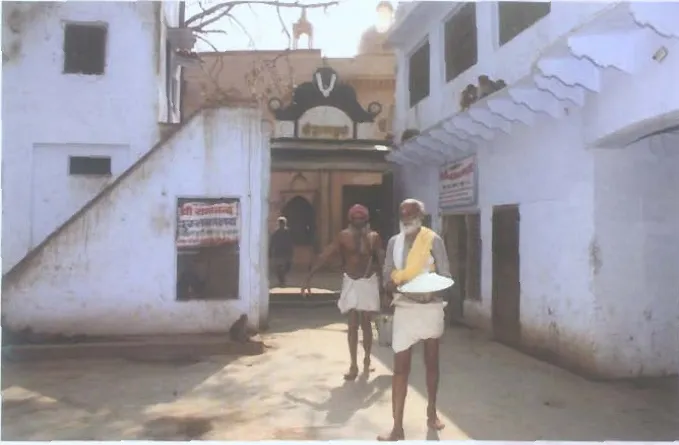
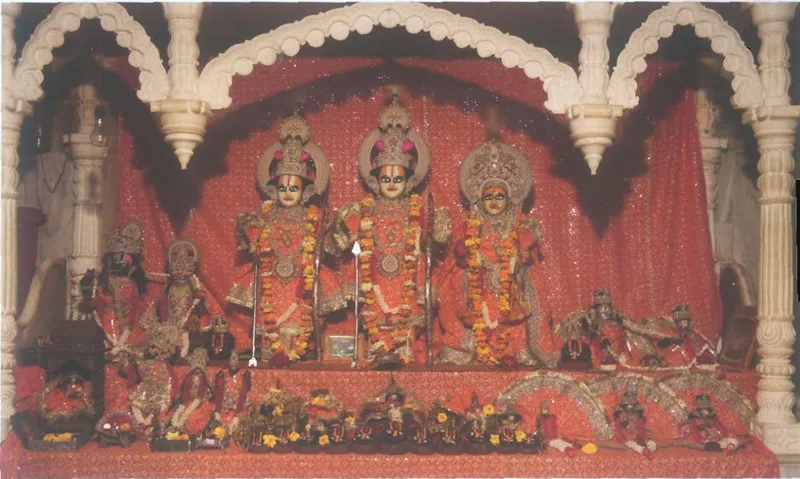
Sudāmā Kuti is a temple of the Rāmānandī Vaiṣṇavas in Vṛndāvana. According to Vṛndāvana, the Playground of God (2010), it was founded by a devotee of that line named Sudāmā, and his image is kept there. The name is his; no source connects the temple with Kṛṣṇa's friend Sudāmā. The same book gives no date for the founding and does not say where in the town the temple stands.[251 +1] It says that Deities of Sītā, Rāma, Lakṣmaṇa and Hanumān stand on the altar and that the temple gives out a large amount of prasādam, food first offered to the Deities, and it shows the entrance, the altar and the image of the founder, Sudāmā Mahārāja. What it describes is as of 2010.[251 +1]
Śrīla Prabhupāda writes in general, without naming this temple, that the Rāmānandīs, also called Rāmāts, are a branch of the Rāmānuja-sampradāya and worship Deities of Sītā-Rāma very strictly.[253]
General teaching (does not name the place)“From the Śrī Rāmānuja-sampradāya there is another branch known as Rāmānandī or Rāmāt, and the followers of that branch also worship Deities of Sītā-Rāma very rigidly.”
Śrīla Prabhupāda, Śrī Caitanya-caritāmṛta, Madhya-līlā 9.11, purport · vedabase.io
The Tulasī Rāma Mandira
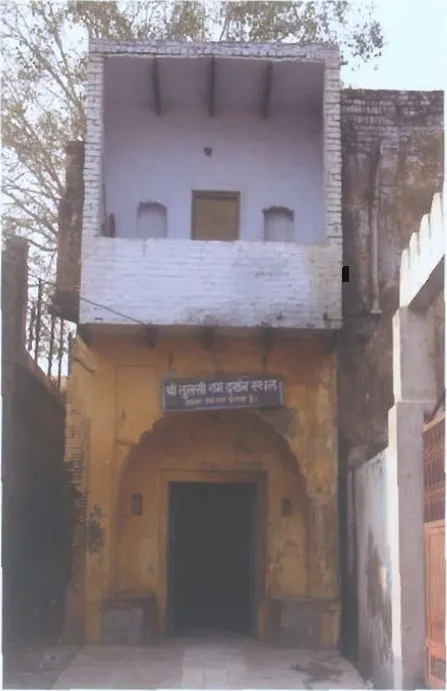
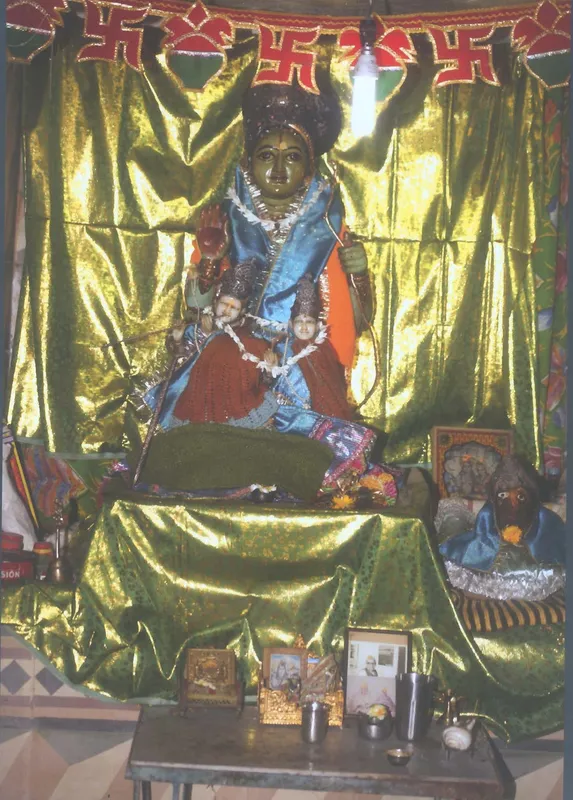
The Tulasī Rāma Mandira is a temple in Vṛndāvana town with small Deities of Rādhā and Kṛṣṇa, a large Deity of Lord Rāma holding a bow behind Them, and a Deity of the Hindi poet Śrī Tulasī dāsa. It is known only from Vṛndāvana, the Playground of God (2010), which describes and shows the altar. The book does not say where in the town the temple stands or when it was built, and no scripture or statement of Śrīla Prabhupāda about the temple has been found.[252 +1]
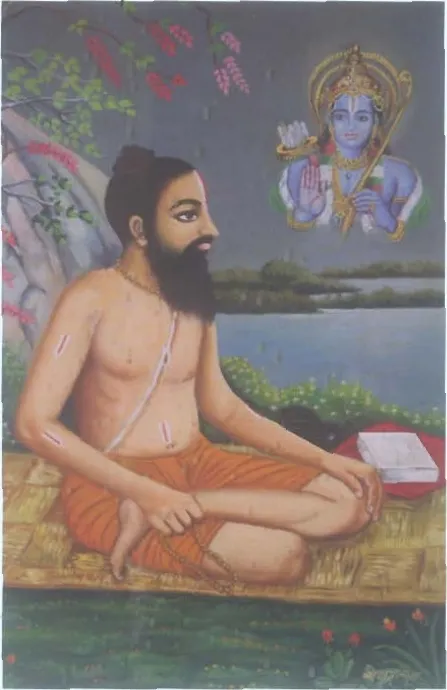
According to the same book, this was once a temple of small Rādhā-Kṛṣṇa Deities. When Śrī Tulasī dāsa came here, he told Kṛṣṇa that he would not bow down to Him unless he saw Him with bow and arrows in His hands. According to the local tradition the book records, Lord Rāmacandra then appeared before him, and the devotees installed the large Deity of Rāma who still stands behind Rādhā and Kṛṣṇa. The book names no source and no date, so this account is not certain.[252] It dates Śrī Tulasī dāsa to about 1532 to 1623, shortly after the time of Śrī Caitanya Mahāprabhu; these dates are not certain, since no other source consulted checks them.[252]
The temple's story above is the guidebook's; what Śrīla Prabhupāda said concerns Śrī Tulasī dāsa himself and his book, not this temple. In a lecture of 1968 he called Śrī Tulasī dāsa "a great devotee", a devotee of Lord Rāmacandra, and he explains that Śrī Tulasī dāsa named his Hindi Rāma-carita-mānasa after his own devotion to Rāma.[252 +2] According to his teaching, Rāma and Kṛṣṇa are the same Lord, and a devotee may still wish to see one form; when a devotee mentioned Tulasī dāsa's wish to see Rāma, he answered in 1970 (a general teaching, not about this temple):[255 +1]
General teaching (does not name the place)Just like Hanumān said that "Although I know Rāma and Kṛṣṇa are the same, still, I want to see Rāma." We also. Although we know Rāma and Kṛṣṇa the same, but we want to see Kṛṣṇa. Devotee: Tulasidāsa said that he wants to see Rāma. Prabhupāda: Yes. That is devotee's inclination.
Śrīla Prabhupāda, Śrīmad-Bhāgavatam 6.1.14 (lecture and conversation), Bombay, 10 November 1970 · vedabase.io
On the authority of Śrī Tulasī dāsa's book and teaching he was more reserved. In a letter of 6 September 1969 he wrote that the Rāma-carita-mānasa is "not very authorized", unlike the Rāmāyaṇa, and that its author, of the Rāmānanda sampradāya, has a tint of Māyāvāda philosophy and is not considered a pure Vaiṣṇava; on a morning walk in Vṛndāvana on 29 August 1975 he said the same.[256 +1]
Location
| Where it is | on the banks of the Yamunā[260] |
|---|
Places at Vṛndāvana
219 places
Areas (9)
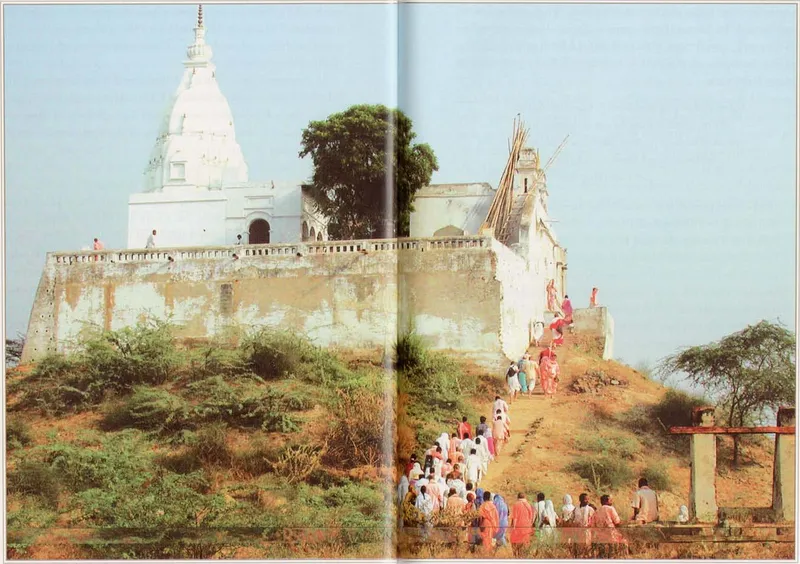
Bhātrola
भतरौडBhātrola, also called Bhojana-sthala, "the place of the meal", is the village of Vṛndāvana where, according to Śrī Vraja-maṇḍala Parikramā (2007), Kṛṣṇa ate the food brou …
Ramaṇa-reti (Vṛndāvana)
रमण-रेती (वृन्दावन)Ramaṇa-reti, "the pleasing sands", is a sandy area on the western edge of Vṛndāvana, on the old Chattikara road.
Kāliya-damanavana
कालिय-दमनवनKāliya-damanavana, "the forest of the subduing of Kāliya", is one of the twelve small forests within the parikramā (the walk around) of Vṛndāvana town.
Gopālavana
गोपालवनGopālavana is one of the twelve small forests within the parikramā (the walk around) of Vṛndāvana town.
Kevārivana
केवारिवनKevārivana is one of the old forests within the parikramā (the walk around the town) of Vṛndāvana, north-west of Aṭalavana, and the forest of Dāvānala-kuṇḍa.
Jhūlanavana
झूलनवनJhūlanavana, the "swing forest", is the tenth of the twelve forests (vanas) that the guidebook Śrī Vraja-maṇḍala Parikramā (2007) counts inside the ten-mile parikramā of …
Show all (9)
Ghāṭas
19 placesKuñjas of the sakhīs
5 placesPlaces of the ācāryas
28 places- Rūpa Gosvāmī Samādhi (Rādhā-Dāmodara)
- Prabhupāda's rooms (Rādhā-Dāmodara)
- Gopāla Bhaṭṭa Gosvāmī's samādhi
- Raghunātha Bhaṭṭa Gosvāmī's samādhi (Sixty-Four Samādhis Garden)
- Prabodhānanda Sarasvatī's samādhi
- Śrīnivāsa Ācārya Samādhi
- Rūpa Gosvāmī's bhajana-kuṭī (Rādhā-Dāmodara)
- Lord Caitanya's sitting place (Imlītalā)
Show all (28)
- Lokanātha Gosvāmī Samādhi (Rādhā-Gokulānanda)
- Jīva Gosvāmī's samādhi (Rādhā-Dāmodara)
- Kṛṣṇadāsa Kavirāja Gosvāmī Samādhi (Rādhā-Dāmodara)
- Bhūgarbha Gosvāmī's samādhi (Rādhā-Dāmodara)
- Gaṅgānārāyaṇa Cakravarti's samādhi
- Bilvamaṅgala Ṭhākura's samādhi
- Viśvanātha Cakravartī Ṭhākura's samādhi
- Sanātana Gosvāmī's samādhi
- Rāmacandra Kavirāja's samādhi
- Kāśīśvara Paṇḍita Samādhi
- Subuddhi Rāya Samādhi
- Madhu Paṇḍita's samādhi
- Bhaktisiddhānta Sarasvatī Gosvāmī Puṣpa-samādhi (Rādhā-Dāmodara)
- Gaurīdāsa Paṇḍita's samādhi
- Narottama dāsa Ṭhākura's puṣpa-samādhi
- Svāmī Haridāsa's samādhi
- Puṣpa-samādhi of King Birhambir
- Puṣpa-samādhis of Tapana Miśra and Candraśekhara Ācārya
- Gadādhara Paṇḍita's danta-samādhi
- Śyāmānanda Paṇḍita's puṣpa-samādhi
Temples and shrines
51 places- Rādhā-Govinda Mandira (Vṛndāvana, old)
- Rādhā-Madana-mohana Mandira (Vṛndāvana, old)
- Sākṣi-gopāla Mandira
- Rādhā-Dāmodara Mandira
- Rādhā-Gopīnātha Mandira
- Rādhā-Ramaṇa Mandira
- Gopīśvara Mahādeva Mandira
- Yogapīṭha (old Govinda temple)
Show all (51)
- Batharan-bihārī Mandira
- Rādhā-Gokulānanda Mandira
- Ṣaḍbhuja Mahāprabhu Mandira
- Paurṇamāsī-devī Mandira
- Rādhā-Śyāmasundara Mandira
- Rādhā-Śyāmarāya Mandira
- Bhaṭṭajī Mandira
- Mīrābai Mandira
- Raṅgajī Mandira
- Madana-mohana Mandira (Vṛndāvana, new)
- Madana-mohana Mandira (Bhaṭṭa neighbourhood)
- Raṅga Mahal (Sevā-kuñja)
- Dāvānala-bihārī Mandira
- Raṅga Mahal (Nidhuvana)
- Rādhā-Vallabha Mandira
- Kāliya-mardana Mandira
- Yugala-kiśora Mandira (Mirror Temple)
- Temple of Rādhā stealing Kṛṣṇa's flute (Nidhuvana)
- Vaṁśī-gopāla Mandira
- Rūpa-Sanātana Gauḍīya Maṭha
- Murāri Gupta's Gaura-Nitāi Mandira
- Rādhā-Braja-mohana Mandira
- Aṣṭa-sakhī Mandira
- Bāṅke-bihārī Mandira
- Govindajī Mandira (Vṛndāvana, new)
- Rādhā-Mādhava Mandira (Bhramara-ghāṭa)
- Bankhaṇḍī Mahādeva Mandira
- Lālā Bābū Mandira
- Śāhajī Mandira
- Taḍāsa-vālā Mandira
- Tekari Rānī Mandira
- Sītānātha Mandira
- Kātyāyanī-devī Mandira
- Rādhākānta Mandira
- Śrījī Mandira
- Jaipur Mandira
- Yugala-kiśora Mandira (Keśī-ghāṭa)
- Kṛṣṇa-Balarāma Mandira (Govinda-ghāṭa)
- Soṇā Gaurāṅga Mandira
- Yugala-bihārī Mandira (Yugala-ghāṭa)
- Savāmana Śālagrāma Mandira
- Rādhā-Gopāla Mandira
- Amiya Nimāi Mandira
Other places
35 placesShow all (35)
- Govardhana-śilā of Raghunātha dāsa Gosvāmī
- Kadamba tree at Kāliya-ghāṭa
- Kadamba tree (Cīra-ghāṭa, Vṛndāvana)
- Māna-bhañjana-sthala
- Praskandana-kṣetra
- Gomā-ṭīlā
- Sanātana Gosvāmī's govardhana-śilā (Rādhā-Dāmodara)
- Rāsa-sthalī (Sevā-kuñja)
- Appearance place of Rādhā-Ramaṇa
- Prabhupāda's rooms (Vaṁśī-gopāla Mandira)
- Veṇu-kūpa
- Parikramā path
- Advaitavaṭa
- 64 Samādhis
- Aśoka tree (Brahma-kuṇḍa)
- Śyāmānanda Tilaka-sthāna
- Grantha-ghar
- Samādhi Garden (Rādhā-Gokulānanda)
- Dāna-galī
- Bhaktivedanta Swami Gate
- Bhaktivedanta Svāmī Gośala
- Bhaktivedanta Swami International Gurukula
- Ṭaṭīyā-sthāna
- Vṛndāvana Research Institute
- Sūradāsa Madana-mohanajī's place
- Caitanya Viśrāma Sthālī
- Śyāmānanda Prabhu's samāja-bāḍī
Also described on this page
- Bhīma-ghāṭa ghāṭa
- Gautama Ṛṣi's āśrama āśrama
- Sudāmā Kuti temple
- Tulasī Rāma Mandira temple
Also listed here
- Advaita Bhavan bhavana, residence
- Akrūra-gaon village
- Ancient temple at Brahma-kuṇḍa temple
- Annapūrṇa-devī (Sevā-kuñja) shrine
- Aṭhkhambā street/lane
- Bardwan-ghāṭa ghāṭa
- Barwara-ghāṭa ghāṭa
- Bihar-ghāṭa ghāṭa
- Bihārījī Mandira (ghāṭa-list builder's title, unidentified) temple
- Bāṅke-bihārī Bazaar street/lane (bazaar)
- Cīra-ghāṭa (eight miles up-river) ghāṭa
- Dharoyāra-ghāṭa ghāṭa
- Dhurawara-ghāṭa ghāṭa
- Dhūsara-ghāṭa ghāṭa
- Fogla Āśrama āśrama
- Gaṅgā-mohana-ghāṭa ghāṭa
- Giridhārījī Mandira temple
- Gopīnātha Bazaar street/lane (bazaar)
- Gopīnātha-bhavana bhavana
- Hanumāna-ghāṭa ghāṭa
- Himmata-bahādura-ghāṭa ghāṭa
- Hāḍābāḍī-kuñja temple
- Imli-ghāṭa ghāṭa
- Kaḍiyā-ghāṭa ghāṭa
- Kiśor Rānī's Ghāṭa ghāṭa
- Koriya-ghāṭa ghāṭa
- Kālābābū-kuñja temple
- Loī-bāzār street/lane
- Mahāntajī-ghāṭa ghāṭa
- Mahārānī Svarṇamayī Mandira temple
- Manas Mandira temple
- Nabhawala-ghāṭa ghāṭa
- Nagari Dās Ghāṭa ghāṭa
- Nayā-ghāṭa ghāṭa
- Nāgarī-ghāṭa ghāṭa
- Nāmāovālā-ghāṭa ghāṭa
- Nṛsiṁhadeva Mandira (Vṛndāvana) temple
- Pandawara-ghāṭa ghāṭa
- Ranawat-ghāṭa ghāṭa
- Rasikānanda's puṣpa-samādhi puṣpa-samādhi
- Raṅgajī Bāg garden
- Retiyā-bāzāra street/lane
- Rādhā-Vallabha Mandira (original) temple
- Rādhā-bāga-ghāṭa ghāṭa
- Rāsa-maṇḍala (Rādhā-Ramaṇa Mandira) rāsa-sthalī
- Sanātana Gosvāmī's well well
- Sevā-kuñja-galī street/lane
- Tehriwara-ghāṭa ghāṭa
- Tekari-ghāṭa ghāṭa
- Varāha Mandira (Varāha-ghāṭa) temple
- Varāha-ghāṭa ghāṭa
- Vihāravana (Vṛndāvana) forest
- Vihārījī-ghāṭa ghāṭa
- Vyāsa-gherā city quarter
- Vṛndāvana (forest) forest
- Vṛndāvana Candrodaya Mandira temple
- Yugala-kiśora Mandira (Keśī-ghāṭa) temple
- Yugala-kiśora Mandira (north-east of Rādhā-Mādhava Mandira) temple
- Ādi-badrīvana forest (grove of ber / badrī trees)
- Śrījī-ghāṭa ghāṭa
- Rādhā-kūpa well
- Śāhajāpura Mandira temple
Nearby places
Mathurā · Yamunā · Govardhana
Pictures
14 pictures
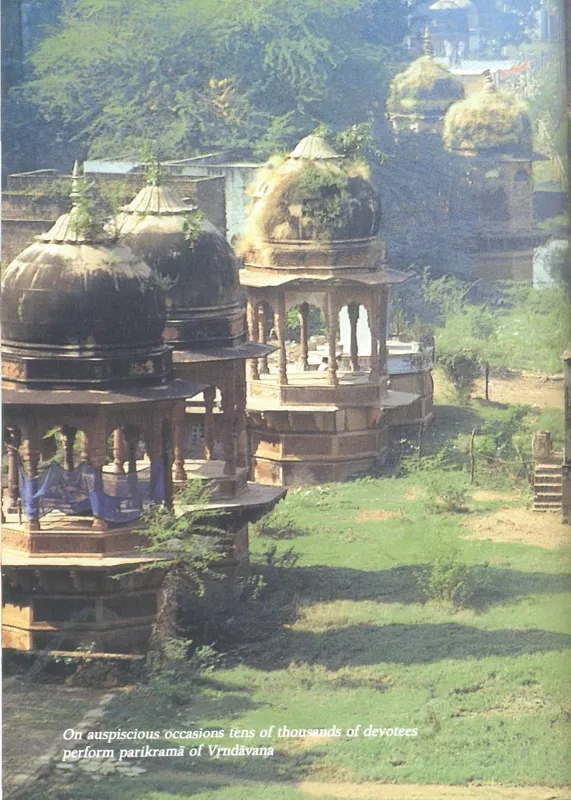
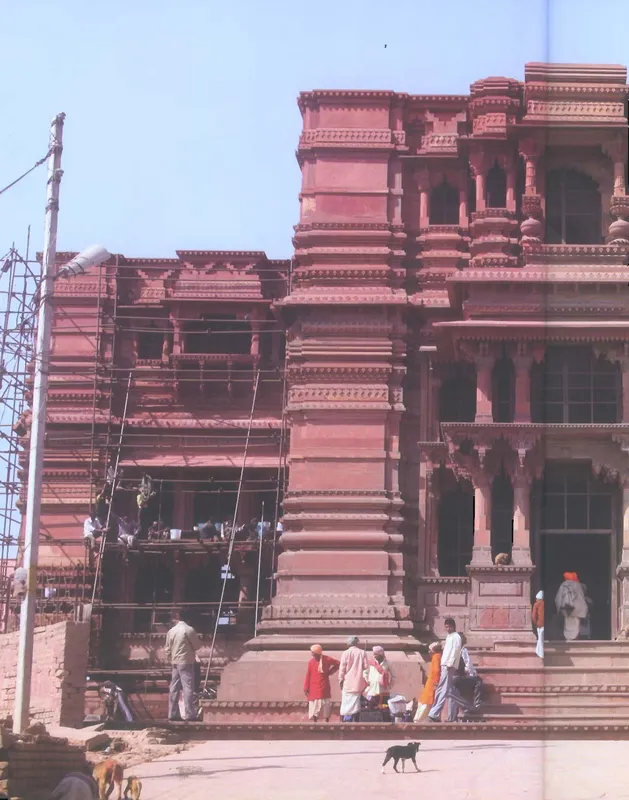
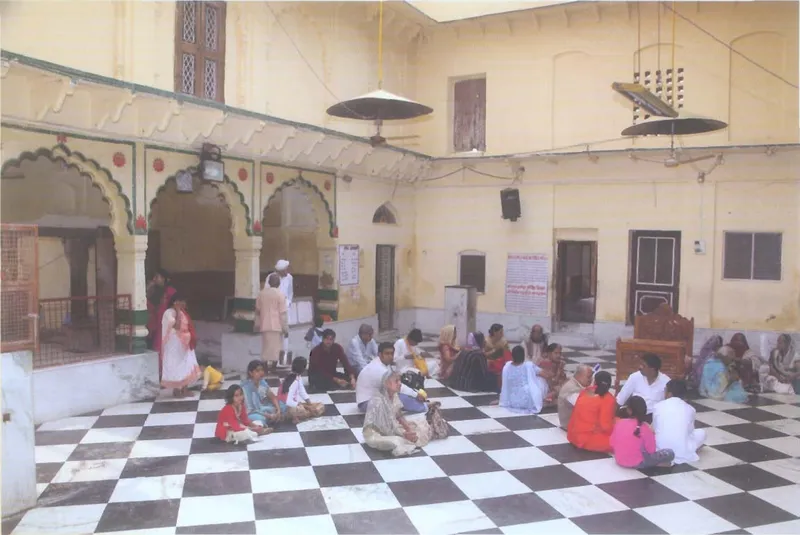
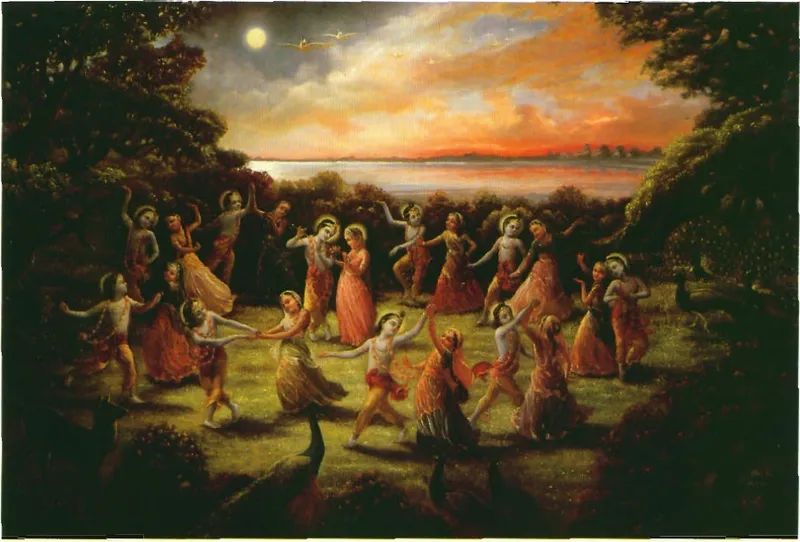
History
The Gosvāmīs and the town of temples
The Caitanya-caritāmṛta tells that Śrī Caitanya Mahāprabhu sent Śrīla Rūpa Gosvāmī and Śrīla Sanātana Gosvāmī to Vṛndāvana:[33 +5]
ভক্তি প্রচারিয়া সর্বতীর্থ প্রকাশিল ।
মদনগোপাল-গোবিন্দের সেবা প্রচারিল ॥ ৩২ ॥
bhakti pracāriyā sarva-tīrtha prakāśila
madana-gopāla-govindera sevā pracārila
After going to Vṛndāvana, the brothers preached devotional service and discovered many places of pilgrimage. They specifically initiated the service of Madana-mohana and Govindajī.
Translation: Śrīla A.C. Bhaktivedanta Swami PrabhupādaŚrīla Prabhupāda said in 1974 that each of the Gosvāmīs founded one temple in Vṛndāvana and others followed: Śrīla Rūpa Gosvāmī the temple of Govindajī, Śrīla Jīva Gosvāmī the temple of Rādhā-Dāmodara.[118] In 1967 he said that Śrī Caitanya Mahāprabhu authorised Śrīla Sanātana Gosvāmī to uncover the city, that his temple of Madana-mohana is the oldest in Vṛndāvana, and that thousands of temples were built after him.[36] Read more: The great temple of Śrī Govinda →
The chronology tables of two guidebooks, Govardhana Hill (2001) and The Color Guide to Vṛndāvana (2000), give these years: Śrī Caitanya Mahāprabhu's visit 1515, the arrival of Śrīla Rūpa Gosvāmī and Śrīla Sanātana Gosvāmī 1516, of Śrīla Jīva Gosvāmī 1535, the Madana-mohana temple 1580 and the Govindajī temple 1590. Govardhana Hill adds Śrīla Mādhavendra Purī's visit in 1479 and the arrival of Śrīla Lokanātha Gosvāmī and Śrīla Bhūgarbha Gosvāmī in 1509. No dated document for these years has been seen.[119 +5]
The guidebooks also say that Emperor Akbar met Śrīla Jīva Gosvāmī in Vṛndāvana in 1570. Hindu tradition records such meetings, but, as the historian A. W. Entwistle (1987) notes, no non-Hindu source confirms them, so the meeting is not certain.[120 +4] Entwistle reports a document at the Vṛndāvana Research Institute that records how Todar Mal, Akbar's finance minister, persuaded Akbar on Śrīla Jīva Gosvāmī's behalf to recognise the custodians of the Govindadeva and Madana-mohana temples; the document itself has not been independently examined.[128]
According to the historian A. W. Entwistle (1987), the Gauḍīya priests of the Govindadeva, Gopīnātha, Rādhā-Dāmodara and Rādhā-vinoda temples sought the protection of the rulers of Amber and took their Deities first to Kāmā; he gives the years in or shortly before 1714 for Govindadeva at Amber and 1760 for Rādhā-Dāmodara at Jaipur, and 1728 for Madana-mohana at Karauli.[124 +1] What Aurangzeb did to the temples themselves, the sources tell differently:[124 +1] Read more: The temples of Vṛndāvana in Mughal times →
Accounts differ Aurangzeb's relation to the Vṛndāvana temples.
- Govardhana Hill: India's Most Sacred Mountain (2001) chronology1670: Emperor Aurangzeb attacks Vṛndāvana.
- The Color Guide to Vṛndāvana (2000) chronology1670: Aurangzeb desecrates temples.
- Śrī Vraja-maṇḍala Parikramā (2007)After the Gosvāmīs left this world 'the narrow-minded Mughal emperor Aurangzeb destroyed the famous temples'; because of his 'atrocities' the king of Jaipura took Govinda, Gopīnātha and Madana-mohana to Rājasthāna.
- Śrīla Prabhupāda, lecture 18 March 1967Śrīla Sanātana Gosvāmī's temple, the oldest in Vṛndāvana, 'was desecrated by … Emperor Aurangzeb'.
Śrī Vraja-maṇḍala Parikramā (2007) says that Vṛndāvana was at one time renamed Fakīrābād, as Prayāga became Allahabad; no dated document for this is known, so it may be only a report.[130]
Where the sources differ
Which forests make up the twelve forests of Vraja (and whether Vṛndāvana is one of them).
Accounts differ Which forests make up the twelve forests of Vraja (and whether Vṛndāvana is one of them).
- Padma Purāṇa Pātāla 69.16–17Bhadra, Śrī, Loha, Bhāṇḍīra, Mahā, Tāla, Khadira, Bakula, Kumuda, Kāmya, Madhu and Vṛndāvana; seven west and five east of the Yamunā.
- Śrīla Prabhupāda, ŚB 4.8.42, CC Madhya 5.12 and CC Madhya 17.193 purportsTwelve forests: five east of the Yamunā (Bhadra, Bilva, Lauha, Bhāṇḍīra, Mahāvana) and seven west (Madhu, Tāla, Kumuda, Bahulā, Kāmya, Khadira, Vṛndāvana); CC Madhya 5.12 writes 'Loha' for Lauha and gives the names without '-vana', ŚB 4.8.42 and CC Madhya 17.193 give them with it.
- Śrīla Prabhupāda, CC Madhya 1.239 purportPilgrims today visit Kāmyavana (at Mathurā), Tālavana, Tamālavana, Madhuvana, Kusumavana, Bhāṇḍīravana, Bilvavana, Bhadravana, Khadiravana, Lohavana, Kumudavana and Gokula-mahāvana — without Vṛndāvana.
- A one-page reprint of Śrīla Prabhupāda's lists (untitled)Reprints the SB 4.8.42 list (with Vṛndāvana) and the CC Madhya 1.239 list (labelled 'SB 4.8.43 PURPORT') on the same page.
Accounts differ Why the cowherds moved to Vṛndāvana.
- Śrīmad-Bhāgavatam 10.11.22–28 (Upananda)Because of the repeated disturbances (demons) at Mahāvana/Gokula; Vṛndāvana is good for the cows.
- Garga-saṁhitā Vṛndāvana-khaṇḍa 1.3–9 (Sannanda)Because of the dangers at Mahāvana (Pūtanā, the cart, Tṛṇāvarta, the falling trees); they should go to Vṛndāvana and may return when the dangers are over.
- Harivaṁśa 52.9–33, 53.1–7Kṛṣṇa says the old forest is exhausted and proposes fresh Vṛndāvana; to create a cause He produces wolves from the hairs of His body, and the frightened elders decide to move.
- Viṣṇu Purāṇa 5.6.21–24The elders, frightened by the great omens (Pūtanā's death, the overturned cart, the trees falling without wind), decide to go to Vṛndāvana.
Accounts differ Where the cowherds' settlement stood after they moved to Vṛndāvana.
- Śrīmad-Bhāgavatam 10.11.35In Vṛndāvana, the carts set in a half-moon; no place is named.
- Śrīla Jīva Gosvāmī, Laghu-toṣaṇī on ŚB 10.11.35South-west of Kāliya-hrada, two yojanas long, taking in the region called Saṭṭīkarā, with Govardhana in front; Nanda's famous residence at Nandīśvara came later.
- Śrīla Jīva Gosvāmī, Laghu-toṣaṇī on ŚB 10.13.29 (Vaṁśīdhara repeats it)The settlement reached close to the Ariṣṭa-kuṇḍa at the north-east corner of Govardhana, four krośas by the straight road from the region called Saṭīkarā.
- Śrīla Jīva Gosvāmī, Krama-sandarbha, and Vaṁśīdhara on ŚB 10.11.35Mostly south of Kāliya-hrada, eight krośas long and four wide (Vaṁśīdhara: with Govardhana in front).
Accounts differ In which season, and at what age of Kṛṣṇa, the rāsa took place.
- Śrīmad-Bhāgavatam 10.29.1, 10.32.12On the autumn (śarad) nights, under the autumn moon.
- Śrīla Sanātana Gosvāmī on ŚB 10.47.43The lilies (kumuda) of the gopī's words show the autumn, the right time.
- Śrīla Viśvanātha Cakravartī on ŚB 10.29.1On the full moon of Āśvina in the year after Govardhana was lifted, when Kṛṣṇa was eight.
- Śrīla Jīva Gosvāmī, Laghu-vaiṣṇava-toṣaṇī on ŚB 10.45.3The rāsa-līlā in the autumn of the ninth year ('navamasya śaradi rāsa-līlā'); in the same count Govardhana was lifted in Kārttika of the eighth year and Ariṣṭa was killed on the full moon of Caitra in the eleventh.
Accounts differ Why Kṛṣṇa left Vṛndāvana for Mathurā.
- Śrīmad-Bhāgavatam 10.36.17-30 and 10.39.35Nārada revealed Kṛṣṇa's identity to Kaṁsa; Kaṁsa sent Akrūra to bring the two sons of Ānakadundubhi from Nanda's Vraja; leaving, Kṛṣṇa promised the gopīs, 'I will return'.
- Śrīla Prabhupāda, Kṛṣṇa book ch. 39Kṛṣṇa was moved by the gopīs' plight, 'but His duty was to start for Mathurā, for this was foretold by Nārada'.
- Śrīla Jīva Gosvāmī, Laghu-toṣaṇī on ŚB 10.39.7Kṛṣṇa could not go without the leave of His parents in Vraja and wanted Kaṁsa himself to be the cause of His going, so He waited for such a person as Akrūra to come.
- Śrīla Sanātana Gosvāmī on ŚB 10.39.37In one manifestation Kṛṣṇa never left Vṛndāvana; in another He set out for the city.
Accounts differ How long Kṛṣṇa lived in Vraja before He went to Mathurā, and how old He was then.
- Śrīmad-Bhāgavatam 3.2.26Eleven years, with Balarāma, in Nanda's cow pastures.
- Brahma-vaivarta Purāṇa 4.54.22A full eleven years in Nanda's house; then a full hundred years in Mathurā and Dvārakā.
- Śrīla Prabhupāda, The Nectar of Devotion ch. 26 and 42His Vṛndāvana pastimes end by the end of His fifteenth year; He went to Mathurā to kill Kaṁsa when He was sixteen.
- Śrīla Prabhupāda, ŚB 3.2.26 purportHe was carried to Vṛndāvana just after His appearance and 'lived there for eleven years'.
Accounts differ How the Yamunā lies around Vṛndāvana town.
- Śrī Vraja-maṇḍala Parikramā (2007)The Yamunā flows on three sides of Vṛndāvana.
- The Color Guide to Vṛndāvana (2000)The river used to encircle Vṛndāvana but now touches the town on only two sides, leaving many ghāṭas dry.
- Padma Purāṇa, Pātāla-khaṇḍa 69.36The verse places Vṛndāvana in relation to the Yamunā with the word 'yamunāyāḥ pradakṣiṇam', which the Motilal English translation takes as south of the Yamunā.
Accounts differ Where Annapūrṇā-devī's shrine is and whether she is Paurṇamāsī.
- Śrī Vraja-maṇḍala Parikramā (2007)Annapūrṇa-devī 'near Sevā-kuñja'; Paurṇamāsī-devī listed separately, 'near Sevā-kuñja, to the east'.
- Vṛndāvana, the Playground of God (2010)A small temple of Annapūrṇā devī, 'who is actually Paurṇamāsī', to the left of the Gopeśvara Mahādeva temple near Vaṁśīvaṭa; caption: 'a form of Paurṇamāsī, overseeing the rāsa dance'.
Where Gautama Ṛṣi lived, and where the story of his curse took place. The Vṛndāvana guidebooks place his āśrama and austerities here, which is not certain; the Purāṇas and Śrīla Prabhupāda put his dwelling on the Godāvarī.[187 +5]
Accounts differ Where Gautama Ṛṣi's āśrama was, and where the story of his curse took place.
- The Color Guide to Vṛndāvana (2000) and the undated parikramā notes VṛndāvanaThis is where the great sage Gautam Ṛṣī performed austerities thousands of years ago (Vṛndāvana, near Varāha-ghāṭa).
- Vṛndāvana, the Playground of God (2010)Gautama Ṛṣi's āśrama was here; the story of the curse follows, with no place named for it.
- Varāha Purāṇa 71.10–71.43Gautama performed austerities in the Daṇḍaka forest and made his great āśrama on Śataśṛṅga; the cow story ends with the river Godāvarī.
- Śrīla Prabhupāda, CC Madhya 9.14 purportGautama Ṛṣi used to live on the bank of the Gautamī-gaṅgā (a branch of the Godāvarī) opposite Rajahmundry.
More on this place
Nanda's family at Nandagrāma · The cowherds' vision at Brahma-hrada · The Kātyāyanī vow and the gopīs' clothes: the pastime and its places · Where the autumn rāsa took place
- →Nanda's family at Nandagrāmaarticle›
- →The cowherds' vision at Brahma-hradaarticle›
- →The Kātyāyanī vow and the gopīs' clothes: the pastime and its placesarticle›
- →Where the autumn rāsa took placearticle›
- →Kṛṣṇa's promise to return to Vraja, and Loṭhā Bābā of Pūñcharīarticle›
- →Uddhava brings Kṛṣṇa's message to the gopīsarticle›
- →The great temple of Śrī Govindaarticle›
- →The temples of Vṛndāvana in Mughal timesarticle›
- →Śrīla Prabhupāda at the Rādhā-Dāmodara templearticle›
- →How Śrīla Prabhupāda built the Kṛṣṇa-Balarāma Mandiraarticle›
References
260 references
- Śrīmad-Bhāgavatam 10.11.28, GRETIL
- Śrīmad-Bhāgavatam 10.11.35–36, GRETIL
- Śrīla Prabhupāda, Śrīmad-Bhāgavatam, Canto 10, chapter 11, verse 28, purport · vedabase.io
- Harivaṁśa, 52.21–25, GRETIL
- Harivaṁśa, 52.28–30, GRETIL
- Harivaṁśa, 53.20–22, GRETIL
- Garga-saṁhitā, Vṛndāvana-khaṇḍa (2) 1.16–18, Sanskrit Wikisource
- Śrīla Prabhupāda, Śrī Caitanya-caritāmṛta, Madhya-līlā 5.12, purport · vedabase.io
- The Colour Guide to Rādhā-kuṇḍa (1999), Rājaśekhara dāsa Brahmacārī, PDF p. 13
- Nārada Purāṇa, Uttara-bhāga, adhyāya 80, verses 6–9
- Nārada Purāṇa, Uttara-bhāga, adhyāya 80, vv.77-81
- Śrīmad-Bhāgavatam 10.13.59–60, GRETIL
- Śrīmad-Bhāgavatam 10.15.1, Bhagavata Vidya Pith edition, ed. Bhagavata Rishi and Krishna Shankar Shastri, 1996
- Śrīmad-Bhāgavatam 10.21.5, Bhagavata Vidya Pith edition, ed. Bhagavata Rishi and Krishna Shankar Shastri, 1996
- Śrīmad-Bhāgavatam 10.18.3, Bhagavata Vidya Pith edition, ed. Bhagavata Rishi and Krishna Shankar Shastri, 1996
- Śrīmad-Bhāgavatam 10.46.18, Bhagavata Vidya Pith edition, ed. Bhagavata Rishi and Krishna Shankar Shastri, 1996
- Śrīmad-Bhāgavatam 10.15.9, Bhagavata Vidya Pith edition, ed. Bhagavata Rishi and Krishna Shankar Shastri, 1996
- Śrīmad-Bhāgavatam 10.29.1
- Śrīmad-Bhāgavatam 10.32.11–12
- Śrīmad-Bhāgavatam 10.47.43, Bhagavata Vidya Pith edition, ed. Bhagavata Rishi and Krishna Shankar Shastri, 1996
Show all 260 references
- Śrīla Sanātana Gosvāmī: commentary on ŚB 10.47.43, Bhagavata Vidya Pith edition, ed. Bhagavata Rishi and Krishna Shankar Shastri, 1996
- Śrīla Prabhupāda, Kṛṣṇa, the Supreme Personality of Godhead (Kṛṣṇa book), Chapter 29, 'The Rāsa Dance: Introduction' · vedabase.io
- Śrīmad-Bhāgavatam 10.30.24, GRETIL
- Śrīla Kṛṣṇadāsa Kavirāja Gosvāmī, Śrī Caitanya-caritāmṛta, Ādi-līlā 5.17, online edition · vedabase.io
- Śrīla Kṛṣṇadāsa Kavirāja Gosvāmī, Śrī Caitanya-caritāmṛta, Ādi-līlā 5.19, online edition · vedabase.io
- Śrīla Kṛṣṇadāsa Kavirāja Gosvāmī, Śrī Caitanya-caritāmṛta, Ādi-līlā 5.20, online edition · vedabase.io
- Śrīla Jīva Gosvāmī, Kṛṣṇa-sandarbha, anuccheda 116, GRETIL
- Padma Purāṇa, Pātāla-khaṇḍa (5) 69.8–11, Sanskrit Wikisource
- Śrīla Prabhupāda, Lecture on The Nectar of Devotion, Vṛndāvana, 18 October 1972 · vedabase.io
- Śrīla Rūpa Gosvāmī, Laghu-bhāgavatāmṛta, 1.5.461 (quoting the Yāmala), GRETIL
- Śrī Vraja-maṇḍala Parikramā (2007), PDF p. 294
- The Color Guide to Vṛndāvana (2000), Written and Photographed by Rājaśekhara dāsa Brahmacārī, PDF p. 15
- Śrīla Kṛṣṇadāsa Kavirāja Gosvāmī, Śrī Caitanya-caritāmṛta, Madhya-līlā 18.71, online edition · vedabase.io
- Śrīla Kṛṣṇadāsa Kavirāja Gosvāmī, Śrī Caitanya-caritāmṛta, Madhya-līlā 1.31, online edition · vedabase.io
- Śrīla Kṛṣṇadāsa Kavirāja Gosvāmī, Śrī Caitanya-caritāmṛta, Madhya-līlā 1.32, online edition · vedabase.io
- Śrīla Prabhupāda, Lecture on Śrī Caitanya-caritāmṛta, Ādi-līlā 7.149–171, San Francisco, 18 March 1967 · vedabase.io
- Śrī Vraja-maṇḍala Parikramā (2007), PDF p. 295
- Vṛndāvana-Dhāma Ki Jaya! (c. 1986), by Dhruva Mahārāja dāsa, PDF p. 15
- Satsvarūpa dāsa Gosvāmī, Śrīla Prabhupāda-līlāmṛta, vol. 2, ch. 44 · vedabase.io
- Satsvarūpa dāsa Gosvāmī, Śrīla Prabhupāda-līlāmṛta, vol. 2, ch. 52 · vedabase.io
- Śrī Vraja-maṇḍala Parikramā (2007), PDF p. 339
- Śrīla Rūpa Gosvāmī, Laghu-bhāgavatāmṛta, 2.1.46 (quoting the Ādi Purāṇa), GRETIL
- Śrīmad-Bhāgavatam, 10.21.10, online edition · vedabase.io
- Śrīmad-Bhāgavatam, 10.47.61 (as quoted in CC Antya-līlā 7.47), online edition · vedabase.io
- Śrī Vraja-maṇḍala Parikramā (2007), PDF p. 292
- The Color Guide to Vṛndāvana (2000), Written and Photographed by Rājaśekhara dāsa Brahmacārī, PDF p. 16
- Śrīmad-Bhāgavatam 10.14.34, Bhagavata Vidya Pith edition, ed. Bhagavata Rishi and Krishna Shankar Shastri, 1996
- Śrīla Prabhupāda, Kṛṣṇa, the Supreme Personality of Godhead (Kṛṣṇa book), Chapter 14, 'Prayers Offered by Lord Brahmā to Lord Kṛṣṇa' · vedabase.io
- Śrīla Rūpa Gosvāmī, Upadeśāmṛta, verse 9
- Śrīla Rūpa Gosvāmī, Bhakti-rasāmṛta-sindhu, 2.1.99 (Dakṣiṇa-vibhāga, laharī 1: Kṛṣṇa's quality no. 19, deśa-kāla-supātrajña, 'knowing the right place, time and persons'), GRETIL
- Śrīla Rūpa Gosvāmī, Bhakti-rasāmṛta-sindhu, 2.1.173 (Dakṣiṇa-vibhāga, laharī 1: Kṛṣṇa's quality no. 48, samṛddhimān, 'possessed of great wealth'), quoted as from the Kṛṣṇa-karṇāmṛta, GRETIL
- Śrīla Rūpa Gosvāmī, Bhakti-rasāmṛta-sindhu, 2.1.324-325 (Dakṣiṇa-vibhāga, laharī 1: Kṛṣṇa's middle kaiśora age, introduced at 2.1.320, and its example), GRETIL
- Śrīla Prabhupāda, The Nectar of Devotion, Chapter 21, 'Qualities of Śrī Kṛṣṇa', section 19, 'Expert judge of time and circumstances' · vedabase.io
- Śrīla Prabhupāda, The Nectar of Devotion, Chapter 22, 'Qualities of Kṛṣṇa Further Explained', section 48, 'All-opulent' · vedabase.io
- Śrīla Prabhupāda, The Nectar of Devotion, Chapter 26, 'Stimulation for Ecstatic Love' (Kṛṣṇa at thirteen to fourteen years) · vedabase.io
- Śrīla Kṛṣṇadāsa Kavirāja Gosvāmī, Śrī Caitanya-caritāmṛta, Madhya-līlā 14.219, online edition · vedabase.io
- Padma Purāṇa, Pātāla-khaṇḍa (5) 69.56–60, Sanskrit Wikisource
- Garga-saṁhitā, Vṛndāvana-khaṇḍa (2) 1.14–15, Sanskrit Wikisource
- Varāha Purāṇa, adhyāya 156, verses 6–11, Sanskrit Wikisource
- Bhāgavata-māhātmya, Padma version, adhyāya 1, verse 61, Sanskrit Wikisource
- Bhāgavata-māhātmya, Padma version, adhyāya 1, verse 50, Sanskrit Wikisource
- Śrīla Viśvanātha Cakravartī Ṭhākura, Vraja-rīti-cintāmaṇi, first sarga, vv.12-13
- Śrīla Sanātana Gosvāmī (Bṛhad-vaiṣṇava-toṣaṇī) and Śrīla Jīva Gosvāmī (Laghu-vaiṣṇava-toṣaṇī): commentaries on Śrīmad-Bhāgavatam: commentary on ŚB 10.11.28, Bhagavata Vidya Pith edition, ed. Bhagavata Rishi and Krishna Shankar Shastri, 1996
- Śrīla Kṛṣṇadāsa Kavirāja Gosvāmī, Śrī Caitanya-caritāmṛta, Madhya-līlā 5.13, online edition · vedabase.io
- Śrīla Prabhupāda, The Nectar of Instruction, Text 8, purport · vedabase.io
- Varāha Purāṇa, adhyāya 153, verses 45–49, Sanskrit Wikisource
- Śrīla Rūpa Gosvāmī, Mathurā-māhātmya v.331-332
- Śrīla Rūpa Gosvāmī, Mathurā-māhātmya v.357-361
- Śrīmad-Bhāgavatam 10.11.23, GRETIL
- Śrīla Prabhupāda, Kṛṣṇa, the Supreme Personality of Godhead (Kṛṣṇa book), Chapter 11, 'Killing the Demons Vatsāsura and Bakāsura' · vedabase.io
- Śrīla Sanātana Gosvāmī (Bṛhad-vaiṣṇava-toṣaṇī): commentary on ŚB 10.11.35, Bhagavata Vidya Pith edition, ed. Bhagavata Rishi and Krishna Shankar Shastri, 1996
- the undated parikramā notes Mahāvana, ¶97
- Śrīla Prabhupāda, Kṛṣṇa, the Supreme Personality of Godhead (Kṛṣṇa book), Chapter 21, 'The Gopīs Attracted by the Flute' · vedabase.io
- Śrīla Rūpa Gosvāmī, Stava-mālā, part 26 v.28-29 of the text (the Chando'ṣṭādaśaka hymns; v.29 as numbered there), after the edition of Bhakti Saranga Goswami and Purushottam Das, Vrindavan, 1959
- Śrīla Viśvanātha Cakravartī: commentary on ŚB 10.28.17, Bhagavata Vidya Pith edition, ed. Bhagavata Rishi and Krishna Shankar Shastri, 1996
- Śrīmad-Bhāgavatam 10.22.2, GRETIL
- Śrīmad-Bhāgavatam 10.22.9, GRETIL
- The Color Guide to Vṛndāvana (2000), Written and Photographed by Rājaśekhara dāsa Brahmacārī, PDF p. 102
- Śrīla Jīva Gosvāmī: commentary on ŚB 10.22.2, Bhagavata Vidya Pith edition, ed. Bhagavata Rishi and Krishna Shankar Shastri, 1996
- Śrīmad-Bhāgavatam 10.22.2–3, GRETIL
- Śrīla Narahari Cakravartī, Bhakti-ratnākara, Fifth Wave (pañcama taraṅga), printed p. 269 (1912 edition), 2nd ed., 1912
- Śrīla Prabhupāda, The Nectar of Instruction, Text 9, purport · vedabase.io
- The Colour Guide to Rādhā-kuṇḍa (1999), Rājaśekhara dāsa Brahmacārī, PDF p. 14
- The Color Guide to Vṛndāvana (2000), Written and Photographed by Rājaśekhara dāsa Brahmacārī, PDF p. 39
- Śrī Vraja-maṇḍala Parikramā (2007), PDF p. 71
- Śrīmad-Bhāgavatam 10.36.17, GRETIL
- Śrīmad-Bhāgavatam 10.36.20, GRETIL
- Śrīla Prabhupāda, Kṛṣṇa, the Supreme Personality of Godhead (Kṛṣṇa book), Chapter 36, 'Kaṁsa Sends Akrūra for Kṛṣṇa' · vedabase.io
- Vṛndāvana, the Playground of God (2010), Bhakti Caitanya Svāmī, PDF p. 178
- Śrīmad-Bhāgavatam 10.36.30, GRETIL
- Śrīmad-Bhāgavatam 10.39.35, GRETIL
- Śrīla Prabhupāda, Kṛṣṇa, the Supreme Personality of Godhead (Kṛṣṇa book), Chapter 39, 'Akrūra’s Return Journey and His Vision of Viṣṇuloka Within the Yamunā River' · vedabase.io
- Śrīla Prabhupāda, Kṛṣṇa, the Supreme Personality of Godhead (Kṛṣṇa book), Chapter 46, 'Uddhava Visits Vṛndāvana' · vedabase.io
- Śrīla Sanātana Gosvāmī: commentary on ŚB 10.39.37, Bhagavata Vidya Pith edition, ed. Bhagavata Rishi and Krishna Shankar Shastri, 1996
- Vaṁśīdhara: commentary on ŚB 10.3.51, Bhagavata Vidya Pith edition, ed. Bhagavata Rishi and Krishna Shankar Shastri, 1996
- Śrīla Sanātana Gosvāmī: commentary on ŚB 10.5.1, Bhagavata Vidya Pith edition, ed. Bhagavata Rishi and Krishna Shankar Shastri, 1996
- Śrī Vraja-maṇḍala Parikramā (2007), PDF p. 285
- Śrīla Jīva Gosvāmī: commentary on ŚB 10.28.17, parts 3/4-4/4, Bhagavata Vidya Pith edition, ed. Bhagavata Rishi and Krishna Shankar Shastri, 1996
- Baladeva Vidyābhūṣaṇa: commentary on ŚB 10.11.36, Bhagavata Vidya Pith edition, ed. Bhagavata Rishi and Krishna Shankar Shastri, 1996
- Śrīla Kṛṣṇadāsa Kavirāja Gosvāmī, Śrī Caitanya-caritāmṛta, Madhya-līlā 18.70, online edition · vedabase.io
- Śrīla Kṛṣṇadāsa Kavirāja Gosvāmī, Śrī Caitanya-caritāmṛta, Madhya-līlā 18.78, online edition · vedabase.io
- Śrīla Kṛṣṇadāsa Kavirāja Gosvāmī, Śrī Caitanya-caritāmṛta, Madhya-līlā 18.79, online edition · vedabase.io
- Śrīla Prabhupāda, Śrī Caitanya-caritāmṛta, Madhya-līlā, Chapter 18, chapter summary · vedabase.io
- Śrīla Narahari Cakravartī, Bhakti-ratnākara, Fifth Wave (pañcama taraṅga), printed p. 289 (1912 edition), 2nd ed., 1912
- Śrīla Prabhupāda, Śrī Caitanya-caritāmṛta, Madhya-līlā 18.70, purport · vedabase.io
- Śrī Vraja-maṇḍala Parikramā (2007), PDF p. 284
- Śrīla Kṛṣṇadāsa Kavirāja Gosvāmī, Śrī Caitanya-caritāmṛta, Madhya-līlā 18.74, online edition · vedabase.io
- Śrīmad-Bhāgavata-māhātmya, Skanda version, adhyāya 2, verses 4-6, Sanskrit Wikisource
- The Colour Guide to Rādhā-kuṇḍa (1999), Rājaśekhara dāsa Brahmacārī, PDF p. 35
- Śrī Vraja-maṇḍala Parikramā (2007), PDF p. 325
- Śrīla Raghunātha dāsa Gosvāmī, Vraja-vilāsa-stava, verse 61
- Śrīla Raghunātha dāsa Gosvāmī, Muktā-carita, (Lalitā's account), GRETIL
- Śrīla Raghunātha dāsa Gosvāmī, Muktā-carita, GRETIL
- the undated parikramā notes Khadiravana, ¶60
- the undated parikramā notes Khadiravana, ¶61
- Śrīla Sanātana Gosvāmī: commentary on ŚB 10.13.59, Bhagavata Vidya Pith edition, ed. Bhagavata Rishi and Krishna Shankar Shastri, 1996
- Śrī Vraja-maṇḍala Parikramā (2007), PDF p. 291
- Śrīla Prabhupāda, Morning Walk with Professor Durckheim, Germany, 21 June 1974 · vedabase.io
- Govardhana Hill: India's Most Sacred Mountain (2001), Rajasekhara dasa Brahmacari, PDF p. 160
- Govardhana Hill: India's Most Sacred Mountain (2001), Rajasekhara dasa Brahmacari, PDF p. 161
- The Color Guide to Vṛndāvana (2000), Written and Photographed by Rājaśekhara dāsa Brahmacārī, PDF p. 25
- Śrīla Prabhupāda, Letter to Akbar Ali Khan, letter dated 24 February 1975 (vedabase 'letter-to-akbar-ali-khan') · vedabase.io
- The Color Guide to Vṛndāvana (2000), Written and Photographed by Rājaśekhara dāsa Brahmacārī, PDF p. 27
- A. W. Entwistle, §5.25 'The exodus of deities from Braj', printed p. 183 with n. 255, Egbert Forsten, Groningen, 1987
- The Colour Guide to Rādhā-kuṇḍa (1999), Rājaśekhara dāsa Brahmacārī, PDF p. 173
- Vṛndāvana, the Playground of God (2010), Bhakti Caitanya Svāmī, PDF p. 58
- A. W. Entwistle, §5.12 'Akbar and his Hindu associates', printed p. 158 with n. 114, Egbert Forsten, Groningen, 1987
- A. W. Entwistle, §5.12, printed p. 160 with n. 127, Egbert Forsten, Groningen, 1987
- A. W. Entwistle, §5.25, printed p. 185 with nn. 266-268, Egbert Forsten, Groningen, 1987
- Śrī Vraja-maṇḍala Parikramā (2007), PDF p. 140
- Śrīla Prabhupāda, The Nectar of Devotion, Concluding Words, 30 June 1969 · vedabase.io
- Śrīla Rūpa Gosvāmī, Śrī Vṛndāvanāṣṭaka, Vṛndāvanāṣṭaka vv.1-2, after the edition of Bhakti Saranga Goswami and Purushottam Das, Vrindavan, 1959
- Śrīla Sanātana Gosvāmī: commentary opening verse 9, listed under ŚB 10.1.1, Bhagavata Vidya Pith edition, ed. Bhagavata Rishi and Krishna Shankar Shastri, 1996
- The Colour Guide to Rādhā-kuṇḍa (1999), Rājaśekhara dāsa Brahmacārī, PDF p. 41
- Śrīla Raghunātha dāsa Gosvāmī, Vraja-vilāsa-stava, verses 98, 100 and 105
- Śrīla Kṛṣṇadāsa Kavirāja Gosvāmī, Śrī Caitanya-caritāmṛta, Ādi-līlā 5.195, online edition · vedabase.io
- Śrīla Kṛṣṇadāsa Kavirāja Gosvāmī, Śrī Caitanya-caritāmṛta, Ādi-līlā 5.200, online edition · vedabase.io
- Śrīla Gopāla Bhaṭṭa Gosvāmī, Hari-bhakti-vilāsa, 1.4, GRETIL
- Caitanya-candrāmṛta, verse 12, GRETIL
- The Color Guide to Vṛndāvana (2000), Written and Photographed by Rājaśekhara dāsa Brahmacārī, PDF p. 9
- Vṛndāvana-mahimāmṛta, second śataka, v.3, after Shyamlal Hakim's edition, Vrindavan, 1978
- Vṛndāvana-mahimāmṛta, second śataka, v.50, after Shyamlal Hakim's edition, Vrindavan, 1978
- Śrīla Kṛṣṇadāsa Kavirāja Gosvāmī, Śrī Caitanya-caritāmṛta, CC Madhya-līlā 25.187, online edition · vedabase.io
- Śrīla Kṛṣṇadāsa Kavirāja Gosvāmī, Śrī Caitanya-caritāmṛta, CC Madhya-līlā 25.195, online edition · vedabase.io
- Śrīla Kṛṣṇadāsa Kavirāja Gosvāmī, Śrī Caitanya-caritāmṛta, CC Madhya-līlā 25.197, online edition · vedabase.io
- Śrīla Kṛṣṇadāsa Kavirāja Gosvāmī, Śrī Caitanya-caritāmṛta, Madhya-līlā 25.198, online edition · vedabase.io
- Śrīla Kṛṣṇadāsa Kavirāja Gosvāmī, Śrī Caitanya-caritāmṛta, CC Madhya-līlā 25.201, online edition · vedabase.io
- Śrīla Kṛṣṇadāsa Kavirāja Gosvāmī, Śrī Caitanya-caritāmṛta, CC Madhya-līlā 25.204, online edition · vedabase.io
- Śrīla Narahari Cakravartī, Bhakti-ratnākara, Eleventh Wave (ekādaśa taraṅga), printed p. 664 (1912 edition), 2nd ed., 1912
- Śrīla Narahari Cakravartī, Bhakti-ratnākara, Eleventh Wave (ekādaśa taraṅga), printed p. 665 (1912 edition), 2nd ed., 1912
- Śrīla Prabhupāda, The Nectar of Devotion, Chapter 13, 'Five Potent Forms of Devotional Service' · vedabase.io
- Śrīla Prabhupāda, The Nectar of Devotion, Chapter 35, 'Neutral Love of God' · vedabase.io
- Vṛndāvana-Dhāma Ki Jaya! (c. 1986), by Dhruva Mahārāja dāsa, PDF p. 64
- The Color Guide to Vṛndāvana (2000), Written and Photographed by Rājaśekhara dāsa Brahmacārī, PDF p. 61
- The Color Guide to Vṛndāvana (2000), Written and Photographed by Rājaśekhara dāsa Brahmacārī, PDF p. 165
- the undated parikramā notes Vṛndāvana, ¶77
- the undated parikramā notes Vṛndāvana, ¶80
- the undated parikramā notes Vṛndāvana, ¶125
- Śrīla Narahari Cakravartī, Bhakti-ratnākara, Fifteenth Wave (pañcadaśa taraṅga), 1912 ed. p. 1055, 2nd ed., 1912
- Śrīla Prabhupāda, Śrī Caitanya-caritāmṛta, Madhya-līlā 1.97, purport · vedabase.io
- Śrīla Prabhupāda, Śrī Caitanya-caritāmṛta, Madhya-līlā 4.12, purport · vedabase.io
- the undated parikramā notes Vṛndāvana, ¶124
- Śrīla Prabhupāda, Śrīmad-Bhāgavatam, Canto 1, Introduction (the essence of Śrī Caitanya's preaching) · vedabase.io
- Śrīla Prabhupāda, Śrīmad-Bhāgavatam, 3.1.2, purport · vedabase.io
- Śrīla Prabhupāda, Lecture on Śrīmad-Bhāgavatam 6.2.14, Vṛndāvana, 17 September 1975 · vedabase.io
- VRINDAVAN TRIP- 2015, ¶4
- Śrīla Prabhupāda, Kṛṣṇa, the Supreme Personality of Godhead (Kṛṣṇa book), Chapter 38, 'Akrūra's Arrival in Vṛndāvana' · vedabase.io
- Śrīla Prabhupāda, Śrīmad-Bhāgavatam, 10.13.60, purport · vedabase.io
- The Color Guide to Vṛndāvana (2000), Written and Photographed by Rājaśekhara dāsa Brahmacārī, PDF p. 1
- Śrīla Prabhupāda, The Nectar of Devotion, Chapter 6, 'How to Discharge Devotional Service', item (8) · vedabase.io
- Śrīla Prabhupāda, The Nectar of Devotion, Chapter 12, 'Further Aspects of Transcendental Service' (Ūrja-vrata) · vedabase.io
- Śrīla Prabhupāda, The Nectar of Devotion, Chapter 16, 'Spontaneous Devotion Further Described' · vedabase.io
- Satsvarūpa dāsa Gosvāmī, Śrīla Prabhupāda-līlāmṛta, vol. 1, ch. 9 · vedabase.io
- Satsvarūpa dāsa Gosvāmī, Śrīla Prabhupāda-līlāmṛta, vol. 1, ch. 10 · vedabase.io
- Na Yoga Siddhir Na Mamastu (Śrī Śrī Vṛndāvanāṣṭakam) (Viśvanātha Cakravartī Ṭhākura (as the song book credits it)) · song book
- Śrīla Viśvanātha Cakravartī Ṭhākura, Śrī Vṛndāvanāṣṭaka, Vṛndāvanāṣṭaka vv.5-6 (the index counts the hymn as part 24)
- Vṛndāvana Dhāme Āmi Base Āchi Ekā (Vṛndāvana-bhajana) (A.C. Bhaktivedanta Swami Prabhupāda (as the song book credits it)) · song book
- Śrīla Prabhupāda, The Nectar of Devotion, Chapter 18, 'Character of One In Ecstatic Love' · vedabase.io
- Śrī Vraja-maṇḍala Parikramā (2007), PDF p. 340
- Śrī Vraja-maṇḍala Parikramā (2007), PDF p. 341
- Śrī Vraja-maṇḍala Parikramā (2007), PDF p. 298
- Śrī Vraja-maṇḍala Parikramā (2007), PDF p. 345
- Śrīla Nārāyaṇa Bhaṭṭa, Vraja-bhakti-vilāsa, section 'Vihāravanotpatti-māhātmya-nirūpaṇa' (no. 71), opening verses; printed p. 136, 1st ed., publ. Bābā Kṛṣṇadāsa, Kusuma-sarovara, Saṁvat 2008
- Śrīla Nārāyaṇa Bhaṭṭa, Vraja-bhakti-vilāsa, section 'Vihāravanotpatti-māhātmya-nirūpaṇa' (no. 71), continuation; printed p. 137, 1st ed., publ. Bābā Kṛṣṇadāsa, Kusuma-sarovara, Saṁvat 2008
- Śrīla Nārāyaṇa Bhaṭṭa, Vraja-bhakti-vilāsa, list of forty-two forests of the northern bank (no. 19); printed p. 36, 1st ed., publ. Bābā Kṛṣṇadāsa, Kusuma-sarovara, Saṁvat 2008
- Śrī Vraja-maṇḍala Parikramā (2007), PDF p. 25
- Vṛndāvana, the Playground of God (2010), Bhakti Caitanya Svāmī, PDF p. 122
- The Color Guide to Vṛndāvana (2000), Written and Photographed by Rājaśekhara dāsa Brahmacārī, PDF p. 51
- the undated parikramā notes Vṛndāvana, ¶16
- the undated parikramā notes Vṛndāvana, ¶17
- Śrī Vraja-maṇḍala Parikramā (2007), PDF p. 342
- Mathurá (1883), F. S. Growse, B.C.S., M.A. Oxon., C.I.E. (as the title page gives him, p. 271
- Śrī Vraja-maṇḍala Parikramā (2007), PDF p. 344
- Pulinbihārī Datta, ch. 23 (upasaṁhāra), list of the quarters (pallī) of Vṛndāvana, nos. 5 and 43, printed p. 276, text lines 11 and 23
- Śrī Vraja-maṇḍala Parikramā (2007), PDF p. 337
- Vṛndāvana, the Playground of God (2010), Bhakti Caitanya Svāmī, PDF p. 158
- Vṛndāvana, the Playground of God (2010), Bhakti Caitanya Svāmī, PDF p. 160
- Śrīla Prabhupāda, Room Conversation, Vṛndāvana, 12 November 1977 · vedabase.io
- Śrīla Prabhupāda, Room Conversation with Vrindavan De, Vṛndāvana, 6 July 1977 · vedabase.io
- F. S. Growse, Mathurá: A District Memoir
- Śrī Vraja-maṇḍala Parikramā (2007), PDF p. 322
- Śrī Vraja-maṇḍala Parikramā (2007), PDF p. 335
- Vṛndāvana, the Playground of God (2010), Bhakti Caitanya Svāmī, PDF p. 189
- Vṛndāvana, the Playground of God (2010), Bhakti Caitanya Svāmī, PDF p. 191
- Śrīla Prabhupāda, Letter to: Panchu, Letter of 11 October 1966, New York · vedabase.io
- Śrīla Prabhupāda, Letter to: Gurudasa, Letter of 5 December 1970, Indore · vedabase.io
- Śrīla Prabhupāda, Śrīmad-Bhāgavatam 1.8.41 lecture, Māyāpur, 21 October 1974 · vedabase.io
- Śrī Vraja-maṇḍala Parikramā (2007), PDF p. 303
- Śrī Vraja-maṇḍala Parikramā (2007), PDF p. 305
- Pulinbihārī Datta, ch. 14 (caturdaśa pariccheda), printed p. 169
- Mathurá (1883), F. S. Growse, B.C.S., M.A. Oxon., C.I.E. (as the title page gives him, p. 264
- Muttra (1911), D. L. Drake-Brockman, I.C.S. (edited and compiled), p. 241
- The Color Guide to Vṛndāvana (2000), Written and Photographed by Rājaśekhara dāsa Brahmacārī, PDF p. 31
- Mathurá (1883), F. S. Growse, B.C.S., M.A. Oxon., C.I.E. (as the title page gives him, p. 270
- Muttra: A Gazetteer
- F. S. Growse, Mathurá: A District Memoir, 3rd ed
- Pulinbihārī Datta, ch. 23 (upasaṁhāra, 'conclusion'), list of Vṛndāvana's ghāṭas and their builders, nos. 26-28, printed p. 276
- A. W. Entwistle, ch. 8 §66 'Vrindaban' (sources line and introduction), printed p. 400, Egbert Forsten, Groningen, 1987
- The Color Guide to Vṛndāvana (2000), Written and Photographed by Rājaśekhara dāsa Brahmacārī, PDF p. 132
- Vṛndāvana, the Playground of God (2010), Bhakti Caitanya Svāmī, PDF p. 227
- Pulinbihārī Datta, ch. 23 (upasaṁhāra, 'conclusion'), list of Vṛndāvana's ghāṭas and their builders, nos. 10-14, printed p. 274
- Pulinbihārī Datta, ch. 23 (upasaṁhāra, 'conclusion'), list of Vṛndāvana's ghāṭas and their builders, introduction and nos. 1-2, printed p. 274
- Pulinbihārī Datta, ch. 23 (upasaṁhāra, 'conclusion'), list of Vṛndāvana's ghāṭas and their builders, nos. 5, 8, 11 and 15, printed p. 274
- Pulinbihārī Datta, ch. 23 (upasaṁhāra, 'conclusion'), list of Vṛndāvana's ghāṭas and their builders, nos. 9, 12-13 and 16-17, printed p. 274
- Pulinbihārī Datta, ch. 23 (upasaṁhāra, 'conclusion'), list of Vṛndāvana's ghāṭas and their builders, no. 27, printed p. 276
- Śrī Vraja-maṇḍala Parikramā (2007), PDF p. 343
- Vṛndāvana, the Playground of God (2010), Bhakti Caitanya Svāmī, PDF p. 145
- Vṛndāvana, the Playground of God (2010), Bhakti Caitanya Svāmī, PDF p. 144
- The Color Guide to Vṛndāvana (2000), Written and Photographed by Rājaśekhara dāsa Brahmacārī, PDF p. 68
- Śrī Vraja-maṇḍala Parikramā (2007), PDF p. 321
- The Color Guide to Vṛndāvana (2000), Written and Photographed by Rājaśekhara dāsa Brahmacārī, PDF p. 136
- Śrī Vraja-maṇḍala Parikramā (2007), PDF p. 334
- Vṛndāvana, the Playground of God (2010), Bhakti Caitanya Svāmī, PDF p. 142
- Vṛndāvana, the Playground of God (2010), Bhakti Caitanya Svāmī, PDF p. 234
- Śrīla Prabhupāda, Morning Walk, Vṛndāvana, 25 August 1975 · vedabase.io
- Śrīla Prabhupāda, Morning Walk, Bombay, 12 April 1976 · vedabase.io
- Vṛndāvana, the Playground of God (2010), Bhakti Caitanya Svāmī, PDF p. 129
- Vṛndāvana, the Playground of God (2010), Bhakti Caitanya Svāmī, PDF p. 148
- Pulinbihārī Datta, ch. 23 (upasaṁhāra, 'conclusion'), list of Vṛndāvana's ghāṭas and their builders, nos. 15-17, printed p. 274
- the undated parikramā notes Vṛndāvana, ¶20
- Varāha Purāṇa, chapter 71, verses 71.10–71.14, Sanskrit Wikisource
- Varāha Purāṇa, chapter 71, verses 71.23–71.24, Sanskrit Wikisource
- Varāha Purāṇa, chapter 71, verses 71.39–71.43, Sanskrit Wikisource
- Nārada Purāṇa, उत्तरार्धः/अध्यायः 72 v.72-3–72-7 (Uttara-bhāga, chapter 72, verses 3-7)
- Śrīla Jīva Gosvāmī, Tattva-sandarbha, anuccheda 16, GRETIL
- Baladeva Vidyābhūṣaṇa, commentary on anuccheda 16, GRETIL
- Vṛndāvana, the Playground of God (2010), Bhakti Caitanya Svāmī, PDF p. 123
- Śrīla Prabhupāda, Bhagavad-gītā As It Is, 4.2, translation · vedabase.io
- Śrīla Prabhupāda, Śrī Caitanya-caritāmṛta, Ādi-līlā 10.84, purport · vedabase.io
- Śrīla Prabhupāda, Śrī Īśopaniṣad Lecture [recites verses 1–12], Los Angeles, 8 July 1971 · vedabase.io
- Vṛndāvana, the Playground of God (2010), Bhakti Caitanya Svāmī, PDF p. 229
- Vṛndāvana, the Playground of God (2010), Bhakti Caitanya Svāmī, PDF p. 230
- Śrīla Prabhupāda, Śrī Caitanya-caritāmṛta, Madhya-līlā 9.11, purport · vedabase.io
- Vṛndāvana, the Playground of God (2010), Bhakti Caitanya Svāmī, PDF p. 231
- Śrīla Prabhupāda, Rādhāṣṭamī Lecture, Montreal, 30 August 1968 · vedabase.io
- Śrīla Prabhupāda, Letter to: Raktaka, letter 69-09-06, 6 September 1969 · vedabase.io
- Śrīla Prabhupāda, Śrīmad-Bhāgavatam 6.1.14 (lecture and conversation), Bombay, 10 November 1970 · vedabase.io
- Śrīla Prabhupāda, Morning Walk, Vṛndāvana, 29 August 1975 · vedabase.io
- Śrīla Prabhupāda, Śrī Caitanya-caritāmṛta, Madhya-līlā 9.14, purport · vedabase.io
- The Color Guide to Vṛndāvana (2000), Written and Photographed by Rājaśekhara dāsa Brahmacārī, p. 1