Sri Akshobhya Tirtha
Guru of Jayatirtha, Fourth Pontiff of the Madhva Peetha
The complete life, on one page: The main biography and every pastime page, in order, in one place
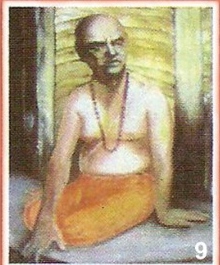
Introduction
Sri Akshobhya Tirtha holds a clear and well-recorded place in the history of Dvaita Vedanta. Dvaita tradition agrees that he was the fourth pontiff to hold the Madhva Peetha after Madhvacharya himself, following Padmanabha Tirtha, Narahari Tirtha and Madhava Tirtha. He won a famous public debate against the Advaita scholar Vidyaranya. And in his final years he trained Jayatirtha. Dvaita scholars regard Jayatirtha as the most important commentator the Madhva sampradaya produced after its own founder. His extraordinary life is told in full on his own page.
| Detail | Description |
|---|---|
| Birth name | Govinda Shastri, also called Govinda Bhatta |
| Ordained by | Sources differ. Sri Vyasaraja Matha's own succession record names Sri Madhava Tirtha, his immediate predecessor as pontiff. Wikipedia, following B. N. K. Sharma, names Padmanabha Tirtha instead. Some devotional accounts name Madhvacharya himself. |
| Tenure as pontiff | Traditionally 1350-1365 CE, the fourth of the four pontiffs after Madhvacharya |
| Chief disciple and successor | Jayatirtha |
| Best-recorded deed | Won a public debate against the Advaita scholar Vidyaranya at Mulbagal on the meaning of the phrase "tat tvam asi." A stone pillar commemorating it still stands there. |
| Institution founded | Sri Kudli Akshobhya Tirtha Matha, near Shivamogga, Karnataka, carried forward by his disciple Trailokya Bhushana Tirtha |
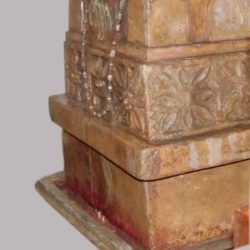
| Samadhi | Malkhed (ancient Manyakheta), Karnataka, on the bank of the river Kagini |
Scriptural evidence for the introduction (1)
মধ্বাচার্য-স্থানে আইলা যাঁহা ‘তত্ত্ববাদী’ ।
উড়ুপীতে ‘কৃষ্ণ’ দেখি, তাহাঁ হৈল প্রেমোন্মাদী ॥
madhvācārya-sthāne āilā yāṅhā 'tattvavādī'
uḍupīte 'kṛṣṇa' dekhi, tāhāṅ haila premonmādī
Word for word
madhva-ācārya-sthāne: at the place of Madhvācārya; āilā: arrived; yāṅhā: where; tattva-vādī: philosophers known as Tattvavādīs; uḍupīte: at the place known as Uḍupī; kṛṣṇa dekhi: seeing the Deity of Lord Kṛṣṇa; tāhāṅ: there; haila: became; prema-unmādī: mad in ecstasy
Caitanya Mahaprabhu next arrived at Udupi, the place of Madhvacharya, where the philosophers known as Tattvavadis resided. There He saw the Deity of Lord Krishna and became mad with ecstasy.
From the purport: Purport excerpt: "The disciplic succession of the Madhvacharya-sampradaya is as follows... (14) Padmanabha, 1120; Narahari, 1127; Madhava, 1136; and Akshobhya 1159; (15) Jaya Tirtha, 1167."
This same purport separately lists the eight original monastery-commanders Madhvacharya appointed at Udupi, naming one of them "Akshobhya Tirtha (Pejavara-matha)", a different office and a different person from the fourth Mula-Matha pontiff profiled here, who appears instead in the purport's own sequential disciplic-succession list quoted above, immediately before Jaya Tirtha. Readers should not conflate the two same-named figures.
Chapter 1
Victory Over Vidyaranya at Mulbagal
A public debate on the meaning of "tat tvam asi" that Dvaita tradition still points to as Akshobhya Tirtha's single greatest achievement.
Akshobhya Tirtha's public debate with the Advaita scholar Vidyaranya (1302-1387) is recorded more consistently, and by more independent sources, than any other episode credited to him. The debate was on the meaning of the Upanishadic text "tat tvam asi," "that thou art." Advaita Vedanta reads this phrase as proof of the soul's ultimate identity with Brahman. Dvaita Vedanta reads it very differently, as a statement of similarity or relationship, never of literal oneness.
| Detail | Description |
|---|---|
| Opponent | Vidyaranya, Advaita scholar associated with the founding of the Vijayanagara Empire |
| Judge | Vedanta Desika, the Sri Vaishnava (Vishishtadvaita) scholar of many subjects, chosen by both sides |
| Location | Mulbagal, near Kolar, Karnataka |
| Verdict | Recorded in favor of Akshobhya Tirtha, in a verse still quoted in traditional circles |
| Physical evidence | A stone pillar at Mulbagal marking the victory, badly damaged but still standing |
| Independent written records | Vyasa Tirtha's Jayatirtha-Vijaya, the Raghavendra-Vijaya, and the Sri Vaishnava work Acharya-Vijaya-Champu |
Two Traditions, One Question #
Vidyaranya was among the strongest Advaita scholars of his time. History remembers him above all for his role in the founding of the Vijayanagara Empire in 1336. Both Uttaradi Math's own tradition and B. N. K. Sharma's academic history describe Akshobhya Tirtha as living in the same period as Vidyaranya, and as his recognized equal in learning. Their disagreement was about a single Upanishadic phrase, "tat tvam asi," which was already one of the sharpest points of dispute between the Advaita and Dvaita schools as a whole. Does it declare the individual soul and Brahman to be one and the same, as Shankaracharya's followers held? Or does it point instead to a relationship of dependence and similarity between two things that remain truly and eternally different, as Madhvacharya's followers held? Neither side treated this as a small technical point. For both schools, the whole structure of their philosophy depended on how this one phrase was read.
An Arbitrated Verdict #
The two scholars did not leave the dispute unresolved. Both agreed to present their arguments to Vedanta Desika, the celebrated Sri Vaishnava logician and poet, and to let him judge between them. This detail alone shows how seriously Indian philosophers of the fourteenth century took public debate. Tradition holds that Vedanta Desika's verdict favored Akshobhya Tirtha, recorded in a Sanskrit verse still quoted by traditional Dvaita scholars today. This tradition is not found only in the sources of one group. B. N. K. Sharma's academic history notes that it is confirmed by the Vedantadesika-Vaibhavaprakashika of Macharya (sixteenth century). It is also confirmed by an even earlier, fifteenth-century work associated with the Parakala Matha in Mysore. Both works come from institutions that had no particular reason to favor the reputation of a rival Dvaita pontiff.
A Pillar, and an Honest Note on Dating #
Unlike most of what survives about Akshobhya Tirtha, this episode left a physical record in stone. A stone pillar at Mulbagal marks the victory. Sharma describes it as still to be found today, though "in a grossly mutilated form." The event is also recorded in Vyasa Tirtha's own Jayatirtha-Vijaya. Vyasa Tirtha wrote it about a century later. He was not a direct personal disciple of Jayatirtha, but a celebrated later successor in the same Madhva tradition. Even so, his book is an early and respected source, close to Akshobhya Tirtha's own lineage. The event also appears in the later Raghavendra-Vijaya. Notably, it even appears in a Sri Vaishnava text, the Acharya-Vijaya-Champu, whose own teachings gave it no reason to invent a Dvaita victory. The sources really differ on the exact date, and we say so plainly. Popular retellings often date the debate to 1336 CE, the same year as Vijayanagara's founding. But Sharma's own careful study of the dates leaves the exact year open. He notes that the debate could fall anywhere from the 1320s to the 1360s, depending on which dating scheme is used for the pontiffs before Akshobhya Tirtha. The basic shape of the debate and its outcome are well confirmed by several independent traditions. Its exact calendar date is not.
Chapter 2
Kudli Matha and the Narasimha Consecrations
His own school admits that he wrote little. Akshobhya Tirtha left his mark instead through the deities he consecrated and the matha he founded.
B. N. K. Sharma's academic history says plainly that Akshobhya Tirtha was "not distinguished as a writer." One work, the Madhva-tattva-sara-samgraha, is credited to him by a single source, but no manuscript of it has ever been found. Judging from the title alone, Sharma thinks it was probably a short handbook of Dvaita teaching, not a major work of philosophy. Independent records tell us what Akshobhya Tirtha did, not what he wrote. That record is found in the institutions and consecrated deities that survive from his time as pontiff.
| Detail | Description |
|---|---|
| Matha founded | Sri Kudli Akshobhya Tirtha Matha, at the confluence of the Tunga and Bhadra rivers near Shivamogga |
| Successor at Kudli | His disciple Trailokya Bhushana Tirtha |
| Deity consecrated at Kudli | Chintamani Narasimha |
| Deity consecrated at Mulbagal | Angara Narasimha, traditionally said to have been sketched in charcoal that transformed into an idol |
| Deity consecrated near Shivamogga | Mukhyaprana (Hanuman), at Pillangiri |
| Dated inscription | A Kannada copper-plate grant of 1337 CE recording a purificatory rite he performed at Malkhed |
A Matha at the Meeting of Two Rivers #
At Kudli, where the Tunga and Bhadra rivers meet near present-day Shivamogga, Akshobhya Tirtha is credited with consecrating a Deity of Chintamani Narasimha. He is also credited with founding a matha there. It continues in an unbroken line to this day and is now known as the Sri Kudli Akshobhya Tirtha Matha. Sri Vyasaraja Matha's own succession record states that Akshobhya Tirtha trained Jayatirtha as his eventual successor on the Madhva Peetha itself. Separately, he also ordained another disciple, Trailokya Bhushana Tirtha, to carry on this matha at Kudli. So a second line of succession began alongside the first, separate from the main seat of the pontiffs that passed to Jayatirtha. That Kudli line, under various names, still continues on its own today.
Deities at Mulbagal and Pillangiri #
Two further consecrations are recorded from Akshobhya Tirtha's travels through the region around Kolar and Shivamogga. At Mulbagal, the same town where his debate with Vidyaranya took place, tradition credits him with consecrating a Deity of Narasimha. It is called Angara Narasimha, "the charcoal Narasimha." He is said to have first sketched the form on a hillock in charcoal, and the sketch then took shape as an idol. Near Shivamogga, at a site called Pillangiri, he is also credited with consecrating a Deity of Mukhyaprana. This is the name the Madhva-sampradaya tradition uses for Hanuman as the incarnation of Vayu. These accounts come from Dvaita-tradition sources. They are not confirmed by independent archaeology or by academic historians, so we present them as tradition, not as verified historical fact.
One Firmly Dated Act #
Most of the material about Akshobhya Tirtha is traditional and undated. But one specific act of his is supported by truly independent evidence with a clear date. B. N. K. Sharma's academic history cites a Kannada copper-plate grant, dated Sarvajit era 1337 CE. The researcher Kapatral Krishnarao first brought it to the notice of scholars. It records a purification rite (prayashchitta) that Akshobhya Tirtha personally performed at Malkhed for two men, Ranganna and Damanna, described as Patils (village headmen). The rite restored their lost standing as Brahmins. This is a small act next to a philosophical debate or a temple consecration. But for a historian it is rarer and more valuable, because it survives on a dated, physical inscription, not in a later devotional retelling. It is direct evidence that in 1337 CE Akshobhya Tirtha was active as a religious authority at Malkhed, the same town where his own samadhi would later be established.
Chapter 3
Guru of Jayatirtha and the Samadhi at Malkhed
Akshobhya Tirtha's greatest legacy was not a book but a disciple, trained in his final years at Malkhed and still honored there beside his own guru today.
In the years after his debate with Vidyaranya, tradition holds that Akshobhya Tirtha moved north from the Kolar region to Pandharpur, on the bank of the Bhima river. There, in his later years, he met the young man who would become his most celebrated disciple and eventual successor: Jayatirtha.
| Detail | Description |
|---|---|
| Meeting place | The bank of the Bhima river, near Pandharpur |
| Disciple | Jayatirtha |
| Later residence | Malkhed (ancient Manyakheta), Karnataka |
| Jayatirtha's succession | 1365 CE, on Akshobhya Tirtha's disappearance |
| Akshobhya Tirtha's samadhi | Malkhed, on the bank of the river Kagini |
| Later institutions descending from this line | Uttaradi Matha, Vyasaraja Matha, Raghavendra Swami Matha (the Matha-traya) |
A Meeting at Pandharpur #
Life and Renunciation Under Akshobhya Tirtha tells in full the story of Jayatirtha's own remarkable early life. It covers his birth name Dhondopant, his family background, and the well-known story of how he came to seek initiation. This page tells Akshobhya Tirtha's own side of the meeting. By tradition, he was the ascetic the young Dhondopant met on the bank of the Bhima river near Pandharpur. Akshobhya Tirtha accepted him as a disciple, ordained him into sannyasa, and gave him the name by which he is remembered: Jayatirtha.
Final Years at Malkhed #
After Jayatirtha's initiation, tradition holds that the two of them moved further north to Malkhed, ancient Manyakheta, on the bank of the river Kagini. Malkhed was once the capital of the Rashtrakuta dynasty. Akshobhya Tirtha spent his last years here. In the words of Dvaita tradition, he devoted himself to training his gifted disciple in the fine points of Madhva's own Dvaita philosophy. These were the skills of explaining texts that later let Jayatirtha uncover meanings in Madhvacharya's writing that earlier scholars had missed. Jayatirtha's own later writings are said to pay warm, direct tribute to the guru who had given him this training. When Akshobhya Tirtha's own life came to a close in 1365, Jayatirtha succeeded him as the sixth pontiff of the line running back through Madhvacharya. In just twenty-three years as pontiff, Jayatirtha went on to become the single most important commentator Dvaita Vedanta produced after its own founder.
A Samadhi Shared With His Disciple #
Akshobhya Tirtha's own samadhi (brindavana) stands at Malkhed on the bank of the Kagini. By tradition, Jayatirtha's own tomb is also nearby in the same town. Guru and disciple, in a sense, are still close to one another in the place both called home in their final years. Over the following two centuries, the line that continued after Jayatirtha split into what Dvaita tradition calls the Matha-traya, the three mathas: the Uttaradi Matha, the Vyasaraja Matha, and the Raghavendra Swami Matha at Mantralayam. All three trace their line of descent back through Jayatirtha to Akshobhya Tirtha himself. Whatever differences of teaching or organization have grown up between these three mathas over the centuries, all three still honor Akshobhya Tirtha. For all of them, he is the guru of Jayatirtha, the disciple from whom they all descend.
Closing
From Govinda Shastri To Akshobhya Tirtha #
By tradition, Akshobhya Tirtha was born in Uttara-Karnataka under the name Govinda Shastri, also recorded as Govinda Bhatta. No source records his birth year directly. The commonly quoted date of about 1282 CE is a modern reconstruction, worked out backward from his documented tenure as pontiff from 1350 to 1365. Devotional accounts say he first followed a non-Vaishnava, Advaita line of teaching. He later travelled to Udupi after hearing of Madhvacharya's growing fame, and there he surrendered to him.
We do not know for certain who actually gave Akshobhya Tirtha his sannyasa initiation. Sri Uttaradi Math's own historical account states that he "took sanyasa directly from Shri Madhvacharya" and received the Deity of Aja-Vithala from him personally. B. N. K. Sharma's history, the standard scholarly book on this period, is very careful about that claim. Sharma notes there is "no evidence, apart from tradition," that Madhva himself personally ordained the later ones among his early successors. He also points out that Dvaita sources disagree on this exact question. One source, the Satyasandhavilasa, names Padmanabha Tirtha as the one who initiated Narahari, Madhava and Akshobhya Tirtha in turn. Another, a verse by the Haridasa poet Pranega Vithala, calls Akshobhya the direct disciple of Madhava Tirtha instead. Sri Vyasaraja Matha's own succession record clearly takes this second view: "Sri Akshobhya Tirtha was ordained the 5th Pithadhipati by Sri Madhava Tirtha." This page follows that Dvaita-tradition succession record and treats Madhava Tirtha as Akshobhya Tirtha's guru. But Sharma himself calls the whole question "vague" and other sources disagree.
Fourth Pontiff Of The Madhva Peetha #
Whoever ordained whom, Dvaita tradition agrees that Padmanabha, Narahari, Madhava and Akshobhya Tirtha held the Madhva Peetha one after another. Later tradition calls this group the "Mula-Matha" line. It is separate from the eight mathas that Madhvacharya founded at Udupi, which all existed side by side. Sharma again urges caution here. He notes that the idea of one pontiff "succeeding" another and "ruling" for a fixed number of years was not clearly recorded at first. It was recorded clearly only after the three major mathas tracing back through Jayatirtha were properly established, around the middle of the fifteenth century. That was a full century after Akshobhya Tirtha's own death. But every account agrees that Akshobhya Tirtha was the last name in this founding group of four before Jayatirtha received the seat in 1365.
Place In The Gaudiya Guru-Parampara #
On this one point, Akshobhya Tirtha's place in the traditional Gaudiya Vaishnava guru-parampara is better recorded than the place of several other names in the same chain. We say this plainly, as we also do on Madhavendra Puri's Life in the Madhva Sampradaya. Srila Prabhupada's own purport to Sri Chaitanya-charitamrita, Madhya 9.245, gives a numbered disciplic succession of the Madhva sampradaya:
"The disciplic succession of the Madhvacharya-sampradaya is as follows... (14) Padmanabha, 1120; Narahari, 1127; Madhava, 1136; and Akshobhya 1159; (15) Jaya Tirtha, 1167."
Here Padmanabha, Narahari, Madhava and Akshobhya Tirtha appear together as one generation, immediately followed by Jaya Tirtha. This matches the Dvaita-tradition succession order followed above. One point may cause confusion. The same purport also separately lists the eight original heads of the monasteries that Madhvacharya appointed at Udupi. It names one of them as "Akshobhya Tirtha (Pejavara-matha)." That is a different office and a different person from the fourth Mula-Matha pontiff described here, because the two lists describe two separate lines of succession. In the Gaudiya list, Jayatirtha stands between Akshobhya Tirtha and Jnanasindhu, the next name in the chain. The Gaudiya list gives this order, but no independent source confirms Jnanasindhu as the name after Jayatirtha. This placement is discussed in full on Place in the Gaudiya Guru-Parampara.
- B. N. K. Sharma, History of the Dvaita School of Vedanta and Its Literature (1961/1981), full text via Internet Archive
- Sri Akshobhya Tirtha - Sri Uttaradi Math (official)
- Sri Akshobhya Tirtha - Sri Vyasaraja Matha (official)
- Akshobhya Tirtha - Gaudiya History (ISKCON Desire Tree)
- Sri Chaitanya-charitamrita, Madhya-lila 9.245, purport
- Madhavendra Puri: Life in the Madhva Sampradaya (this website)
