Srila Bhakti Promode Puri Goswami Maharaja was born Promode Bhushan Chakravarti on 8 October 1898 (one source gives 18 October) in the village of Ganganandapur, Jessore district, in a strict brahmin household. His parents, Tarini Charan Chakravarti and Ram Rangini Devi, raised him in a family already turned toward Krishna bhakti, and even as a small child he showed an attraction to Krishna that went beyond ordinary religious upbringing. One story recorded by his own math tells how, as a boy tending the family's home Deity, he once forgot to cover the Lord with a blanket through a cold Bengal winter night - and that he himself began shivering with chills until the oversight was set right, as if the child's own body carried the discomfort he had left the Deity to bear alone. Whatever exactly happened that night, the story fixed a pattern of thought that never left him: worship of God was not a formality to complete but something felt in the body.
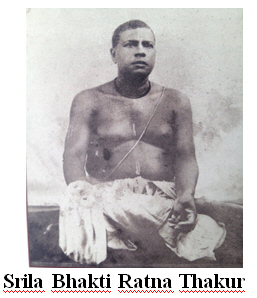
His first real teacher on this path was a neighbor, Srila Bhakti Ratna Thakura, a godbrother and siksha disciple of Bhaktivinoda Thakura. In the language the Gaudiya Vaishnava tradition uses for this kind of relationship, Bhakti Ratna Thakura was his vartma-pradarsaka-guru, the one who "shows the path" before initiation - introducing him to Bhaktivinoda Thakura's writings and to the Chaitanya-charitamrita and Srimad-Bhagavatam years before he took formal diksha from anyone. He went on to Bangabasi College in Calcutta and graduated with honors in chemistry, a detail worth keeping in mind for a man who would spend the rest of his life as an editor and archivist rather than a scientist.
The turning point came in 1915. As a university student he traveled to the Yogapith in Sri Mayapur, the site Bhaktivinoda Thakura and later Bhaktisiddhanta Sarasvati Thakura had identified as Sri Chaitanya Mahaprabhu's birthplace, and there he met Bhaktisiddhanta Sarasvati Thakura himself, then still known by his pre-sannyasa name Bimala Prasad Datta. Sources are consistent on an unusual detail of timing: this first meeting fell on the very day - by some accounts the day after - that Bhaktisiddhanta Sarasvati Thakura's own guru, Srila Gaura Kishora Dasa Babaji, had entered his eternal abode at that same Yogapith. A young man arriving to see the site of Mahaprabhu's birth found himself, by pure timing, present at the passing of one acharya and the first sight of the next - two generations of the parampara meeting on the same patch of ground within a day of each other.
He did not commit to the relationship immediately. Several accounts place a second, more decisive meeting at the Yogapith temple in 1917, after which he began the slower internal process that, in the Gaudiya Vaishnava path, usually precedes formal initiation. That process came to its point on Sri Krishna Janmastami in 1923, when he received both harinama and mantra diksha from Bhaktisiddhanta Sarasvati Thakura and was given the name Pranavananda Brahmachari - the name by which he would be known through the fourteen years he spent in his guru's personal service. On that same day, by his own math's account, Bhaktisiddhanta Sarasvati Thakura handed him a fountain pen and told him to use it in the mission's service - a simple gift that, in hindsight, named the entire shape of the vocation that followed. What that vocation actually looked like, and how it kept him at his guru's side for over a decade, is told on The Service of the Pen.