Married Young, Renounced Almost at Once #
According to the secondary Gaudiya sources, Dhananjaya Pandit was the son of a well-to-do father, though the sources give the father's name differently. He was married while still young to a woman named Haripriya. (See Dhananjaya Pandit's main page for the two different accounts of his birth and parents; neither has been checked against an original text.) Both accounts agree on what happened next. Dhananjaya did not settle into married life. He set out on pilgrimage almost immediately, and his father gave him money for the journey.
He did not keep it. Tradition says he carried the entire sum to Sri Chaitanya Mahaprabhu and gave it away. He then continued his travels with nothing in his hand but a kamandalu, a simple begging bowl. A later devotional verse in the Vaishnava-vandana tradition still remembers him this way. It praises him as a vilasi vairagi, a playful renounced man, who gave his all to the Lord and left carrying only a bowl. The available sources do not establish who wrote the verse or when. So it is treated here as a devotional tribute, not as a dated historical record. But it matches closely how Krishnadasa Kaviraja Goswami himself describes Dhananjaya in a single line of Sri Chaitanya-charitamrita: atyanta virakta, "extremely renounced."
Daily Obeisance to Tulasi Devi #
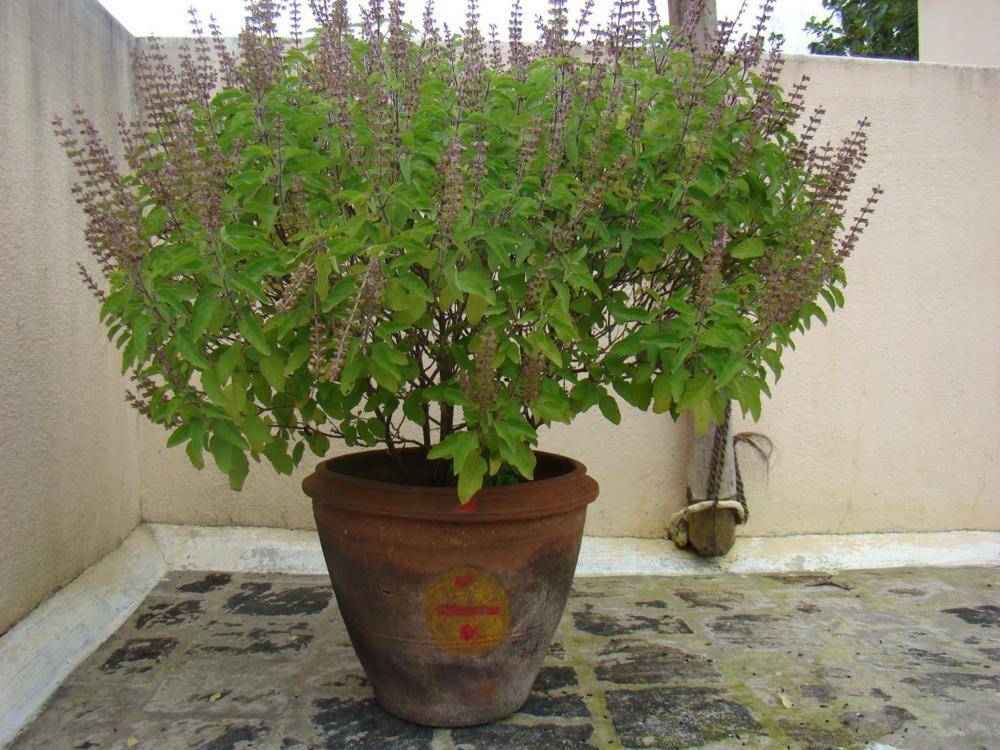
The same renunciation is remembered in a smaller, daily form. Dhananjaya Pandit is said to have bowed down flat in obeisance before Tulasi Devi three times every day without fail: morning, noon and evening. Gaudiya memory has kept this simple practice alongside the larger story of his wedding-day renunciation. It is a small detail, but it tells us something. The same man who could give away his father's fortune in a single gesture also kept a quiet act of humility, repeated every day, as part of his life. Tulasi worship of this kind is still central to Gaudiya Vaishnava sadhana in general. Dhananjaya's own devotion to her is one of the few personal, day-to-day habits of his that are recorded at all.
A Description from Chaitanya-bhagavata #
Gaudiya memory also preserves a short line about Dhananjaya Pandit that is said to come from Vrindavana dasa Thakura's Chaitanya-bhagavata. But the two secondary sources do not even agree with each other on where in that text it is found. One gives it as Antya-khanda 5.733 and translates it as "Dhananjaya Pandit was a very rare soul. Nityananda Prabhu was always present in his heart." The other cites it as 3.5.773 and renders it "Dhananjaya Pandit was an extraordinarily great Vaishnava. Nityananda took up permanent residence in his heart." Vedabase.io does not have a separate searchable text of the Chaitanya-bhagavata, so neither reference could be checked against an original edition. Both versions agree on the main point, that Nityananda Prabhu's presence in Dhananjaya's heart was total and permanent. So that much is repeated here with confidence. The exact chapter and verse are openly left as an unanswered question.
Sankirtana in Navadvipa #
Before his renunciation carried him away from Bengal completely, Dhananjaya Pandit is remembered as having taken part for a time in Nityananda Prabhu's own sankirtana in Navadvipa. This was the public chanting and dancing that marked Sri Chaitanya Mahaprabhu's early public movement. Sources differ on exactly how this period fits with his marriage, his pilgrimage, and his final departure for Vrindavana. One account says that after his time in the Navadvipa sankirtana he returned to Sitalagrama, before setting out again on pilgrimage. The fuller story of that later journey includes a stay at a village called Sanchara-Panchara and two separate trips toward Vrindavana. It belongs to a different chapter of his story, told on The Deities of Sitalagrama.
An Honest Note on the Record #
Only a little can be said with real confidence. Chaitanya-charitamrita itself confirms only that Dhananjaya Pandit was renounced and devoted. It does not tell the wedding-day story at all. The story of the begging bowl, the daily bows to Tulasi Devi, and even the exact order of his travels all come entirely from later secondary collections. This difference is pointed out clearly here instead of being blurred. In the end, a short account with honest sources is the more faithful tribute to a truly renounced devotee.
