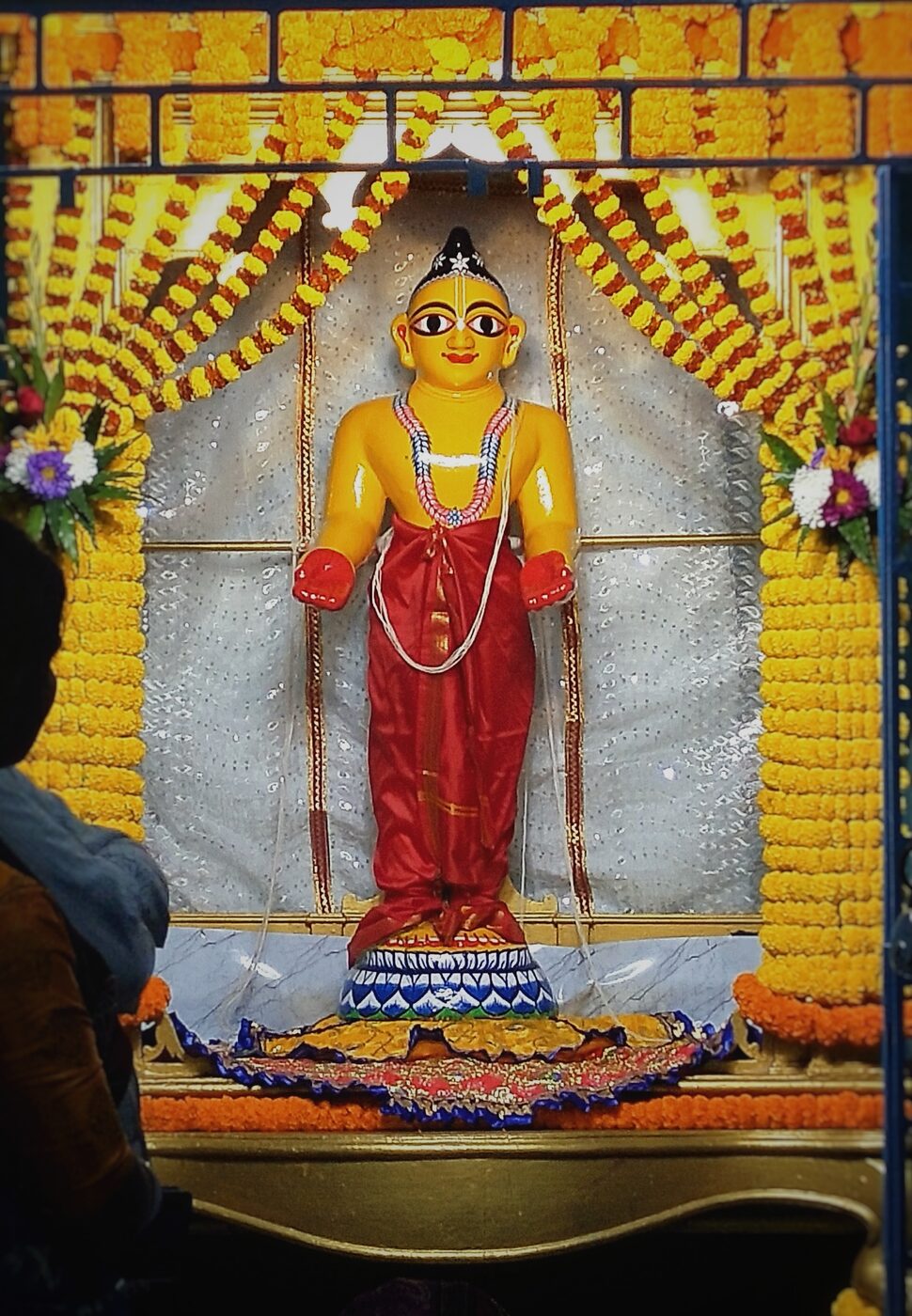
Sri Nityananda Prabhu
Patita-pavana, the Deliverer of the Fallen
Also known as Nitai, Nityananda Rama, Avadhuta, Balarama
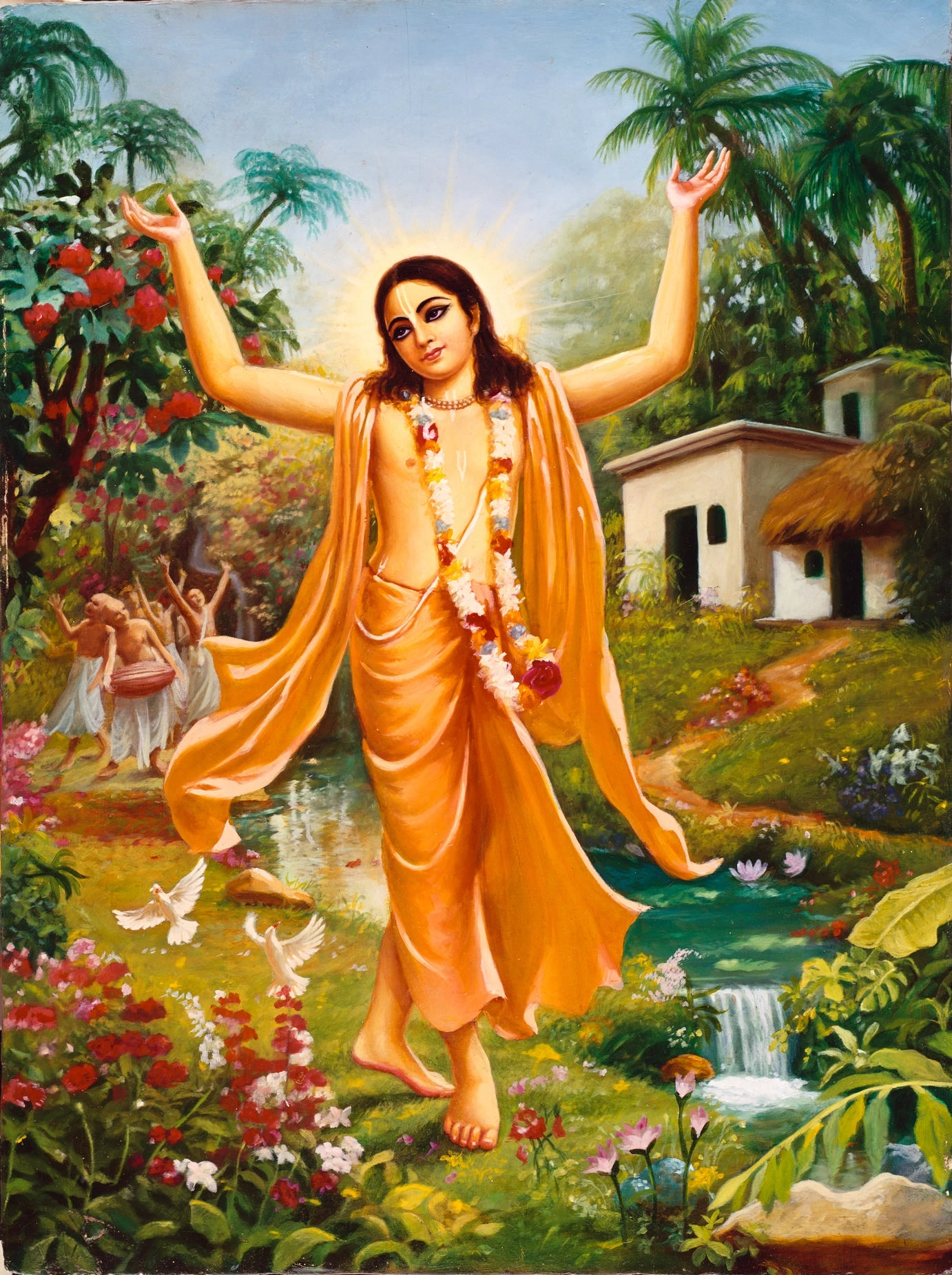
“Go, friends, go through the streets of the town, meet every man at his door, and ask him to chant the name of Hari with a holy life.”
The instruction Sri Chaitanya Mahaprabhu gave to Nityananda Prabhu and Haridasa Thakura
Sri Nityananda Prabhu is the second member of the Panca-tattva and, in Gaudiya Vaishnava theology, the principle of the spiritual master himself. Sri Chaitanya Mahaprabhu is Krishna appearing as His own devotee, and Nityananda Prabhu is understood to be Balarama. Balarama is Krishna's elder brother and His first expansion. He is also the source of all service to Krishna. Vaishnavas therefore approach Mahaprabhu through Nityananda Prabhu rather than directly, on the principle that one reaches the Lord by the mercy of the Lord's servant. The pairing is so fundamental to Bengali devotional life that the two are almost never named separately: they are simply Gaura-Nitai.
| Detail | Description |
|---|---|
| Identity | Balarama, the second member of the Panca-tattva (Gaura-ganoddesha-dipika 11; Chaitanya-charitamrita Madhya 1.28) |
| Advent | Ekachakra, Birbhum district, Bengal, around 1474 |
| Parents | Hadai Ojha (Hadai Pandita) and Padmavati Devi |
| Wives | Vasudha and Jahnava, daughters of Suryadasa Sarakhela |
| Field of work | Bengal, by the order of Sri Chaitanya Mahaprabhu |
| Known as | Patita-pavana, the deliverer of the fallen |
Advent at Ekachakra #
He appeared around 1474 in the village of Ekachakra, in the Birbhum district of Bengal. This was some twelve years before Mahaprabhu. His parents were Hadai Ojha (Hadai Pandita) and Padmavati Devi. The biographies describe how, as a child, He acted out the pastimes of Krishna and Balarama with the other village boys. He would take sometimes one role and sometimes another. It is said that His play seemed so real that it made the adults watching it uneasy.
Leaving Home and Twenty Years of Pilgrimage #
When Nityananda was about twelve or thirteen, a travelling sannyasi named Lakshmipati Tirtha stopped at Hadai Pandita's house. The sannyasi asked for the boy as his companion. This was a guest's request, and it could not honourably be refused. Hadai Pandita gave his only son away and, the accounts say, collapsed. Nityananda left Ekachakra and did not return for some twenty years. He spent those years in continuous pilgrimage across the length of India. The Chaitanya-bhagavata records this journey at length. It covered Gaya, Kashi, Prayag, Mathura, Vrindavana, Dvaraka, Rameshvaram and the tirthas of the south.
The Meeting With Sri Chaitanya Mahaprabhu #
Nityananda came to Nabadwip around 1506. He was then in His early thirties, and Mahaprabhu had already begun the sankirtana movement. Their meeting is one of the best-loved episodes in Bengali Vaishnava literature. After arriving in the town, Nityananda hid Himself. Mahaprabhu knew very well who had come, and He sent devotees to find Nityananda. In the end Mahaprabhu revealed Himself in His four-armed and six-armed forms, and these forms made clear who both of them really were. From that point the two were inseparable, and Nityananda became the movement's most fearless preacher.
Kavi Karnapura's Gaura-ganoddesha-dipika (verse 11), explaining the Panca-tattva, says plainly who the two of Them are:
bhakta-rūpo gauracandro yato’sau nanda-nandanaḥ
bhakta-svarūpo nityānando vraje yaḥ śrī-halāyudhaḥ
"In this Panca-tattva, the bhakta-rupa (form of a devotee) is Lord Caitanya Mahaprabhu, who formerly appeared as Lord Krsna, the son of Nanda Maharaja. The bhakta-svarupa (devotional incarnation) is Lord Nityananda, who formerly appeared in Vrajabhumi as Lord Balarama." (Gaura-ganoddesha-dipika 11)
Chaitanya-charitamrita joins His identity and His mood of service in a single verse:
yadyapi āpani haye prabhu balarāma
tathāpi caitanyera kare dāsa-abhimāna
"Although Nityānanda Prabhu is none other than Balarāma Himself, He nonetheless always thinks of Himself as the eternal servant of Lord Śrī Caitanya Mahāprabhu." (Chaitanya-charitamrita Madhya 1.28)
The Deliverance of Jagai and Madhai #
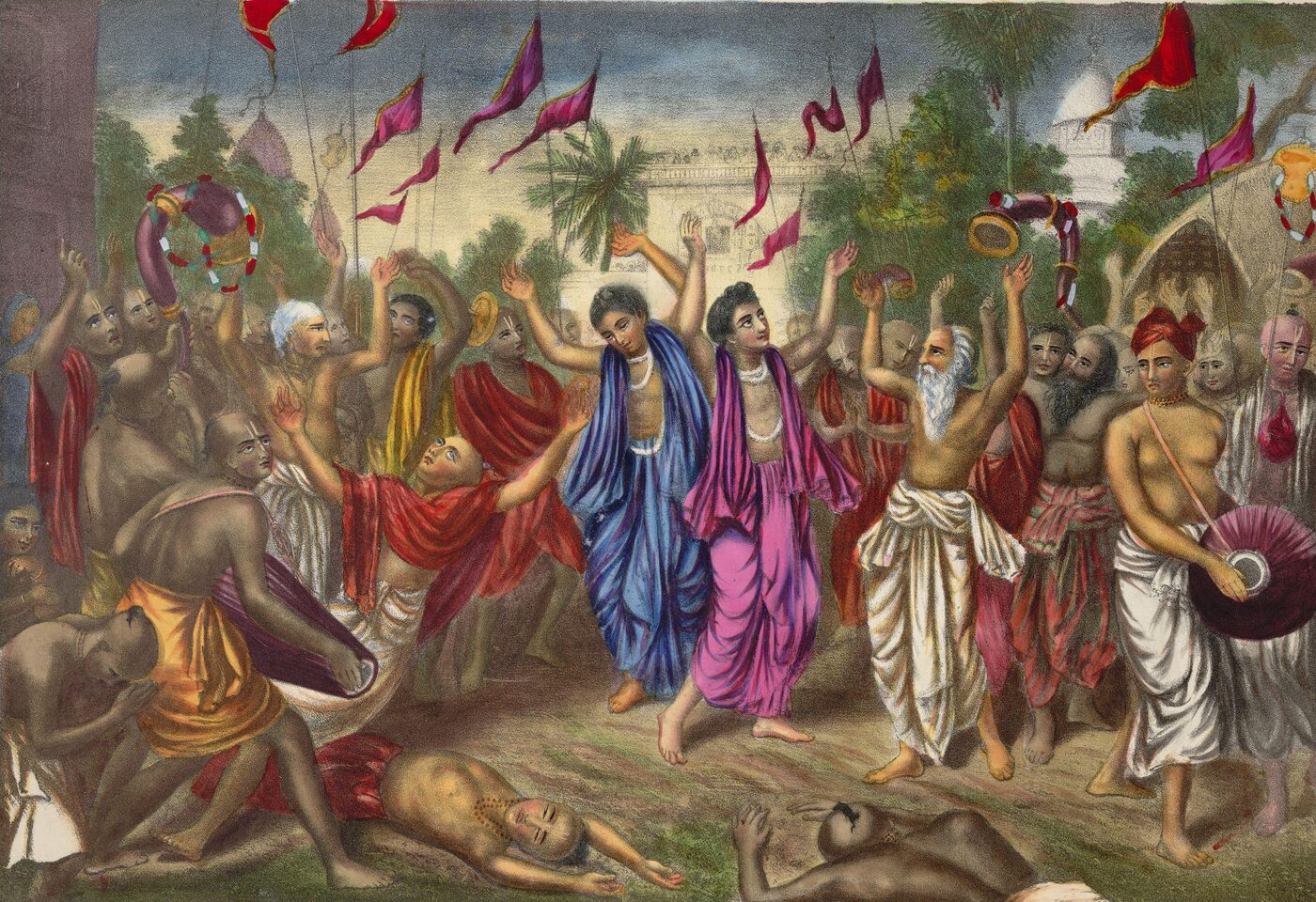
His most famous act belongs to that period. Sent out with Haridasa Thakura to call every householder in Nabadwip to chant, He approached the two notorious brothers Jagai and Madhai and was struck on the head by Madhai with a broken earthen pot, so that blood ran down His face. When Mahaprabhu came in fury to punish them, it was the bleeding Nityananda who threw Himself between the Lord and the brothers and begged that they be forgiven. The episode fixed His reputation permanently as the most merciful of all the Lord's associates, the one who takes the blow and then pleads for the man who struck Him.
The Bengal Mission and Household Life #
When Mahaprabhu settled at Jagannatha Puri, He appointed Nityananda Prabhu to lead the mission throughout Bengal. Largely because of this, Gaudiya Vaishnavism became a mass movement and did not stay limited to Nabadwip. Nityananda preached across Bengal for decades, initiated thousands, and organised the householder communities that carried the tradition forward. At the request of the devotees He also married. His wives were Vasudha and Jahnava, daughters of Suryadasa Sarakhela. After Nityananda Prabhu's disappearance, Jahnava Mata became one of the most authoritative teachers in the entire tradition. The Gaudiya community accepted her leadership without dispute.
The Mercy of Nitai #
Gaudiya Vaishnavas hold that no one is qualified to approach Sri Chaitanya Mahaprabhu without first receiving the mercy of Nityananda Prabhu, and one certainly cannot approach Rādhā and Kṛṣṇa without His mercy. This teaching is expressed in the much-repeated line of Narottama Dasa Thakura that when Nitai's mercy comes, one attains Radha and Krishna. He is called patita-pavana, the deliverer of the fallen, and the tradition insists that His mercy asks nothing of anyone. The reason usually given is the Jagai and Madhai episode. Nityananda forgave even the man who struck Him and made Him bleed. In doing so He showed, in effect, the full extent of His mercy.
Scriptural evidence
Quoted in the text above:
- Madhya 1.28 Sri Chaitanya-charitamrita quoted above ↑
Further verses:
अस्यार्थो विवृतस्तैर्यः स सङ्क्षिप्य विलिख्यते ।
भक्तरूपो गौरचन्द्रो यतोऽसौ नन्दनन्दनः ॥
भक्तस्वरूपो नित्यानन्दो व्रजे यः श्रीहलायुधः ।
भक्तावतार आचार्योऽद्वैतो यः श्रीसदाशिवः ॥
भक्ताख्याः श्रीनिवासाद्या यतस्ते भक्तरूपिनः ।
भक्तशक्तिर्द्विजाग्रण्यः श्रीगदाधरपण्डितः ॥११॥
asyārtho vivṛtas tair yaḥ sa saṅkṣipya vilikhyate |
bhakta-rūpo gauracandro yato’sau nanda-nandanaḥ ||
bhakta-svarūpo nityānando vraje yaḥ śrī-halāyudhaḥ |
bhaktāvatāra ācāryo’dvaito yaḥ śrī-sadāśivaḥ ||
bhaktākhyāḥ śrīnivāsādyā yatas te bhakta-rūpinaḥ |
bhakta-śaktir dvijāgraṇyaḥ śrī-gadādhara-paṇḍitaḥ ||11||
I shall now summarily explain the meaning of these words. In this Panca-tattva, the bhakta-rupa (form of a devotee) is Lord Caitanya Mahaprabhu, who formerly appeared as Lord Krsna, the son of Nanda Maharaja. The bhakta-svarupa (devotional incarnation) is Lord Nityananda, who formerly appeared in Vrajabhumi as Lord Balarama. The bhaktavatara (devotional manifestation) is Lord Advaita Acarya, who is not different from Lord Sadasiva. The bhaktakhya (pure devotee) is Srinivasa and the other great devotees as well. The bhakta-sakti (devotional energy) is Gadadhara Pandita, the foremost of brahmanas.
From the purport: Describing such individual service, the Gaura-gaṇoddeśa-dīpikā (11-16) declares that although Lord Caitanya Mahāprabhu appeared as a devotee, He is none other than the son of Nanda Mahārāja. Similarly, although Śrī Nityānanda Prabhu appeared as Lord Caitanya's assistant, He is none other than Baladeva, the carrier of the plow.
Kavi Karnapura's summary of the Panca-tattva: Nityananda Prabhu is the bhakta-svarupa, who in Vraja is Balarama (Sri Halayudha). Sanskrit: diacritic edition of the Gaura-ganoddesha-dipika; English translation as published at bvmlu.org. Purport excerpt: Srila Prabhupada, Chaitanya-charitamrita Adi 17.301.
Disciples
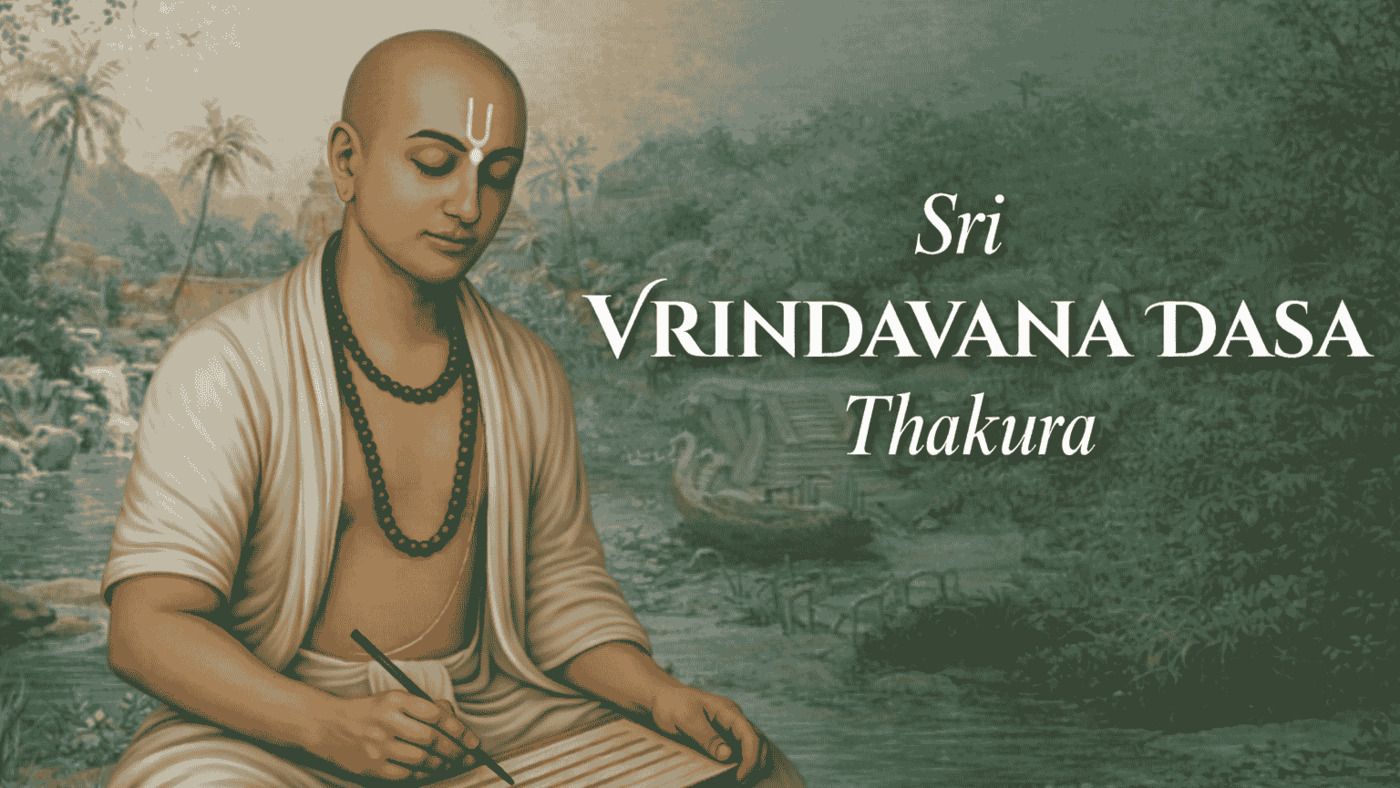
Srila Vrindavana Dasa Thakura
Author of Sri Chaitanya-Bhagavata
c. 1507 CE (Krishna Dvadashi, month of Vaishakh, 1429 Shaka era) – c. 1589 CE (exact year disputed)
6 pastime pages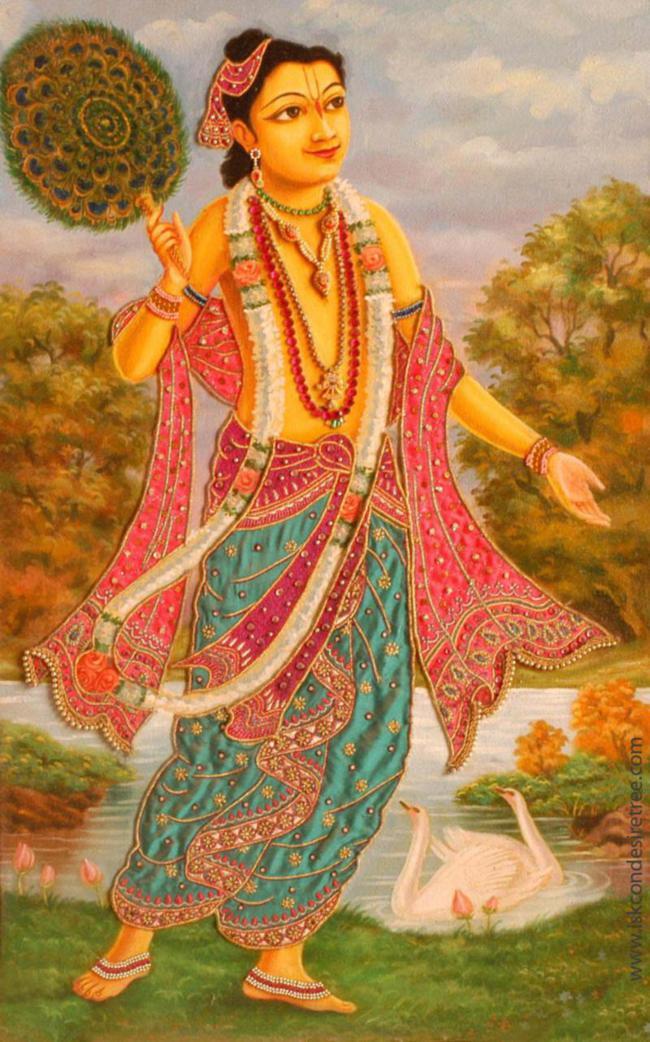
Srila Abhirama Gopala Thakura
Nityananda Prabhu's Preacher-Associate at Khanakula Krishnanagara
Not recorded (flourished late 15th - early 16th century) – Krishna Saptami (dark seventh) of the month of Chaitra; year not recorded
5 pastime pages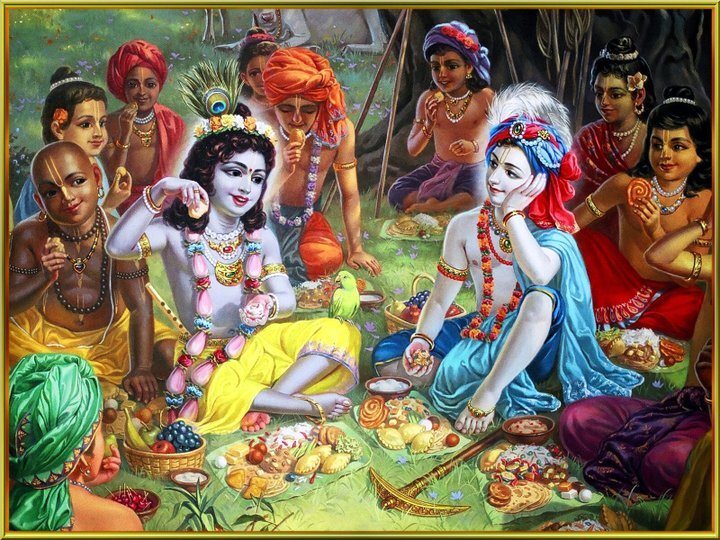
Srila Purushottama Dasa Thakura
Bengali Devotee Wholly Absorbed in Nityananda Prabhu
Not recorded (probably early-to-mid 16th century) – Not recorded in the available sources
3 pastime pages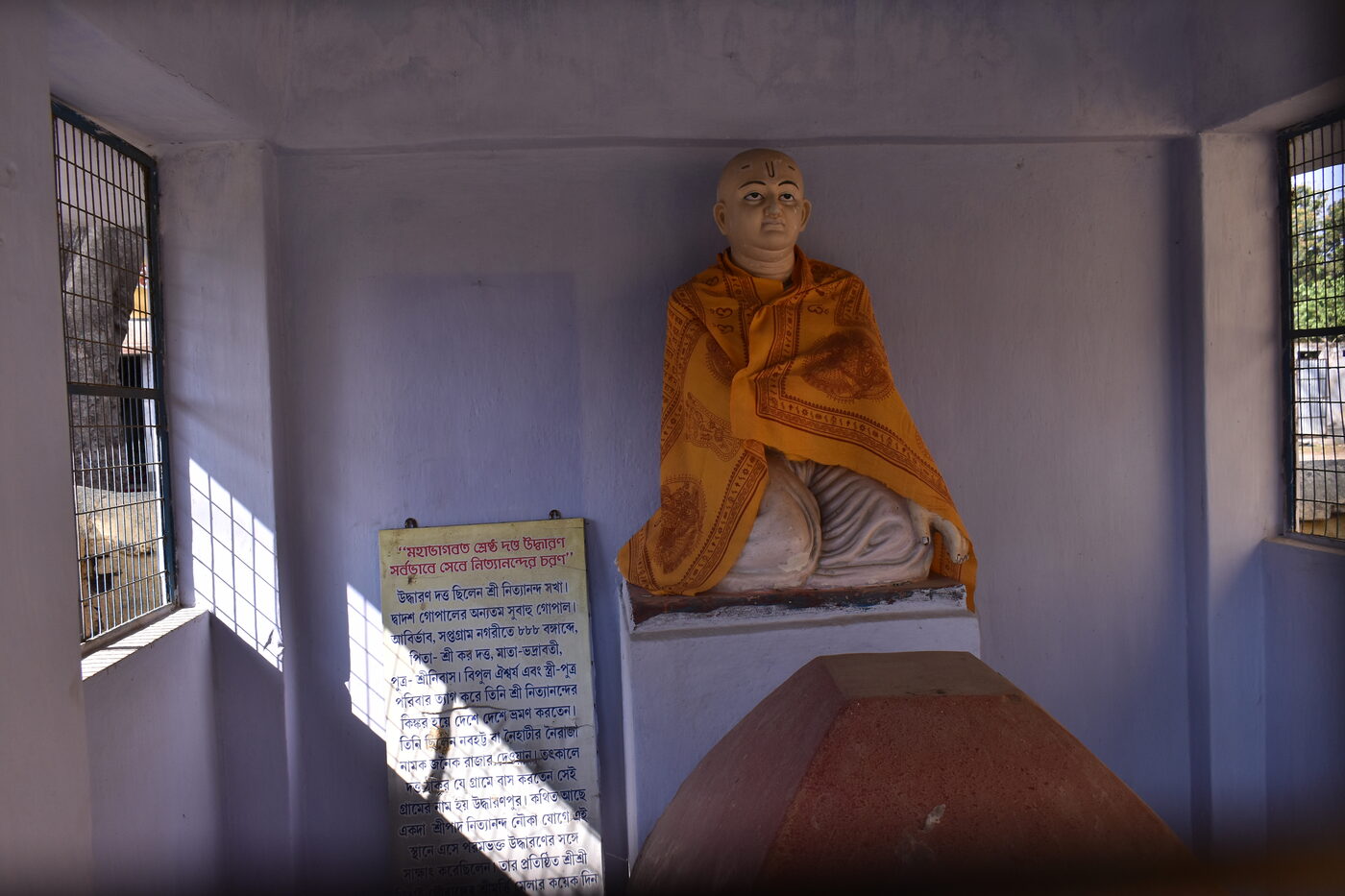
Srila Uddharana Datta Thakura
The Gold Merchant Who Cooked for Nityananda Prabhu
c. 1481 – Krishna Trayodashi, month of Pausha, Shaka 1463 (usually given as c. 1541; one account often copied online gives 1552)
4 pastime pages
Srila Dhananjaya Pandit
Renounced Servant of Nityananda Prabhu at Sitalagrama
Not reliably recorded (one secondary source gives a date of 1485 without saying which era it uses; this date could not be checked, or made to fit with Mahaprabhu's own lifetime) – Shukla-ashtami (the bright eighth) of the month of Kartik; year not recorded
2 pastime pages
Sundarananda Thakura
Nityananda Prabhu's Most Intimate Servant Among the Twelve Gopalas
Not recorded in the available sources – Full-moon day of Magha, per Bhaktisiddhanta Sarasvati Thakura's Anubhasya; full-moon day of Kartika, per a separate account (sources differ; year not recorded either way)
2 pastime pages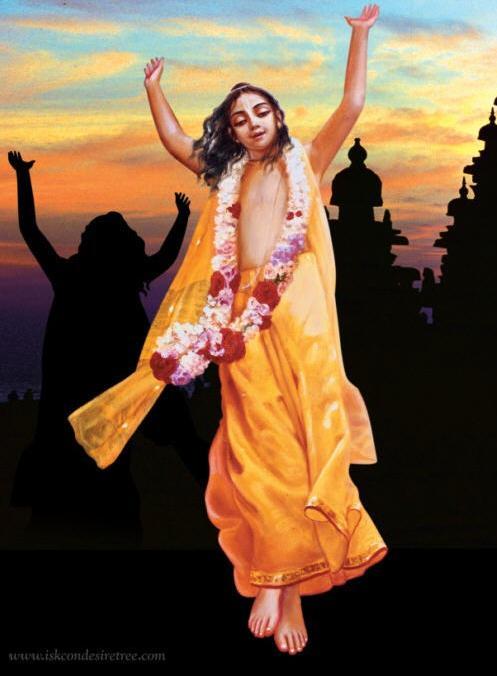
Srila Minaketana Rama Dasa
The Ecstatic Servant of Sri Nityananda Prabhu
Not recorded – Not recorded
2 pastime pages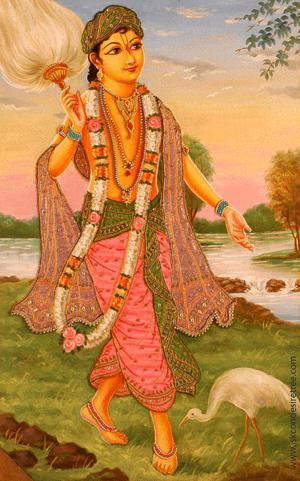
Parameshvara Dasa Thakura
The Fifth of Nityananda Prabhu's Twelve Gopalas
Not recorded – Not recorded (disappearance festival observed on the full-moon day of Vaishakha, April-May)
2 pastime pages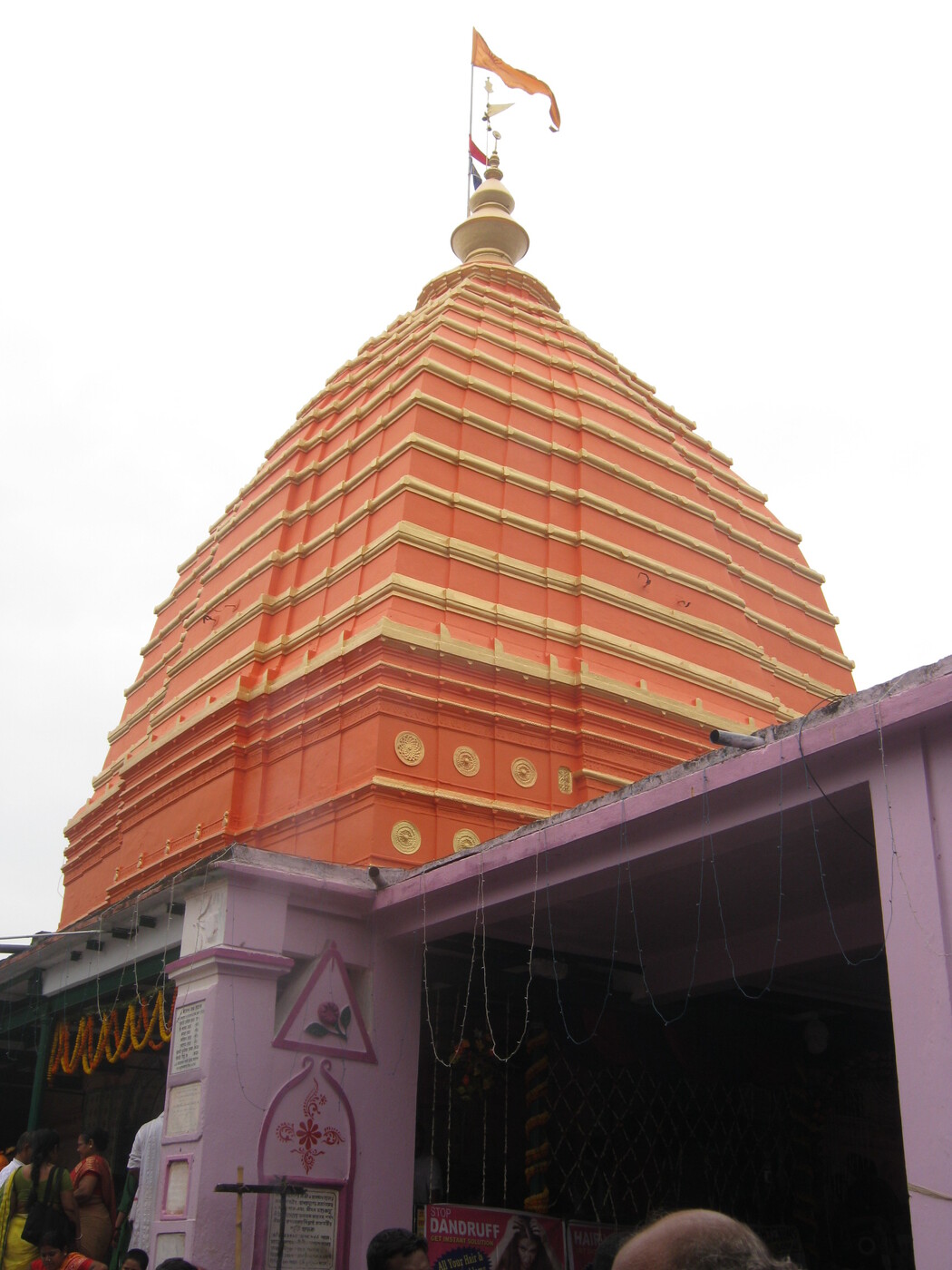
Srila Kamalakara Pippalai
One of Nityananda Prabhu's Twelve Gopalas, Founder of Deity Worship at Mahesha
c. 1492 (Gaudiya Vaishnava Abhidhana; not stated in Sri Chaitanya-charitamrita itself) – Chaitra Shukla Trayodashi, 1563 (family tradition; not independently confirmed)
3 pastime pagesFrequently asked
When was Sri Nityananda Prabhu born?
Sri Nityananda Prabhu appeared c. 1474, Magha Sukla Trayodashi in Ekachakra, Birbhum, Bengal.
When and where did Sri Nityananda Prabhu disappear?
Sri Nityananda Prabhu disappeared c. 1540 at Ekachakra (by tradition).
What are the main pastimes of Sri Nityananda Prabhu?
The pastimes covered here include: The Advent at Ekachakra, Childhood Pastimes at Ekachakra, Twenty Years of Pilgrimage, The Meeting with Sri Chaitanya Mahaprabhu, The Deliverance of Jagai and Madhai, The Preaching Mission in Bengal, Marriage to Vasudha and Jahnava, The Mercy of Nitai, The Disappearance of Sri Nityananda Prabhu.