By his own later years, Narottama Dasa Thakura had already lost two people whose company he prized more than almost anyone else's. His closest friend Ramachandra Kaviraja died in Vrindavana. When the news reached Ramachandra's guru, Srinivasa Acharya, the grief was more than Srinivasa could bear, and he too passed away not long after. When Narottama received word of both deaths, he described himself as drowning in an ocean of separation. Tradition says it was in this state that he composed his song *ye anilo prema-dhana*.
An Arrival Carrying the Golden Gauranga #
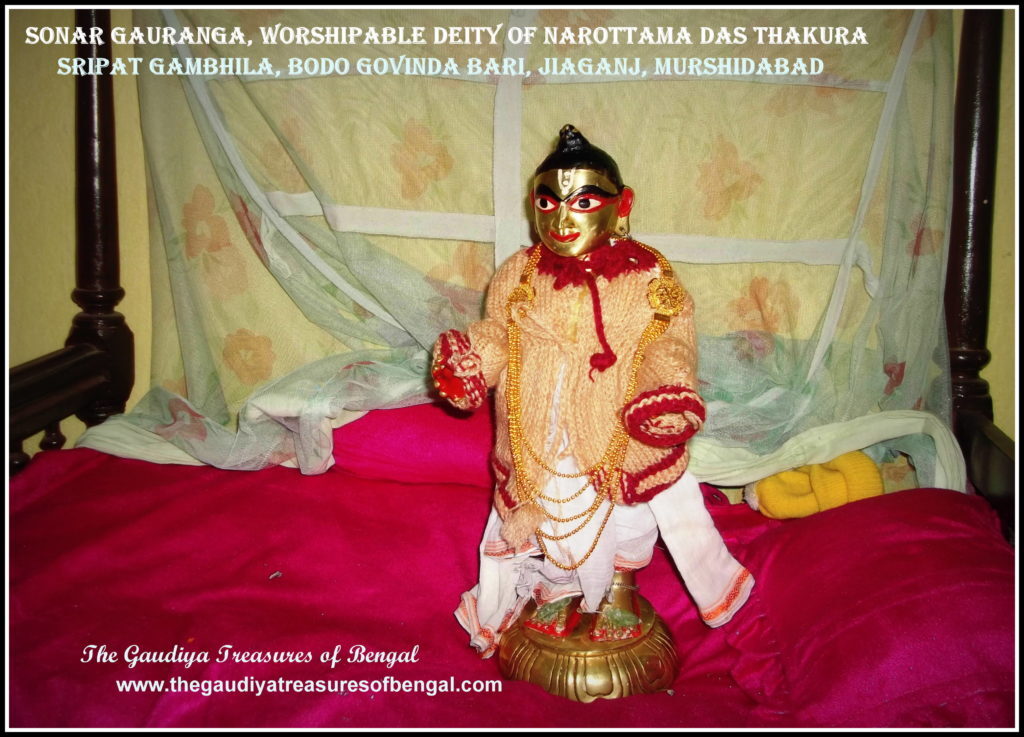
One tradition drawn from the Bhakti-ratnakara records that Narottama came at last to Gambhila, Ganga Narayana Chakravarti's own home, while he was in this state. He did not come empty-handed. Years before, he had discovered a pair of self-manifest deities, Gaura-Vishnupriya, hidden inside a Bengal brahmana's grain store. The story goes that a venomous snake guarded them and let no one else near, until Narottama walked in and lifted the deities out himself. From that day he rarely traveled without the golden Gauranga deity from that discovery. It is still called sonar Gauranga. This was the same deity he carried with him to Gambhila for what would be his final visit there.
The Final Bath #
At Gambhila, Narottama ordered two of his disciples, Ganga Narayana Chakravarti and Ramakrishna, to arrange his bathing in the river. He entered the water, offered repeated obeisances, and then stood asking his disciples to wipe his body clean. As Ganga Narayana and Ramakrishna did so, Narottama is said to have merged into the water and vanished from view. Later Vaishnava writers describe this disappearance as being like milk dissolving into milk, leaving no visible trace at all. The riverbank where it happened came to be called Dudhghat, "the milk landing," a name it still carries as a place of pilgrimage.
A Different Telling, Left Open #
Narottama Dasa Thakura's own page draws on the same Bhakti-ratnakara tradition. It agrees that the final bath took place at a village called Gambhila near Kheturi, though it does not name Ganga Narayana among those present. That page also notes a separate telling, found in some reference sources including Wikipedia. This telling focuses instead on the ongoing caste controversy over his brahmana disciples during Narottama's last year, and it does not mention Gambhila by name. Neither account can be checked against records from that time. So both are given here as the sources present them. This fits the wider pattern already noted for Narottama's biography. Most of what survives of these final years comes from devotional writing set down a generation or more after the events themselves.
The golden Gauranga deity that Narottama carried to Gambhila that day has remained there ever since. It is worshiped today at Bodo Govinda Bari. This is the same home where Ganga Narayana had once turned from a proud critic into a devoted disciple. His own legacy there is told on Legacy at Bodo Govinda Bari.
