Sri Ganga Narayana Chakravarti
Foremost Disciple of Narottama Dasa Thakura
The complete life, on one page: The main biography and every pastime page, in order, in one place
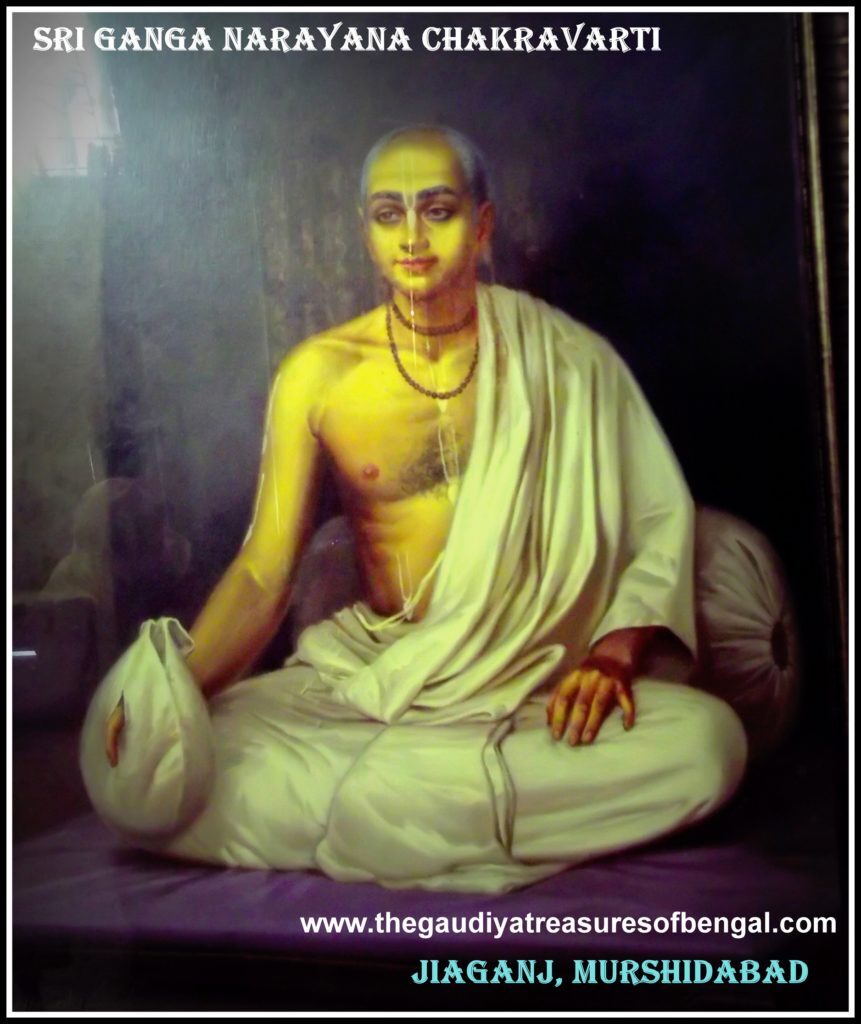
Introduction
Sri Ganga Narayana Chakravarti was a brahmana scholar of Gambhila, a village in Bengal's Murshidabad district now known as Jiaganj. Gaudiya Vaishnava tradition remembers him as one of the foremost disciples of Narottama Dasa Thakura. Unlike the great goswami authors of Vrindavana, he left behind no books of his own. What survives of his life comes down through devotional biographies of his guru, chiefly the Bhakti-ratnakara and Narottama-vilasa. It also comes through the oral and pilgrimage tradition still maintained at his family home at Gambhila. This kind of record is more limited, but it tells his story with unusual care. He is not just a name in a list. His pride, his change of heart and his later devotion are all told in real detail.
| Detail | Description |
|---|---|
| Standing | A wealthy, widely respected brahmana scholar who taught hundreds of students daily at Gambhila |
| Guru | Narottama Dasa Thakura |
| Family | Wife Narayani Devi and daughter Vishnupriya Devi, both remembered as devotees who assisted his service |
| Known for | Defending Narottama Dasa Thakura at Kumarapura; present at Narottama's final days at Gambhila |
| Legacy site | Bodo Govinda Bari, Sripat Gambhila, Jiaganj, Murshidabad, maintained by his descendants |
| Samadhi | Location disputed; see below |
Chapter 1
Scholar of Gambhila
How a proud brahmana pandit came to regret dismissing a kayastha saint.
Long before he ever knelt at Narottama Dasa Thakura's feet, Ganga Narayana Chakravarti was already one of the best-known men in Gambhila. He came from a wealthy brahmana family, had a scholar's education behind him, and ran a household school where, tradition says, hundreds of students studied under him at a time. In a Bengal where a brahmana's learning and birth still counted for almost everything, that combination made him a person of real standing. When Narottama's following began to grow, he became one of its sharpest critics.
An Uncomfortable Question of Caste #
The difficulty was not Narottama's teaching, which few could fault. It was his birth. Narottama belonged to the kayastha community, not the brahmana class. Even so, he had begun accepting brahmana disciples. This reversed the usual order, and it offended exactly the kind of learned, caste-conscious brahmana that Ganga Narayana was at that time. A generation earlier, Sri Chaitanya Mahaprabhu himself had taught that true devotion, not birth, was what qualified a person to teach and initiate others. Krishnadasa Kaviraja Goswami had written that same teaching down for all time in Sri Chaitanya-charitamrita. But Ganga Narayana, like many brahmana scholars of his generation, had not yet made it his own. Gambhila, known today as Jiaganj, lies a few stops from Murshidabad on the bank of the Bhagirathi. It was not a remote place where such questions could be avoided. It stood in a district full of brahmana scholars. So a scholar of Ganga Narayana's standing there had every reason to think his objection was simply common sense.
A Friend's Transformation #
The sources agree that what changed his mind was watching someone close to him take initiation from Narottama and come back a different man. But they disagree about who that person was. One early account, from the family history kept at Gambhila itself, names a close friend and fellow scholar, Ramakrishna Acharya. After his initiation, Ramakrishna Acharya's devotion suddenly deepened, and Ganga Narayana could find no way to dismiss it. A separate modern account says instead that the association of Harirama Acharya, another of Narottama's disciples, opened his eyes. Neither source can be checked directly against the other, so the question of which name is correct is left open. But both agree on the effect. A proud man saw, from very close, something in a friend's character that all his scholarship could not explain.
Regret, and a Decision #
The change in his friend did not stay a private observation for long. Ganga Narayana began to see his past criticism of Narottama as an offense, not as an opinion he could defend. Tradition says the regret that followed grew so heavy that he decided to seek out the very teacher he had once dismissed. Initiation on the Bank of the Ganges tells of that decision and the unusual way it was finally answered. It is the episode in which Gambhila's proudest scholar became one of Narottama Dasa Thakura's most devoted disciples.
Chapter 2
Initiation on the Bank of the Ganges
A dream, a river meeting, and a proud scholar's surrender.
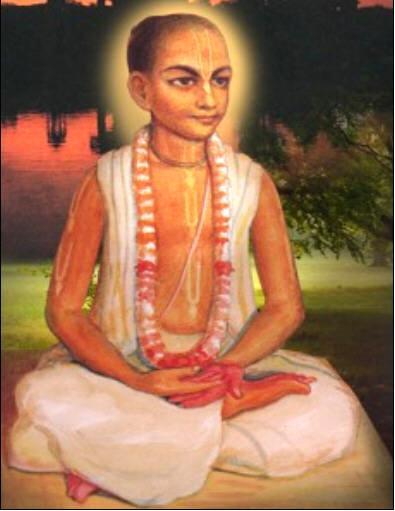
Narottama-vilasa, the traditional biography of Narottama Dasa Thakura compiled by his followers, does not describe Ganga Narayana Chakravarti simply walking up and asking for initiation. It tells the story as a dream. After a day of grieving over how he had once looked down on Narottama, Ganga Narayana fell into a troubled sleep. Narottama himself is said to have appeared to him there, shining with light and full of compassion. Smiling, he spoke: "Why do you lament? You are my servant. All your desires shall be fulfilled. You will get to meet me tomorrow while bathing in the Ganges. I shall come over here from Kheturi; we shall talk more tomorrow while bathing."
A Hesitant Guru #
Ganga Narayana woke, finished his morning duties, and went straight to the river. It was the same stretch of the Bhagirathi, a tributary of the Padma, that still flows past Murshidabad today. Narottama was there, exactly as promised, and Ganga Narayana at once fell at his feet and begged for initiation. But the answer he got was not an immediate yes. Narottama pointed out the same difficulty that Ganga Narayana himself had once raised against others. Narottama was a kayastha and Ganga Narayana was a brahmana. If Narottama initiated him, it would only give brahmana critics a new reason to blame them both. This was a real warning, not a formality. Not long after, the same controversy did reach Narottama's brahmana disciples, in the events told on The Disguised Shopkeepers of Kumarapura.
An Answer That Settled the Matter #
Ganga Narayana's reply is the line by which this meeting is remembered: a disciple who has taken shelter at Narottama's feet, he said, has nothing to fear from any brahmana devoid of devotion. Whatever doubt Narottama still carried, that answer resolved it. Pleased with Ganga Narayana's conviction, he initiated him then and there, on what Narottama-vilasa calls an auspicious day, and, in the biography's own words, offered him unto the lotus feet of Sri Chaitanya Mahaprabhu himself.
Criticism, and an Answer to It #
The criticism Narottama had predicted came quickly. Brahmanas heard that Ganga Narayana Chakravarti had taken initiation from Narottama. Of all people, he was the very scholar who had once mocked Narottama's kayastha birth. So they made him a target of exactly the kind of mockery he had once given to others. Tradition says it had no real effect on him. By his own account, Ganga Narayana had already found what all his years of scholarship had failed to give him. Tradition also says that in time some of the very brahmanas who had criticized him became his own disciples. He went on to study the writings of the Six Goswamis under Narottama's guidance. The family record at Gambhila says that he engaged himself in near-constant harinama sankirtana. He became the foremost among all of Narottama's disciples. The same account says that in later years he was a teacher of countless disciples. He was well known among the Vaishnavas of Vrindavana and held dear by them, even though his own household never left Bengal.
An Ordinary Life Made Extraordinary #
Many of Narottama's other disciples survive only as names in a list. Ganga Narayana's story is told here in detail because of exactly this reversal. His scholarship and wealth had once made him unwilling to humble himself. But within a single episode he was ready to humble himself completely, and he stayed that way for the rest of his life. Before long, he was devoted enough to risk his own safety in his guru's defense. That episode is told next on The Disguised Shopkeepers of Kumarapura.
Scriptural evidence for this chapter (2)
Aichhe kata khed divaratri gongaila
Sesh ratri haite kichu nidra akarshila
Swapne dekha dilen thakura mahasaya
Karuna nirmita murti maha-tyejamaya
Manda manda hashi kahe Ganga-Narayana-e
Tumi mor kinkara, koroho khed kene
Sab manoratha siddhi haibe tomar
Kaali ganga-snane dekha paibe amar
Kheturi haite ami ailam etha
Snan-kaale tomar sahith kahiba sab katha
Throughout the entire day, Ganga Narayana lamented his misfortune of offending Narottama. Toward the end of the night he found some sleep, and Narottama Dasa Thakura appeared in his dream, his form full of compassion and splendidly effulgent. Smiling gently, he spoke to Ganga Narayana: 'Why do you lament? You are my servant, all your desires shall be fulfilled. You will get to meet me tomorrow while bathing in the Ganges. I shall come here from Kheturi; we shall talk more tomorrow while bathing.'
The earliest textual source for the story of Ganga Narayana's initiation, and the basis for the account here of the dream that brought him to the riverbank.
Mantra diksha diya mahasaya harsha haila
Sri Krishna-Caitanya pada-padme samarpila
Narottama mahasaya bhakti avatara
Ganga-Narayane kaila svashakti sanchara
Narottama Dasa was very pleased to give initiation to Ganga Narayana; he offered Ganga Narayana unto the lotus feet of Sri Krishna Chaitanya. Narottama Dasa Thakura is an incarnation of devotional love, and he imbued Ganga Narayana with his own devotional prowess.
Cited here as the verse describing the moment of initiation itself, following directly on the dream verses above in the same source.
Chapter 3
The Disguised Shopkeepers of Kumarapura
A betel-nut stall, a hidden Sanskrit scholar, and a debate Narottama Dasa Thakura never had to fight himself.
Ramachandra Kaviraja has his own account of this episode, told from his side. What follows is the same episode as Ganga Narayana Chakravarti's own tradition remembers it. More than any other story, it is the reason his name survived at all outside his own family's records.
Word of an Attack Reaches Two Disciples First #
A group of smarta brahmanas decided that Narottama Dasa Thakura had gone too far in initiating brahmanas despite his own kayastha birth. They did not come quietly. They recruited a local king, Raja Narasimha, and a powerful traveling debater, Rupanarayana Pandita. Rupanarayana was a dig-vijaya pandit, a scholar who had made a career of defeating rivals in open contest. The group set out for Kheturi to expose Narottama in public. Word of the plan reached Ganga Narayana and Ramachandra Kaviraja before the party arrived. The two disciples did not wait for the confrontation to come to their guru.
Two Ordinary Shopkeepers #
They traveled ahead to Kumarapura, a town the king's party would have to pass through. There they set up two market stalls under false trades. Ganga Narayana posed as a pan-walla selling betel nut, and Ramachandra as a potter selling clay cooking pots. Neither gave the slightest sign that two accomplished Sanskrit scholars stood behind the disguises. Then the smarta party's own students came to buy supplies. They found shopkeepers who answered them in fluent Sanskrit and drew them almost at once into a philosophical debate. According to the Bhakti-ratnakara, the debate was based on the Bhagavatam's own teaching that spiritual qualification rests on character and devotion, not on the family one happens to be born into.
A Debate Lost in a Marketplace #
Word of the argument reached the students' teachers, and soon the whole party, Raja Narasimha and Rupanarayana Pandita among them, had gathered at the two stalls. Rupanarayana himself entered the debate and lost it, defeated by two men he had taken for common tradesmen. Asked at last who they really were, Ganga Narayana and Ramachandra answered with practiced humility: two insignificant disciples of Narottama Dasa Thakura Mahasaya. The king turned to his own pandits with a pointed question: if they could not even defeat two ordinary disciples in a village marketplace, how did they expect to defeat the guru himself? Humiliated, the party turned back without ever reaching Kheturi.
A Dream That Finished What the Debate Started #
That same night, tradition says, Durga-devi appeared to Raja Narasimha and Rupanarayana Pandita in almost identical dreams. She warned them that only surrender at Narottama's own feet could undo the offense they had committed against him. Both men rose before dawn, bathed, and went back, this time to ask forgiveness, not to fight. In time they themselves were initiated by Narottama with the Radha-Krishna mantra. For his guru's sake, Ganga Narayana was willing to give up a scholar's dignity for a market stall. Ramachandra Kaviraja's own page remembers this as one more proof of how completely both disciples had given their lives to Narottama's mission.
Chapter 4
The Final Days at Gambhila
A grieving guru, a golden deity, and a disciple ordered to attend his final bath.
By his own later years, Narottama Dasa Thakura had already lost two people whose company he prized more than almost anyone else's. His closest friend Ramachandra Kaviraja died in Vrindavana. When the news reached Ramachandra's guru, Srinivasa Acharya, the grief was more than Srinivasa could bear, and he too passed away not long after. When Narottama received word of both deaths, he described himself as drowning in an ocean of separation. Tradition says it was in this state that he composed his song *ye anilo prema-dhana*.
An Arrival Carrying the Golden Gauranga #
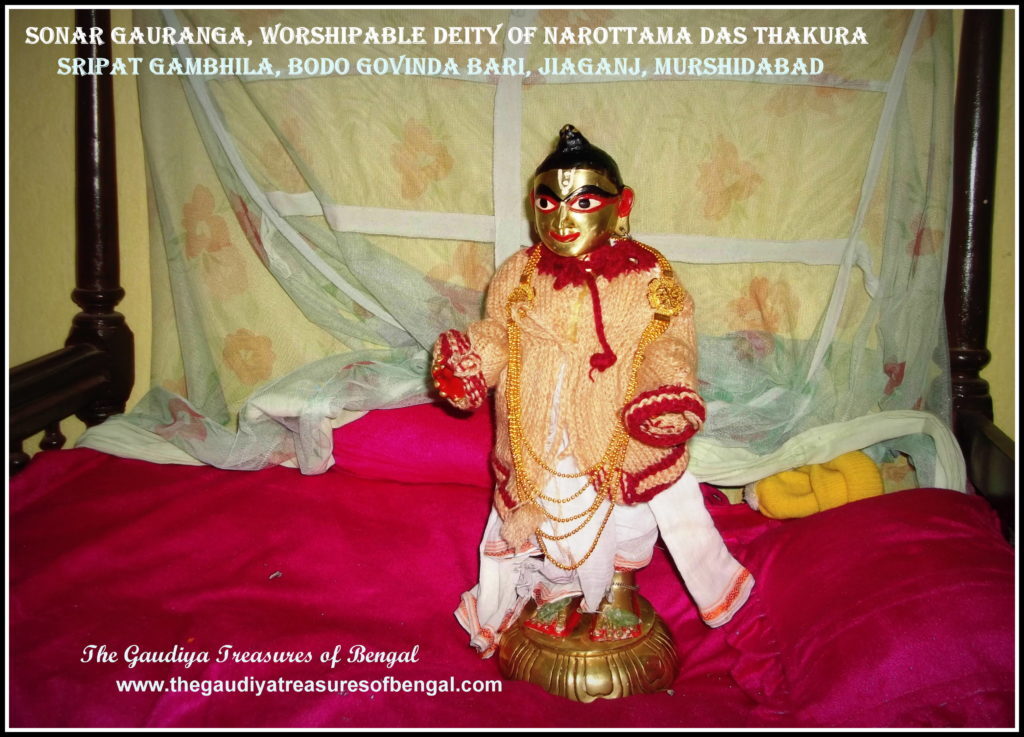
One tradition drawn from the Bhakti-ratnakara records that Narottama came at last to Gambhila, Ganga Narayana Chakravarti's own home, while he was in this state. He did not come empty-handed. Years before, he had discovered a pair of self-manifest deities, Gaura-Vishnupriya, hidden inside a Bengal brahmana's grain store. The story goes that a venomous snake guarded them and let no one else near, until Narottama walked in and lifted the deities out himself. From that day he rarely traveled without the golden Gauranga deity from that discovery. It is still called sonar Gauranga. This was the same deity he carried with him to Gambhila for what would be his final visit there.
The Final Bath #
At Gambhila, Narottama ordered two of his disciples, Ganga Narayana Chakravarti and Ramakrishna, to arrange his bathing in the river. He entered the water, offered repeated obeisances, and then stood asking his disciples to wipe his body clean. As Ganga Narayana and Ramakrishna did so, Narottama is said to have merged into the water and vanished from view. Later Vaishnava writers describe this disappearance as being like milk dissolving into milk, leaving no visible trace at all. The riverbank where it happened came to be called Dudhghat, "the milk landing," a name it still carries as a place of pilgrimage.
A Different Telling, Left Open #
Narottama Dasa Thakura's own page draws on the same Bhakti-ratnakara tradition. It agrees that the final bath took place at a village called Gambhila near Kheturi, though it does not name Ganga Narayana among those present. That page also notes a separate telling, found in some reference sources including Wikipedia. This telling focuses instead on the ongoing caste controversy over his brahmana disciples during Narottama's last year, and it does not mention Gambhila by name. Neither account can be checked against records from that time. So both are given here as the sources present them. This fits the wider pattern already noted for Narottama's biography. Most of what survives of these final years comes from devotional writing set down a generation or more after the events themselves.
The golden Gauranga deity that Narottama carried to Gambhila that day has remained there ever since. It is worshiped today at Bodo Govinda Bari. This is the same home where Ganga Narayana had once turned from a proud critic into a devoted disciple. His own legacy there is told on Legacy at Bodo Govinda Bari.
Scriptural evidence for this chapter (1)
Gola haita Priyasaha Sri Gaurasundara
Krore aila haila sarva nayana gochara
From within the grain store, the beloved Sri Gaurasundara deity came into his embrace, becoming visible to every eye present.
Narahari Chakravarti Thakura's verse describing Narottama Dasa Thakura's discovery of the golden Gauranga deity he later carried to Ganga Narayana Chakravarti's home at Gambhila for his final bath; cited by Narahari Chakravarti Thakura in Bhakti-ratnakara.
Chapter 5
Legacy at Bodo Govinda Bari
A house that still stands, a samadhi that is disputed, and a quiet link to Sri Vishvanatha Chakravarti Thakura.
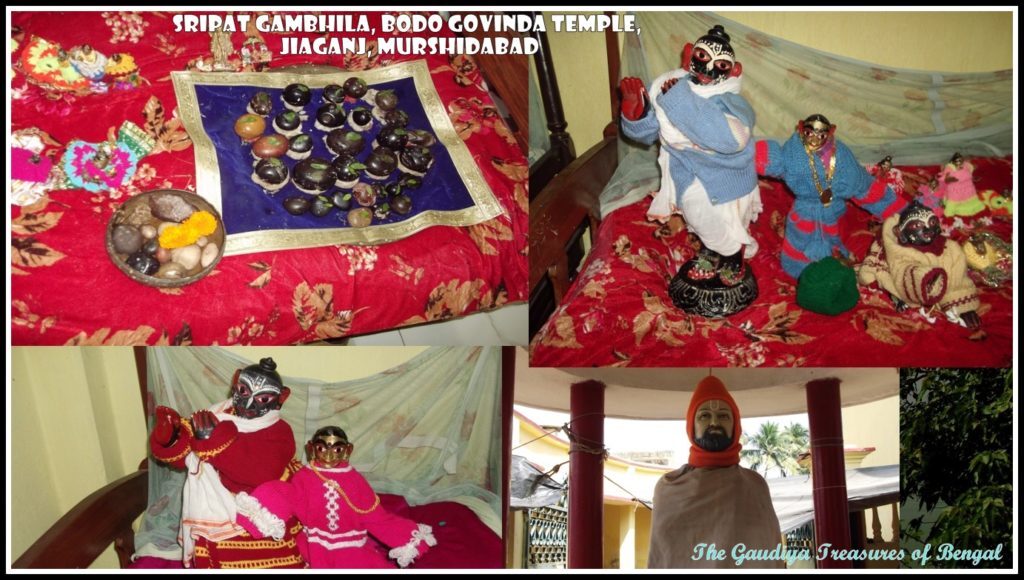
Ganga Narayana Chakravarti's own residence at Gambhila has survived. It is known by a name it earned from the deities kept there: Bodo Govinda Bari, "the great house of Govinda." His descendants still maintain it. The golden Gauranga deity that Narottama Dasa Thakura carried there in his final years is still among the images worshiped in the household today. Other deities connected to that same period of Narottama's life are worshiped there too. A wife, Narayani Devi, and a daughter, Vishnupriya Devi, are themselves remembered as devotees, and they assisted Ganga Narayana in his service. But no son is recorded. As told below, this detail matters for a connection that few sources explain in full.
Where Is He Actually Buried #
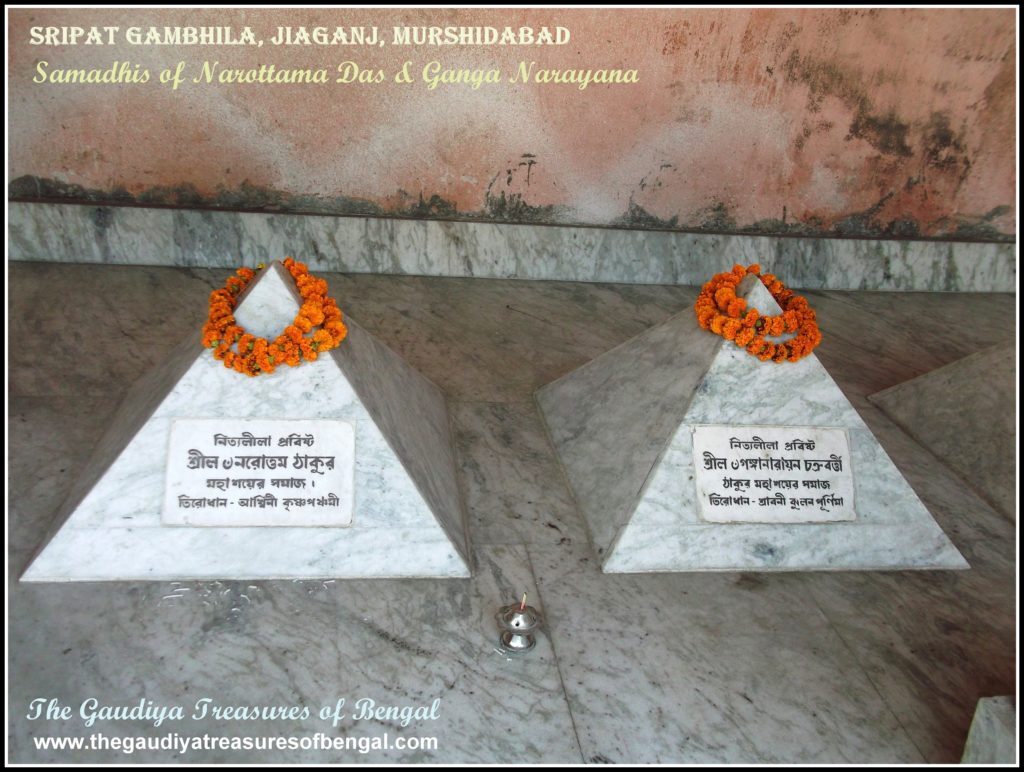
The record gives more than one answer about where Ganga Narayana's own samadhi is. A photograph taken at Sripat Gambhila shows two marble samadhis standing side by side under a single roof. The caption says they are those of Narottama Dasa Thakura and Ganga Narayana Chakravarti together. This is clear evidence that a local tradition holds both teacher and disciple to be buried at Gambhila itself. Separately, at least two independent reference sources state that Ganga Narayana's samadhi is not at Gambhila but in Vrindavana. They place it in the courtyard of the Radha-Gokulananda temple, right next to Narottama's own. This is the same courtyard where Vishvanatha Chakravarti Thakura himself is buried, a detail those sources give without further comment. Both traditions are recorded here without deciding which is correct. In the same way, Narottama Dasa Thakura's own page leaves open the closely related question of exactly where and how his own final days took place.
An Unexpected Thread to Vishvanatha Chakravarti Thakura #
Ganga Narayana had no son of his own. At least one detailed account of Vishvanatha Chakravarti Thakura's guru-lineage records that he adopted Krishna Charana Chakravarti as his own child. Krishna Charana was the youngest son of Ramakrishna Bhattacharya, who was himself a well-known disciple of Narottama Dasa Thakura. Krishna Charana's own son, Radharamana Chakravarti, went on to become the father of Vishvanatha Chakravarti Thakura. By this account, Radharamana was also Vishvanatha's initiating guru. Vishvanatha Chakravarti Thakura was the Bhagavatam commentator whose Sarartha-darsini is still one of Gaudiya Vaishnavism's most quoted works. Vishvanatha names this very lineage in the opening invocation to the Rasa-panchadhyaya chapter of that same commentary. He bows in abbreviated form to "Rama" (his guru Radharamana), "Krishna" (his parama-guru Krishna Charana), "Ganga-charana" (Ganga Narayana Chakravarti, further back in the same line), and "Narottama-natha" (Narottama Dasa Thakura and his own guru, Lokanatha Gosvami).
Vishvanatha Chakravarti Thakura's own page draws on other sources. It describes his guru as either Krishnacarana Chakravarti directly or Krishnacarana's own disciple Radharamana Chakravarti. Both are placed in the line descending from Narottama. That page does not settle which of the two actually gave him diksha, and it does not mention the adoption thread at all. So, taking all this together, the link to Ganga Narayana is best treated as real but still uncertain. No account says that Ganga Narayana was Vishvanatha's direct guru. But if the lineage is read as Vishvanatha's own invocation suggests, Ganga Narayana was an earlier link in the chain of teachers standing behind one of Gaudiya Vaishnavism's most influential commentators. It is a fitting, if quiet, legacy for a scholar who once needed a dream on a riverbank to change his own mind.
Scriptural evidence for this chapter (1)
Sri Ramakrishna Ganga-charanau natva Guror-guru premnah
Srila Narottama-natha Sri Gauranga Prabhum naumi
Having bowed to Rama (my guru Radharamana) and Ganga-charana (Ganga Narayana Chakravarti, further back in the same line of loving teachers), I bow to Srila Narottama, my Lord, and to Sri Gauranga Prabhu.
Vishvanatha Chakravarti Thakura's own invocation verse, naming his guru-lineage in abbreviated form; the phrase 'Ganga-charana' is read by at least one source as referring to Ganga Narayana Chakravarti, an adoptive ancestor several links back in that same line. Vishvanatha Chakravarti Thakura's own page does not repeat this specific reading.
- Ganga Narayana Cakravarti | Gaudiya History
- Ganga Narayan Chakravarti | Sripat Gambhila (Bodo Govinda bari), Murshidabad - The Gaudiya Treasures of Bengal
- Ganga Narayana Cakravarti - Video | Gaudiya History
- Ganga Narayana Cakravarti - Stephen Knapp
- Viswanatha Chakravarti Thakura - Prabhupada Rays
- VF Spot 43: Samadhi Temple of Srila Ganga Narayan Chakravarti - ISKCON Govardhan Eco Village
- Narottama dasa Thakura - Biography | Gaudiya History
