Sri Jayatirtha
Tikacharya, the Commentator of Dvaita Vedanta
The complete life, on one page: The main biography and every pastime page, in order, in one place
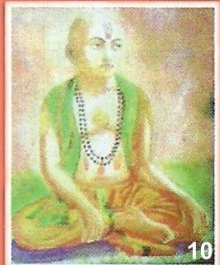
Introduction
Śrī Jayatīrtha holds a special place in the guru-paramparā. Scholars of Dvaita Vedānta, including those outside the Gauḍīya Vaiṣṇava tradition, regard him as the most important philosopher of the Madhva-sampradāya after Madhvācārya himself. He accepted sannyāsa in his twenties from Akṣobhya Tīrtha and served for only twenty-three years as the sixth leader after Madhvācārya. During this short period, he wrote or is credited with more than twenty works. Most of them are commentaries on the writings of Madhvācārya. Because of these works, he became known as Ṭīkācārya, "the Commentator." In his academic work *History of the Dvaita School of Vedanta and Its Literature*, B. N. K. Sharma explains that Jayatīrtha strengthened Dvaita philosophy in much the same way that Vācaspati Miśra strengthened Śaṅkarācārya's Advaita. His commentaries helped the young Dvaita school stand alongside the much older Advaita and Viśiṣṭādvaita schools.
| Detail | Description |
|---|---|
| Birth name | Dhondopant, also given as Dhondo Pant Raghunath, of a Deshpande family |
| Approximate dates | Traditionally about 1345-1388 CE; pontiff 1365-1388 (23 years). Srila Prabhupada's purport to Chaitanya-charitamrita, Madhya 9.245, gives an earlier date, Shaka 1167 (about 1245 CE). This gap is looked at honestly below |
| Birthplace | Traditionally Mangalvedhe, near Pandharpur, Maharashtra. One early source instead places his family at Malkhed, Karnataka. B. N. K. Sharma leaves the question open |
| Identity | Incarnation of Indra with the avesha of Shesha, according to the Madhva tradition (Uttaradi Matha) |
| Guru | Akshobhya Tirtha, fifth pontiff after Madhvacharya |
| Title | Tikacharya, "the Commentator," for his commentaries on nearly all of Madhvacharya's writing |
| Chief works | Nyaya-sudha (on the Anu-vyakhyana) and Tattva-prakashika (on the Brahma-sutra-bhashya), among more than twenty works in all |
| Samadhi | Malkhed (ancient Manyakheta), Karnataka, on the bank of the river Kagini |
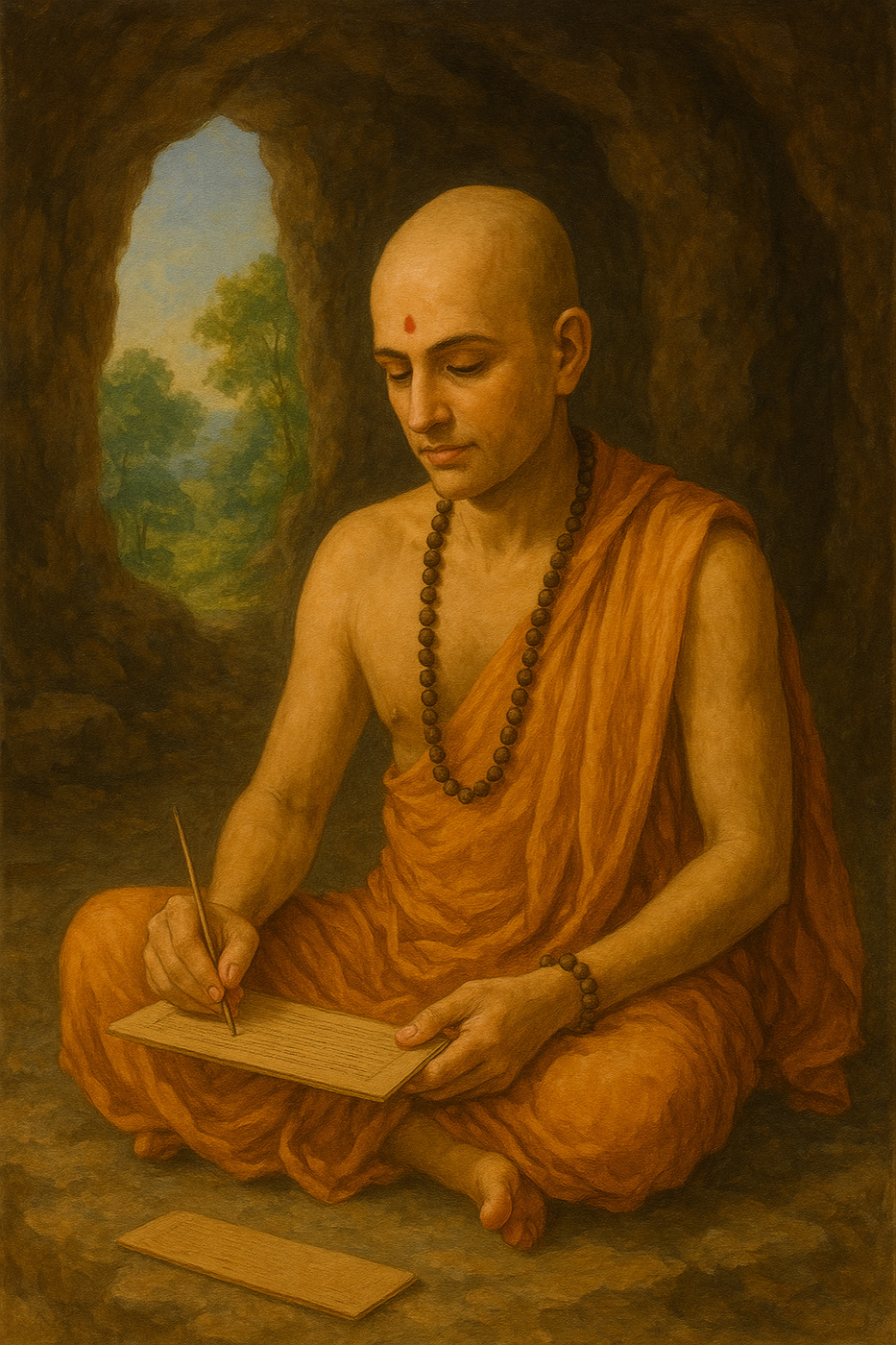
Chapter 1
Life and Renunciation Under Akshobhya Tirtha
A nobleman's son named Dhondopant, a chance meeting at a riverbank, and a story that later retellings made more dramatic than the facts allow.
Before he was Jayatirtha, he was Dhondopant, also recorded as Dhondo Pant Raghunath. He was born into a Deshpande family of Vishvamitra gotra, a family with a respected place in local military life. B. N. K. Sharma's academic *History of the Dvaita School of Vedanta and Its Literature* draws its account from the S.A., a Sanskrit biographical source close to Jayatirtha's own disciple-lineage. Sharma's book treats even his birthplace as uncertain. The common tradition names Mangalvedhe, about twelve miles from Pandharpur. But the older Gurucharya text instead makes him the son of a chieftain of Malkhed itself, in Karnataka. This is the town where he would later live and pass away. Sharma leaves the question open, and we leave it open here too.
| Detail | Description |
|---|---|
| Birth name | Dhondopant, also Dhondo Pant Raghunath |
| Family | Deshpande family of military rank, Vishvamitra gotra (Bharadvaja gotra given in some accounts) |
| Birthplace | Traditionally Mangalvedhe, near Pandharpur; the Gurucharya instead names Malkhed |
| Age at renunciation | About twenty |
| Guru | Akshobhya Tirtha |
| Ordination name | Jayatirtha |
| Year he became pontiff | 1365 CE, succeeding Akshobhya Tirtha directly |
A Chance Meeting At A Riverbank #
Dhondopant grew up with wealth and status, and every account says he spent his youth as a keen rider and sportsman, not as a scholar. Sharma records that he had already married two wives by the time the turning point came. At about twenty years old, he was out riding on a hot day and stopped at a river to water his horse. Instead of getting down, he rode straight into the water and drank from it. Every source that tells this story keeps that same image. Sharma's own account names the river as the Chandrabhaga, the sacred name for the Bhima river at Pandharpur. This agrees with other sources that name the river as the Bhima. But a footnote in Sharma records that the Gurucharya places this same meeting at Malkhed instead, on the river Kagini. Akshobhya Tirtha is independently known to have spent his final years there. Which tradition is right cannot be decided from the evidence we have, and Sharma does not try to force an answer.
On the far bank sat an ascetic, Akshobhya Tirtha, already advanced in age, watching the young horseman's unusual way of drinking. A brief exchange of questions is said to have moved Dhondopant deeply enough that he asked, on the spot, to become this stranger's disciple. Word reached his father, who came in person to bring him home. What happened next is where the sources start to disagree.
The Story Sharma Rejects #
The more colorful retellings of this period include the version still told on gaudiyahistory.iskcondesiretree.com, which is drawn from the *Jayatirtha-vijaya* tradition of the Vyasa Tirtha lineage. In these retellings, the father forcibly brings his son home a second time, after Jayatirtha had already taken formal sannyasa. He does this specifically to force him back into married life. One version even adds a scene of a cobra appearing in the bedchamber before the father gives in and lets his son return to Akshobhya Tirtha.
Sharma plainly treats this added story as fiction. Such a move, he writes, would have been "unthinkable and impossible to carry out in the social and religious climate of orthodox Brahmin society in the 14th century." He gives the example of the Maharashtrian saint Jnanadeva, whose own family was socially boycotted for a far smaller break of the rules of sannyasa. Sharma takes this as proof that no priesthood of that period would have helped a monk who had already taken sannyasa go back to married life. Sharma calls the whole story "a stupid invention in bad taste to glorify one who was great in himself," and he also notes that at least one later Kannada scholar took the story even further. That scholar invented a son supposedly born to Jayatirtha during this time, and Sharma rejects this claim outright as baseless.
The more careful sources, checked against each other, agree on a simpler story without the added drama. The father did try once to take his son back before the ordination. But wiser advice won, and Dhondopant returned to Akshobhya Tirtha. He was ordained a sannyasi under the name Jayatirtha, and he spent the following years training closely in Madhva's Dvaita philosophy under his guru's direct instruction. Akshobhya Tirtha, by then living out his final years at Malkhed, gave his full attention to this one disciple, and Jayatirtha's own later writing carries a warm, personal tribute to what his guru gave him. When Akshobhya Tirtha passed away, Jayatirtha succeeded him as leader of the Madhva line, in 1365. This was the start of the twenty-three-year period described on Nyaya-sudha and the Commentaries on Madhva. The close of that period is described on Samadhi at Malkhed and the Three Mathas.
Chapter 2
Nyaya-sudha and the Commentaries on Madhva
Eighteen commentaries and three books of his own, written in twenty-three years, that gave Dvaita Vedanta its standard written form.
Jayatirtha earned the title Tikacharya, "the Commentator," through a body of writing of twenty-one titles. These are eighteen commentaries on works by Madhvacharya and three independent works of his own. Almost nothing in Madhva's own Sarvamula collection was left without his commentary. He commented on nearly all the writing of Madhvacharya, his guru's own teacher, in a working life of only twenty-three years. Sharma's academic history sees this completeness as the one fact that did more than anything else to win Dvaita Vedanta a standing equal to the far older Advaita and Vishishtadvaita schools.
| Detail | Description |
|---|---|
| Magnum opus | Nyaya-sudha, commentary on Madhva's Anu-vyakhyana |
| Most-studied work | Tattva-prakashika, commentary on Madhva's Brahma-sutra-bhashya |
| Total works credited to him | Twenty-one: eighteen commentaries, three independent treatises |
| Independent treatises | Vadavali, Pramana-paddhati, Padyamala |
| Later commentaries drawn to the Tattva-prakashika | At least eleven, chief among them Vyasa Tirtha's Tatparya-chandrika |
| Honorific title | Tikacharya, "the Commentator" |
The Nyaya-sudha, His Magnum Opus #
Jayatirtha's most important work is the Nyaya-sudha. It is a vast commentary on Madhvacharya's Anu-vyakhyana, which is Madhva's own verse supplement to his Brahma-sutra-bhashya. Sharma's history records that it runs to roughly 24,000 granthas (verse-units). It was first titled Visamapada-vakyartha-vivrti, before later tradition settled on the shorter name it is known by today. This name is popularly shortened to the Sudha. It closely examines the views of the rival Vedanta teachers of its day, among them Shankaracharya, Bhaskara, Ramanujacharya and Yadavaprakasha. It also deals with the separate schools of Nyaya, Samkhya, Mimamsa and Buddhist philosophy. A traditional saying quoted by Sharma holds that the Sudha alone deserves to be called a true commentary. After a lifetime of studying this literature, Sharma himself calls it a work with "not one other" like it "in the whole range of Sanskrit philosophical literature."
The Tattva-prakashika and the Rest of the Sutra-prasthana #
The Tattva-prakashika is his second most important work, and today it is by far the most widely studied commentary on Madhva's Brahma-sutra-bhashya. It runs to about 8,000 granthas. It so thoroughly replaced earlier commentaries that at least eleven later Dvaita scholars wrote their own commentaries on it in turn. Chief among them is Sri Vyasa Tirtha's own Tatparya-chandrika, which is still studied today.
Beyond these two central works, Jayatirtha wrote commentaries on nearly every other text in Madhva's Sutra-prasthana and beyond: on the Tattva-samkhyana, Tattva-viveka, Tattvoddyota, Vishnu-tattva-nirnaya, Mayavada-khandana, Prapancha-mithyatvanumana-khandana, Upadhi-khandana, Pramana-lakshana and Karma-nirnaya (all short works of Madhva's own that argue against opposing views), the Nyaya-vivarana, the Shatprashna Upanishad-bhashya and Isha Upanishad-bhashya, the Rg-bhashya, and two separate commentaries on Madhva's writing on the Bhagavad-gita: the Gita-bhashya Prameya-dipika and the Gita-tatparya Nyayadipika. Together with the Nyaya-sudha and Tattva-prakashika, this makes eighteen commentaries in all.
Three Works Of His Own #
Jayatirtha also left three independent works, not commentaries on Madhva at all. The Vadavali is an early, sharply argued work against the Advaita teaching that the visible world is ultimately unreal, or mithya. The Pramana-paddhati is a compact textbook on how true knowledge is gained in Dvaita philosophy. It sets out the pramanas (means of valid knowledge) that the school recognizes, and its theory of how error and mistaken understanding arise. The Padyamala is a smaller work on points of worship drawn from Madhva's own Tantra-sara-sangraha. On the strength of the commentaries and these three original works, later tradition ranks Jayatirtha, together with Madhvacharya and Vyasa Tirtha, as one of the Munitraya, "the three sages" of Dvaita Vedanta. Sharma's own history is formally dedicated to these same three names.
Chapter 3
Samadhi at Malkhed and the Three Mathas
No inscription records his death, yet every major living branch of the Madhva-sampradaya still traces its own matha back to him.
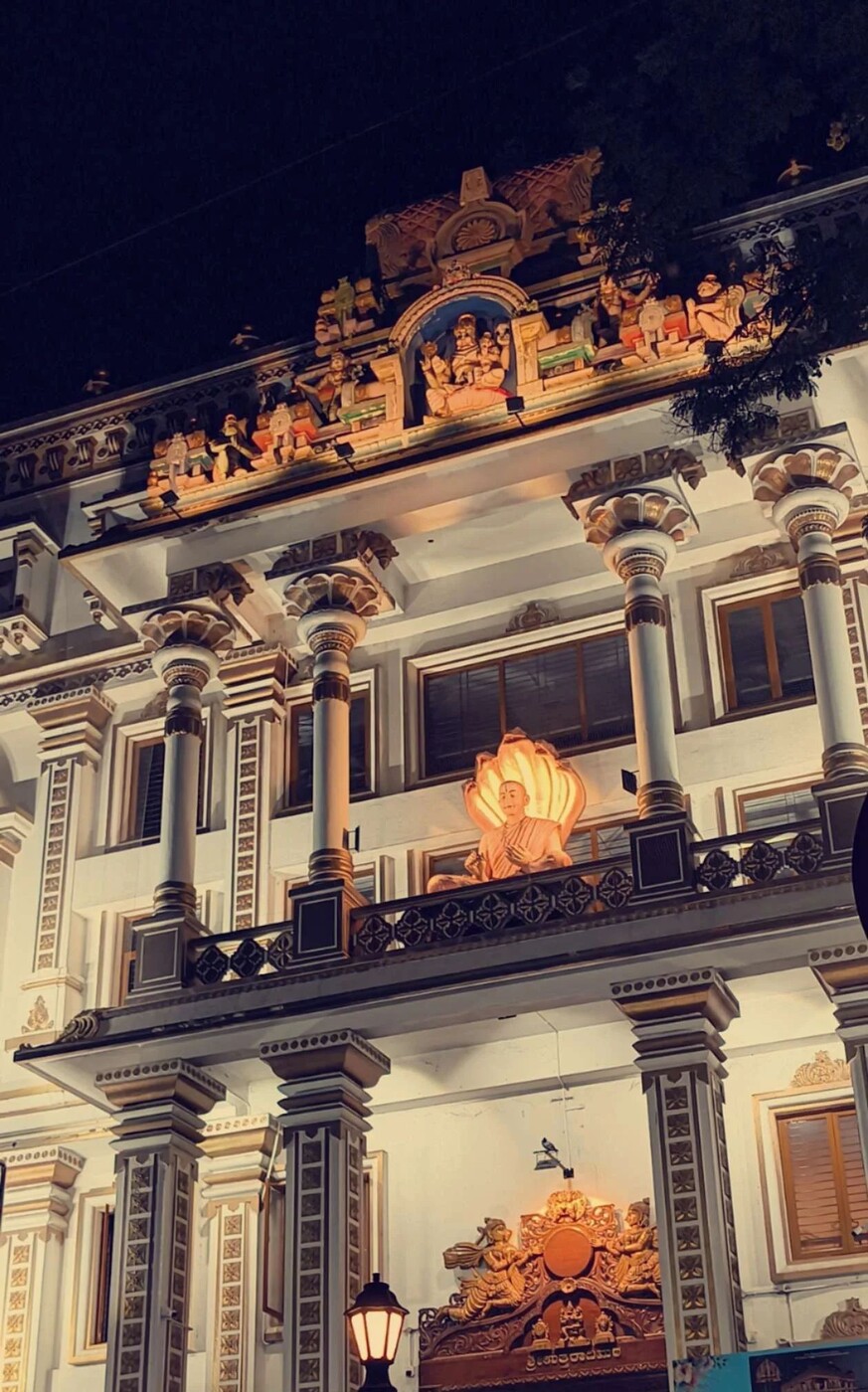
By tradition, Jayatirtha passed from this world in 1388, at Malkhed, ancient Manyakheta. This was the former capital of the Rashtrakuta kings, in what is now Karnataka's Kalaburagi district. Sharma's academic history notes a truly curious gap here. No inscription or historical document naming so important a writer has ever been found. One so-called nineteenth-century inscription claimed to record his date. But Sharma himself later examined it and rejected it as a forgery, made by joining pieces of unrelated texts. What survives instead is a strong and steady memory, kept by devotees and by the mathas, of where he is honored. This memory remains even though no independent document proves exactly when he passed away.
| Detail | Description |
|---|---|
| Traditional year of disappearance | 1388 CE, at the close of a 23-year pontificate |
| Samadhi (brindavana) site | Malkhed (Manyakheta), Karnataka, on the bank of the river Kagini |
| Neighboring samadhis | Those of his own guru, Akshobhya Tirtha, and of Raghunatha Tirtha |
| Immediate successor | Vidyadhiraja Tirtha, pontiff from 1388 |
| First matha split | About 1412 CE |
| Second matha split | About 1435 CE |
| The Matha-traya today | Uttaradi Matha, Vyasaraja Matha, Raghavendra Swami Matha |
A Brindavana On The Kagini #
Jayatirtha's samadhi, called a brindavana in this tradition, stands at Malkhed on the bank of the river Kagini, which flows into the Bhima. It is close to the samadhi of his own guru Akshobhya Tirtha, who had spent his own final years at the same place. His brindavana sits between those of Akshobhya Tirtha and of a later head of the matha, Raghunatha Tirtha. The site still draws an annual Aradhana festival with pilgrims from across India. One older travel account also claims a second tomb site at Anagondi, near Hampi, next to a samadhi identified there as Padmanabha Tirtha's. But this is only one personal account, with weak support. It does not appear in Sharma's academic history or in the more carefully recorded Malkhed tradition. So it is mentioned here only to be complete, not as an established fact.
The Matha-traya: Three Mathas From One Root #
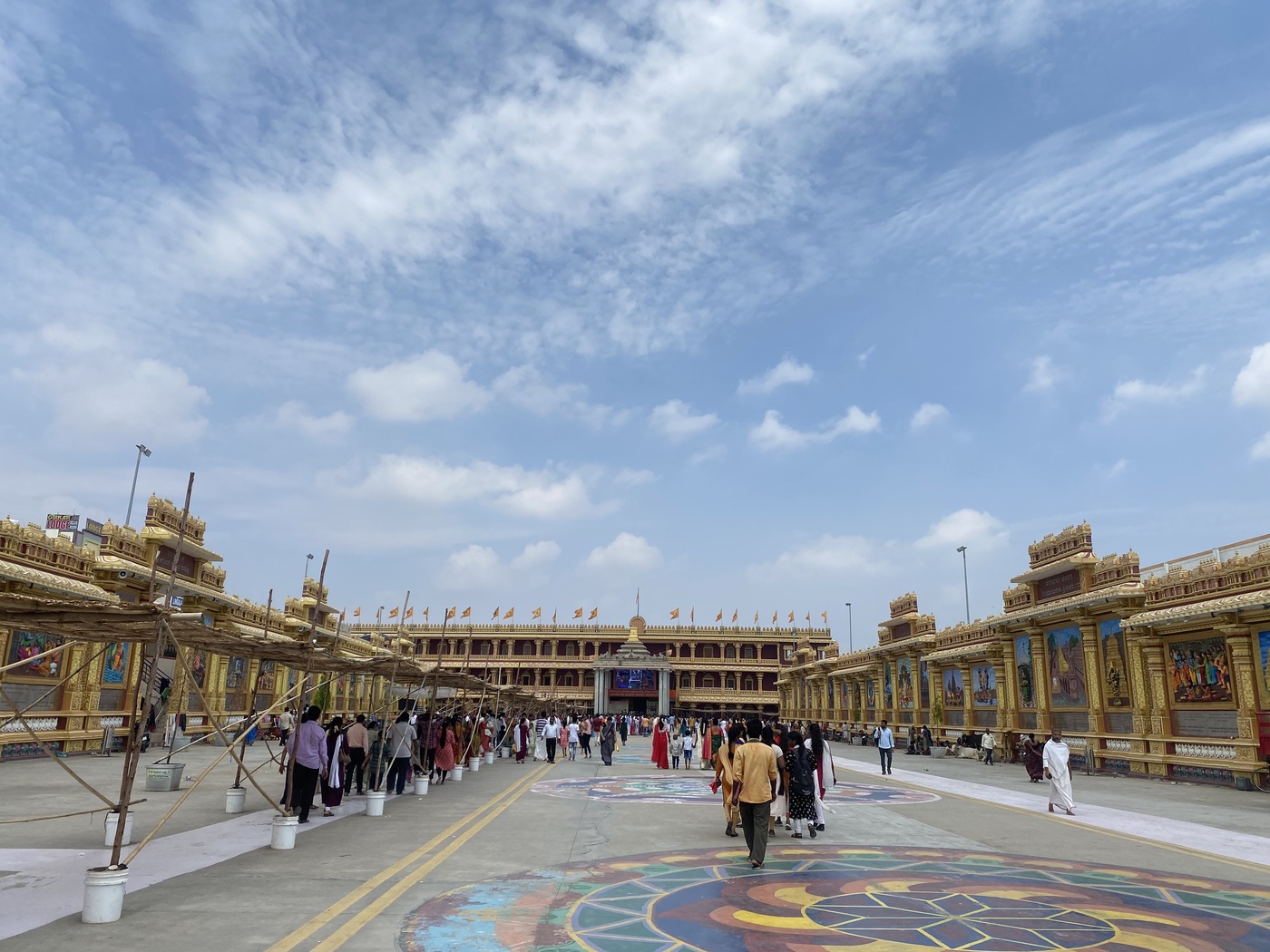
Jayatirtha was succeeded on the pitha by Vidyadhiraja Tirtha in 1388. Sharma's history calls Vidyadhiraja Jayatirtha's "immediate disciple and successor," and dates his time as head of the matha to about 1388-1412. Sharma bases this revised date on independent matha records. The matha eventually split under Vidyadhiraja's own line of successors, not under Jayatirtha directly. The first split came around 1412, when the line divided into two branches. Around 1435, the younger of those two branches split a second time. Over the following two centuries, this gave rise to three separate institutions. The first is the Vyasaraja Matha. It was later renamed for its most celebrated head, Vyasa Tirtha. His fame in the early 1500s, with the support of the Vijayanagara kings, made this matha especially well known. The second is the Raghavendra Swami Matha, based today at Mantralayam. It is named for its own celebrated seventeenth-century head, Raghavendra Tirtha. The third is the Uttaradi Matha. Its name comes from a region and dates only from the time of Raghunatha Tirtha in the mid-1400s. It refers to Uttara-Karnataka, the northern part of Karnataka, the region its heads came from after that time.
All three survive as active institutions today. Whatever rivalry has grown between them over the centuries, "these three Mutts now enjoy the status of 'Matha-traya' or the three premier Madhva Mathas descended from Jayatirtha," Sharma states plainly. In the same breath, he adds that the smaller, less prominent mathas founded separately by Padmanabha Tirtha, Madhava Tirtha and Akshobhya Tirtha "are as much historically connected with Madhva" as these three are. In his view, no single matha can claim to be Madhva's only heir. Few figures in the history of the Madhva-sampradaya stand so directly at the root of nearly every major living branch of the tradition.
Chapter 4
Place in the Gaudiya Guru Parampara
Two of the main sources used on this website give a different name for the one who came after Jayatirtha, and independent Dvaita scholarship agrees with one of them.
Every independent source agrees, without question, that Jayatirtha's own guru was Akshobhya Tirtha. This matches the traditional Gaudiya guru-parampara list exactly. But who came *after* Jayatirtha in that same list is far less clear. We set out this disagreement fully here, as has been done for other figures in this line, for example on Madhavendra Puri's Life in the Madhva Sampradaya.
| Detail | Description |
|---|---|
| Gaudiya guru-parampara list's claim | Jnanasindhu, then Dayanidhi, then Vidyanidhi |
| Srila Prabhupada's CC Madhya 9.245 purport | Names Vidyadhiraja Tirtha as the very next pontiff after Jayatirtha |
| B. N. K. Sharma's independent academic history | Also names Vidyadhiraja Tirtha as Jayatirtha's immediate disciple and successor |
| Jnanasindhu or Dayanidhi in either independent source | Neither name appears in the purport's 46-name list or in Sharma's history |
| Vidyanidhi's possible position | Appears twentieth in the purport's own numbered list, several pontiffs after Jayatirtha, not immediately after him |
Two Lists, One Point Of Departure #
The traditional Gaudiya guru-parampara list names Jayatirtha's disciple as Jnanasindhu, followed by Dayanidhi and then Vidyanidhi, before the chain reaches Rajendra Tirtha and, eventually, Vyasa Tirtha. There is a real difficulty with each of these three names. Jnanasindhu is not found anywhere outside this devotional list. In Kavi Karnapura's older Sri Gaura-Ganoddesha-dipika, a different name, Mahanidhi, is given in Dayanidhi's place. And, as explained on Vidyanidhi's own page, two Gaudiya-tradition sources identify him with Vidyadhiraja Tirtha, the seventh head of the Udupi matha, who is known from independent records.
Srila Prabhupada's own purport to Sri Chaitanya-charitamrita, Madhya 9.245, gives a separate, fully numbered list of forty-six heads of the matha, with Shaka-era dates. By his own account, he drew this list from the South Kanara Manual and the Bombay Gazette, not from the Guru-parampara devotional song itself. In that list, Jayatirtha is the fifteenth name, and the very next entry, sixteenth, is Vidyadhiraja Tirtha:
"(14) Padmanabha, 1120; Narahari, 1127; Madhava, 1136; and Aksobhya, 1159; (15) Jaya Tirtha, 1167; (16) Vidyadhiraja, 1190; (17) Kavindra, 1255... (20) Vidyanidhi, 1298." (Srila Prabhupada's purport, Sri Chaitanya-charitamrita, Madhya 9.245)
Neither Jnanasindhu nor Dayanidhi appears anywhere in this list. Vidyanidhi does appear, but as the twentieth name, five pontiffs and several generations after Jayatirtha, not as his immediate successor.
Where Independent Scholarship Agrees With The Purport #
This difference should be taken seriously, and not dismissed as a simple copying error. The reason is that Sharma's academic history reaches exactly the same conclusion by an entirely separate route. Sharma researched it independently of Prabhupada's purport, and he drew on the Uttaradi and Raghavendra Swami mathas' own records of their line of heads. Sharma calls Vidyadhiraja Tirtha "the immediate disciple and successor of Jayatirtha on the Pitha," and, based on that same matha record, he places Vidyadhiraja's time as head at about 1388-1412 CE. So two independent lines of evidence, neither one drawing on the other, agree that Vidyadhiraja Tirtha, not Jnanasindhu, took the pitha directly from Jayatirtha.
This leaves two possible ways to understand why the Gaudiya list names Jnanasindhu, Dayanidhi and Vidyanidhi. One possibility is that the Guru-parampara song preserves a real, separate line of disciples. This line would be distinct from the heads of the matha recorded in the Uttaradi and Raghavendra Swami matha records, and it is simply not recorded anywhere else. The other possibility, suggested on Vidyanidhi's own page, is that "Vidyanidhi" is a faint echo of Vidyadhiraja Tirtha's name, passed down through many generations by word of mouth or in handwritten copies. In that case, Jnanasindhu and Dayanidhi would be connected, in some way not yet explained, to that same figure or to disciples around him. Neither possibility can be confirmed or ruled out from the sources we have, so which one is correct remains an open question. But one thing can be said plainly. On the specific question of who succeeded Jayatirtha, Srila Prabhupada's purport to Madhya 9.245 and the independent academic history of the Dvaita school agree with each other. Both differ from the devotional Guru-parampara list that the Gaudiya tradition otherwise follows.
Scriptural evidence for this chapter (1)
madhvācārya-sthāne āilā yāṅhā ‘tattvavādī’
uḍupīte ‘kṛṣṇa’ dekhi, tāhāṅ haila premonmādī
Word for word
madhvācārya-sthāne: at the place of Madhvācārya; āilā: arrived; yāṅhā: where; tattva-vādī: philosophers known as Tattvavādīs; uḍupīte: at the place known as Uḍupī; kṛṣṇa dekhi: seeing the Deity of Lord Kṛṣṇa; tāhāṅ: there; haila: became; prema-unmādī: mad in ecstasy
Caitanya Mahaprabhu next arrived at Udupi, the place of Madhvacharya, where the philosophers known as Tattvavadis resided. There He saw the Deity of Lord Krishna and became mad with ecstasy.
From the purport: Purport excerpt: "The disciplic succession of the Madhvacarya-sampradaya is as follows (the dates are those of birth in the Sakabda Era; for Christian era dates, add seventy-eight years.): ... (14) Padmanabha, 1120; Narahari, 1127; Madhava, 1136; and Aksobhya 1159; (15) Jaya Tirtha, 1167; (16) Vidyadhiraja, 1190; (17) Kavindra, 1255; ... (20) Vidyanidhi, 1298 ..."
This is Srila Prabhupada's own numbered list of Madhva-sampradaya pontiffs, cited on the Madhvacharya page for the whole guru-parampara project. It places Jaya Tirtha fifteenth and names Vidyadhiraja as the very next pontiff, sixteenth, not Jnanasindhu, as the separate Gaudiya guru-parampara devotional list claims. Vidyanidhi does appear later in this same list, but as the twentieth name, five pontiffs after Jaya Tirtha. The full discrepancy is examined here.
- Jayatirtha - Hindupedia, the Hindu Encyclopedia
- Jayatirtha - New World Encyclopedia
- B. N. K. Sharma, History of the Dvaita School of Vedanta and Its Literature (1961/1981), full text via Internet Archive
- Jaya Tirtha - Gaudiya History (ISKCON Desire Tree)
- Sri Chaitanya-charitamrita, Madhya-lila 9.245, purport
- Madhavendra Puri: Life in the Madhva Sampradaya (this website)
