Krishnadasa's family lived in Jhamatpur, a village near Naihati in the Katwa region of Bengal's Burdwan district. His father was Bhagiratha and his mother was Sunanda, and he had a younger brother, Shyamadasa. Krishnadasa tells us almost nothing else about his childhood or his education. By adulthood, though, he was already known in his village as a devoted host of Vaishnava gatherings.
At a Glance
- Born in Jhamatpur, near Naihati in Bengal's Burdwan district, to Bhagiratha and Sunanda.
- Hosted a kirtana attended by Nityananda Prabhu's ecstatic servant, Minaketana Ramadasa.
- Rebuked his own brother Shyamadasa for showing faith in Chaitanya Mahaprabhu while doubting Nityananda Prabhu.
- Received Nityananda Prabhu's order, in a dream that same night, to leave for Vrindavana.
- Left behind a Deity of Gaura-Nitai in Jhamatpur that is still worshiped there today.
Sankirtana With Minaketana Ramadasa #
Krishnadasa describes one such gathering directly in Chaitanya-charitamrita. It was a kirtana held at his own home, and Minaketana Ramadasa attended it. Ramadasa was a servant of Nityananda Prabhu, known for showing his ecstatic love openly, without holding it back. Ramadasa wept constantly as he sang. A respected brahmana named Gunarnava Mishra was present, and he did not rise to show respect when Ramadasa entered the courtyard. At one point Ramadasa scolded him for this, sharply comparing him to a man who once disrespected Lord Balarama. Gunarnava Mishra was absorbed in his own temple service, and he took no offense at all.
Rebuking His Own Brother #
The important exchange came after the festival, when Krishnadasa's brother Shyamadasa argued with Minaketana Ramadasa. Krishnadasa admits that Shyamadasa had genuine faith in Sri Chaitanya Mahaprabhu, but only a faint regard for Nityananda Prabhu. Ramadasa was hurt by this. In anguish he broke his own flute and left. Krishnadasa did not defend his brother. Chaitanya and Nityananda, he told him, are a single body in two forms; to trust one while doubting the other is worse than useless, "like accepting half a hen." After this rebuke Shyamadasa's faith collapsed. Krishnadasa records this plainly, and he does not soften it in the retelling.
Nityananda Prabhu's Command in a Dream #
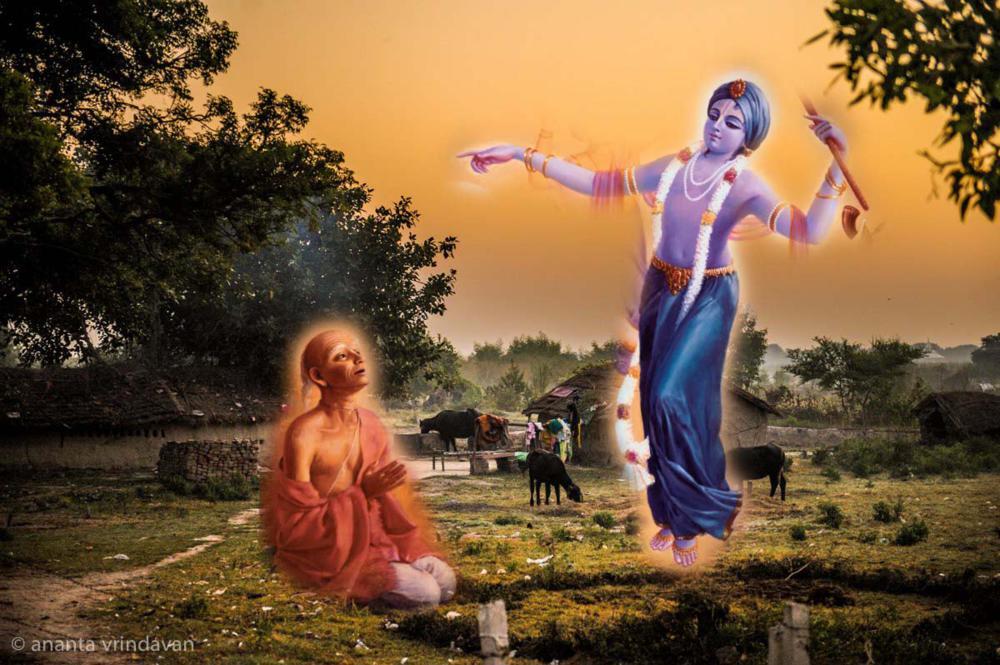
That same night, by Krishnadasa's own account, Nityananda Prabhu appeared to him in a dream, evidently pleased that Krishnadasa had defended his honor. The words Krishnadasa records from the Lord are simple and direct: "O Krishnadasa, do not be afraid. Go to Vrindavana, for there you will attain all things." He calls the encounter the end of his life as a Bengal householder. The text itself does not spell out how this dream-appearance should be understood. It could be a formal initiation, or an inspired call that pointed Krishnadasa toward the guru he would actually take at Vrindavana. Some devotional retellings describe Nityananda Prabhu as the true guru of Krishnadasa's heart. But in his own closing words to Chaitanya-charitamrita, Krishnadasa names Raghunatha Dasa Goswami specifically as his spiritual master. In the end, it was toward that relationship that this dream sent him.
A Portrait in Humility #
The same chapter of Chaitanya-charitamrita that records this dream also preserves some of the most severe self-description found anywhere in Vaishnava literature. Krishnadasa writes of himself, without exaggeration for literary effect: "I am more sinful than Jagai and Madhai, and lower than a worm in stool." He goes further. He warns that anyone who even hears his name loses the benefit of his own pious deeds. And he says that only Nityananda Prabhu's boundless mercy, which makes no distinctions, could reach someone as fallen as himself. In a 1976 lecture at Vrindavana, Srila Prabhupada quoted these same lines as the very definition of Vaishnava humility. It was not a performance, he said. It was the genuine way a soul absorbed in devotion sees himself.
A Village Deity That Outlived Him #
Krishnadasa left for Vrindavana and, by tradition, never returned to Bengal. But something of his presence remained in Jhamatpur. This was a Deity of Gaura-Nitai, that is, Chaitanya Mahaprabhu and Nityananda Prabhu together. Krishnadasa himself is said to have installed this Deity before his departure. According to later Gaudiya Vaishnava accounts, that Deity continued to be worshiped in the village long after Krishnadasa's own family line had died out. It is a small but lasting sign of the devotion of a man who otherwise left almost nothing of himself behind in the place where he was born.
