By the time Krishnadasa was well established at Vrindavana, Sri Chaitanya Mahaprabhu had already left this world some decades earlier. Vrindavana Dasa Thakura's Chaitanya-bhagavata stood as the standard account of his life. But the Vrindavana Vaishnava community felt that the book left a gap. It described Chaitanya Mahaprabhu's youth in Navadvipa in rich detail, but it passed quickly over his last eighteen years at Puri. Only Krishnadasa, through his guru Raghunatha Dasa Goswami, had any real access to those years. Fewer and fewer people were left who remembered those years firsthand. So the Vaishnavas of Vrindavana asked Krishnadasa to set the record down before it was lost.
Seeking Permission at the Madana-mohana Temple #
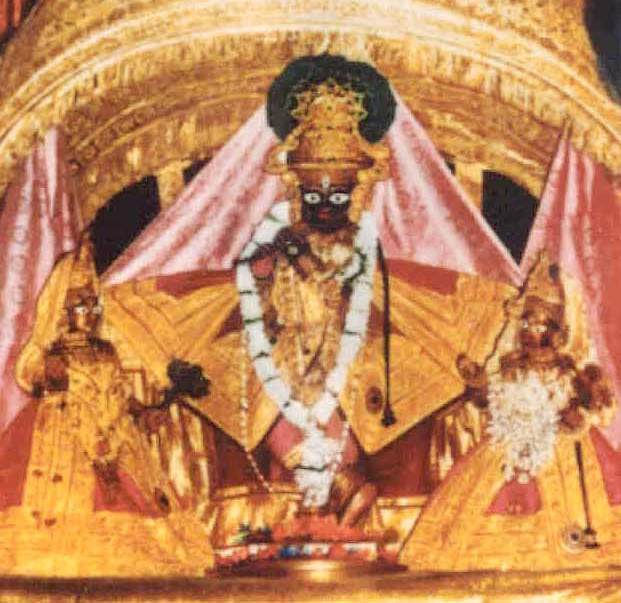
Krishnadasa did not treat this as a request he could simply accept. He describes going before the Deity of Sri Madana-mohana, in front of the assembled Vaishnava community, to ask permission directly. Sri Madana-mohana, established by Sanatana Gosvami, is one of Vrindavana's main worshipable Deities. According to the traditional account, Madana-mohana's garland fell from around the Deity's neck as Krishnadasa prayed, and the temple's pujari lifted it and placed it on Krishnadasa's own chest. The gathered devotees took this as a clear sign of the Lord's approval, and Krishnadasa began to write.
An Author Who Says So, Repeatedly #
This episode is not just a devotional story told by others. Krishnadasa refers to it himself, more than once, inside Chaitanya-charitamrita. He does so most clearly near the very end of the book, where he writes: "Sri Madana-gopala has given the order that is making me write. Although this should not be disclosed, I disclose it because I am unable to remain silent." He adds, almost apologetically, that keeping silent about the order would itself be ungrateful toward the Lord. He asks his readers not to mistake his telling of it for pride. Few authors in Vaishnava literature speak so openly and so consciously about their own right to write. Fewer still combine this with such an open admission that they are personally unfit for the task. This tension is explored further in Composing Sri Chaitanya-charitamrita.
Permission Sought, and One Refusal Honored #
Krishnadasa did not stop at Madana-mohana. Vaishnava tradition also records that, before he began to write, he asked for and received specific permission from Lokanatha Gosvami and Raghunatha Bhatta Gosvami. It also records that Lokanatha Gosvami, when he gave permission, made one request of his own: that his name be left out of the finished book. Krishnadasa honored this so consistently that Lokanatha Gosvami is barely mentioned anywhere in the whole of Chaitanya-charitamrita. This small but telling detail shows how literally Krishnadasa followed the wishes of the Vrindavana Vaishnavas, whom his writing was meant to satisfy. Vaishnava tradition also says that Gopala Bhatta Gosvami made an almost identical request. He gave his blessings for the project, but with the same condition that Lokanatha Gosvami had set: his name too should be left out of the finished book. Krishnadasa appears to have kept both promises with equal care. This is part of the reason why two of Vrindavana's most senior Goswamis are mentioned so rarely in a book that owes so much to the community they led.
A Dancing Dog, By His Own Description #
Krishnadasa's opening words to the entire work show this same humility. He begins Chaitanya-charitamrita by offering respects to Sri Chaitanya Mahaprabhu, "by whose desire I have become like a dancing dog and suddenly taken to the writing of Sri Chaitanya-charitamrita, although I am a fool." He chose a deliberately lowly image: a performing animal, not a scholar, moved by someone else's will. Read together with the Madana-mohana episode, this opening shows how Krishnadasa understood the whole work that follows. He saw himself as carrying out the work, not as its author. It was an order from Vrindavana's own Deities, carried out by an old man who considered himself unfit even to attempt it.
