Srila Krishnadasa Kaviraja Goswami
Author of Sri Chaitanya-charitamrita
The complete life, on one page: The main biography and every pastime page, in order, in one place
Introduction
śrī-rūpa-raghunātha-pade yāra āśa
caitanya-caritāmṛta kahe kṛṣṇadāsa
"Desiring the mercy of Sri Rupa and Sri Raghunatha, Krishnadasa narrates Sri Chaitanya-charitamrita." These are Krishnadasa Kaviraja Goswami's own words of surrender, repeated at the close of nearly every chapter of Sri Chaitanya-charitamrita itself.
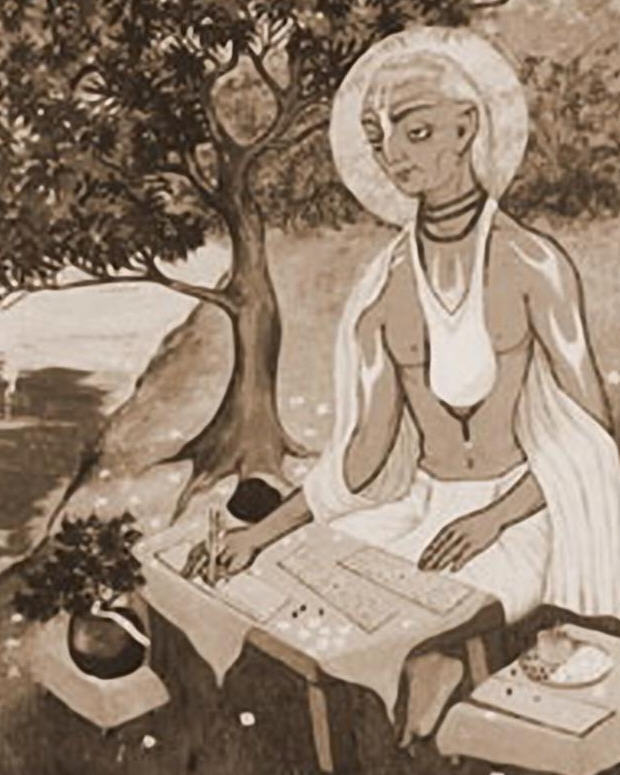
Srila Krishnadasa Kaviraja Goswami is remembered above all as the author of Sri Chaitanya-charitamrita, the work Gaudiya Vaishnavas regard as the single most authoritative account of the life and teachings of Sri Chaitanya Mahaprabhu. Very little about his own life can be said with any confidence, because he wrote almost nothing about himself. His own writing gives only a handful of scattered verses about his family and his call to Vrindavana. Yet those few verses, together with the enormous book he left behind, are enough to make him one of the greatest figures of the entire Gaudiya Vaishnava tradition.
| Detail | Description |
|---|---|
| Full name | Krishnadasa Kaviraja Goswami |
| Born | c. 1496-1528 (sources disagree sharply) |
| Birthplace | Jhamatpur, near Naihati, Burdwan district, Bengal |
| Spiritual master | Raghunatha Dasa Goswami, at Vrindavana |
| Chief work | Sri Chaitanya-charitamrita |
| Disappeared | c. 1615-1620, Vrindavana (some traditions say 1616-1617) |
| Direct disciple | Narottama Dasa Thakura |
Chapter 1
Early Life and the Call to Vrindavana
A physician's household in rural Bengal, and the dream that ended Krishnadasa's life as a householder.
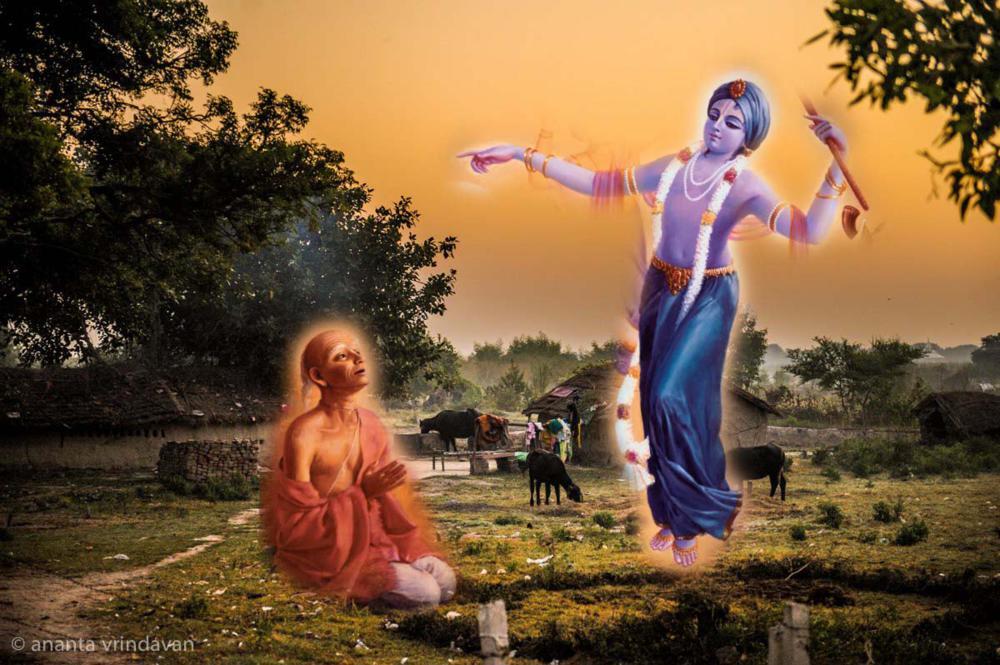
Krishnadasa's family lived in Jhamatpur, a village near Naihati in the Katwa region of Bengal's Burdwan district. His father was Bhagiratha and his mother was Sunanda, and he had a younger brother, Shyamadasa. Krishnadasa tells us almost nothing else about his childhood or his education. By adulthood, though, he was already known in his village as a devoted host of Vaishnava gatherings.
At a Glance
- Born in Jhamatpur, near Naihati in Bengal's Burdwan district, to Bhagiratha and Sunanda.
- Hosted a kirtana attended by Nityananda Prabhu's ecstatic servant, Minaketana Ramadasa.
- Rebuked his own brother Shyamadasa for showing faith in Chaitanya Mahaprabhu while doubting Nityananda Prabhu.
- Received Nityananda Prabhu's order, in a dream that same night, to leave for Vrindavana.
- Left behind a Deity of Gaura-Nitai in Jhamatpur that is still worshiped there today.
Sankirtana With Minaketana Ramadasa #
Krishnadasa describes one such gathering directly in Chaitanya-charitamrita. It was a kirtana held at his own home, and Minaketana Ramadasa attended it. Ramadasa was a servant of Nityananda Prabhu, known for showing his ecstatic love openly, without holding it back. Ramadasa wept constantly as he sang. A respected brahmana named Gunarnava Mishra was present, and he did not rise to show respect when Ramadasa entered the courtyard. At one point Ramadasa scolded him for this, sharply comparing him to a man who once disrespected Lord Balarama. Gunarnava Mishra was absorbed in his own temple service, and he took no offense at all.
Rebuking His Own Brother #
The important exchange came after the festival, when Krishnadasa's brother Shyamadasa argued with Minaketana Ramadasa. Krishnadasa admits that Shyamadasa had genuine faith in Sri Chaitanya Mahaprabhu, but only a faint regard for Nityananda Prabhu. Ramadasa was hurt by this. In anguish he broke his own flute and left. Krishnadasa did not defend his brother. Chaitanya and Nityananda, he told him, are a single body in two forms; to trust one while doubting the other is worse than useless, "like accepting half a hen." After this rebuke Shyamadasa's faith collapsed. Krishnadasa records this plainly, and he does not soften it in the retelling.
Nityananda Prabhu's Command in a Dream #
That same night, by Krishnadasa's own account, Nityananda Prabhu appeared to him in a dream, evidently pleased that Krishnadasa had defended his honor. The words Krishnadasa records from the Lord are simple and direct: "O Krishnadasa, do not be afraid. Go to Vrindavana, for there you will attain all things." He calls the encounter the end of his life as a Bengal householder. The text itself does not spell out how this dream-appearance should be understood. It could be a formal initiation, or an inspired call that pointed Krishnadasa toward the guru he would actually take at Vrindavana. Some devotional retellings describe Nityananda Prabhu as the true guru of Krishnadasa's heart. But in his own closing words to Chaitanya-charitamrita, Krishnadasa names Raghunatha Dasa Goswami specifically as his spiritual master. In the end, it was toward that relationship that this dream sent him.
A Portrait in Humility #
The same chapter of Chaitanya-charitamrita that records this dream also preserves some of the most severe self-description found anywhere in Vaishnava literature. Krishnadasa writes of himself, without exaggeration for literary effect: "I am more sinful than Jagai and Madhai, and lower than a worm in stool." He goes further. He warns that anyone who even hears his name loses the benefit of his own pious deeds. And he says that only Nityananda Prabhu's boundless mercy, which makes no distinctions, could reach someone as fallen as himself. In a 1976 lecture at Vrindavana, Srila Prabhupada quoted these same lines as the very definition of Vaishnava humility. It was not a performance, he said. It was the genuine way a soul absorbed in devotion sees himself.
A Village Deity That Outlived Him #
Krishnadasa left for Vrindavana and, by tradition, never returned to Bengal. But something of his presence remained in Jhamatpur. This was a Deity of Gaura-Nitai, that is, Chaitanya Mahaprabhu and Nityananda Prabhu together. Krishnadasa himself is said to have installed this Deity before his departure. According to later Gaudiya Vaishnava accounts, that Deity continued to be worshiped in the village long after Krishnadasa's own family line had died out. It is a small but lasting sign of the devotion of a man who otherwise left almost nothing of himself behind in the place where he was born.
Scriptural evidence for this chapter (2)
are are krsnadasa, na karaha bhaya
vrndavane yaha, - tanha sarva labhya haya
Word for word
are are krsnadasa - O, O Krishnadasa; na karaha bhaya - do not fear; vrndavane yaha - go to Vrindavana; tanha - there; sarva labhya haya - everything is attainable
“O my dear Krishnadasa, do not be afraid. Go to Vrindavana, for there you will attain all things.”
The words Krishnadasa Kaviraja records Nityananda Prabhu speaking to him in the dream that sent him from Bengal to Vrindavana.
jagai madhai haite muni se papistha
purisera kita haite muni se laghistha
Word for word
jagai madhai haite - than Jagai and Madhai; muni se papistha - I am more sinful; purisera kita haite - than the worms in stool; muni se laghistha - I am lower
“I am more sinful than Jagai and Madhai and even lower than the worms in the stool.”
One of Krishnadasa Kaviraja's own severest self-descriptions, later quoted by Srila Prabhupada as a model of genuine Vaishnava humility.
Chapter 2
Discipleship Under the Goswamis
How a Bengali householder became, at Vrindavana, the disciple of Raghunatha Dasa Goswami and a student of the entire Goswami circle.
When Krishnadasa reached Vrindavana, he found a small but extraordinary community of Goswamis. Sri Chaitanya Mahaprabhu had personally directed them to recover Krishna's lost pilgrimage sites. He had also asked them to give the theology of Chaitanya Vaishnavism, which is full of feeling, a clear and systematic philosophical foundation. Rupa Gosvami and Sanatana Gosvami were already settled there, with their nephew Jiva Gosvami. Raghunatha Bhatta Gosvami and Gopala Bhatta Gosvami were also there. Krishnadasa entered this circle as a student, not an equal. By his own account in the closing lines of Chaitanya-charitamrita, he counted all of them among the teachers who shaped his understanding.
Raghunatha Dasa Goswami, His Spiritual Master #
In this circle, one person stands out as Krishnadasa's actual diksha-guru: Raghunatha Dasa Goswami. Raghunatha Dasa Goswami had given up a wealthy zamindar family to follow Sri Chaitanya Mahaprabhu. During the Lord's last years at Puri, he had lived under the close personal care of Svarupa Damodara Gosvami, Chaitanya's confidential secretary. Krishnadasa names him directly and clearly in the final chapter of his own book: "Sri Raghunatha dasa Gosvami, who is my spiritual master." This is a rare moment in a work that otherwise says almost nothing about its author, where the author speaks plainly about himself. It also settles a question that might otherwise stay open. Whatever role Nityananda Prabhu's dream-vision played in first sending Krishnadasa to Vrindavana, it was Raghunatha Dasa Goswami who formally received him there as a disciple.
An Irreplaceable Source: Svarupa Damodara's Notes #
This link with Raghunatha Dasa Goswami mattered for much more than initiation alone. Raghunatha Dasa Goswami had lived at Puri during exactly those years of Sri Chaitanya Mahaprabhu's life about which the least had been recorded. These were the final eighteen years, which Vrindavana Dasa Thakura's earlier Chaitanya-bhagavata had mostly left out. Svarupa Damodara Gosvami had kept a diary of these years in short Sanskrit notebook-verses. That original notebook is now lost. But Raghunatha Dasa Goswami had learned its contents by heart while serving at Svarupa Damodara's side. Krishnadasa learned this material directly from him, and it would later fill the whole of Chaitanya-charitamrita's Antya-lila. The knowledge passed by word of mouth along this single line, from Svarupa Damodara to Raghunatha Dasa Goswami to Krishnadasa. Without it, the closest and most personal record of Sri Chaitanya Mahaprabhu's final years might not exist at all.
Learning Among Rare Manuscripts #
Krishnadasa also benefited from the library the Goswamis had built up at Vrindavana. For that time it was a remarkably large collection. It included rare Sanskrit manuscripts gathered by Sanatana Gosvami and Rupa Gosvami during their own years of study and travel. Vaishnava tradition holds that Krishnadasa spent years absorbed in this material under Jiva Gosvami's theological guidance, long before anyone asked him to write a book of his own. This training can be seen all through Chaitanya-charitamrita, where he constantly and confidently uses scripture to support Gaudiya Vaishnava teaching.
A Scholar Before He Arrived #
Krishnadasa did not come to this training empty-handed. Even in Bengal, before the dream that sent him to Vrindavana, he had already become skilled in Sanskrit grammar, in the six classical systems of philosophy, and in the Vedic and Upanishadic literature. This was the ordinary education available to a learned Bengali household of his time. This preparation let him enter the Goswamis' circle at Vrindavana as a capable student, not as a mere curiosity. Later it also let him handle with ease the difficult theological arguments that Chaitanya-charitamrita would need.
An Identity Beyond This World #
Some devotional accounts also identify Krishnadasa, in his eternal spiritual identity, as one of Radha's handmaidens in Krishna's Vraja pastimes. Kavi-karnapura's Gaura-ganoddesha-dipika names him Ratnarekha Manjari, though other sources give the name Kasturi Manjari instead. Such identifications belong to Gaudiya Vaishnavism's confidential literature on the eternal identities of Chaitanya's associates, not to ordinary biography. But they show how highly Krishnadasa came to be honoured by the tradition that formed him.
Scriptural evidence for this chapter (2)
(combined verses; see source for full Bengali and IAST text)
“I am writing this book by the mercy of the lotus feet of Sri Govindadeva, Sri Chaitanya Mahaprabhu, Lord Nityananda, Advaita Acharya, other devotees and the readers of this book, as well as Svarupa Damodara Gosvami, Sri Rupa Gosvami, Sri Sanatana Gosvami, Sri Raghunatha dasa Gosvami, who is my spiritual master, and Sri Jiva Gosvami.”
Krishnadasa Kaviraja's own, unambiguous naming of Raghunatha Dasa Goswami as his spiritual master, from the closing chapter of Chaitanya-charitamrita.
From the purport: Purport excerpt: “The author of Sri Caitanya-caritamrta, Srila Krsnadasa Kaviraja Gosvami, stands as the direct disciple of Srila Rupa Gosvami and Srila Raghunatha dasa Gosvami.”
Srila Prabhupada's own summary, at the opening of Chaitanya-charitamrita's first chapter, of Krishnadasa Kaviraja's place in the disciplic succession.
Chapter 3
The Command to Write Chaitanya-charitamrita
How a Vrindavana Deity's fallen garland became, for Krishnadasa, an order he could not refuse.
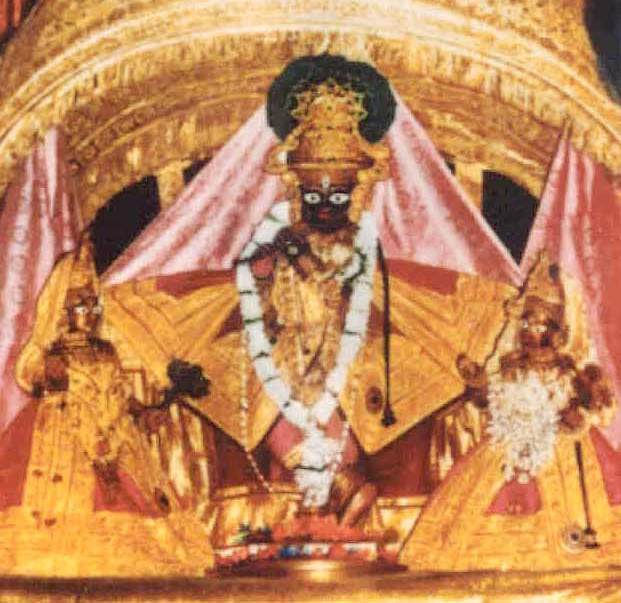
By the time Krishnadasa was well established at Vrindavana, Sri Chaitanya Mahaprabhu had already left this world some decades earlier. Vrindavana Dasa Thakura's Chaitanya-bhagavata stood as the standard account of his life. But the Vrindavana Vaishnava community felt that the book left a gap. It described Chaitanya Mahaprabhu's youth in Navadvipa in rich detail, but it passed quickly over his last eighteen years at Puri. Only Krishnadasa, through his guru Raghunatha Dasa Goswami, had any real access to those years. Fewer and fewer people were left who remembered those years firsthand. So the Vaishnavas of Vrindavana asked Krishnadasa to set the record down before it was lost.
Seeking Permission at the Madana-mohana Temple #
Krishnadasa did not treat this as a request he could simply accept. He describes going before the Deity of Sri Madana-mohana, in front of the assembled Vaishnava community, to ask permission directly. Sri Madana-mohana, established by Sanatana Gosvami, is one of Vrindavana's main worshipable Deities. According to the traditional account, Madana-mohana's garland fell from around the Deity's neck as Krishnadasa prayed, and the temple's pujari lifted it and placed it on Krishnadasa's own chest. The gathered devotees took this as a clear sign of the Lord's approval, and Krishnadasa began to write.
An Author Who Says So, Repeatedly #
This episode is not just a devotional story told by others. Krishnadasa refers to it himself, more than once, inside Chaitanya-charitamrita. He does so most clearly near the very end of the book, where he writes: "Sri Madana-gopala has given the order that is making me write. Although this should not be disclosed, I disclose it because I am unable to remain silent." He adds, almost apologetically, that keeping silent about the order would itself be ungrateful toward the Lord. He asks his readers not to mistake his telling of it for pride. Few authors in Vaishnava literature speak so openly and so consciously about their own right to write. Fewer still combine this with such an open admission that they are personally unfit for the task. This tension is explored further in Composing Sri Chaitanya-charitamrita.
Permission Sought, and One Refusal Honored #
Krishnadasa did not stop at Madana-mohana. Vaishnava tradition also records that, before he began to write, he asked for and received specific permission from Lokanatha Gosvami and Raghunatha Bhatta Gosvami. It also records that Lokanatha Gosvami, when he gave permission, made one request of his own: that his name be left out of the finished book. Krishnadasa honored this so consistently that Lokanatha Gosvami is barely mentioned anywhere in the whole of Chaitanya-charitamrita. This small but telling detail shows how literally Krishnadasa followed the wishes of the Vrindavana Vaishnavas, whom his writing was meant to satisfy. Vaishnava tradition also says that Gopala Bhatta Gosvami made an almost identical request. He gave his blessings for the project, but with the same condition that Lokanatha Gosvami had set: his name too should be left out of the finished book. Krishnadasa appears to have kept both promises with equal care. This is part of the reason why two of Vrindavana's most senior Goswamis are mentioned so rarely in a book that owes so much to the community they led.
A Dancing Dog, By His Own Description #
Krishnadasa's opening words to the entire work show this same humility. He begins Chaitanya-charitamrita by offering respects to Sri Chaitanya Mahaprabhu, "by whose desire I have become like a dancing dog and suddenly taken to the writing of Sri Chaitanya-charitamrita, although I am a fool." He chose a deliberately lowly image: a performing animal, not a scholar, moved by someone else's will. Read together with the Madana-mohana episode, this opening shows how Krishnadasa understood the whole work that follows. He saw himself as carrying out the work, not as its author. It was an order from Vrindavana's own Deities, carried out by an old man who considered himself unfit even to attempt it.
Scriptural evidence for this chapter (2)
sri-madana-gopala more lekhaya ajna kari'
kahite na yuyaya, tabu rahite na pari
Word for word
sri-madana-gopala - the Madana-mohana Deity of Vrindavana; more lekhaya ajna kari - causes me to write by giving the order; kahite na yuyaya - it is not befitting to say; tabu rahite na pari - still I am not able to remain silent
“Sri Madana-mohana Deity of Vrindavana has given the order that is making me write. Although this should not be disclosed, I disclose it because I am unable to remain silent.”
Krishnadasa Kaviraja's own, direct statement that the order to write Chaitanya-charitamrita came from the Madana-mohana Deity of Vrindavana.
na kahile haya mora krta-ghnata-dosa
dambha kari bali' srota, na kariha rosa
Word for word
na kahile haya - if I do not say, there is; mora krta-ghnata-dosa - my fault of ingratitude; dambha kari bali - taking me as proud; srota - O readers; na kariha rosa - do not be angry
“If I did not disclose this fact, I would be guilty of ingratitude to the Lord. Therefore, my dear readers, please do not consider me too proud and be angry at me.”
Krishnadasa Kaviraja's own justification for disclosing the Madana-mohana episode despite his instinct toward humility and silence.
Chapter 4
Composing Sri Chaitanya-charitamrita
Where Krishnadasa found his material, how he arranged the book, and the main theological teaching of Gaudiya Vaishnavism's most authoritative biography of Sri Chaitanya Mahaprabhu.
Chaitanya-charitamrita is organized into three sections, or lilas. The Adi-lila's fourteen chapters describe Chaitanya Mahaprabhu's early life. More importantly, they lay the philosophical foundation for everything that follows. Above all, there is the claim that Chaitanya is Krishna and Radha united in a single form, and the book's opening verses state this outright. He appeared in order to relish and distribute the very love of God that Radha alone, of all Krishna's associates, feels for Him. The Madhya-lila's twenty-five chapters cover most of Chaitanya Mahaprabhu's public mission after taking sannyasa. This includes his famous conversation with Ramananda Raya on the nature of transcendental rasa, or devotional relationship with Krishna. The Antya-lila's twenty chapters narrate the final eighteen years at Puri. This is the very period that Vrindavana Dasa Thakura's Chaitanya-bhagavata had left largely untold. The Antya-lila closes with Krishnadasa's own long reflection on the Shikshashtaka, Chaitanya Mahaprabhu's eight verses of instruction.
Weaving Together Four Earlier Records #
Krishnadasa did not invent this material. He brought it together from earlier records, and he did so openly and gratefully. For Chaitanya Mahaprabhu's early years, his main source was Vrindavana Dasa Thakura's Chaitanya-bhagavata itself. Krishnadasa states this debt plainly. He praises Vrindavana Dasa as "equal to Srila Vyasadeva" and explains that he meant only to fill in episodes Vrindavana Dasa had left out, not to repeat him or go beyond him. For the order of events, he drew on Murari Gupta's Kadaca, also called Sri-krishna-chaitanya-charanamrita. This was a diary kept by a schoolmate and physician of Chaitanya Mahaprabhu. Because it was an eyewitness record, every later biographer built on it. From Kavi-karnapura he took material found in the Chaitanya-chandrodaya-nataka and the Krishna-chaitanya-charanamrita Mahakavya. And for the all-important last eighteen years, he depended on Svarupa Damodara Gosvami's notebook of short Sanskrit verses summing up events, which is now lost. Its contents reached him by word of mouth through his own guru, Raghunatha Dasa Goswami.
An Explicit Theology, Not Just a Biography #
Chaitanya-charitamrita is not just a record of events. It argues its theology very directly. Chaitanya-bhagavata had already treated Chaitanya Mahaprabhu as an incarnation of Krishna. But Krishnadasa states the fuller doctrine clearly and many times. He teaches that Chaitanya Mahaprabhu is Radha and Krishna combined in a single form, taking on Radha's mood and complexion while remaining Krishna Himself. The book's opening Sanskrit verse puts it directly: the loving affairs of Radha and Krishna are transcendental manifestations of the Lord's own pleasure-giving potency, and though the two are one in identity, they have "again united, in the form of Sri Krishna Chaitanya." Around this single claim, Krishnadasa builds a systematic account of rasa-tattva, the science of devotional relationships with Krishna. Later Gaudiya Vaishnava theologians treated this account as the tradition's most authoritative statement on the subject.
A Poem in a Changed Tongue #
By the time he wrote, Krishnadasa had lived away from Bengal for so many decades. For this reason, the Bengali of Chaitanya-charitamrita is known for using a great many Sanskrit words. In places it is unusually difficult even for readers fluent in the language. Centuries later, Srila Prabhupada translated the work into English. He chose to keep the original Bengali text printed alongside his translation, instead of replacing it. He said he did this on purpose, to follow the example of his own guru, Bhaktisiddhanta Sarasvati Thakura. Bhaktisiddhanta Sarasvati Thakura had predicted that devotees the world over would one day want to learn Bengali just to read Chaitanya-charitamrita as Krishnadasa had written it. In 1974, while still working on the translation, Prabhupada estimated that his English edition of this single work would run to about ten volumes. The work itself had first been composed by one sick old man at Vrindavana.
More Than Chaitanya-charitamrita Alone #
Chaitanya-charitamrita was not Krishnadasa's only book. Vaishnava tradition also credits him with Govinda-lilamrita, a detailed account of Krishna's eternal daily pastimes through the eight watches of the day (ashta-kaliya-lila). It also credits him with a commentary on Bilvamangala Thakura's Krishna-karnamrita. Tradition holds that Krishnadasa received the title kaviraja, "king of poets," specifically for Govinda-lilamrita. It is the very title by which he is known today. Narottama Dasa Thakura, Krishnadasa's own direct disciple, named both books together in his Prema-bhakti-chandrika: "Krishnadasa Kaviraja stands among the rasika devotees, for he composed Chaitanya-charitamrita. He described both Gaura's and Govinda's pastimes, hearing which even a stone would melt. Yet even so," Narottama adds, speaking of himself with the same humility Krishnadasa himself had shown, "my mind has not been drawn to these works."
Srila Bhaktisiddhanta Sarasvati Thakura, in one of the strongest statements ever made about the book, told his disciples: "If it were to happen that all the books in the world were destroyed, leaving only Srimad-Bhagavatam and Chaitanya-charitamrita, the people of this world would still be able to achieve the ultimate goal of life. Even if Srimad-Bhagavatam were lost, leaving only Chaitanya-charitamrita, there would be no loss to humanity, for whatever has not been revealed in the Bhagavatam is found in Chaitanya-charitamrita." Chaitanya-charitamrita itself is traditionally said to have been completed in 1615, only a handful of years before Krishnadasa's own disappearance.
A Book Its Own Author Doubted He Could Finish #
None of this systematic argument came easily. Through much of the writing, Krishnadasa was already old, and by his own repeated admission he was nearly blind and deaf. This physical struggle is described in Life of Austerity at Radha-Damodara. In Srila Prabhupada's later judgement, the scope of the work made it "the postgraduate study of Krishna consciousness", beyond even the Bhagavad-gita and Srimad-Bhagavatam in what it demands of the reader. Yet Krishnadasa completed such a work. This is part of why Gaudiya Vaishnavas have always seen the writing of Chaitanya-charitamrita as something that cannot be separated from its author's own devotion.
Scriptural evidence for this chapter (1)
radha krsna-pranaya-vikrtir hladini saktir asmad
ekatmanav api bhuvi pura deha-bhedam gatau tau
caitanyakhyam prakatam adhuna tad-dvayam caikyam aptam
radha-bhava-dyuti-suvalitam naumi krsna-svarupam
Word for word
radha krsna-pranaya-vikrtih hladini saktih - the transformation of Radha and Krishna's love is the pleasure potency; eka-atmanau api - although one in identity; deha-bhedam gatau - obtained separate forms; caitanya-akhyam prakatam adhuna - now manifest, known as Chaitanya; tad-dvayam ca aikyam aptam - the two have attained oneness; naumi krsna-svarupam - I bow to Him who is identical with Krishna
“The loving affairs of Sri Radha and Krishna are transcendental manifestations of the Lord's internal pleasure-giving potency. Although Radha and Krishna are one in Their identity, previously They separated Themselves. Now these two transcendental identities have again united, in the form of Sri Krishna Chaitanya.”
The opening verse in which Krishnadasa Kaviraja states, explicitly and directly, the book's central theological claim: that Chaitanya Mahaprabhu is Radha and Krishna combined.
Chapter 5
Life of Austerity at Radha-Damodara
Blind, deaf, and trembling with old age, Krishnadasa kept writing near the temple that would become his resting place.
Near the close of Chaitanya-charitamrita, in its very last chapter, Krishnadasa gives an account of his own physical condition. It reads less like fine writing and more like a plain medical report. "I am old and troubled by invalidity," he writes. "I am almost blind and deaf, my hands tremble, and my mind and intelligence are unsteady." A few verses later he goes further still. He describes himself as suffering from five kinds of disease at once, and unable to walk or sit properly. He says he could die "at any time of the day or night."
Continuing Regardless #
These lines are remarkable because of where Krishnadasa places them. He does not give them as an excuse to stop. He gives them as the start of his explanation of why he kept going. He tells his readers directly that he has "previously given an account of my inabilities" and asks them to hear, now, the reason he still continued to write. That reason was the order he understood he had received from Sri Madana-mohana. He says he could not, in good conscience, leave this order unmentioned, however much it cost his humility to reveal it.
A Drop From the Ocean #
Krishnadasa's sense of his own smallness was not limited to his body. Earlier in the same closing chapter he compares himself to a small red-beaked bird. The bird drinks from the ocean to quench its thirst, but it takes in only the tiniest part of the water: "so I have touched," he writes, "only a drop of the ocean of Sri Chaitanya Mahaprabhu's pastimes." A few lines later he goes further still. He questions whether he can even claim to be the book's author at all: "I infer that 'I have written' is a false understanding, for my body is like a wooden doll." Read together, these lines show an old man who was completing the single most detailed biography of Chaitanya Mahaprabhu in existence. Even so, he refused to take credit for having written it in any ordinary sense.
A Complaint Repeated From the Start #
This was not the only place in the book where Krishnadasa described his condition in such harsh terms. Earlier, in Madhya-lila, he had already written, "I am now an old man and an invalid. My hand trembles as I write and my memory fails me. I am going blind and deaf, but still I manage to write, and this is a great wonder" (Madhya-lila 2.90). He would return to the same complaint, in fuller and more painful detail, in the book's closing chapter.
Near the Radha-Damodara Temple #
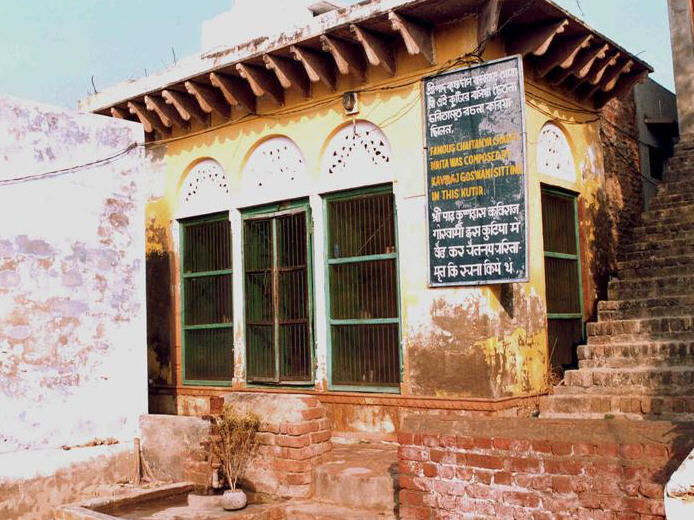
Vaishnava tradition places Krishnadasa's final years at or near the Radha-Damodara temple in Vrindavana, established in honor of Rupa Gosvami's own worshipable Deities. A small kutir associated with Krishnadasa on the temple grounds is still shown to visitors today as the place where Chaitanya-charitamrita was composed. Whatever the exact details of his daily life there, his own verses give a clear picture. They show a man living out his final years in real physical hardship. He had very little to live on. By his own account, the Deities and devotees around him sustained him spiritually.
Written Beside Which Kunda? #
Even within the tradition, there is disagreement about exactly where Krishnadasa spent these final years and wrote his book. This page follows several later accounts, which place his kutir on the grounds of the Radha-Damodara temple in Vrindavana itself. Other traditional accounts instead place him at Radha-kunda, on the banks of its twin pool, Shyama-kunda. There he is said to have built his bhajana-kutira beside that of his own guru, Raghunatha Dasa Goswami. He did this so that he could hear, directly and every afternoon, Raghunatha Dasa's memories of Sri Chaitanya Mahaprabhu's final years at Puri. The two traditions differ on the exact spot. But both agree on the main fact: Krishnadasa wrote near his guru, with devotion to him, and not in isolation.
Gratitude, Not Complaint #
Even in describing his own sufferings, Krishnadasa does not ask for sympathy. In the same closing chapter, he says that whatever he managed to write did not come from any ability of his own. It came from "the mercy of the lotus feet of Sri Govindadeva, Sri Chaitanya Mahaprabhu, Lord Nityananda, Advaita Acharya, other devotees and the readers of this book". He also gives credit, by name, to Svarupa Damodara Gosvami, Rupa Gosvami, Sanatana Gosvami, his own guru Raghunatha Dasa Goswami, and Jiva Gosvami. This is a very long list of thanks from a man who, elsewhere in the same book, calls himself lower than a worm in stool. It fits, from beginning to end, with how little Krishnadasa ever claimed for himself.
Scriptural evidence for this chapter (2)
vrddha jaratura ami andha, badhira
hasta hale, mano-buddhi nahe mora sthira
Word for word
vrddha - an old man; jara-atura ami - I am troubled by invalidity; andha - blind; badhira - deaf; hasta hale - my hands tremble; manah-buddhi nahe mora sthira - my mind and intelligence are not steady
“I am old and troubled by invalidity. I am almost blind and deaf, my hands tremble, and my mind and intelligence are unsteady.”
Krishnadasa Kaviraja's own description of his physical condition, written near the very end of Chaitanya-charitamrita.
(see source for full Bengali and IAST text)
“I am infected with so many diseases that I can neither properly walk nor properly sit. Indeed, I am always exhausted by five kinds of diseases. I may die at any time of the day or night.”
Continues Krishnadasa Kaviraja's frank account of the illness and infirmity he was writing under in his final years.
Chapter 6
Disappearance and Legacy
An uncertain death date, a persistent legend firmly rejected, and an unbroken chain of disciples running to the present day.
Exactly when Krishnadasa Kaviraja Goswami passed away is not settled. Most modern accounts place his disappearance somewhere between about 1615 and 1620. Some Gaudiya Vaishnava traditions narrow this further to 1616 or 1617. Even his birth year is disputed by several decades, and Chaitanya-charitamrita itself gives no exact date for when it was completed. So this uncertainty is not surprising, and there is nothing suspicious about it. It is simply the kind of gap that remains when a very private man leaves behind an enormous book and almost no other record of himself.
A Legend Worth Naming and Rejecting #
One persistent story, associated with the later Sahajiya tradition rather than mainstream Gaudiya Vaishnavism, claims that Jiva Gosvami grew jealous of Chaitanya-charitamrita's reception and threw its manuscript into a well, and that Krishnadasa died of the shock. Serious Gaudiya Vaishnava scholars reject this story completely. The manuscript clearly survived, because Krishnadasa's own disciple, Mukunda, preserved it and published it after his disappearance. Jiva Gosvami was himself deeply respected in the same Vrindavana community, and nothing in the historical record connects him to any such act. We mention the story here only so that it can be set aside, not repeated without question.
The Samadhi at Radha-Damodara #
What is agreed upon is the place: Krishnadasa's samadhi, or memorial tomb, stands on the grounds of the Radha-Damodara temple in Vrindavana, near where he is believed to have spent his final years and completed his book. It remains a place of pilgrimage for Gaudiya Vaishnavas visiting Vrindavana today.
An Unbroken Chain of Disciples #
Apart from the book itself, Krishnadasa's most important legacy is the line of disciples that comes from him. His own direct disciple was Narottama Dasa Thakura. After him the line continued through Vishvanatha Chakravarti Thakura and Jagannatha Dasa Babaji to Bhaktivinoda Thakura, then to Gaura Kishora Dasa Babaji and Bhaktisiddhanta Sarasvati Thakura, and from him to Srila Prabhupada. Prabhupada said that Bhaktisiddhanta Sarasvati Thakura read Chaitanya-charitamrita whenever he had a spare moment. He also said that Bhaktisiddhanta Sarasvati Thakura predicted that people around the world would one day learn Bengali just to read it in the original. Prabhupada took this prediction seriously. So his own English translation prints the Bengali text beside it, word for word, and does not give only a paraphrase.
Kept in Print by a Devoted Editor #
Chaitanya-charitamrita has survived into the modern era largely thanks to Bhaktisiddhanta Sarasvati Thakura. He edited and published an important edition of the text through the Gaudiya Math. He also wrote its Bhumika, or introduction, which discusses the little that could be known for certain about Krishnadasa's own life. When Srila Prabhupada began his own English translation decades later, he carried forward this same edition and this same reverence for the text. He kept the original Bengali printed beside the English, so that nothing of Krishnadasa's own voice would be lost in translation.
Beyond the Household, Beyond the Ashramas #
Srila Prabhupada offered one more assessment of what happened to Krishnadasa once he reached Vrindavana: "After arriving in Vrindavana, Krishnadasa became indifferent to talk about his previous family life and totally absorbed in Hari-katha. This behavior is appropriate for someone in the third or fourth station and completely committed to the devotional life. Chaitanya-charitamrita is the composition of someone who has reached the status of a paramahamsa and is completely beyond the four ashramas," he wrote in his purport to the same chapter where he traced the disciple line from Krishnadasa down to himself (Sri Chaitanya-charitamrita, Adi-lila, Chapter 1, "The Spiritual Masters").
Some traditional accounts say that Krishnadasa's cremated remains are not at the Radha-Damodara temple itself. They place them at the Teen Goswami samadhi-pitha near Radha-kunda. These accounts add that certain Gaudiya Vaishnava saints of this time were cremated instead of being buried in the usual way, so that hostile forces could not later dishonour their remains. This page follows the more commonly repeated tradition, which places his samadhi at Radha-Damodara. But it honestly records this other account and does not try to settle the question.
The Measure Prabhupada Gave It #
Prabhupada's own judgement of the book shows Krishnadasa's legacy more clearly than anything else. He described the Bhagavad-gita as the entry-level study of Krishna consciousness, the Srimad-Bhagavatam as the graduate study, and Chaitanya-charitamrita as the postgraduate study, the deepest and most demanding of the three. It is not a small claim to make about a book written by a man who, by his own account, could barely see the page in front of him.
Closing
Early Life in Bengal #
Krishnadasa was born in the village of Jhamatpur, near Naihati in the Katwa area of Bengal's Burdwan (Barddhaman) district, to a father named Bhagiratha and a mother named Sunanda. He had a younger brother, Shyamadasa. Apart from these bare facts, little can be said with certainty about his early years. Gaudiya Vaishnava writers have long explained this silence by his own extreme humility, not by any lack of a story worth telling.
Even his caste is disputed. Srila Bhaktisiddhanta Sarasvati Thakura edited an early printed edition of Chaitanya-charitamrita. He wrote openly that no one could say for certain whether Krishnadasa was born a brahmana, a kayastha, or a vaidya (the physicians' caste, with which the title "Kaviraja" is sometimes linked). He left the question open and did not force an answer. Sources are also divided on when he was born. Estimates range from about 1496 to about 1528, and no single date is generally accepted.
Years of Training Among the Goswamis #
At Vrindavana, Krishnadasa joined the circle of the Goswamis. Sri Chaitanya Mahaprabhu had personally directed them to recover the holy places of Krishna's Vraja and to give Gaudiya Vaishnava theology its systematic foundation. Krishnadasa accepted Raghunatha Dasa Goswami, one of Chaitanya's most renounced personal associates, as his diksha-guru. He states this plainly in his own closing words to Chaitanya-charitamrita. He also named Rupa Gosvami, Sanatana Gosvami, Jiva Gosvami, Raghunatha Bhatta Gosvami and Gopala Bhatta Gosvami among the teachers who shaped his understanding. Raghunatha Dasa Goswami had lived under Svarupa Damodara Gosvami's personal care during Chaitanya Mahaprabhu's final years at Puri. So it was above all Raghunatha Dasa Goswami who gave Krishnadasa the close, detailed knowledge of those years of the Lord's life, about which the least had been written.
An Old Man's Last, Great Labor #
Krishnadasa was already old when he began Chaitanya-charitamrita, and by his own account he was nearly blind and deaf. Near the very end of the book he describes his condition openly, hiding nothing. His hands trembled as he wrote, and his memory failed him. He says that he was troubled by five kinds of disease at once, any of which might end his life "at any time of the day or night." He finished the work anyway. He said that he was able to do it not by his own strength, but by the mercy of Sri Chaitanya Mahaprabhu, Nityananda Prabhu, Advaita Acharya, Svarupa Damodara Gosvami, Rupa Gosvami, Sanatana Gosvami, Jiva Gosvami, and his own guru Raghunatha Dasa Goswami. And, he insists again, it was by the direct order of Madana-mohana.
Disappearance and Place in the Guru-parampara #
Krishnadasa is believed to have passed away at Vrindavana sometime between about 1615 and 1620. Some traditions narrow this to 1616 or 1617. His samadhi stands today on the grounds of the Radha-Damodara temple, where he spent his final years. A later legend from the Sahajiya tradition claimed that Jiva Gosvami, out of jealousy, threw the manuscript of Chaitanya-charitamrita into a well. Mainstream Gaudiya Vaishnava scholars reject this story completely. The manuscript clearly survived, and after Krishnadasa's disappearance it was published by his own disciple, Mukunda.
The guru-parampara continued from Krishnadasa. His direct disciple was Narottama Dasa Thakura. From Narottama Dasa Thakura the line continued in turn through Vishvanatha Chakravarti Thakura and Jagannatha Dasa Babaji to Bhaktivinoda Thakura, Gaura Kishora Dasa Babaji, Bhaktisiddhanta Sarasvati Thakura, and Srila Prabhupada himself. Prabhupada described Chaitanya-charitamrita as nothing less than "the postgraduate study of Krishna consciousness," and in his own account of spiritual education he placed it even beyond the Bhagavad-gita and Srimad-Bhagavatam. This is because of the depth it demands of its reader. Seen in this light, an old man with trembling hands, near the Radha-Damodara temple, wrote the book that would carry the Chaitanya tradition, intact, into the modern world.
Songs in the Vaishnava Song Book #
The Vaishnava Song Book carries 4 songs attributed to Srila Krishnadasa Kaviraja Goswami: see the full author page here.
- Gaudiya History: Krishnadasa Kaviraja Goswami - Biography
- Gaudiya History: Krishnadasa Kaviraja Goswami - Biography (2)
- Sri Chaitanya-charitamrita, Adi-lila, Chapter 1 (Bhaktivedanta VedaBase)
- Sri Chaitanya-charitamrita, Antya-lila 20.90-100 (Bhaktivedanta VedaBase)
- Srila Prabhupada lecture, Sri Chaitanya-charitamrita Adi-lila 7.1, Mayapur, March 1 1974
