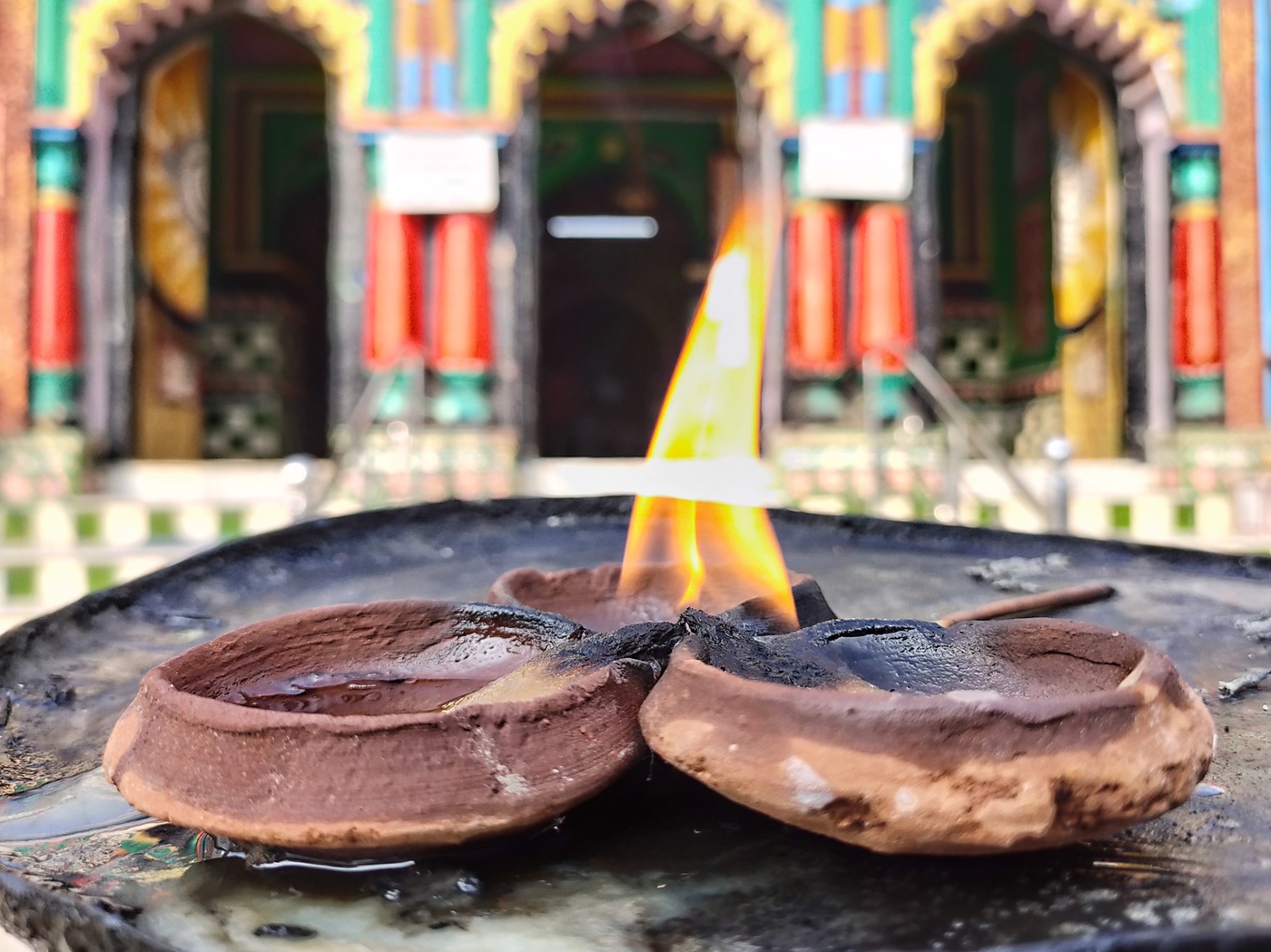
Carrying Gopala's order to bring sandalwood from Jagannatha Puri, Madhavendra Puri crossed from Bengal into Orissa and stopped for the night at Remuna, where a strikingly beautiful Deity of Gopinatha was worshiped. Chaitanya-charitamrita gives this one stop more attention than almost any other episode in Madhavendra Puri's life, and Sri Chaitanya Mahaprabhu Himself, generations later, visited the same temple and retold the story to His own devotees there with evident delight.
A Question About the Evening Offering #
Overwhelmed by the Deity's beauty, Madhavendra Puri danced and chanted in the temple courtyard before asking a priest what foods were regularly offered to Gopinatha. He learned that each evening the Deity received sweet rice in twelve earthen pots. The offering was so famous that it had its own name, amrita-keli. This particular preparation, later known simply as gopinatha-kshira, was offered nowhere else in the world. While the priest was describing it, the offering was actually being placed before the Deity, right in front of Madhavendra Puri.
An Offense Considered, and Refused #
A small, entirely human thought crossed Madhavendra Puri's mind. If he could just taste a little of that sweet rice, he could make something similar for his own Gopala back in Vrindavana. He caught himself almost at once. Chaitanya-charitamrita records how he judged himself, without softening it: "A paramahamsa like Madhavendra Puri is always satisfied in the loving service of the Lord. Material hunger and thirst cannot impede his activities. When he desired to taste a little sweet rice offered to the Deity, he considered that he had committed an offense by desiring to eat what was being offered to the Deity" (Madhya 4.124). He did not want to risk that thought coming back. So he left the temple entirely, without a word to anyone, and sat down to chant alone in the empty village marketplace for the night. As he always did, he refused to beg for food that had not been offered to him freely.
The Deity's Own Theft #
That same night Gopinatha appeared to His sleeping priest in a dream with an unusual instruction: "O priest, please get up and open the door of the temple. I have kept one pot of sweet rice for the sannyasi Madhavendra Puri. This pot of sweet rice is just behind My cloth curtain. You did not see it because of My tricks. A sannyasi named Madhavendra Puri is sitting in the vacant marketplace. Please take this pot of sweet rice from behind Me and deliver it to him" (Madhya 4.127-129). The priest woke, bathed, opened the temple, and found the pot exactly where Gopinatha had said. The Deity had kept it hidden so that it was not noticed during the regular offering. He carried it through the village calling out for the sannyasi by name. He told a bewildered Madhavendra Puri that Gopinatha Himself had stolen sweet rice for him. Formerly the Deity had stolen a pot of sweet rice for Madhavendra Puri, Krishnadasa Kaviraja Goswami writes; therefore He became very famous as the Lord who stole the sweet rice, kshira-chora (Madhya 4.20). Overwhelmed with ecstatic love, Madhavendra Puri ate the offering. Then he washed the clay pot, broke it into pieces, and kept the pieces wrapped in his cloth. Afterward he ate one piece each day as a treasured remnant of Krishna's mercy.
Fleeing His Own Reputation #
Madhavendra Puri knew that word of the miracle would draw crowds by morning. So he left Remuna before dawn and walked on to Jagannatha Puri. But there, his growing fame as a great devotee only made it harder for him to collect quietly the sandalwood he had come for. Chaitanya-charitamrita makes a short comment here about spiritual fame: "Being afraid of his reputation, Madhavendra Puri fled from Remuna. But the reputation brought by love of Godhead is so sublime that it goes along with the devotee, as if following him" (Madhya 4.147). Devotees at Jagannatha Puri heard his story and helped him get sandalwood, camphor, an assistant, and official travel papers. He carried the load back through Remuna a second time. He was unpaid, and he was often hungry, because he would not beg.
Smearing Gopinatha, Cooling Gopala #
Resting again at the Gopinatha temple, Madhavendra Puri had one more dream: Gopala had already received the sandalwood in spirit and now told him to grind it with the camphor and apply the pulp to Gopinatha's own body instead of carrying it onward to Govardhana. "There is no difference between My body and Gopinatha's body," Gopala explained. "They are one and the same. Therefore if you smear the sandalwood pulp on the body of Gopinatha, you will naturally also smear it on My body." Madhavendra Puri obeyed, staying at Remuna through the hot season until the entire stock was used, before finally returning to Jagannatha Puri.
Chaitanya Mahaprabhu's Own Pilgrimage There #
Decades later, Sri Chaitanya Mahaprabhu visited this same Gopinatha temple on His own way to Jagannatha Puri. Chaitanya-charitamrita records that when He offered obeisances, the flower helmet on Gopinatha's head fell and landed on His own head. This sent Him into open ecstasy. Chaitanya Mahaprabhu had been told the temple's history by Isvara Puri. This account had been handed down from Madhavendra Puri, His guru's guru. Chaitanya Mahaprabhu stayed the night especially to receive the same sweet rice prasadam. There, in front of the assembled devotees, He recited Madhavendra Puri's own verse of separation, and He fell to the ground unconscious in love of God. This scene is told in full on The Seed of the Bhakti Creeper. Srila Prabhupada retold this entire story often in his own lectures. Once he summed up its deeper point with his usual bluntness: when Krishna acts as a thief for His devotee's sake, "he is famous as a great thief... still people go to see Him, how nice this thief is. That is the difference between Krishna and ourself."
