Srila Madhavendra Puri
Root of the Gaudiya Bhakti Creeper
The complete life, on one page: The main biography and every pastime page, in order, in one place
Introduction
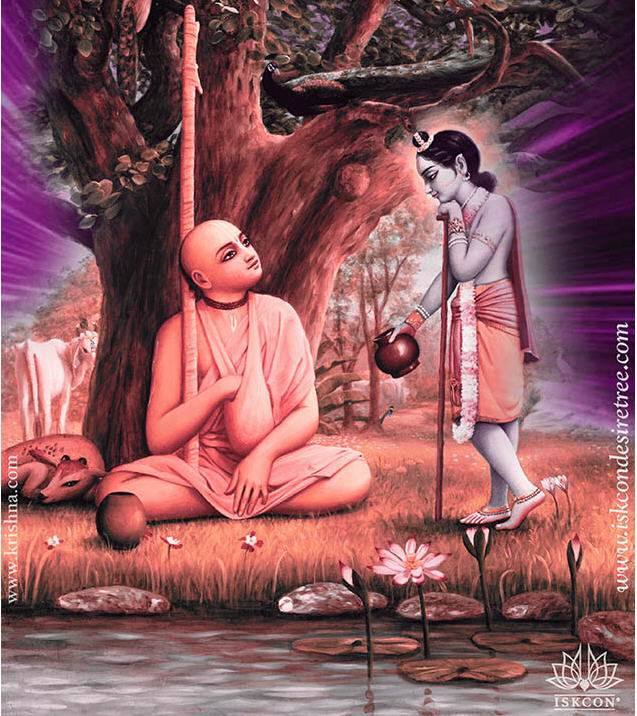
Srila Madhavendra Puri belongs to a small group of devotees whom Sri Chaitanya-charitamrita honors not just for personal holiness, but for starting something entirely new. Krishnadasa Kaviraja Goswami calls him the point where the seed of love of Godhead first cracked open in this age. That seed later grew, through his own disciple's disciple, into Sri Chaitanya Mahaprabhu Himself. Madhavendra Puri was formally a sannyasi of the Brahma-Madhva-Gaudiya sampradaya (the Madhva, or Tattvavadi, order). But his devotion went far beyond that order's rules and rituals. So Gaudiya Vaishnavas remember him less as a Madhva monk and more as the source of their own special mood of loving, often tearful, separation from Krishna. This mood is called vipralambha-bhakti.
| Detail | Description |
|---|---|
| Also called | Madhvendra Puri, Sri Madhava Puri |
| Sannyasa order | Madhva (Tattvavadi) sampradaya, under Lakshmipati Tirtha |
| Lived | Dates not fixed by tradition; Wikipedia estimates circa 1420-1490 |
| Chief disciples | Isvara Puri and Advaita Acharya |
| Famous for | Discovering the Gopala Deity at Govardhana; the kshira-chora Gopinatha pastime at Remuna |
| Called in Chaitanya-charitamrita | The first sprout of the desire tree of bhakti |
| Samadhi | Remuna, Orissa, beside the Kshira-chora Gopinatha temple |
Scriptural evidence for the introduction (1)
mādhava-īśvara-purī, śacī, jagannātha
advaita ācārya prakaṭa hailā sei sātha
Word for word
mādhava: Mādhavendra Purī; īśvara-purī: Īśvara Purī; śacī: Śacīmātā; jagannātha: Jagannātha Miśra; advaita ācārya: Advaita Ācārya; prakaṭa: manifested; hailā: were; sei sātha: together with this
"Madhavendra Puri, Isvara Puri, Srimati Sacimata and Srila Jagannatha Misra all appeared with Sri Advaita Acharya."
Chaitanya-charitamrita lists Madhavendra Puri among the small handful of eternal associates who appeared on earth specifically to prepare the way for Sri Chaitanya Mahaprabhu's own descent.
Chapter 1
Life in the Madhva Sampradaya
A sannyasi of the Madhva order whose own conduct, more than any ritual, became the standard Sri Chaitanya Mahaprabhu pointed His followers toward.
Almost nothing is recorded about Madhavendra Puri's birth or early years. No text names his birthplace, his family, or the year he was born; the commonly cited estimate of roughly 1420 is a modern guess, not a date drawn from any Vaishnava text. His story, as Vaishnava tradition tells it, really begins with his sannyasa: his acceptance into the Madhva, or Tattvavadi, order of renunciation under an acharya named Lakshmipati Tirtha, in the disciplic line traced back to Madhvacharya himself.
A Sampradaya of Ritual, Reshaped #
In his purport to the famous verse of separation that Madhavendra Puri composed near the end of his life (Chaitanya-charitamrita, Madhya 4.197), Srila Prabhupada explains the history plainly. Prabhupada writes that pure devotees who follow Vedanta are divided into four sampradayas. Madhavendra Puri accepted the Sri Madhvacharya-sampradaya and took sannyasa within its proper disciplic succession. But from Madhvacharya himself down through Lakshmipati Tirtha, Prabhupada says, the worship in that line had been mostly ritualistic, with "hardly a sign of love of Godhead." The purport states that Madhavendra Puri was the one who introduced madhurya into that sampradaya for the first time. Madhurya is the mood of conjugal love found in Vrindavana's own pastimes. This new branch came to be called the Madhva-Gaudiya sampradaya.
However, people outside the Gaudiya tradition really do question this lineage claim. Modern historians who have studied the surviving Tattvavadi (Madhva) records note that followers of that school never mention Madhavendra Puri or his disciples at all. Some argue that his own teacher more likely belonged to an Advaita Vedanta order of monks, the Shringeri math tradition, and not to Madhvacharya's line. Separately, the Pushtimarga tradition founded by Vallabhacharya tells a very different story about the same period and the same Deity of Gopala. This is discussed on Discovering the Gopala Deity at Govardhana. We will not try to decide here which of these two histories is right. What follows is the account that Sri Chaitanya-charitamrita itself gives. It is the very account through which the Gaudiya Vaishnava tradition has always understood him.
Advaita Acharya's Own Guru #
Whatever the finer points of sampradaya history, one plain fact is recorded without dispute in Chaitanya-charitamrita. Advaita Acharya himself sought initiation from Madhavendra Puri. Madhavendra Puri was travelling east toward Bengal, on his journey to fetch sandalwood for the Gopala Deity. On the way, he stopped at Advaita Acharya's home in Shantipura. There, "the Acharya became very pleased upon seeing the ecstatic love of Godhead manifest in Madhavendra Puri," and asked to be initiated by him on the spot (Madhya 4.110-111). Bhaktisiddhanta Sarasvati Thakura's own commentary on this verse connects it to one of Chaitanya Mahaprabhu's most quoted teachings on who is fit to be a guru. In that teaching, birth and formal position matter far less than realized knowledge of Krishna. Advaita Acharya was already a great teacher. He chose Madhavendra Puri as his spiritual master because of what he saw in Madhavendra Puri, not because of any official rank.
The Sanodiya Brahmana of Mathura #
Chaitanya Mahaprabhu Himself retold one story, decades later, in the very city where it happened. This story shows most clearly how far Madhavendra Puri's personal standard went beyond ordinary religious custom. In Mathura, Madhavendra Puri had once accepted a brahmana of the Sanodiya community as an initiated disciple. He had even taken a meal cooked in that brahmana's home, though a sannyasi was not normally expected to eat food from that particular community. Later, Chaitanya Mahaprabhu met the same family. He learned of their connection to His grand-guru and insisted on eating there too. His traveling companion Balabhadra Bhattacharya had to explain the reason to the astonished brahmana. Chaitanya Mahaprabhu's own reasoning, recorded in Chaitanya-charitamrita, was direct. He said, "Mahajano yena gatah sa panthah," which means that whatever path a great soul has walked becomes the path others should follow (Madhya 17.186). He also said, even more pointedly, "A devotee's behavior establishes the true purpose of religious principles. The behavior of Madhavendra Puri Gosvami is the essence of such religious principles" (Madhya 17.185). It is hard to find a stronger statement anywhere in the text. It shows how completely Krishnadasa Kaviraja Goswami and Chaitanya Mahaprabhu Himself regarded Madhavendra Puri's own conduct as the true measure of dharma. They placed it above caste custom and above formal sampradaya rules alike.
A Wandering, Largely Silent Life #
Beyond these episodes, the tradition describes Madhavendra Puri's general character in the same way wherever it is told. He traveled constantly across India and kept almost entirely to himself. He avoided even ordinary conversation, for fear of being drawn into anything worldly. Chaitanya Mahaprabhu Himself described him this way to Nityananda Prabhu: "Sri Madhavendra Puri used to remain alone. He was completely renounced and always very silent. He was uninterested in everything material, and for fear of talking about mundane things, he always lived without a companion." That solitary wandering eventually carried him to Govardhana Hill in Vrindavana. There the story that made him famous across the Vaishnava world really begins. It is told in full on Discovering the Gopala Deity at Govardhana.
Scriptural evidence for this chapter (4)
Quoted in the text above:
- Madhya 17.185 Sri Chaitanya-charitamrita quoted above ↑
Further verses:
ayi dīna-dayārdra nātha he
mathurā-nātha kadāvalokyase
hṛdayaṁ tvad-aloka-kātaraṁ
dayita bhrāmyati kiṁ karomy aham
Word for word
ayi: O My Lord; dīna: on the poor; dayā-ārdra: compassionate; nātha: O master; mathurā-nātha: the master of Mathura; kadā avalokyase: when shall I see You; hṛdayam: My heart; tvat-aloka-kātaram: aggrieved by not seeing You; dayita: O most beloved; bhrāmyati: becomes overwhelmed; kiṁ karomi aham: what shall I do
"O My Lord! O most merciful master! O master of Mathura! When shall I see You again? Because of My not seeing You, My agitated heart has become unsteady. O most beloved one, what shall I do now?"
From the purport: Purport excerpt: "Out of the four sampradayas, the Sri Madhvacarya-sampradaya was accepted by Madhavendra Puri... Sri Madhavendra Puri introduced the conception of conjugal love for the first time in the Madhvacarya-sampradaya."
Prabhupada's purport to Madhavendra Puri's own verse of separation is the primary source naming Lakshmipati Tirtha as his guru and crediting him with first bringing conjugal-love devotion into the Madhva sampradaya.
tāṅra ṭhāñi mantra laila yatana kariñā
calilā dakṣiṇe purī tāṅre dīkṣā diñā
Word for word
tāṅra ṭhāñi: from him; mantra laila: accepted initiation; yatana kariñā: making efforts; calilā dakṣiṇe: started toward the south; purī: Madhavendra Puri; tāṅre dīkṣā diñā: having given Him initiation
"Advaita Acharya begged to be initiated by Madhavendra Puri. After initiating Him, Madhavendra Puri started for South India."
One of the two chief disciples of Madhavendra Puri named across sources, Advaita Acharya sought initiation from him on his own initiative, during the sandalwood journey that led to the Remuna pastime.
tarko 'pratiṣṭhaḥ śrutayo vibhinnā
nāsāv ṛṣir yasya mataṁ na bhinnam
dharmasya tattvaṁ nihitaṁ guhāyāṁ
mahājano yena gataḥ sa panthāḥ
Word for word
tarkaḥ apratiṣṭhaḥ: dry argument is not fixed; śrutayaḥ vibhinnāḥ: the Vedas have different departments; dharmasya tattvam: the truth of religious principles; nihitam guhāyām: hidden in the heart of a realized person; mahā-janaḥ yena gataḥ: the path a great soul has walked; saḥ panthāḥ: that is the path
"Dry arguments are inconclusive. A great personality whose opinion does not differ from others is not considered a great sage. Simply by studying the Vedas, which are variegated, one cannot come to the right path by which religious principles are understood. The solid truth of religious principles is hidden in the heart of an unadulterated, self-realized person. Consequently, as the sastras confirm, one should accept whatever progressive path the mahajanas advocate."
Quoted by Sri Chaitanya Mahaprabhu immediately after praising Madhavendra Puri's conduct, this verse from the Mahabharata gives the scriptural principle behind treating a great devotee's own behavior as authoritative.
Chapter 2
Discovering the Gopala Deity at Govardhana
A cowherd boy who came in a dream sent an old sannyasi digging through jungle undergrowth for a Deity who had been waiting years for him alone.
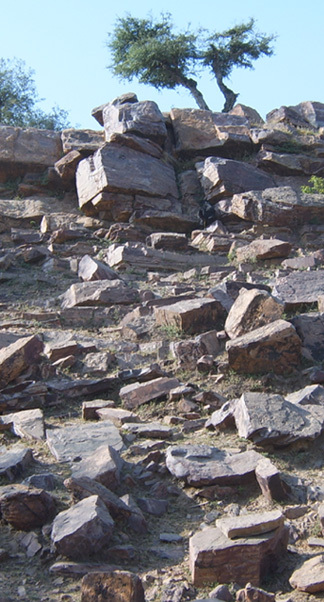
After years of wandering, Madhavendra Puri arrived at Govardhana Hill in Vrindavana, and it was here, according to Chaitanya-charitamrita, that Krishna Himself began arranging one of the tradition's most beloved Deity stories. Madhavendra Puri circled the hill in near-constant ecstasy, "almost mad in his ecstasy of love of Godhead," unable to tell whether it was day or night, sometimes standing, sometimes collapsing to the ground. After bathing at Govinda-kunda he sat beneath a tree to rest for the evening.
Milk From an Unknown Boy #
An unfamiliar cowherd boy approached him with a pot of milk and asked, smiling, why Madhavendra Puri had not eaten and what kind of meditation he was doing. When Madhavendra Puri asked who he was, the boy answered simply that he was a village cowherd, and that in his village nobody went hungry: the women who had seen Madhavendra Puri at the water had sent him with milk. After drinking it, Madhavendra Puri found the boy had vanished without returning for the pot as promised. He sat awake most of the night chanting, and only near dawn did he doze off, at which point the same boy returned, this time in a dream.
Gopala's Own Request #
In the dream, the boy led Madhavendra Puri to a bush deep in the jungle and identified Himself: "My name is Gopala. I am the lifter of Govardhana Hill. I was installed by Vajra, and here I am the authority" (Madhya 4.41). He explained that His priest had hidden Him in the thicket during an attack and then fled. So He had been left exposed to cold, rain and heat for years. He had been waiting for Madhavendra Puri in particular to come and serve Him. Madhavendra Puri woke up in tears. He lamented that he had seen Krishna face to face without recognizing Him. At dawn he gathered the villagers and had them cut a path into the dense jungle with choppers and spades. There he found the Deity exactly as described, covered in dirt and undergrowth.
An Installation Vrindavana Still Remembers #
What followed was not a quiet re-installation. It was a full public festival. Villagers carried the heavy Deity to the hilltop, where He was seated on a stone throne. Nine hundred pots of water were brought from Govinda-kunda for the bathing ceremony. The Deity was massaged with oil, bathed in stages with panca-gavya and panchamrita, dressed in new garments, and garlanded with tulasi and flowers. Every family in the surrounding villages brought food. The entire hilltop was reportedly covered with stacks of rice, dal, chapatis, and sweets. The offering was so large that Chaitanya-charitamrita records a small miracle in passing: "Although Sri Gopala ate everything offered, still, by the touch of His transcendental hand, everything remained as before" (Madhya 4.77). This became the first annakuta, or Govardhana Puja, festival at the site. The festival is still celebrated by Vaishnavas worldwide. News of Gopala's appearance drew crowds from village after village for days afterward. Madhavendra Puri initiated many of the local brahmanas into Vaishnava worship on the spot. Later he gave the Deity's daily service to two renounced brahmanas who had arrived from Bengal. In this way he set up organized temple worship at Govardhana. Not long afterward, Rupa Goswami and Sanatana Goswami settled in Vrindavana themselves and began restoring it. They would build greatly on this arrangement.
Sandalwood, and a Second Journey #
After two years of worship, Gopala appeared to Madhavendra Puri in another dream. His body, buried so long in the earth, was still overheated. He asked for sandalwood pulp from the Malaya hills, which could be obtained through Jagannatha Puri, to cool Him (Madhya 4.106). Despite his age, Madhavendra Puri set out east on foot at once to carry out the order. The journey took him first to Advaita Acharya's home in Shantipura, discussed on Life in the Madhva Sampradaya. From there it led him into one of the most famous pastimes connected with his name, told on The Kshira Chora Gopinatha of Remuna.
A Deity, and a Disputed History #
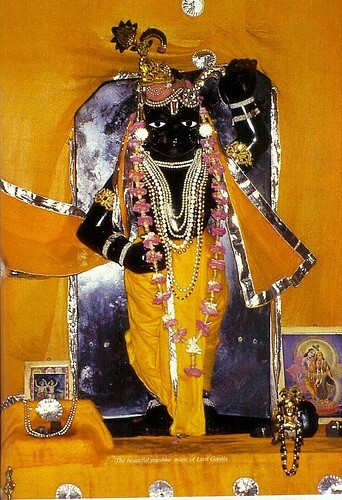
Two living Vaishnava traditions really disagree about what eventually happened to this same Gopala Deity. The disagreement should be told honestly, not smoothed over. The Gaudiya account draws on Chaitanya-charitamrita and on Srila Prabhupada's purports to it, and he repeated it in many lectures and conversations. It holds that Gopala continued to be worshiped at Govardhana in the Gaudiya line Madhavendra Puri founded. It says that He was later moved for safety during renewed unrest, and that today He is worshiped as Srinathji at Nathadvara in Rajasthan. Prabhupada said on more than one occasion that an Indian court had formally ruled that the Deity's origin belongs to Gaudiya Vaishnavism. The Pushtimarga tradition founded by Vallabhacharya tells a very different story. In that story, Vallabhacharya himself, or his son Vitthalanatha, personally discovered Srinathji and began worshiping Him, with no role for Madhavendra Puri at all. Some Pushtimarga texts instead describe Madhavendra Puri as a later teacher of Vallabha. Modern historians such as Alan Entwistle consider this claim unlikely, given the years in which the two men probably lived. We do not try to settle here which account is historically correct. Both are given because both are genuinely and sincerely held.
Scriptural evidence for this chapter (2)
Quoted in the text above:
- Madhya 4.41 Sri Chaitanya-charitamrita quoted above ↑
Further verses:
gopāla kahe, — 'purī, āmāra tāpa nāhi yāya
malayaja-candana lepa', tabe se juḍāya'
Word for word
gopāla kahe: Gopala said; purī: My dear Madhavendra Puri; āmāra tāpa nāhi yāya: My bodily heat does not go away; malayaja-candana lepa': smear sandalwood pulp; tabe se juḍāya: then it will cool
"My bodily temperature still has not decreased. Please bring sandalwood from the Malaya province and smear the pulp over My body to cool Me."
Two years after His installation, Gopala's second dream-request sent Madhavendra Puri on the long journey east that led directly to the Remuna pastime.
Chapter 3
The Kshira Chora Gopinatha of Remuna
Madhavendra Puri wished to taste the Deity's sweet rice, then felt ashamed of even that wish and asked for nothing, so Gopinatha stole a pot of it for him in the night.
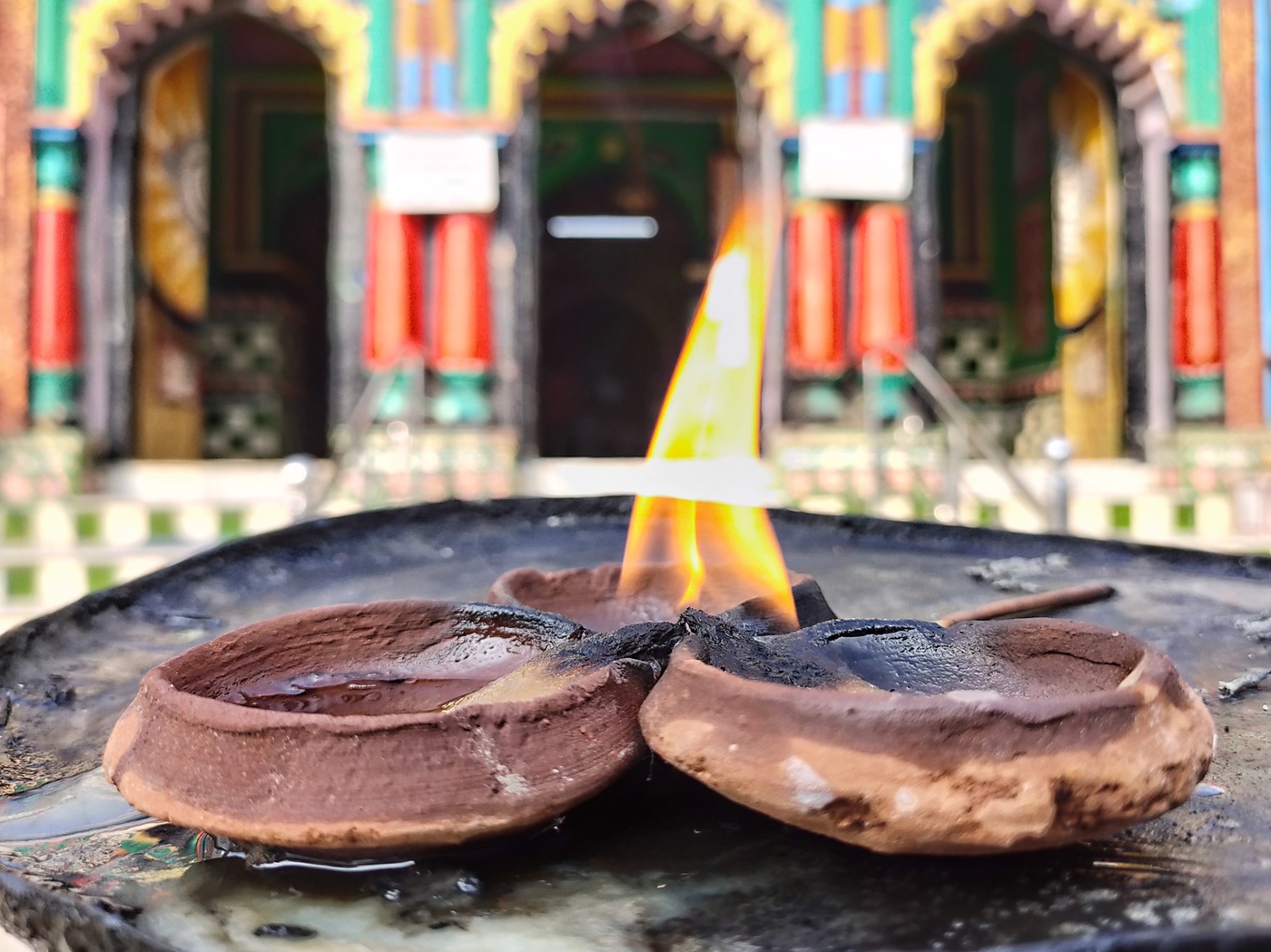
Carrying Gopala's order to bring sandalwood from Jagannatha Puri, Madhavendra Puri crossed from Bengal into Orissa and stopped for the night at Remuna, where a strikingly beautiful Deity of Gopinatha was worshiped. Chaitanya-charitamrita gives this one stop more attention than almost any other episode in Madhavendra Puri's life, and Sri Chaitanya Mahaprabhu Himself, generations later, visited the same temple and retold the story to His own devotees there with evident delight.
A Question About the Evening Offering #
Overwhelmed by the Deity's beauty, Madhavendra Puri danced and chanted in the temple courtyard before asking a priest what foods were regularly offered to Gopinatha. He learned that each evening the Deity received sweet rice in twelve earthen pots. The offering was so famous that it had its own name, amrita-keli. This particular preparation, later known simply as gopinatha-kshira, was offered nowhere else in the world. While the priest was describing it, the offering was actually being placed before the Deity, right in front of Madhavendra Puri.
An Offense Considered, and Refused #
A small, entirely human thought crossed Madhavendra Puri's mind. If he could just taste a little of that sweet rice, he could make something similar for his own Gopala back in Vrindavana. He caught himself almost at once. Chaitanya-charitamrita records how he judged himself, without softening it: "A paramahamsa like Madhavendra Puri is always satisfied in the loving service of the Lord. Material hunger and thirst cannot impede his activities. When he desired to taste a little sweet rice offered to the Deity, he considered that he had committed an offense by desiring to eat what was being offered to the Deity" (Madhya 4.124). He did not want to risk that thought coming back. So he left the temple entirely, without a word to anyone, and sat down to chant alone in the empty village marketplace for the night. As he always did, he refused to beg for food that had not been offered to him freely.
The Deity's Own Theft #
That same night Gopinatha appeared to His sleeping priest in a dream with an unusual instruction: "O priest, please get up and open the door of the temple. I have kept one pot of sweet rice for the sannyasi Madhavendra Puri. This pot of sweet rice is just behind My cloth curtain. You did not see it because of My tricks. A sannyasi named Madhavendra Puri is sitting in the vacant marketplace. Please take this pot of sweet rice from behind Me and deliver it to him" (Madhya 4.127-129). The priest woke, bathed, opened the temple, and found the pot exactly where Gopinatha had said. The Deity had kept it hidden so that it was not noticed during the regular offering. He carried it through the village calling out for the sannyasi by name. He told a bewildered Madhavendra Puri that Gopinatha Himself had stolen sweet rice for him. Formerly the Deity had stolen a pot of sweet rice for Madhavendra Puri, Krishnadasa Kaviraja Goswami writes; therefore He became very famous as the Lord who stole the sweet rice, kshira-chora (Madhya 4.20). Overwhelmed with ecstatic love, Madhavendra Puri ate the offering. Then he washed the clay pot, broke it into pieces, and kept the pieces wrapped in his cloth. Afterward he ate one piece each day as a treasured remnant of Krishna's mercy.
Fleeing His Own Reputation #
Madhavendra Puri knew that word of the miracle would draw crowds by morning. So he left Remuna before dawn and walked on to Jagannatha Puri. But there, his growing fame as a great devotee only made it harder for him to collect quietly the sandalwood he had come for. Chaitanya-charitamrita makes a short comment here about spiritual fame: "Being afraid of his reputation, Madhavendra Puri fled from Remuna. But the reputation brought by love of Godhead is so sublime that it goes along with the devotee, as if following him" (Madhya 4.147). Devotees at Jagannatha Puri heard his story and helped him get sandalwood, camphor, an assistant, and official travel papers. He carried the load back through Remuna a second time. He was unpaid, and he was often hungry, because he would not beg.
Smearing Gopinatha, Cooling Gopala #
Resting again at the Gopinatha temple, Madhavendra Puri had one more dream: Gopala had already received the sandalwood in spirit and now told him to grind it with the camphor and apply the pulp to Gopinatha's own body instead of carrying it onward to Govardhana. "There is no difference between My body and Gopinatha's body," Gopala explained. "They are one and the same. Therefore if you smear the sandalwood pulp on the body of Gopinatha, you will naturally also smear it on My body." Madhavendra Puri obeyed, staying at Remuna through the hot season until the entire stock was used, before finally returning to Jagannatha Puri.
Chaitanya Mahaprabhu's Own Pilgrimage There #
Decades later, Sri Chaitanya Mahaprabhu visited this same Gopinatha temple on His own way to Jagannatha Puri. Chaitanya-charitamrita records that when He offered obeisances, the flower helmet on Gopinatha's head fell and landed on His own head. This sent Him into open ecstasy. Chaitanya Mahaprabhu had been told the temple's history by Isvara Puri. This account had been handed down from Madhavendra Puri, His guru's guru. Chaitanya Mahaprabhu stayed the night especially to receive the same sweet rice prasadam. There, in front of the assembled devotees, He recited Madhavendra Puri's own verse of separation, and He fell to the ground unconscious in love of God. This scene is told in full on The Seed of the Bhakti Creeper. Srila Prabhupada retold this entire story often in his own lectures. Once he summed up its deeper point with his usual bluntness: when Krishna acts as a thief for His devotee's sake, "he is famous as a great thief... still people go to see Him, how nice this thief is. That is the difference between Krishna and ourself."
Scriptural evidence for this chapter (2)
Quoted in the text above:
- Madhya 4.124 Sri Chaitanya-charitamrita quoted above ↑
Further verses:
pūrve mādhava-purīra lāgi' kṣīra kaila curi
ataeva nāma haila 'kṣīra-corā hari'
Word for word
pūrve: formerly; mādhava-purīra lāgi': for Madhavendra Puri; kṣīra kaila curi: stole sweet rice; ataeva nāma haila: therefore the name became; kṣīra-corā hari: the Lord who stole a pot of sweet rice
"Formerly the Deity had stolen a pot of sweet rice for Madhavendra Puri; therefore He became very famous as the Lord who stole the sweet rice."
The verse that gives the Remuna Deity His enduring name, Kshira-chora Gopinatha, directly tying the title to His theft of the sweet rice for Madhavendra Puri.
Chapter 4
The Seed of the Bhakti Creeper
Chaitanya-charitamrita names him first: the seed from which the whole Gaudiya tree of loving devotion, trunk, branches and fruit, eventually grew.
Near the opening of Sri Chaitanya-charitamrita's account of Sri Chaitanya Mahaprabhu's associates, Krishnadasa Kaviraja Goswami pauses to offer a verse of praise unlike almost any other in the book: "All glories to Sri Madhavendra Puri, the storehouse of all devotional service unto Krishna! He is a desire tree of devotional service, and it is in him that the seed of devotional service first fructified" (Adi 9.10). This is a striking image in a book that is mostly about praising Chaitanya Mahaprabhu Himself. A full chapter before he introduces the tree's central trunk, the author stops to name where its seed first cracked open.
From Seed to Sprout to Tree #
Krishnadasa Kaviraja Goswami does not leave the metaphor there. The very next verse carries the lineage one step further: "The seed of devotional service next fructified in the form of Sri Isvara Puri, and then the gardener Himself, Caitanya Mahaprabhu, became the main trunk of the tree of devotional service" (Adi 9.11). In three short verses, the author shows the origin of the whole Gaudiya Vaishnava movement as one living plant. Madhavendra Puri is the seed, Isvara Puri is its first shoot, and Sri Chaitanya Mahaprabhu is the tree that then grew large enough to shade the entire world. Srila Prabhupada's purport explains the history plainly. The disciplic line from Madhvacharya down to Lakshmipati Tirtha had been "full of ritualistic ceremonies, with hardly a sign of love of Godhead," as he puts it. Madhavendra Puri was the first person in that line to actually show the symptoms of love of Godhead. He was also the first to write the poem that carries its seed. This same image returns near the very end of the book, where it describes his death: "Madhavendra Puri sowed the seed of ecstatic love for Krishna within this material world and then departed. That seed later became a great tree in the form of Sri Caitanya Mahaprabhu" (Antya 8.36).
The Verse Itself #
Prabhupada's purport names the poem that literally contains that seed. It is the verse Madhavendra Puri is remembered chanting again and again at the close of his life: "O My Lord! O most merciful master! O master of Mathura! When shall I see You again? Because of My not seeing You, My agitated heart has become unsteady. O most beloved one, what shall I do now?" (Madhya 4.197). Chaitanya-charitamrita treats this single verse as something very precious: "This verse uncovered the door of ecstatic love," it says. Chaitanya Mahaprabhu Himself recited it at the Gopinatha temple in Remuna, in the story told on The Kshira Chora Gopinatha of Remuna. He reportedly could not get past the opening words. Through tears He repeated only "Ayi dina! Ayi dina!" and then collapsed unconscious in the arms of Nityananda Prabhu. Krishnadasa Kaviraja Goswami adds a detail that explains why the verse carries such force. He holds that it was actually spoken first by Srimati Radharani Herself, when She was grieving over Krishna's departure for Mathura. He also holds that Her own mercy let it come out again, centuries later, from Madhavendra Puri's mouth.
A Mood Not Meant for Imitation #
This particular kind of devotion is called vipralambha-bhakti, the felt ache of separation from Krishna. It became one of the main themes of the entire Gaudiya Vaishnava tradition. Afterward Rupa Goswami developed it at length, and Raghunatha Dasa Goswami gave it its most intense personal expression in his later life. But Srila Prabhupada, speaking in Gorakhpur in 1971, was careful to draw a firm line around it. He described another of Madhavendra Puri's own compositions. In this verse the old sannyasi tells his gayatri-mantra directly, "no more I can chant," and concludes only that he will "sit down somewhere underneath a tree and simply remember Govinda's name. That is sufficient." Then Prabhupada added the caution directly: "This Madhavendra's statement is not for the neophyte devotees. We should not imitate Madhavendra Puri... the position of Madhavendra Puri, the position of Haridasa Thakura, they are different from our position." In other words, this mood is presented as the goal of devotional life, not as a shortcut at its beginning.
The Seed Every Later Acharya Traces Back To #
In the tradition's own understanding, every acharya in the Gaudiya Vaishnava line comes from this single seed. Sri Chaitanya-charitamrita is built on a simple idea. The loving mood that Sri Chaitanya Mahaprabhu distributed to the world did not appear from nowhere. It had a first sprout. That sprout was an aging, mostly silent, wandering sannyasi. He felt ashamed even for wishing to taste the sweet rice offered to the Gopinatha Deity at Remuna. He spent his final years crying for a glimpse of Krishna he could not yet see.
Scriptural evidence for this chapter (3)
Quoted in the text above:
- Adi 9.10 Sri Chaitanya-charitamrita quoted above ↑
- Adi 9.11 Sri Chaitanya-charitamrita quoted above ↑
- Antya 8.36 Sri Chaitanya-charitamrita quoted above ↑
Chapter 5
Isvara Puri and His Disciples
One disciple cleaned his dying guru's body with his own hands and received an ocean of love in return; another mistook the same guru's tears for weakness and was cast out.
Chaitanya-charitamrita names several disciples of Madhavendra Puri. But its longest and clearest account of his relationships with them is about just two men. The text places these two side by side as one deliberate lesson. One shows what a great soul's mercy looks like, and the other shows what his correction looks like.
The Servant Who Cleaned His Body With His Own Hands #
As Madhavendra Puri's health failed in his final years, Isvara Puri attended him with a humility Chaitanya-charitamrita records in almost startling physical detail: "Isvara Puri, the spiritual master of Sri Caitanya Mahaprabhu, performed service to Madhavendra Puri, cleaning up his stool and urine with his own hand" (Antya 8.28). He stayed constantly at his guru's side, chanting Krishna's holy names and narrating Krishna's pastimes to him, helping Madhavendra Puri keep his mind fixed on Krishna through the difficulty of his final illness. Pleased, Madhavendra Puri embraced him and gave a benediction that would shape the rest of Vaishnava history: "Let there be, unto Krishna, the wealth of your love" (Antya 8.30). Chaitanya-charitamrita reports simply that Isvara Puri became, from that moment, like an ocean of ecstatic love for Krishna.
That love, and that lineage, mattered far beyond Isvara Puri's own life. He went on to become Sri Chaitanya Mahaprabhu's own diksha-guru. Isvara Puri initiated Him at Gaya, in one of the most important episodes in the whole Gaudiya Vaishnava tradition. This episode is told in full on Isvara Puri's own biography page. In that sense Madhavendra Puri is, without exaggeration, Mahaprabhu's spiritual grandfather. He was the seed that first bore fruit in Isvara Puri, and only then grew into the tree of Chaitanya Mahaprabhu Himself. The same image is explained at length on The Seed of the Bhakti Creeper.
The Disciple Who Misread His Guru's Tears #
A second disciple, Ramacandra Puri, offers a sharp contrast. He visited Madhavendra Puri near the very end of his life. He found his guru weeping and crying out, "O my Lord, I did not get shelter at Mathura," and he took this for ordinary grief that did not suit an advanced soul. "If you are in full transcendental bliss," Ramacandra Puri told him, "you should now remember only Brahman. Why are you crying?" Madhavendra Puri's answer was immediate and furious: "Get out, you sinful rascal! O my Lord Krishna, I could not reach You, nor could I reach Your abode, Mathura. I am dying in my unhappiness, and now this rascal has come to give me more pain" (Antya 8.22). Prabhupada's purport to this verse explains the misunderstanding directly. Inwardly, Ramacandra Puri was an impersonalist. He could not recognize that his guru's tears "proceeded from the highest stage of ecstatic love of Krishna," not from any ordinary material distress. So he mistook the deepest devotion he had ever witnessed for a lack of spiritual realization.
Chaitanya-charitamrita treats the rebuke, like the blessing given to Isvara Puri, as a lesson for everyone, not only a personal matter: "Isvara Puri received the blessing of Madhavendra Puri, whereas Ramacandra Puri received a rebuke from him. Therefore these two persons, Isvara Puri and Ramacandra Puri, are examples of the objects of a great personality's benediction and punishment. Madhavendra Puri instructed the entire world by presenting these two examples" (Antya 8.32). The text adds that after the rebuke, Ramacandra Puri only became more critical and dry in speculation. In time he became known at Jagannatha Puri for his fault-finding. In a separate episode recorded later in the same chapter, he even turned some of it on Chaitanya Mahaprabhu's own eating habits.
Other Disciples #
Chaitanya-charitamrita's account of Chaitanya Mahaprabhu's wider circle names several more disciples of Madhavendra Puri. Together with Isvara Puri, they are among the "nine sannyasi roots" that grew from the same trunk of devotees. One is Paramananda Puri, a brahmana of the Trihut district who became especially close to Chaitanya Mahaprabhu Himself. Others are Brahmananda Bharati, Vishnu Puri, Keshava Puri and more (Adi 9.13-15). And, as told on Life in the Madhva Sampradaya, Advaita Acharya Himself received initiation from Madhavendra Puri. This makes Advaita Acharya, with Isvara Puri, one of the two chief disciples that most sources name first.
Gaudiya History's summary of Madhavendra Puri's life states the size of this circle plainly: "In one way or another, all the Vaishnavas in Bengal and Kshetra-mandala [Jagannatha Puri] were connected with Sri Madhavendra Puri." Whatever the exact number of his formal disciples was, the same pattern is seen in all of them. Isvara Puri and Ramacandra Puri only show it most clearly. Being near Madhavendra Puri did not, by itself, guarantee realization. It brought out whatever was already present in the disciple's own heart, and then rewarded or corrected it.
Two Paths From One Teacher #
Madhavendra Puri's own final years show, on a small scale, the two paths that his example could lead a disciple toward. One path led to an ocean of love, and the other to a lifetime of dry criticism. Isvara Puri's path led directly to Gaya. There he initiated Sri Chaitanya Mahaprabhu Himself and became, in effect, the last human link in the line that grew from the seed Madhavendra Puri had sown. Ramacandra Puri's path led to a life spent finding fault in others. On at least one later occasion, recorded in the same chapter of Chaitanya-charitamrita, he even found fault in Chaitanya Mahaprabhu's own eating habits. Krishnadasa Kaviraja Goswami presents this contrast mainly to warn every reader, not so much to condemn Ramacandra Puri. Being in the company of a great soul does not, by itself, bring transcendental realization. In the end, what a disciple does with a great teacher's mercy remains the disciple's own responsibility.
Scriptural evidence for this chapter (3)
Quoted in the text above:
- Antya 8.28 Sri Chaitanya-charitamrita quoted above ↑
- Antya 8.32 Sri Chaitanya-charitamrita quoted above ↑
Further verses:
tuṣṭa hañā purī tāṅre kailā āliṅgana
vara dilā — 'kṛṣṇe tomāra ha-uka prema-dhana'
Word for word
tuṣṭa hañā: being pleased; purī: Madhavendra Puri; tāṅre kailā āliṅgana: embraced him; vara dilā: gave the benediction; kṛṣṇe tomāra ha-uka prema-dhana: let there be, unto Krishna, the wealth of your love
"Pleased with Isvara Puri, Madhavendra Puri embraced him and gave him the benediction that he would be a great devotee and lover of Krishna."
The benediction that, in the Gaudiya tradition's own understanding, passed the seed of ecstatic love directly from Madhavendra Puri into the disciple who would go on to initiate Sri Chaitanya Mahaprabhu.
Chapter 6
Final Days and Disappearance
No exact date survives for his passing, only the verse of separation he would not stop reciting, and the reverence Chaitanya Mahaprabhu Himself showed his memory afterward.
Sri Chaitanya-charitamrita gives no fixed year for Madhavendra Puri's disappearance, and no text gives one with any confidence. The commonly cited estimate of roughly 1490 is itself worked out from the dates of events around his life. It is not a date recorded anywhere in Vaishnava scripture. What the tradition does preserve in real detail is the way he passed away, not the calendar date.
A Body Failing, a Mind Fixed on Krishna #
As Madhavendra Puri's health declined, every account says he stayed in the same state that had marked his whole life. He was absorbed in longing for Krishna, not in any concern for his own condition. Chaitanya-charitamrita describes him at this stage chanting Krishna's holy name. He cried out, "O my Lord, I did not get shelter at Mathura," and his disciple Isvara Puri understood this outward expression as ecstatic love. So Isvara Puri stayed to serve him. Another disciple, Ramacandra Puri, misread it as ordinary grief and was sharply rebuked for saying so. Both episodes, and what they reveal about the two disciples involved, are told in full on Isvara Puri and His Disciples.
The Verse He Would Not Stop Reciting #
Through this final period, Madhavendra Puri is remembered reciting one verse above all others, the same ayi dina-dayardra natha verse discussed at length on The Seed of the Bhakti Creeper: "O My Lord! O most merciful master! O master of Mathura! When shall I see You again? Because of My not seeing You, My agitated heart has become unsteady. O most beloved one, what shall I do now?" (Antya 8.34). Chaitanya-charitamrita states plainly that "His Divine Grace Madhavendra Puri, the spiritual master of the entire world, thus distributed ecstatic love for Krishna. While passing away from the material world, he chanted the following verse" (Antya 8.33). In other words, his disappearance did not interrupt his devotion. It was the final expression of that devotion. It was the same longing for Mathura that he had lived with for years, still unfulfilled at the very end.
A Samadhi at Remuna #
Tradition places Madhavendra Puri's final resting place at Remuna, in Orissa. It is beside the very temple of Kshira-chora Gopinatha where the Deity had once stolen sweet rice for him so that he would not go hungry. This pastime is told on The Kshira Chora Gopinatha of Remuna. For devotees it is a very fitting place. It was there that he would not seek his own comfort, and yet Krishna's own mercy came to him without his asking. And it is there that the tradition chose, in time, to remember him permanently.
Remembered by Mahaprabhu, and by Prabhupada #
Sri Chaitanya Mahaprabhu never met Madhavendra Puri in this world. By the time Mahaprabhu appeared, Madhavendra Puri was already gone. And yet Chaitanya-charitamrita shows Him honouring Madhavendra Puri's memory with a reverence usually kept for a living guru. Mahaprabhu visited the Gopinatha temple at Remuna Himself. With open delight He retold the entire kshira-chora story to Nityananda Prabhu and the assembled devotees. He also asked Nityananda Prabhu directly to judge "whether there was anyone within the world as fortunate as Madhavendra Puri."
Centuries later, Srila Prabhupada kept the same memory alive in a remarkable number of his own lectures and conversations. Among them were talks in Los Angeles, Delhi, Gorakhpur, London, Mayapur and New York. Again and again he returned to Madhavendra Puri's example. He spoke of Madhavendra Puri's refusal to eat before Krishna was served, and of his willingness to carry sandalwood on foot across hostile territory without complaint. Above all he spoke of Madhavendra Puri's mood of ecstatic separation. In one 1971 lecture, Prabhupada called this a standard so advanced that ordinary devotees should admire it, not try to imitate it. Deep reverence together with an honest warning against imitation is perhaps the truest measure of how the Gaudiya Vaishnava tradition has kept Madhavendra Puri's memory for more than five hundred years. The tradition does not remember him as a distant historical founder. It remembers him as a living example of how far personal devotion to Krishna can carry a soul, even though, formally, his own sampradaya and station were modest.
What Remains Uncertain #
Much about Madhavendra Puri's outer life remains unknown. No text gives his birth year, birthplace or family background, or even a confident date for his disappearance. Every number attached to his life is a modern estimate. These estimates are built around the more firmly dated lives of his disciples and of Sri Chaitanya Mahaprabhu Himself. Even the exact place of his passing is worked out from where his samadhi is remembered to be. It is not taken from any deathbed scene told in Chaitanya-charitamrita. None of this uncertainty affects what the tradition remembers about him with confidence: his conduct, his mood, and the verse he could not stop reciting.
Scriptural evidence for this chapter (2)
Quoted in the text above:
- Antya 8.33-34 Sri Chaitanya-charitamrita quoted above ↑
Further verses:
śuni' mādhavendra-mane krodha upajila
'dūra, dūra, pāpiṣṭha' bali' bhartsanā karila
Word for word
śuni': hearing this; mādhavendra-mane krodha upajila: anger arose in Madhavendra Puri's mind; dūra, dūra, pāpiṣṭha: get out, get out, you sinful rascal; bali' bhartsanā karila: saying this, he chastised him
"Hearing this instruction, Madhavendra Puri, greatly angry, rebuked him by saying, 'Get out, you sinful rascal!'"
From the purport: Purport excerpt: "Ramacandra Puri could not understand that his spiritual master, Madhavendra Puri, was feeling transcendental separation. His lamentation was not material."
The moment Madhavendra Puri rebuked Ramacandra Puri for mistaking his ecstatic tears of separation for ordinary grief, near the very end of his life.
Closing
Further Reading #
A short devotional piece on him is also available here: Sri Madhvendra Puri.
- Sri Chaitanya-charitamrita, Madhya-lila Chapter 4 (Sri Madhavendra Puri's Devotional Service)
- Sri Chaitanya-charitamrita, Antya-lila Chapter 8 (Ramacandra Puri Criticizes the Lord)
- Sri Chaitanya-charitamrita, Adi 9.10-11, purport
- Madhavendra Puri - Gaudiya History (ISKCON Desire Tree)
- Madhavendra Puri - Stephen Knapp
- Srimad-Bhagavatam 4.14.14, lecture transcript, Delhi, November 16 1971
