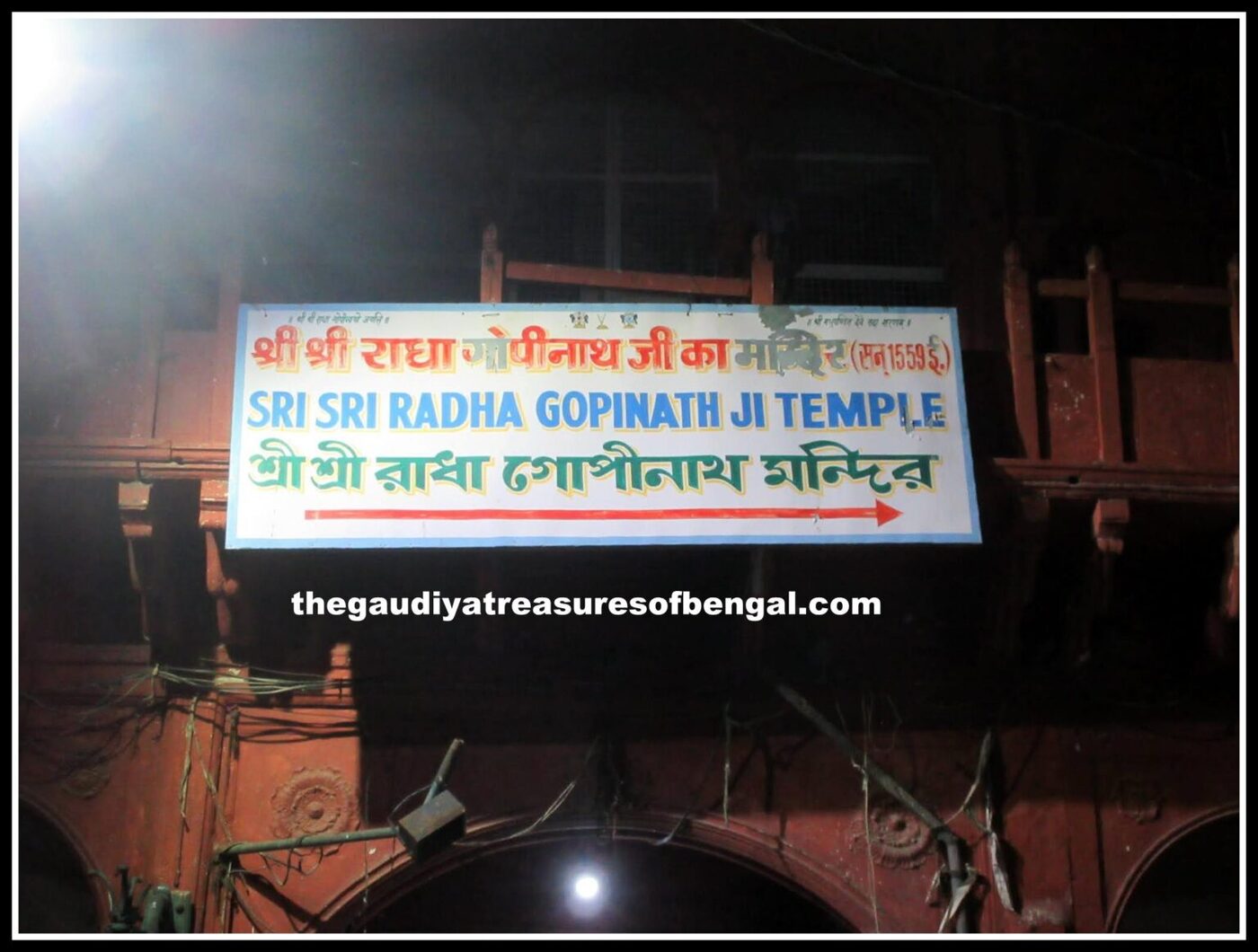
Vamshivata means "the banyan tree of the flute." Tradition marks it as the spot on the bank of the Yamuna where Krishna once stood among the gopis and played on His flute, one of the most cherished sites in all of Vrindavana. It is also the place where, according to Bhakti-ratnakara, a very old and long-lost Deity of Krishna came back to light, and where Madhu Pandit Goswami's own story as a temple priest truly begins.
| Detail | Description |
|---|---|
| Deity | Sri Gopinatha ("beloved of the gopis") |
| Site of discovery | Vamshivata, on the bank of the Yamuna, Vrindavana |
| Traditional origin | Said to have been carved for Krishna's great-grandson Vajranabha, over 5,000 years ago by tradition's count |
| Discovered by | Paramananda Bhattacharya, according to Bhakti-ratnakara and another devotee-compiled account |
| How He was found | Sources disagree: a dream revealing the burial spot in the more widely repeated telling, a monsoon flood of the Yamuna uncovering Him in another devotee-compiled account |
| First temple | Opened 1589, credited to Raja Saganji, one of the Shekhawat princes of Rajasthan, per that same account |
| Taken up in worship by | Madhu Pandit Goswami |
| Primary source | Bhakti-ratnakara (no standalone corpus on vedabase.io; quoted here via secondary translations and a Prabhupada purport); another devotee-compiled account |
An Image Carved From a Mother's Memory #
Gaudiya Vaishnava tradition traces Gopinatha's origin back to a time long before Mahaprabhu's own era. It goes all the way back to Vajranabha, who is described as Krishna's great-grandson. Vajranabha is said to have wanted images of Krishna made after Krishna's disappearance from this world. According to the story, Vajranabha had three Deities carved based on descriptions given by Queen Uttara, Maharaja Parikshit's mother, who had actually seen Krishna in person. One Deity captured Krishna's face; that one became known as Govindaji. Another captured His legs; that became Madana-mohanji. A third captured His chest and shoulders, and that, tradition says, is Gopinatha, the very Deity Madhu Pandit would one day serve. According to this account, all three were later buried or hidden, most likely during times of invasion and unrest. They lay forgotten for centuries.
This story comes from devotional tradition. It cannot be checked separately through archaeology or outside history, and it is given here as tradition. But several separate sources that describe Vrindavana's oldest temples all tell the same three-Deity story, with Govindaji, Madana-mohanji, and Gopinatha each linked to a different part of Krishna's form. This suggests that it is an old and widely shared local tradition, not a story that someone made up once.
Found Again at Vamshivata #
Centuries later, Rupa Goswami, Sanatana Goswami, and their companions were searching Vrindavana's forests for the lost sites and lost Deities of Krishna's own pastimes. In those years, Gopinatha's location is said to have come to light near Vamshivata. Bhakti-ratnakara credits the discovery to Paramananda Bhattacharya, who by most accounts was Gadadhara Pandit's own disciple. Several later retellings add a striking detail. They say that the Deity Himself appeared in a dream and showed exactly where He lay buried in the earth. After that, the site was dug and the image was recovered. This detail cannot be checked directly in the original Bengali text of Bhakti-ratnakara, because no full English translation of that work is available online. So this dream story is reported here as tradition, not as settled fact.
Another devotional account of the founding acharyas tells the moment of discovery differently, and it does not mention any dream. In that account, Madhu Pandit himself had been searching everywhere for the lost Deity of Gopinatha. He could not find Him anywhere and felt great sorrow. So he gave up eating and sat at Vamshivata, shedding tears without stopping. It happened to be the monsoon season, and the Yamuna overflowed her banks. The flood waters swept away the old banyan tree standing at Vamshivata. When the waters went down, Paramananda Bhattacharya, Madhu Pandit's close friend and companion, found Gopinatha half buried in the ground just beneath where the tree had stood. Paramananda called Madhu Pandit at once, and Madhu Pandit brought the Deity out of the ground.
Both versions agree that Paramananda Bhattacharya was the one who found Gopinatha, and both place the discovery at Vamshivata. But they disagree on how it happened. In the more widely repeated telling, a dream showed the place where He was buried. In that other devotional account, a flood swept away the tree that had hidden Him. The two versions cannot be made to agree here, so both are reported instead of quietly choosing one.
The words that Bhakti-ratnakara is quoted as saying about the Deity, after He was found, read more like a hymn than a record of events. It calls Gopinatha "an ocean of mercy" who "forever sports along the enchanting banks of the Yamuna at Vamshivata," whose "bodily luster steals the mind of whoever sees Him," and whose sweetness, once it enters the heart, "immediately extinguishes the burning fire of material existence." After this discovery, the responsibility for the Deity's daily worship passed to Madhu Pandit. This was the beginning of a service that would fill most of the rest of his life. It is told on the next page, Forty Years of Service and a Temple Takes Shape.
The First Temple at Vamshivata #
The Deity was then moved to the spot where the present Gopinatha temple stands. Another devotional account of the founding acharyas dates the opening of that first temple building to 1589. It credits the building to Raja Saganji, one of the Shekhawat princes of Rajasthan. The same source records that Aurangzeb's soldiers damaged and defiled this temple in 1670. After that, a new temple was built next to the original one. The following pages tell what became of Sri Gopinatha's worship, and of the temple that housed Him, in the generations after Madhu Pandit. They also look at a separate report that gives 1819 as the date of a replacement temple building, and at how that date may or may not fit with this account.
Please note again that this Vamshivata Gopinatha is not the same Deity as the Kshira-chora Gopinatha of Remuna, in Orissa. That Deity is connected to Madhavendra Puri, and His story is told in full on the Kshira-chora Gopinatha story. The two stories share only a name and a general theme. Each is about a Deity of Krishna called Gopinatha who was discovered or made famous through a devotee's personal love. Nothing else connects them.
