Sri Madhu Pandit Goswami
Priest of Sri Gopinatha at Vamshivata
The complete life, on one page: The main biography and every pastime page, in order, in one place
Introduction
madhu-sneha-sama-yuktaṁ prema-saktaṁ mahāśayam |
vṛndāvane rasa-rataṁ vande śrī-madhu-paṇḍitam ||
"I offer my respectful obeisances unto Sri Madhu Pandit. This highly magnanimous soul is bound by strong ties of attachment in love to the Divine Couple, and the affection he feels is as sweet as honey (madhu), so he is known by that name. He is always absorbed in the highest exchange of mellows there in Vrindavan."
This verse opens the chapter on him in another devotional account.
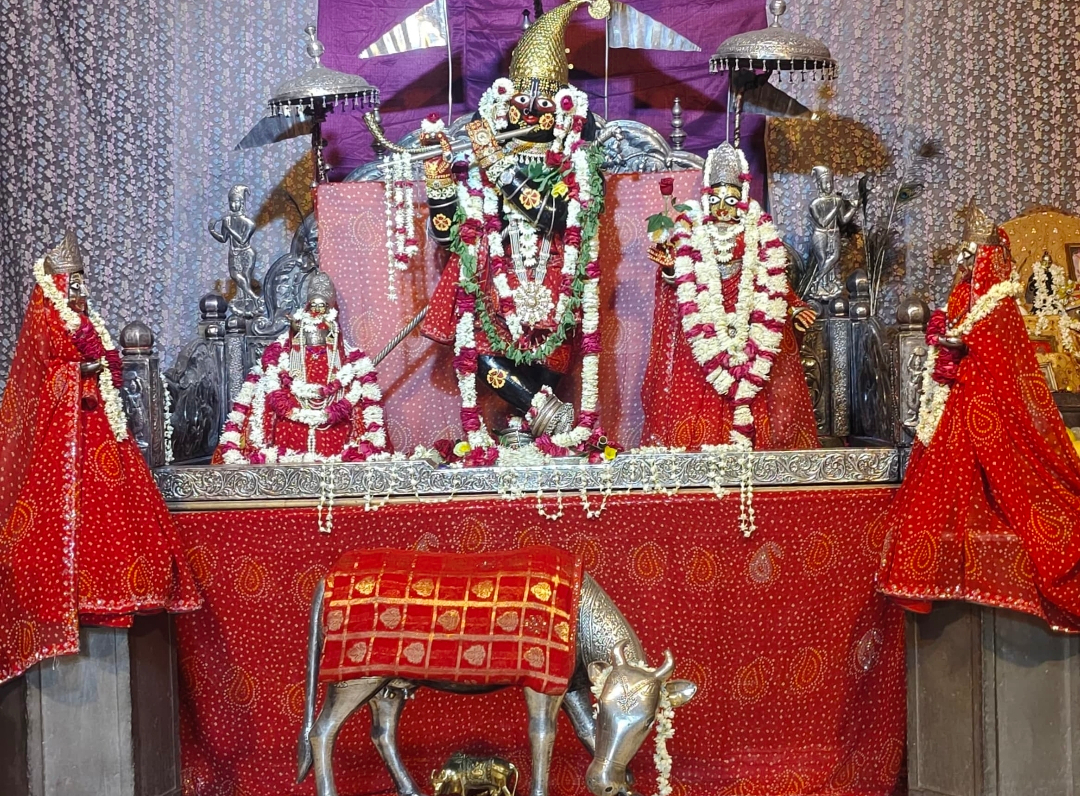
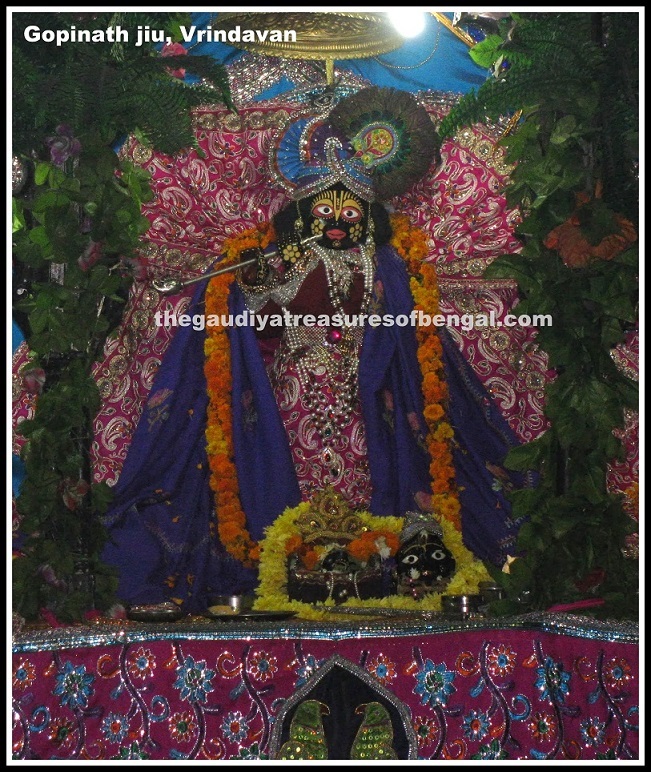
Sri Madhu Pandit Goswami is remembered in Gaudiya Vaishnava tradition as the devotee who took up loving worship of Sri Gopinatha, an ancient Deity of Krishna rediscovered on the bank of the Yamuna at Vamshivata in Vrindavana. He belonged to the generation of devotees who gathered around Rupa Goswami and Sanatana Goswami in Vrindavana after Sri Chaitanya Mahaprabhu's own disappearance. Tradition places him in the disciple-line of Gadadhara Pandit, one of Mahaprabhu's closest personal associates. His name is not widely known outside the circle of those who study Gaudiya history, but the Deity he served is well known. The Gopinatha of Vamshivata is one of Vrindavana's oldest and most celebrated forms of Krishna, and Madhu Pandit's decades of quiet seva are the reason a temple stands there today.
| Detail | Description |
|---|---|
| Also known as | Madhu Pandita, Madhupandit Goswami |
| Home village | Saibona, about two miles from Khardaha, in the district of Twenty-four Parganas, Bengal, where he had already established the worship of Sri Sri Radha-Nandadulalji before coming to Vrindavana |
| Guru | Sri Gadadhara Pandit, on whose order he set out for Vrindavana; some accounts describe him training under Gadadhara's own disciple, Paramananda Bhattacharya, after reaching Vrindavana |
| Known for | Discovering and worshiping Sri Gopinatha at Vamshivata, Vrindavana, for several decades |
| Era | Generation of Rupa Goswami and Sanatana Goswami's companions in Vrindavana, 16th century |
| Samadhi | Within the Sri Radha-Gopinatha temple compound, Vrindavana, near the temple's eastern gate |
| Primary sources | Bhakti-ratnakara (quoted in a Prabhupada purport and in secondary translations); another devotional account of the founding acharyas |
Before we go further, a note is needed. Gaudiya Vaishnavism tells three other well-known Gopinatha stories, and the names are easy to mix up. This is not about the Kshira-chora Gopinatha of Remuna, the Deity in Orissa linked to Madhavendra Puri and famous for stealing a pot of condensed milk. That story is told in full on The Kshira-chora Gopinatha of Remuna. It is also not the Radha-Gopinatha of Agradwipa connected with the Ghosh brothers, Govinda Ghosh, Madhava Ghosh and Vasudeva Ghosh. And it is also different from Tota Gopinatha at Jagannatha Puri, which Madhu Pandit's own guru Gadadhara Pandit served for the rest of his life after Mahaprabhu's disappearance. That story is on Gadadhara Pandit's page. Gaudiya Vaishnavism has several Deities named Gopinatha in several different places. The one described here is the one at Vamshivata in Vrindavana.
Scriptural evidence for the introduction (1)
"Shri Gopinathaji, who is an ocean of mercy, forever sports along the enchanting banks of the Yamuna at Vamshivata. His bodily luster steals the mind of whoever sees Him. When the soothing sweetness of Gopinathaji's charming form enters the heart it immediately extinguishes the burning fire of material existence."
Bhakti-ratnakara has no standalone corpus on vedabase.io, so this passage is quoted here via a reputable secondary translation (Gaudiya History) and cited explicitly as such. It is the traditional description of the Deity Madhu Pandit came to worship.
Chapter 1
Early Life and Discipleship Under Gadadhara Pandit
Every biography of Madhu Pandit Goswami begins by admitting that almost nothing is recorded about his birth, his family, or his childhood. But one clear detail does survive, preserved in a devotee-compiled account. It gives his home village, and even a Deity he served there before he ever went to Vrindavana. Apart from that one detail, the records show him only as a grown man, already a devotee and already headed for Vrindavana. This tells us something about what mattered to the people who first wrote his story down. They were not interested in preserving much more of his worldly background. They were interested in what he did once he reached the place he was going.
| Detail | Description |
|---|---|
| Native place | Saibona, about two miles from Khardaha, in the district of Twenty-four Parganas, Bengal, per another devotee-compiled account |
| Earlier seva | Established the worship of Sri Sri Radha-Nandadulalji at Saibona before ever setting out for Vrindavana |
| Guru (most sources) | Sri Gadadhara Pandit, on whose order he made the journey to Vrindavana |
| Guru (alternate account) | Trained under Paramananda Bhattacharya, Gadadhara Pandit's own disciple, after reaching Vrindavana |
| Generation | Contemporary of Rupa Goswami, Sanatana Goswami, Gopala Bhatta Goswami, and their circle |
| Destination | Vrindavana, drawn by the same pull that brought many Bengali devotees there after Mahaprabhu's disappearance |
A Home Before Vrindavana #
A devotee-compiled account supplies the one clear detail that survives about Madhu Pandit's life before Vrindavana. He came from Saibona, a village about two miles from Khardaha in the district of Twenty-four Parganas. There, before he ever set out for Vrindavana, he established the worship of Sri Sri Radha-Nandadulalji. This detail does not appear in the other sources used earlier, and it changes the picture only slightly. Madhu Pandit did not arrive in Vrindavana as a stranger to Deity worship. He had already spent time serving Krishna and Radha under other names, in his own village, before he came to the greater service of his life.
Coming to Vrindavana #
By the time Madhu Pandit reached Vrindavana, a remarkable community was already forming there. Rupa Goswami and Sanatana Goswami had settled in the forest to write and to teach. Gopala Bhatta Goswami, Raghunatha Dasa Goswami, and others were doing the same. These devotees were not simply visiting a holy place. They were trying to recover, physically and spiritually, the exact places of Krishna's own childhood pastimes: the forests, the riverbanks, and the hidden Deities that centuries of neglect and invasion had buried or scattered. When Madhu Pandit arrived, he joined this same work. His part was smaller, but his devotion was no less.
This wave of arrivals did not happen by accident. Mahaprabhu Himself had sent Rupa Goswami and Sanatana Goswami to Vrindavana specifically to locate its lost sacred sites and establish Deity worship there. News of what they were finding and building drew more devotees from Bengal every year. Some came as scholars and writers, and some as people who had renounced the world. Others, like Madhu Pandit, came as devotees willing to give a lifetime of ordinary, humble service to a single Deity in a single place: cooking, cleaning, and worshiping. In this period Vrindavana was not yet a settled institution. It was a shared work still being built, step by step, as each lost Deity was recovered and each dedicated devotee arrived.
The one detail about his background that survives in every account is his guru. Most later biographies name Sri Gadadhara Pandit directly. Gadadhara Pandit was one of the four principal associates of Sri Chaitanya Mahaprabhu, along with Nityananda Prabhu, Advaita Acharya, and Srivasa Thakura. His own life is closely tied to another Gopinatha Deity entirely, Tota Gopinatha at Jagannatha Puri. That is a completely separate story, told on Gadadhara Pandit's own page. Another devotional account of the founding acharyas plainly supports this more direct version. It states that Madhu Pandit came to Vrindavana specifically on the order of his guru, Sri Gadadhara Pandit. A second line of the tradition gives more detail about how his discipleship worked. It says Madhu Pandit came under the personal care of Paramananda Bhattacharya once he reached Vrindavana, and that Paramananda Bhattacharya was himself Gadadhara Pandit's disciple. Both versions keep Madhu Pandit inside the same short line running back to Gadadhara Pandit and, through him, to Mahaprabhu. They differ only on whether his discipleship was direct, or came one step removed through Gadadhara Pandit's disciple. This page follows the more commonly stated version and records Gadadhara Pandit as his guru. But it also says openly that the other account exists.
A Life Defined by What Came Next #
Madhu Pandit is not worth remembering for a dramatic origin story, since there isn't one on record. He is worth remembering for what he chose to spend his life doing once he arrived in Vrindavana. In Chaitanya-charitamrita he receives only a single passing mention, and it comes inside a purport. There Srila Prabhupada quotes Bhakti-ratnakara's list of the devotees then living alongside Rupa Goswami. Madhu Pandit appears as "Shri Madhu Pandita, whose characteristics are all wonderful," in a list that also names Gopala Bhatta Goswami, Bhugarbha Goswami, and Paramananda Bhattacharya. It is a brief line, but it is enough to place Madhu Pandit, by name, within the generation of devotees who rebuilt Vrindavana's Krishna-bhakti almost from nothing. The rest of his story tells what his life there actually looked like, day to day: the discovery of a lost Deity of Krishna at a place called Vamshivata, and the decades of quiet service that followed.
Scriptural evidence for this chapter (2)
kāśī-miśra, pradyumna-miśra, rāya bhavānanda
yāṅhāra milane prabhu pāilā ānanda
Word for word
kāśī-miśra: Kāśī Miśra; pradyumna-miśra: Pradyumna Miśra; rāya bhavānanda: Bhavānanda Rāya; yāṅhāra: of whom; milane: meeting; prabhu: the Lord; pāilā: got; ānanda: great pleasure
In the list of devotees at Jagannatha Puri [which begins with Paramananda Puri, Svarupa Damodara, Sarvabhauma Bhattacharya and Gopinatha Acharya], Kasi Misra was the fifth, Pradyumna Misra the sixth and Bhavananda Raya the seventh.
Cited only to head off a mix-up: Chaitanya-charitamrita separately names a devotee called Gopinatha Acharya (Sarvabhauma Bhattacharya's brother-in-law) among the residents of Jagannatha Puri: a person, not a Deity, and unrelated to Madhu Pandit's Gopinatha at Vamshivata.
'sādhu-saṅga', 'sādhu-saṅga' — sarva-śāstre kaya
lava-mātra sādhu-saṅge sarva-siddhi haya
Word for word
sādhu-saṅga sādhu-saṅga: association with pure devotees; sarva-śāstre: all the revealed scriptures; kaya: say; lava-mātra: even for a moment; sādhu-saṅge: by association with a devotee; sarva-siddhi: all success; haya: there is.
The verdict of all revealed scriptures is that by even a moment's association with a pure devotee, one can attain all success.
Madhu Pandit's own life, quietly joining the community of devotees who gathered around Rupa and Sanatana Goswami in Vrindavana, is itself an illustration of this verse: even a short association with such devotees is said to bear great spiritual fruit.
Chapter 2
The Discovery of Sri Gopinatha at Vamshivata
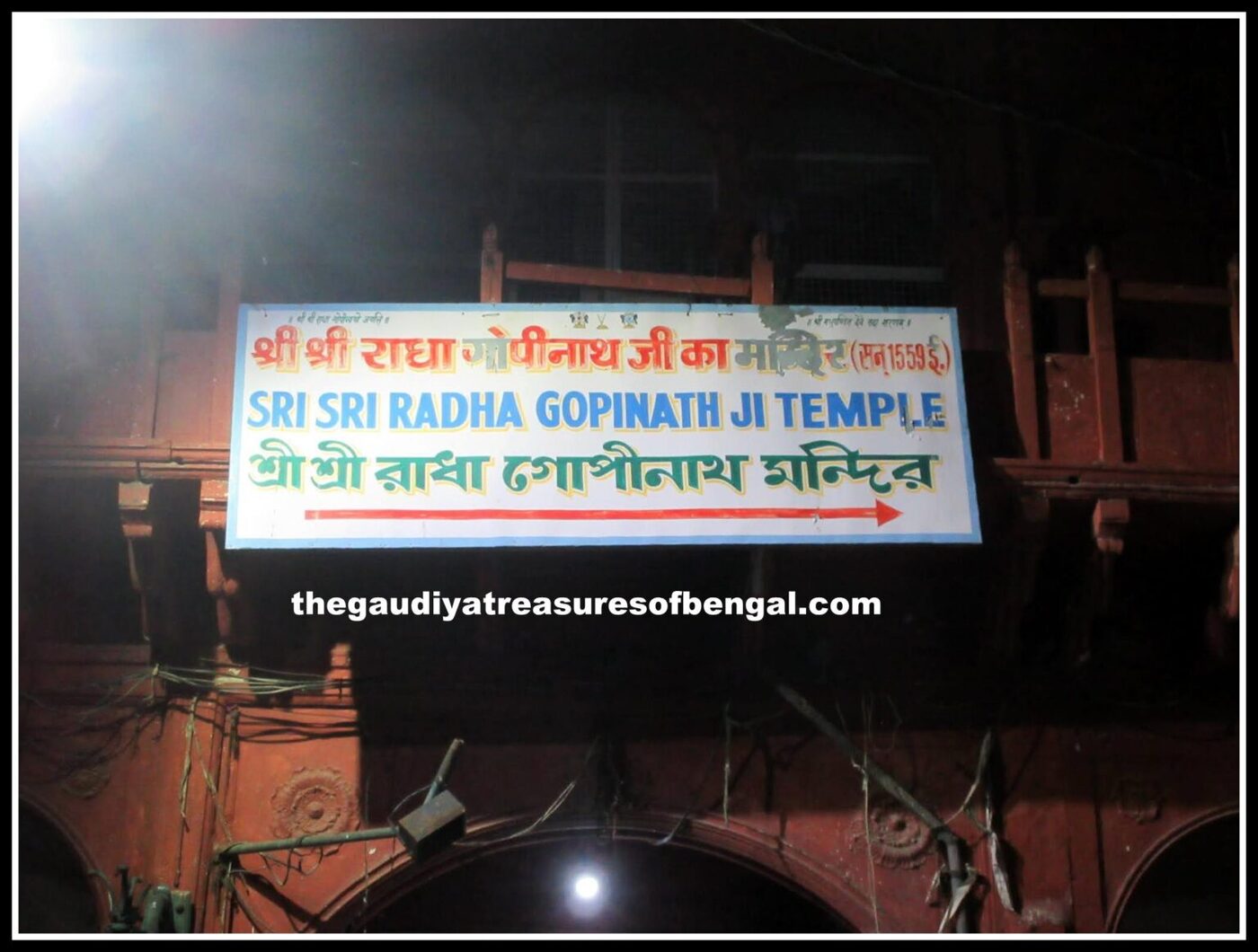
Vamshivata means "the banyan tree of the flute." Tradition marks it as the spot on the bank of the Yamuna where Krishna once stood among the gopis and played on His flute, one of the most cherished sites in all of Vrindavana. It is also the place where, according to Bhakti-ratnakara, a very old and long-lost Deity of Krishna came back to light, and where Madhu Pandit Goswami's own story as a temple priest truly begins.
| Detail | Description |
|---|---|
| Deity | Sri Gopinatha ("beloved of the gopis") |
| Site of discovery | Vamshivata, on the bank of the Yamuna, Vrindavana |
| Traditional origin | Said to have been carved for Krishna's great-grandson Vajranabha, over 5,000 years ago by tradition's count |
| Discovered by | Paramananda Bhattacharya, according to Bhakti-ratnakara and another devotee-compiled account |
| How He was found | Sources disagree: a dream revealing the burial spot in the more widely repeated telling, a monsoon flood of the Yamuna uncovering Him in another devotee-compiled account |
| First temple | Opened 1589, credited to Raja Saganji, one of the Shekhawat princes of Rajasthan, per that same account |
| Taken up in worship by | Madhu Pandit Goswami |
| Primary source | Bhakti-ratnakara (no standalone corpus on vedabase.io; quoted here via secondary translations and a Prabhupada purport); another devotee-compiled account |
An Image Carved From a Mother's Memory #
Gaudiya Vaishnava tradition traces Gopinatha's origin back to a time long before Mahaprabhu's own era. It goes all the way back to Vajranabha, who is described as Krishna's great-grandson. Vajranabha is said to have wanted images of Krishna made after Krishna's disappearance from this world. According to the story, Vajranabha had three Deities carved based on descriptions given by Queen Uttara, Maharaja Parikshit's mother, who had actually seen Krishna in person. One Deity captured Krishna's face; that one became known as Govindaji. Another captured His legs; that became Madana-mohanji. A third captured His chest and shoulders, and that, tradition says, is Gopinatha, the very Deity Madhu Pandit would one day serve. According to this account, all three were later buried or hidden, most likely during times of invasion and unrest. They lay forgotten for centuries.
This story comes from devotional tradition. It cannot be checked separately through archaeology or outside history, and it is given here as tradition. But several separate sources that describe Vrindavana's oldest temples all tell the same three-Deity story, with Govindaji, Madana-mohanji, and Gopinatha each linked to a different part of Krishna's form. This suggests that it is an old and widely shared local tradition, not a story that someone made up once.
Found Again at Vamshivata #
Centuries later, Rupa Goswami, Sanatana Goswami, and their companions were searching Vrindavana's forests for the lost sites and lost Deities of Krishna's own pastimes. In those years, Gopinatha's location is said to have come to light near Vamshivata. Bhakti-ratnakara credits the discovery to Paramananda Bhattacharya, who by most accounts was Gadadhara Pandit's own disciple. Several later retellings add a striking detail. They say that the Deity Himself appeared in a dream and showed exactly where He lay buried in the earth. After that, the site was dug and the image was recovered. This detail cannot be checked directly in the original Bengali text of Bhakti-ratnakara, because no full English translation of that work is available online. So this dream story is reported here as tradition, not as settled fact.
Another devotional account of the founding acharyas tells the moment of discovery differently, and it does not mention any dream. In that account, Madhu Pandit himself had been searching everywhere for the lost Deity of Gopinatha. He could not find Him anywhere and felt great sorrow. So he gave up eating and sat at Vamshivata, shedding tears without stopping. It happened to be the monsoon season, and the Yamuna overflowed her banks. The flood waters swept away the old banyan tree standing at Vamshivata. When the waters went down, Paramananda Bhattacharya, Madhu Pandit's close friend and companion, found Gopinatha half buried in the ground just beneath where the tree had stood. Paramananda called Madhu Pandit at once, and Madhu Pandit brought the Deity out of the ground.
Both versions agree that Paramananda Bhattacharya was the one who found Gopinatha, and both place the discovery at Vamshivata. But they disagree on how it happened. In the more widely repeated telling, a dream showed the place where He was buried. In that other devotional account, a flood swept away the tree that had hidden Him. The two versions cannot be made to agree here, so both are reported instead of quietly choosing one.
The words that Bhakti-ratnakara is quoted as saying about the Deity, after He was found, read more like a hymn than a record of events. It calls Gopinatha "an ocean of mercy" who "forever sports along the enchanting banks of the Yamuna at Vamshivata," whose "bodily luster steals the mind of whoever sees Him," and whose sweetness, once it enters the heart, "immediately extinguishes the burning fire of material existence." After this discovery, the responsibility for the Deity's daily worship passed to Madhu Pandit. This was the beginning of a service that would fill most of the rest of his life. It is told on the next page, Forty Years of Service and a Temple Takes Shape.
The First Temple at Vamshivata #
The Deity was then moved to the spot where the present Gopinatha temple stands. Another devotional account of the founding acharyas dates the opening of that first temple building to 1589. It credits the building to Raja Saganji, one of the Shekhawat princes of Rajasthan. The same source records that Aurangzeb's soldiers damaged and defiled this temple in 1670. After that, a new temple was built next to the original one. The following pages tell what became of Sri Gopinatha's worship, and of the temple that housed Him, in the generations after Madhu Pandit. They also look at a separate report that gives 1819 as the date of a replacement temple building, and at how that date may or may not fit with this account.
Please note again that this Vamshivata Gopinatha is not the same Deity as the Kshira-chora Gopinatha of Remuna, in Orissa. That Deity is connected to Madhavendra Puri, and His story is told in full on the Kshira-chora Gopinatha story. The two stories share only a name and a general theme. Each is about a Deity of Krishna called Gopinatha who was discovered or made famous through a devotee's personal love. Nothing else connects them.
Scriptural evidence for this chapter (4)
"Vrajanabha, Lord Krishna's great-grandson, installed the original Gopinatha Deity in Vrindavana over five-thousand years ago... About five-hundred years ago, Paramananda Bhattacharya discovered the Deity in the earth at Vamshivata on the banks of the Yamuna. Madhu Pandit Goswami, a disciple of Shri Gadadhara Pandit, worshiped the Gopinatha Deity."
No standalone Bhakti-ratnakara corpus exists on vedabase.io; this is the fullest available secondary summary of the traditional origin and rediscovery story, and it is the direct textual basis for calling Madhu Pandit a disciple of Gadadhara Pandit rather than only of Paramananda Bhattacharya.
"Gopinatha, the presiding deity was first installed 5,000 years ago by Vajranabha, Lord Krishna's great-grandson... Vajranabha had three Deities carved according to the descriptions of Krishna given by Parikshit's mother Uttara... Govinda Deva had the same lotus face as Krishna, Madanmohan had the same strong and shapely legs, and Gopinath had the same broad shoulders and chest."
This three-Deity origin account (Govindaji, Madana-mohanji, Gopinatha) is reported consistently across multiple independent devotional-history sources describing Vrindavana's oldest temples; it is presented here as tradition, not as archaeologically verified history.
"The Lord appeared in a dream and instructed His devotee to uncover Him from the earth... Worshipped Sri Gopinath for many years in a humble hut with deep affection."
Sources disagree on whether the dream came to Paramananda Bhattacharya (the more commonly repeated version) or to Madhu Pandit himself; the dream story is reported here as tradition rather than settled fact, following the more commonly repeated attribution to Paramananda Bhattacharya.
gosāñi gopāla-bhaṭṭa ati dayāmaya
bhūgarbha, śrī-lokanātha — guṇera ālaya
śrī-mādhava, śrī-paramānanda-bhaṭṭācārya
Word for word
gosāñi gopāla-bhaṭṭa: the merciful Gopāla Bhaṭṭa Gosvāmī; ati dayāmaya: very merciful; bhūgarbha: Bhūgarbha; śrī-lokanātha: Śrī Lokanātha; guṇera ālaya: a reservoir of good qualities; śrī-mādhava: Śrī Mādhava; śrī-paramānanda-bhaṭṭācārya: Śrī Paramānanda Bhaṭṭācārya
The following Vaishnavas were present with Sri Rupa Gosvami: the merciful Gopala Bhatta Gosvami; Bhugarbha Gosvami; Sri Lokanatha dasa Gosvami, a reservoir of good qualities; Sri Madhava; Sri Paramananda Bhattacharya...
The same purport that names Madhu Pandit also places Paramananda Bhattacharya in Vrindavana among Rupa Gosvami's companions, supporting the tradition that Paramananda Bhattacharya (Gadadhara Pandit's disciple and the Deity's discoverer) was active there alongside Madhu Pandit.
Chapter 3
Forty Years of Service and a Temple Takes Shape
Discovering a Deity is one thing. Serving one, every single day, for decades, with no temple building, no institution, and often no one watching, is another. That second, quieter task is what actually fills most of Madhu Pandit Goswami's recorded life. It is the least dramatic part of his story, but also the part with the most real substance.
| Detail | Description |
|---|---|
| Length of personal service | Reported as around forty years |
| Setting | A simple hut at Vamshivata, before any temple structure existed |
| Later status | Sri Gopinatha's temple became one of Vrindavana's Sapta-devalaya, its seven principal ancient Deity temples |
| Named companions | Gopala Bhatta Goswami, Bhugarbha Goswami, Paramananda Bhattacharya, and others, per Bhakti-ratnakara, as quoted in Srila Prabhupada's purport to Chaitanya-charitamrita |
| Samadhi | Within the Radha-Gopinatha temple compound, Vrindavana (exact spot varies by source; another devotee-compiled account places it near the eastern gate) |
| Unique altar feature | Ananga-manjari stands on Krishna's left, with Radharani on His right, the reverse of every other Gopinatha temple |
Seva in a Hut #
Several accounts state plainly that Madhu Pandit served Sri Gopinatha for roughly forty years from a simple hut, long before the Deity had anything like a proper temple. There would have been no grand arati hall, no crowd of pilgrims, and no money beyond what a lone devotee and perhaps a few well-wishers could provide. This was, in fact, the usual pattern as Vrindavana was being rediscovered in this period. Rupa Goswami and Sanatana Goswami themselves lived and wrote in similarly simple conditions. Several of Vrindavana's now-famous temples, Govindaji's included, began as simple huts around a single recovered Deity. Only later did wealthy patrons or devoted founders of institutions turn them into permanent temples. Madhu Pandit's forty years belong to that same quiet early stage of Vrindavana's history, when its foundations were laid.
Named in a Purport to Chaitanya-charitamrita #
Sri Chaitanya-charitamrita does not tell Madhu Pandit's story directly. No chapter describes his arrival, his service, or his ordinary days at Vamshivata. But his name does appear once in the book. It is not in Krishnadasa Kaviraja Goswami's own verses. It is in a purport where Srila Prabhupada quotes a passage from Bhakti-ratnakara. The passage lists the Vaishnavas who lived together with Rupa Goswami in Vrindavana: "the merciful Gopala Bhatta Gosvami; Bhugarbha Gosvami; Sri Lokanatha dasa Gosvami, a reservoir of good qualities; Sri Madhava; Sri Paramananda Bhattacharya; Sri Madhu Pandita, whose characteristics are all wonderful..." The list continues with many more names. It is a short mention inside a much longer list. But in Srila Prabhupada's own English rendering of the text, it names Madhu Pandit clearly as one of the working community of devotees who built up Vrindavana.
From Hut to Temple #
Over time, the hut gave way to something more lasting. Sri Gopinatha's worship grew into a full temple. It is counted among Vrindavana's Sapta-devalaya, the seven principal ancient Deity temples, which also include Govindaji, Madana-mohanji, Radha-vallabha, Radha-ramana, Radha-damodara, and Gokulananda. A proper stone temple of this size needed far more money and means than a lone priest could raise on his own. Another devotee-compiled account dates the opening of the first such temple to 1589. It credits the building work to Raja Saganji, one of the Shekhawat princes of Rajasthan. This fits a wider pattern in history. During the sixteenth century, Vrindavana's original Deity temples were built up with support from nobles of Sanatana Dharma who were connected to the Mughal court. Govindaji's own famous red sandstone temple was built in the same way. That same account records that Aurangzeb's soldiers damaged and defiled this temple in 1670. After that, a new temple was built beside the original one.
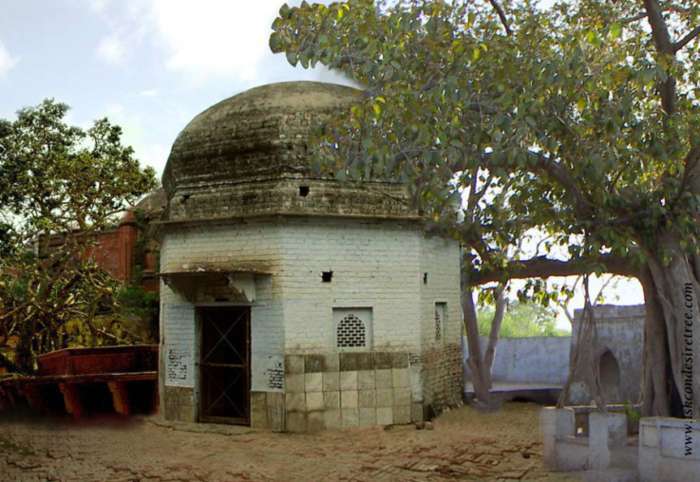
Madhu Pandit's own samadhi, his memorial tomb where his body was laid to rest, still stands within the Radha-Gopinatha temple compound in Vrindavana. Sources do not fully agree on exactly where it is inside the compound. Some describe it as near the entrance, and others toward the rear. Another devotional account of the founding acharyas is more detailed. It places the samadhi near the temple's eastern gate. We record this here as that account's own claim, together with the other descriptions given above, not in place of them. But one thing is not in dispute. The temple itself, and the tradition of worship inside it, go back directly to the decades Madhu Pandit spent serving Gopinatha, mostly alone.
The Unusual Deities on the Altar #
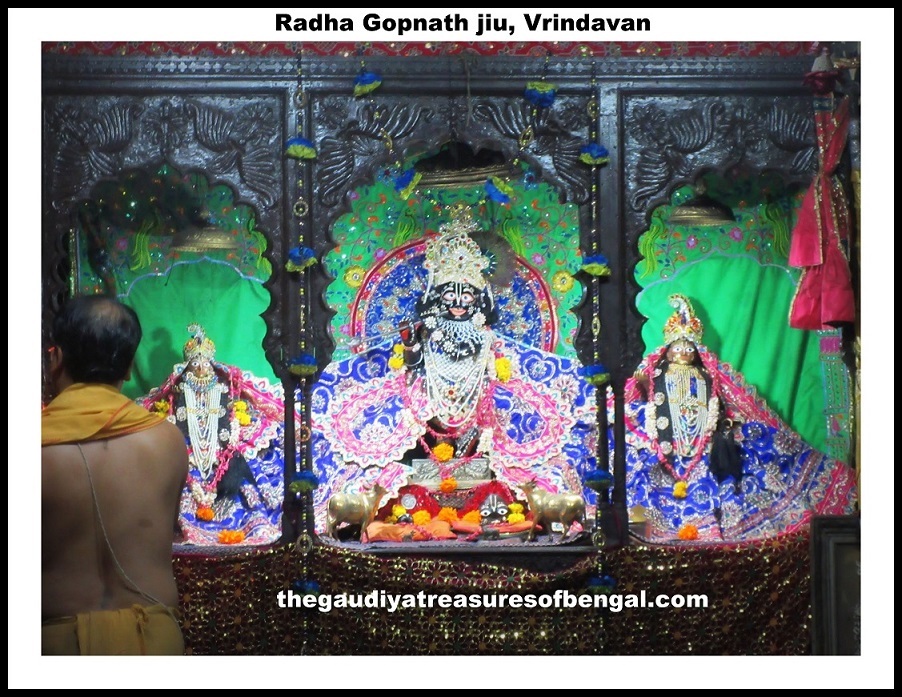
The Gopinatha temple has one more feature that sets it apart from every other Gopinatha temple in Vraja. On its altar, Ananga-manjari, Radharani's younger sister, stands to Krishna's left. Everywhere else, that is Radharani's position. Here, Radharani herself stands to His right. Another devotional account of the founding acharyas tells the story behind this. In 1582, Jahnava Mata, the wife of Nityananda Prabhu, visited Vrindavana on pilgrimage. She felt that the Radharani Deity then being worshiped in the Gopinatha temple was too small. On returning to Bengal, she asked one of her own disciples to carve a new Radharani Deity for the temple. When the new image reached Vrindavana and was installed beside Gopinatha, the devotees there noticed that it looked just like Jahnava Mata herself. This was because the disciple who carved it, being her own follower, had modeled its features on her.
The senior Vaishnavas of Vrindavana were consulted, and it was decided that the new Deity was not just a new image of Radharani. She was Ananga-manjari herself, who in Mahaprabhu's own pastimes had appeared as Jahnava Mata. That Deity had already been installed on the left of Gopinatha, so it was felt that Gopinatha Himself must have arranged this. For this reason she was left standing there and was not moved. The smaller, original Radharani Deity was then placed to Gopinatha's right, where she remains today. Devotees came to see the arrangement as Radharani's own compassion. It is said that Radharani, out of love for her younger sister's deep desire to serve, raised Ananga-manjari to her own usual place at Krishna's left. That same account states that this same arrangement, with Ananga-manjari on the left and Radharani on the right, is also followed at the two Gopinatha temples of Radha-kunda. It is also followed at the Jaipur temple where Gopinatha's original Deity is now worshiped.
Scriptural evidence for this chapter (2)
'govinda' bhakta, āra vāṇī-kṛṣṇadāsa
puṇḍarīkākṣa, īśāna, āra laghu-haridāsa
Word for word
govinda: Govinda; bhakta: a great devotee; āra: and; vāṇī-kṛṣṇadāsa: Vāṇī Kṛṣṇadāsa; puṇḍarīkākṣa: Puṇḍarīkākṣa; īśāna: Īśāna; āra: and; laghu-haridāsa: Laghu Haridāsa
The great devotee Govinda, Vani Krishnadasa, Pundarikaksha, Ishana and Laghu Haridasa also accompanied him.
From the purport: Purport excerpt: "śrī-mādhava, śrī-paramānanda-bhaṭṭācārya / śrī-madhu-paṇḍita — yāṅra caritra āścarya" — "Sri Madhava; Sri Paramananda Bhattacharya; Sri Madhu Pandita, whose characteristics are all wonderful."
This is the one place Madhu Pandit Goswami's name appears in Srila Prabhupada's own English corpus: a purport quoting Bhakti-ratnakara's Sixth Wave list of the Vaishnavas who lived together with Rupa Goswami in Vrindavana, naming Madhu Pandit alongside Paramananda Bhattacharya and Gopala Bhatta Goswami.
"Madhu Pandit... served the deity for 40 years in his hut... Madhu Pandit founded Shri Gopinath Mandir, one of Vrindavan's seven ancient temples. His samadhi (burial shrine) remains in the temple courtyard."
The specific figure of forty years of personal service, and the identification of the temple as one of Vrindavana's Sapta-devalaya (seven ancient temples), rests on this and similar secondary devotional accounts rather than on Chaitanya-charitamrita itself.
Chapter 4
Blessing Shrinivasa Acharya and the Legacy in Jaipur
Madhu Pandit Goswami's story is linked to a much larger and much better-recorded one by a single, simple act. He gave a garland. That garland ties his quiet decades of Deity worship at Vamshivata directly to one of the most important journeys in Gaudiya Vaishnava history. On that journey, Rupa and Sanatana Goswami's writings were carried out of Vrindavana and into Bengal, where the tradition still lives today.
| Detail | Description |
|---|---|
| Recipient of the blessing | Shrinivasa Acharya |
| Occasion | Departure from Vrindavana to carry the Goswamis' manuscripts to Bengal |
| Gift given | Sri Gopinatha's own garland |
| Also departing | Narottama Dasa Thakura and Shyamananda Pandit |
| Later Mughal-era event | Gopinatha's original Deity moved from Vrindavana to Jaipur for safety |
| Present location of the original Deity | Jaipur, Rajasthan, alongside Govindaji and Madana-mohanji |
A Garland Before the Journey #
Shrinivasa Acharya, Narottama Dasa Thakura, and Shyamananda Pandit completed their training under Jiva Goswami and Gopala Bhatta Goswami. By that time, Gaudiya Vaishnavism faced a strange problem. Its philosophy had spread across Bengal in name and in feeling. But almost none of the books that actually explained it had reached the region. These were the writings of Rupa Goswami, Sanatana Goswami, Gopala Bhatta Goswami, Raghunatha Dasa Goswami, and Jiva Goswami. Jiva Goswami chose these three devotees to carry that library east by ox-cart. The journey is told in full on carrying the scriptures to Bengal.
Bhakti-ratnakara records that before they set out, Madhu Pandit Goswami gave Shrinivasa a garland that had been offered to Sri Gopinatha. The same source preserves the words spoken over him at that moment: "Ohe Srinivas! What more can I say? The Lord reveals Himself to His pure devotee, who then preaches His glories to the world. Who can describe the incomprehensible activities of such pure devotees, by which the Lord becomes subservient to their love. Thus did Sri Brajendra Kumar reveal himself to Paramananda Bhattacharya and Sri Madhu Pandit, who are the abodes of many wonderful qualities" (Bhakti-ratnakara 2.473). In Gaudiya Vaishnava practice, a Deity's own garland, once removed after worship, is treated as prasada. It is something touched by the Lord Himself and passed on as a mark of grace. So, in this setting, placing that garland on Shrinivasa just before he left can be understood as a blessing from Gopinatha for the whole journey. It was not only Madhu Pandit's personal good wishes. It was the Deity's own approval of a mission that would decide whether the Goswamis' teachings reached the people Mahaprabhu intended them for. In the sources this is a small moment, a single sentence in most retellings. But it is the one point where Madhu Pandit's story touches directly on events told in detail elsewhere. These events are the later meeting between Shrinivasa and the Bishnupur king Vira Hambira, and the conversion that followed it.
When the Deities Left Vrindavana #
Madhu Pandit did not live to see it. But generations later, the Deity he had spent so much of his life serving faced a danger far greater than being forgotten. Under the Mughal empire, especially during Aurangzeb's reign, temples of Sanatana Dharma across northern India came under constant pressure. So Vrindavana's own guardians made the difficult decision to move their most precious Deities to Rajasthan, where they would be safer. Gopinatha was carried away from Vamshivata along with Govindaji and Madana-mohanji. Tradition connects these same three Deities back to Vajranabha's original carvings. All three at last came to rest in Jaipur. They are still enshrined there today, among the most important historic Krishna Deities in Rajasthan.
Back at Vamshivata, a second Gopinatha Deity, known as a pratibhu-vigraha, was installed so that worship at the original site would not simply stop. One source states that a new temple building for this replacement Deity went up in 1819. This exact claim rests on that single source only, so it is reported here with that warning, not as settled fact. Another devotee-compiled account tells a related story, but it does not obviously match. It says that the original temple at Vamshivata, which it dates to 1589, was damaged and defiled by Aurangzeb's soldiers in 1670. After that, a new temple was built beside the old one. This account does not mention an 1819 date or a separate pratibhu Deity. The two accounts of the temple's rebuilding cannot be made to agree here, so both are recorded instead of choosing one over the other.
How Madhu Pandit Is Remembered #
Gaudiya Vaishnavism has a devotional teaching about eternal identities. It holds that many of Mahaprabhu's associates also have a matching form in Krishna's own original pastimes in Goloka. In this understanding, Madhu Pandit Goswami is remembered as a Mandali-sakhi, a maidservant, in the group of Champakalata-sakhi. This belongs to siddha-pranali, a devotee's spiritual identity as the tradition understands it. It is given here as devotional understanding, not as historical record.
This much can be stated as plain fact. Madhu Pandit's samadhi still stands at the Radha-Gopinatha temple in Vrindavana, near the Deity he gave decades of his life to serving. Another devotee-compiled account places it near the temple's eastern gate. But other sources say only "near the entrance" or "toward the rear." His name survives in only a handful of lines across the whole of Gaudiya Vaishnava literature. There is a single quoted verse in a Prabhupada purport, a paragraph or two in later compilations, and a garland handed to a departing friend. That is very little writing for a whole life. But the temple still standing at Vamshivata, and the line of devotees it has sheltered since, are themselves a kind of record. That record is written in stone and in continued worship, not in words.
Scriptural evidence for this chapter (3)
"Madhu Pandit Goswami blessed Shrinivasa Acharya with Gopinatha's garland before Shrinivasa, Narottama, and Shyamananda took the bullock cart of Goswami granthas from Vrindavana."
This is the central episode connecting Madhu Pandit to the better-documented story of Shrinivasa Acharya, Narottama Dasa Thakura, and Shyamananda Pandit carrying the Goswamis' manuscripts to Bengal, told in full on Shrinivasa Acharya's own pages.
"During the Mughal period, especially under Emperor Aurangzeb, many temples were attacked. To safeguard the idol, it was brought from Vrindavan to Jaipur, where it was reinstalled in a newly built temple... A new temple structure was constructed in 1819 AD to house replacement deities (pratibhu) of Radha and Gopinath."
The 1819 date for the replacement temple at Vamshivata comes from a single source and is reported with that caveat rather than as independently confirmed history.
"In Goloka Vrindavana, Madhu Pandit Goswami serves as Mandali-sakhi in the group of Champakalata-sakhi."
This siddha-pranali identity is a matter of devotional tradition within Gaudiya Vaishnavism's framework of eternal identities, reported here as tradition rather than historical fact.
Closing
A Disciple in Gadadhara Pandit's Line #
Little has survived about Madhu Pandit's birth and family, but one clear detail has. Another devotional account of the founding acharyas records that he came from Saibona, a village about two miles from Khardaha in the district of Twenty-four Parganas. It also records that he had already established the worship of Sri Sri Radha-Nandadulalji there before he ever set out for Vrindavana. Beyond that one home and that one earlier seva, the sources agree only in general terms. They say he came to Vrindavana from Bengal with the same longing that drew Rupa Goswami, Sanatana Goswami, and dozens of other devotees there in the years after Mahaprabhu's own pastimes at Puri and Vrindavana ended. They wanted to live where Krishna had walked as a cowherd boy, and to serve Him there directly. That same devotional account states plainly that Madhu Pandit made the journey on the order of his guru, Sri Gadadhara Pandit. This supports the more commonly followed account of his discipleship. Other accounts give more detail about the chain. They say Madhu Pandit came under the personal guidance of Paramananda Bhattacharya, who was himself Gadadhara Pandit's disciple and already settled in Vrindavana. Either way, every source keeps him inside the same short spiritual line. This page records Gadadhara Pandit as his guru. It also notes the Paramananda Bhattacharya detail openly, instead of choosing one version and hiding the other.
Discovering Sri Gopinatha at Vamshivata #
Vamshivata, the "banyan tree of the flute," is one of Vrindavana's most sacred spots. Tradition holds that Krishna once stood here playing His flute for the gopis. Gaudiya Vaishnava tradition holds that the Gopinatha Deity now worshiped there is extremely old. It says that Krishna's own great-grandson Vajranabha had three Deities carved from descriptions of Krishna's body given by Queen Uttara, Maharaja Parikshit's mother, who had personally seen Him. One image showed Krishna's face, one His legs, and one His chest and shoulders. Tradition identifies the third of these as Gopinatha, and says all three were eventually buried or hidden, and forgotten, for many centuries.
By the account preserved in Bhakti-ratnakara, Gopinatha was brought back to light near Vamshivata by Paramananda Bhattacharya, whom the same tradition names as Gadadhara Pandit's disciple. Several tellings say this was no ordinary discovery. The Deity is said to have appeared in a dream and revealed exactly where He lay buried in the earth. After that, local villagers dug and found Him. Another devotional account of the founding acharyas tells the moment of finding differently. It says Madhu Pandit himself had been searching for the lost Deity. Out of sorrow at not finding Him, he gave up eating and sat weeping at Vamshivata. Then a monsoon flood swept the Yamuna over her banks and carried away the old banyan tree standing there. When the waters went down, Paramananda Bhattacharya found Gopinatha lying half buried in the ground just where the tree had stood, and he called Madhu Pandit to lift Him out. Both accounts agree on who found the Deity and where, but they differ on how. In the more widely repeated telling, it was a dream-revelation. In that other account, a flood uncovered the Deity. Both are recorded here, instead of quietly choosing one. Bhakti-ratnakara's own description of the uncovered Deity is full of warmth, and it is worth quoting. It calls Gopinatha "an ocean of mercy" who "forever sports along the enchanting banks of the Yamuna at Vamshivata," and says the sweetness of His form, once it enters the heart, "immediately extinguishes the burning fire of material existence." Then Madhu Pandit took up the Deity's daily worship and care.
Forty Years of Service, and a Temple Takes Shape #
By most accounts, Madhu Pandit did not begin with anything grand. He is remembered as having served Sri Gopinatha for around forty years from a simple hut at Vamshivata, long before any proper temple building existed. He cooked for the Deity, dressed Him and worshiped Him, more or less alone. He served in the same spirit of personal, unhurried devotion that marked the lives of so many of the Vrindavana Goswamis. Sri Chaitanya-charitamrita itself does not tell this part of his life directly. In all of Srila Prabhupada's English writings, Madhu Pandit's name appears in only one place, a purport to Chaitanya-charitamrita, Madhya-lila 18.52. There Prabhupada quotes Bhakti-ratnakara's list of the Vaishnavas then living with Rupa Goswami in Vrindavana. The list includes "Shri Madhu Pandita, whose characteristics are all wonderful," along with Gopala Bhatta Goswami, Bhugarbha Goswami, and Paramananda Bhattacharya himself.
Over time, the worship Madhu Pandit had kept alive grew into one of the seven principal ancient Deity temples of Vrindavana. Gaudiya Vaishnavas call this group the Sapta-devalaya, and it also includes Govindaji, Madana-mohanji, Radha-vallabha, Radha-ramana, Radha-damodara, and Gokulananda. In time a proper temple building rose over the site. Another devotional account of the founding acharyas dates its opening to 1589. It says the temple was built by Raja Saganji, one of the Shekhawat princes of Rajasthan. This agrees with the more general report elsewhere that a Rajasthani patron supported the temple. Madhu Pandit's own samadhi, or memorial tomb, still stands within that temple's compound in Vrindavana today. That same account places it near the temple's eastern gate. Other sources are less exact. They say only "near the entrance" or "toward the rear" and do not name a side.
The temple has one more special feature. It is the only Gopinatha temple where Ananga-manjari, Radharani's younger sister, stands on Krishna's left. In every other temple, Radharani herself stands in that position. Here Radharani stands to His right instead. Another devotional account of the founding acharyas traces this to a visit by Jahnava Mata, the wife of Nityananda Prabhu, in 1582. Jahnava Mata felt that the Radharani Deity then worshiped there was too small, so she asked a disciple to carve a larger one for the temple. When it arrived, devotees noticed that it looked like Jahnava Mata herself, because the disciple who carved it had modeled it on her own features. The senior Vaishnavas of Vrindavana were consulted, and it was decided that the new Deity was in fact Ananga-manjari, who had appeared in Mahaprabhu's own pastimes as Jahnava Mata. Since she had already been placed on Gopinatha's left, she was left standing there. The smaller, original Radharani Deity was moved to His right, where both remain today. That same account states that this arrangement is repeated at the two Gopinatha temples of Radha-kunda and at the Jaipur temple where Gopinatha's original Deity is now worshiped.
The Garland That Blessed a Mission #
One particular episode links Madhu Pandit to a larger, better-recorded story, the story of Shrinivasa Acharya. Shrinivasa, Narottama Dasa Thakura, and Shyamananda Pandit had finished their training under Jiva Goswami and Gopala Bhatta Goswami. They then prepared to carry the Goswamis' manuscripts out of Vrindavana to Bengal, a journey told in full on carrying the scriptures to Bengal. Bhakti-ratnakara records that Madhu Pandit Goswami blessed Shrinivasa before he set out. He placed on Shrinivasa a garland that had first been offered to Sri Gopinatha, and the same source preserves the words spoken over him: "Ohe Srinivas! What more can I say? The Lord reveals Himself to His pure devotee, who then preaches His glories to the world. Who can describe the incomprehensible activities of such pure devotees, by which the Lord becomes subservient to their love. Thus did Sri Brajendra Kumar reveal himself to Paramananda Bhattacharya and Sri Madhu Pandit, who are the abodes of many wonderful qualities" (Bhakti-ratnakara 2.473). In this tradition, a Deity's garland is understood to carry His personal blessing. So the gesture can be seen as Gopinatha Himself sending Shrinivasa off with the approval of the older generation. That mission would decide whether Gaudiya Vaishnavism's philosophy ever reached the people in Bengal for whom Mahaprabhu meant it.
From Vrindavana to Jaipur, and How He Is Remembered #
Decades after Madhu Pandit's own service, Vrindavana's ancient Deities came under serious threat during the Mughal period, particularly under Aurangzeb. His policies toward the temples of Sanatana Dharma pushed several of Vrindavana's guardians to move their Deities to the safety of Rajasthan. Gopinatha was carried to Jaipur, along with Govindaji and Madana-mohanji. All three remain enshrined there today, among the most important historic Krishna Deities in Rajasthan. Later a second, "pratibhu" Gopinatha Deity was installed back at Vamshivata so that worship there could continue. One source records that a new temple building for this replacement Deity went up in 1819. Another devotional account of the founding acharyas gives a related account of the temple building, but it does not clearly match. It says the original Gopinatha temple at Vamshivata, which it dates to 1589, was desecrated by Aurangzeb's soldiers in 1670. After that, it says, a new temple was built beside the old one. It does not mention an 1819 date or a separate pratibhu Deity. We cannot make these two accounts of the temple's rebuilding agree, so both are reported here instead of choosing one over the other.
Gaudiya Vaishnava devotional tradition gives many of Mahaprabhu's associates an eternal identity in Krishna's original pastimes. Within this tradition, Madhu Pandit Goswami is remembered as a Mandali-sakhi, a maidservant in the group of Champakalata-sakhi, in the eternal Vrindavana of Goloka. This comes from devotional tradition, not from historical record, and it is given here in that way. What we can say more plainly is this. Very little of this devotee's own life story survives. Yet for most of his lifetime he kept a single Deity's worship alive with his own hands. In doing so, he helped keep one thread of Vrindavana's Krishna-bhakti unbroken, between Mahaprabhu's own generation and the Goswamis who followed Him there.
- Sri Chaitanya-charitamrita, Madhya-lila 18.52 (purport quoting Bhakti-ratnakara)
- Madhu Pandit Goswami - Gaudiya History (ISKCON Desire Tree)
- Srila Madhu Pandit Goswami Biography - Hare Krishna Mandir
- Radha Gopinath Temple, Vrindavan: Founded by Madhu Pandit - The Gaudiya Treasures of Bengal
- Sri Sri Radha Gopinath - Holy Dham
- Sri Sri Radha Gopinath - ISKCON Desire Tree
- Madhu Pandit Disappearance - Ramai Swami
