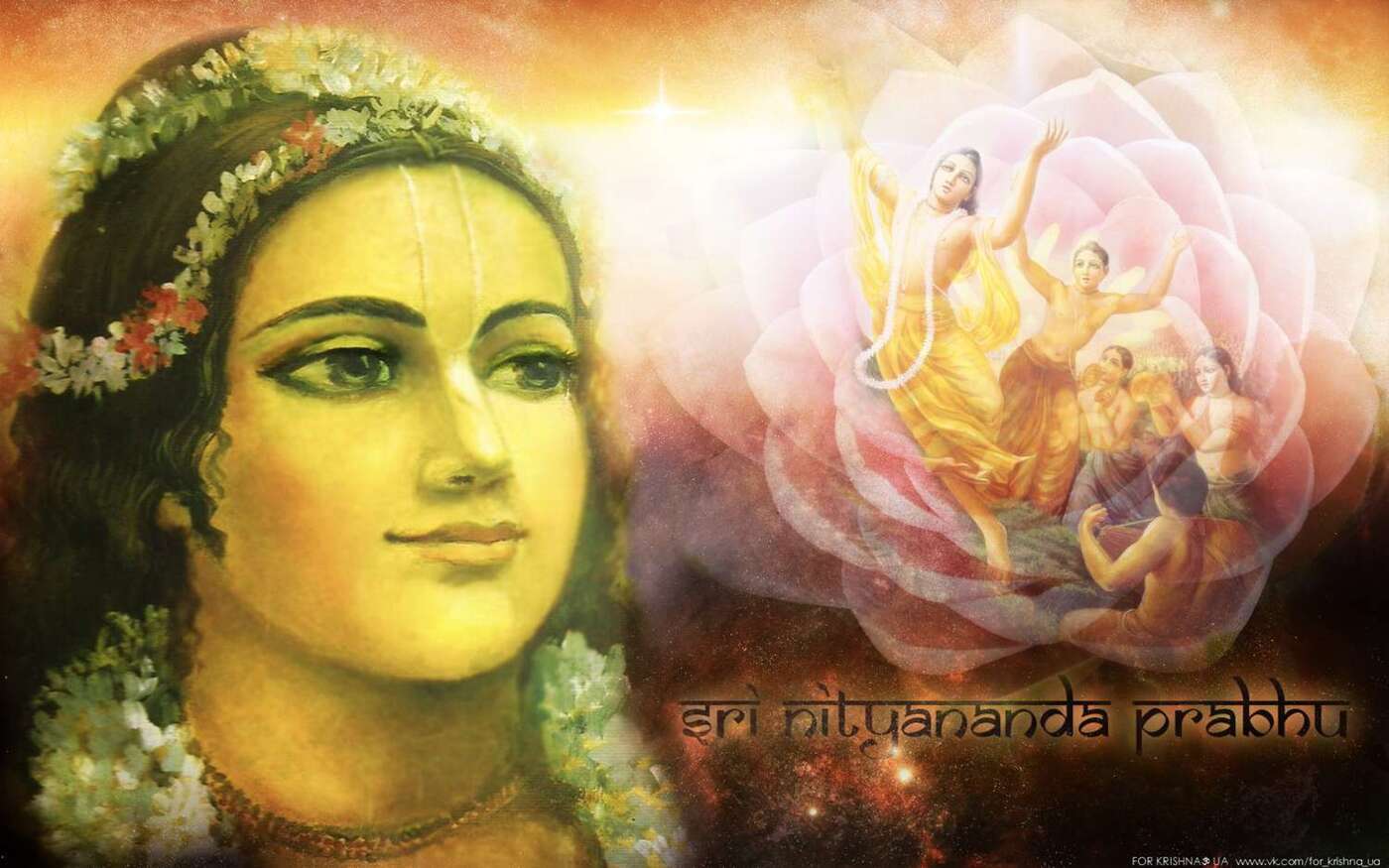
Outside the single evening recorded at Jhamatpur, told in The Kirtana Night at Jhamatapura, almost nothing survives of Minaketana Rama Dasa's own life story. What does survive is a set of references that place him firmly within Sri Nityananda Prabhu's inner circle of associates, and a hint at who he was understood to be beyond this world entirely.
An Avadhuta's Freedom From Convention #
Chaitanya-charitamrita's very first line about him calls Minaketana Rama Dasa a bhrtya, a servant, of Nityananda Prabhu (Adi 5.161). In Gaudiya Vaishnava tradition, being the servant of an avadhuta has its own meaning. Nityananda Prabhu is remembered as an avadhuta in the fullest sense. He is a paramahamsa whose behavior follows no outer rule of caste, dress, or social manners. Instead, He is absorbed in a single unbroken mood of love for Krishna. In his Bengali Anubhashya commentary on this same verse, Bhaktisiddhanta Sarasvati Thakura draws on Sridhara Swami's classical definition of the word avadhuta, asamskrita-deha, one who does not attend to his own body. He applies it to Minaketana as well, as an eternally perfect maha-bhagavata paramahamsa. So, he says, none of the ordinary marks of caste or station appeared in Minaketana's conduct, because he too was wholly absorbed in the mood of Vraja. Seen in this light, the Jhamatpur kirtana no longer looks like strange behavior. It looks exactly like what the tradition expects from an avadhuta's own servant. For such a man, climbing on a stranger's shoulder or striking a bowing devotee with his flute was not misconduct. It was the visible overflow of a love that the ordinary rules of good manners were never made to hold.
Named Among Nityananda Prabhu's Seventy-Five #
In the eleventh chapter of Chaitanya-charitamrita's Adi-lila, Krishnadasa Kaviraja Goswami sets out to name, in detail, as many of Nityananda Prabhu's followers as he can. He does this "for my own self-purification," as he puts it, not to claim that the list is complete. Minaketana Ramadasa appears there as the seventy-fifth name in this list, grouped with Nartaka Gopala, Rambhadra, Gauranga Dasa, and Nrisimha Chaitanya (Adi 11.53). His place in the list tells us little more than what the Jhamatpur episode already shows. He was counted, by name, among Nityananda Prabhu's recognized personal servants. The list is so long that Krishnadasa himself admits no one could ever count Nityananda Prabhu's followers in full.
An Identity Traced to Sankarshana #
Srila Prabhupada's purport to that same verse adds more, drawn from the Gaura-ganoddesha-dipika. This is the traditional Gaudiya Vaishnava text that gives each of Sri Chaitanya Mahaprabhu's associates an eternal identity within Krishna's original Vraja pastimes. According to the purport, the Gaura-ganoddesha-dipika describes Minaketana Ramadasa there as an expansion connected with Sankarshana, the four-armed source of Krishna's own expansions. But the Gaura-ganoddesha-dipika's actual verse (68) is less clear than that single-line purport suggests. Read closely, it can be understood as naming two separate figures, Nishatha and Ulmuka, who enter Gaura-lila as two distinct servants, Minaketana and Rama. In that reading they are not one man with a double name. Later devotional compilers, including the author of Bhakti-ratnakara, settled this by treating Minaketana Rama Dasa as a single person throughout. Chaitanya-charitamrita itself always speaks of him in the same way, as one man with one flute, present on one evening at Jhamatpur. This page follows that better-supported, single-person reading. But the source verse itself leaves real room for the other reading.
Present at the Kheturi Mahotsava #
One more independent mention of Minaketana Rama Dasa is found outside Chaitanya-charitamrita altogether. Narahari Chakravarti's later devotional history, Bhakti-ratnakara, records him among the Vaishnavas who traveled to the great Kheturi Mahotsava. This important festival was organized under the leadership of Jahnava Mata, and it gathered many of Nityananda Prabhu's scattered followers in one place. Bhakti-ratnakara names him there alongside Abhirama Gopala Thakura, Murari Chaitanya, Jnana Dasa, and several others. It describes the whole company in devotional words: "the entire universe is sanctified" merely by the sight of such Vaishnavas together. Beyond this single mention, no further detail of his life at Kheturi, or afterward, has survived in any available source. Neither his birth nor his disappearance is recorded anywhere. This is a real gap. Yet the same record keeps exactly one evening of his devotional life in remarkable and specific detail.
