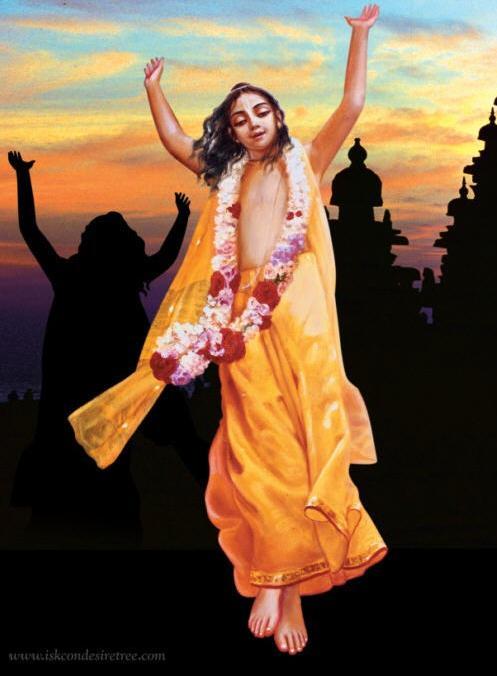
Srila Minaketana Rama Dasa
The Ecstatic Servant of Sri Nityananda Prabhu
Also known as Minaketana Ramadasa, Minaketan Rama Das, Mineketana Ramdas
“Here I find the second Romaharshana-suta, who did not stand to show honor when he saw Lord Balarama.”
Minaketana Rama Dasa's rebuke to a temple priest who failed to rise for him, recorded by Krishnadasa Kaviraja Goswami in Sri Chaitanya-charitamrita, Adi-lila 5.170
Almost everything known about Srila Minaketana Rama Dasa comes from a few dozen verses of one chapter of Sri Chaitanya-charitamrita, plus a single entry in a list and a one-line identification in the Gaura-ganoddesha-dipika. Yet even in that small space, Krishnadasa Kaviraja Goswami paints so clear a picture that Minaketana Rama Dasa has remained a well-known figure in Gaudiya Vaishnava memory for five centuries. He was a servant of Sri Nityananda Prabhu, so absorbed in ecstatic love that he wept without pause and danced without restraint. He would not let even a respected brahmana pujari get away with failing to honor Nityananda Prabhu's name. He should not be confused with three other, unrelated devotees who share only the name Ramadasa: Ramadasa Vipra, a South Indian brahmana devoted to Lord Rama whom Sri Chaitanya Mahaprabhu comforted with a leaf of the Kurma Purana; Ramadasa Brahmana, whose lifelong chanting of Rama's name turned to Krishna's after meeting Mahaprabhu; and Ramadasa Vishvasa, a Bengali government official who served Raghunatha Bhatta Goswami. Minaketana Rama Dasa's story, and his place in the parampara, belong entirely to Nityananda Prabhu's circle.
| Detail | Description |
|---|---|
| Full name | Srila Minaketana Rama Dasa (also Minaketana Ramadasa) |
| Servant of | Sri Nityananda Prabhu |
| Birth / early life | Not recorded; likely lived near Jhamatpur, Bengal |
| Chief episode recorded | An all-night sankirtana at Krishnadasa Kaviraja Goswami's home |
| Position among Nityananda Prabhu's associates | Named 75th in the list given in Chaitanya-charitamrita, Adi-lila 11.53 |
| Identity | An expansion (vyuha) of Lord Sankarshana (Gaura-ganoddesha-dipika 68; Chaitanya-charitamrita Adi 11.53 purport) |
| Also recorded in | Bhakti-ratnakara (present at the Kheturi Mahotsava) |
An Avadhuta in Nityananda Prabhu's Service #
Chaitanya-charitamrita introduces him plainly: "Lord Nityananda Prabhu had a servant named Sri Minaketana Ramadasa, who was a reservoir of love" (Adi 5.161). The description matters as much as the name. Nityananda Prabhu himself is remembered in the Gaudiya Vaishnava tradition as an avadhuta. This means a paramahamsa who does not care at all for ordinary bodily rules or social rank, and who moves through the world in a mood of spiritual absorption too great to hold back. Bhaktisiddhanta Sarasvati Thakura's own commentary on this verse says that Minaketana, as his servant, shared this same freedom from ordinary rules. This point is explained more fully in An Avadhuta Among Nityananda Prabhu's Associates. The episodes that follow show this clearly.
The Kirtana Night at Jhamatapura #
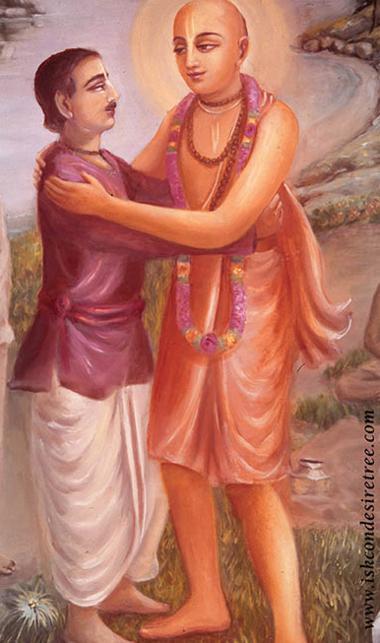
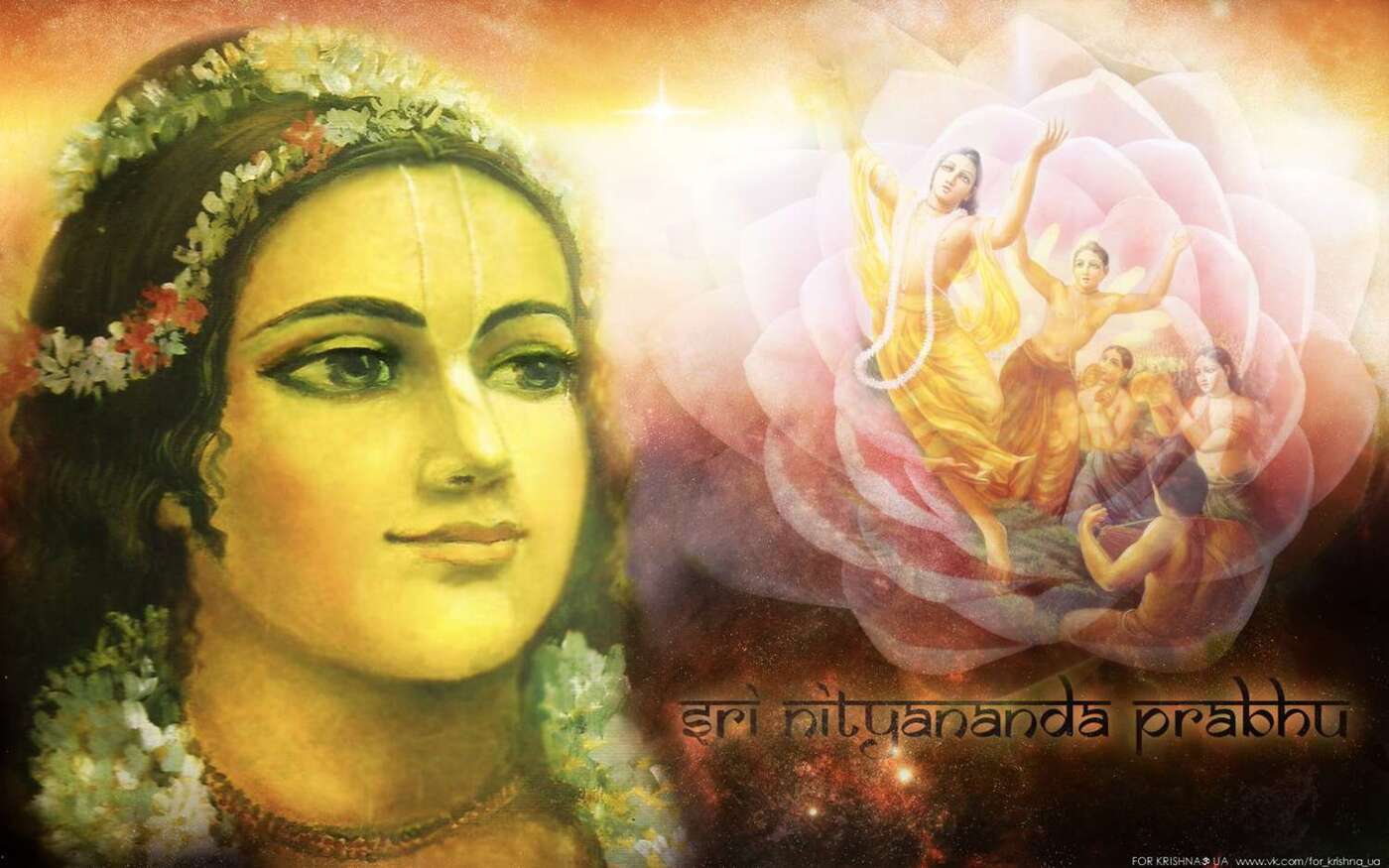
The only episode of his life that is told in full took place at an all-night sankirtana at the Bengal home of Krishnadasa Kaviraja Goswami, years before its host ever left for Vrindavana. Minaketana arrived as an invited guest. Soon he was overcome by symptoms of ecstatic love so intense that the other devotees present came forward, out of simple respect, to touch his feet. But as he swept past them, lost in bhava, he sometimes struck them with his flute or slapped them lightly. When a priest who lived there did not rise and greet him with respect, Minaketana rebuked him on the spot. Krishnadasa records his exact words. The full scene, including that rebuke, is told in The Kirtana Night at Jhamatapura.
The Broken Flute and a Brother's Fall #
The festival's real result came afterward, in an argument between Minaketana and Krishnadasa's own brother. This brother had firm faith in Sri Chaitanya Mahaprabhu but only faint regard for Nityananda Prabhu. Hurt by this uneven faith, Minaketana broke his own flute in anguish and left. Krishnadasa did not defend his brother. Instead he rebuked him, insisting that Chaitanya and Nityananda are a single truth in two forms and that faith in one without the other is worse than useless. Krishnadasa tells elsewhere in Chaitanya-charitamrita what happened that same night. Nityananda Prabhu appeared to him in a dream. He was pleased by this defense of His honor, and He told Krishnadasa to leave for Vrindavana. This is the same dream-command already told in detail on Krishnadasa Kaviraja Goswami's own page, in Early Life and the Call to Vrindavana. So Minaketana's broken flute stands at the turning point of one of the parampara's better-known origin stories, even though Minaketana himself never appears in that story again.
Place Among Nityananda Prabhu's Many Associates #
Apart from this one episode, Chaitanya-charitamrita gives only his place in a long list of Nityananda Prabhu's followers, where he is named seventy-fifth (Adi 11.53). Srila Prabhupada's purport to that verse adds one more identification. It says that the Gaura-ganoddesha-dipika, the traditional guide to the eternal Krishna-lila identities of Chaitanya Mahaprabhu's associates, describes Minaketana Ramadasa as an expansion connected with Sankarshana. But the wording of the Gaura-ganoddesha-dipika's own verse (68) is not clear. It can also be read as naming two separate figures, Nishatha and Ulmuka, who entered Gaura-lila as two servants called Minaketana and Rama. In that reading they are two men, not one man carrying both names. This is a real puzzle in the text. Later compilers, including the author of Bhakti-ratnakara, solve it by treating Minaketana Rama Dasa as a single person throughout. This page follows that same, better-supported reading. But the source verse itself does not fully settle the question.
The verse comes right after Kavi Karnapura's verse on Viracandra Prabhu. Its published English translation reads Minaketana Rama Dasa as one person:
amuṁ prāviśatāṁ kāryāt sajahau niṣaṭholmukau
mīnaketana-rāmādir vyūhaḥ saṅkarṣaṇo’paraḥ
"Lord Viracandra also entered the bodies of the two brothers Nisatha and Ulmuka, who in this way were incarnations of Lord Visnu. Minaketana Rama dasa and others were also incarnations of Lord Sankarsana in this way." (Gaura-ganoddesha-dipika 68)
Srila Prabhupada reads it the same way in his purport to Chaitanya-charitamrita Adi 11.53: "The Gaura-gaṇoddeśa-dīpikā (68) describes Mīnaketana Rāmadāsa as an incarnation of Saṅkarṣaṇa."
Kheturi and an Otherwise Unrecorded Life #
One more mention of him is found outside Chaitanya-charitamrita. Narahari Chakravarti's Bhakti-ratnakara names Minaketana Rama Dasa among the devotees who traveled to the great Kheturi Mahotsava, which was organized under Jahnava Mata's leadership. It lists him with Abhirama Gopala Thakura and several other followers of Nityananda Prabhu as among those "by whose sight the entire universe is sanctified." No birth year, birthplace, disappearance date, or family detail survives for him in any available source. The sources simply do not give these details; they have not been left out by mistake. Yet the same record gives an unusually clear picture of one evening in one devotee's life.
Scriptural evidence
Quoted in the text above:
- CC Adi 5.161 Sri Chaitanya-charitamrita
- Verse 68 Gaura-ganoddesha-dipika
Further verses:
nartaka gopāla, rāmabhadra, gaurāṅga-dāsa
nṛsiṁha-caitanya, mīnaketana rāmadāsa
The dancer Gopāla was the seventy-first, Rāmabhadra the seventy-second, Gaurāṅga dāsa the seventy-third, Nṛsiṁha-caitanya the seventy-fourth and Mīnaketana Rāmadāsa the seventy-fifth.
From the purport: The Gaura-gaṇoddeśa-dīpikā (68) describes Mīnaketana Rāmadāsa as an incarnation of Saṅkarṣaṇa.
The list verse that names Minaketana Rama Dasa as the seventy-fifth of Nityananda Prabhu's branches; Srila Prabhupada's purport adds his identity from Gaura-ganoddesha-dipika 68.
- Sri Chaitanya-charitamrita, Adi-lila, Chapter 5, verses 161-180 (vedabase.io)
- Sri Chaitanya-charitamrita, Adi-lila 11.53 and purport (vedabase.io)
- Minaketana Rama Das — gaudiyahistory.iskcondesiretree.com (excerpted from Shri Chaitanya: His Life & Associates by Shrila Bhakti Ballabh Tirtha Maharaj)
- Ramadasa Vipra, Ramadasa Brahmana and Ramadasa Vishvasa biography pages, gaudiyahistory.iskcondesiretree.com (for disambiguation)
Frequently asked
When was Srila Minaketana Rama Dasa born?
Srila Minaketana Rama Dasa appeared Not recorded in Not recorded; associated by residence with the Jhamatpur area of Bengal, per Krishnadasa Kaviraja Goswami's own account.
Who was the guru of Srila Minaketana Rama Dasa?
The spiritual master of Srila Minaketana Rama Dasa was Sri Nityananda Prabhu.
When and where did Srila Minaketana Rama Dasa disappear?
Srila Minaketana Rama Dasa disappeared Not recorded at Not recorded.
What are the main pastimes of Srila Minaketana Rama Dasa?
The pastimes covered here include: The Kirtana Night at Jhamatapura, An Avadhuta Among Nityananda Prabhu's Associates.