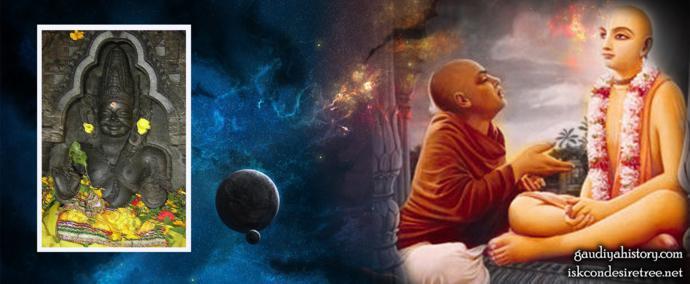
Chaitanya-charitamrita's Madhya-lila opens its tenth chapter with a homecoming. Sri Chaitanya Mahaprabhu had been away from Jagannatha Puri for many months, touring South India. In His absence King Prataparudra had repeatedly asked Sarvabhauma Bhattacharya to arrange an audience with the Lord he had heard so much about. When Mahaprabhu finally returned, He did not go to the king's palace. He went to the home of a Puri brahmana named Kashi Mishra. There, before long, Murari Mahiti was brought into His presence.
A Line of Devotees Like Thirsty Birds #
Sarvabhauma Bhattacharya took his seat at the Lord's right side and began bringing Puri's devotees before Him one after another, naming each in turn. Chaitanya-charitamrita records the image he reached for to describe them: in Mahaprabhu's absence, he said, all these people had been like thirsty cataka birds crying out in distress, and now he simply asked the Lord to accept them. What follows in the text is a scene built almost entirely out of names and short descriptions, one devotee after another, and Krishnadasa Kaviraja Goswami preserves the sequence in the order Sarvabhauma actually spoke it.
The Devotees Named Before Him #
Several other Puri devotees had already been introduced by the time Murari Mahiti's turn came. Sarvabhauma named Janardana, one of Lord Jagannatha's own temple servitors, and Krishnadasa, described simply as the man who carried a golden cane. Then he named Shikhi Mahiti, Murari's own elder brother. He identified Shikhi Mahiti by his post at the temple, as the official "in charge of writing," responsible for the Madala Panji, the temple's record of events and calendar. Next came Pradyumna Mishra, whom Sarvabhauma called chief among all Vaishnavas and a great servitor of Jagannatha. Only then did Sarvabhauma turn to the youngest of the Mahiti household.
Named by His Brother and His Devotion #
"This is Murari Mahiti, the brother of Shikhi Mahiti," Sarvabhauma told the Lord. "He has nothing other than Your lotus feet." It is the entire introduction - one relationship and one devotion, and nothing else. No occupation is named for him as it was for his brother; no title beyond the family's own "Mahiti" is given. In the very next verse, Sarvabhauma turned to yet another devotee who happened to share Murari's own first name. This was a brahmana called Murari. Only this different title sets him apart from Murari Mahiti. He was introduced alongside Candaneshvara, Simheshvara and Vishnudasa as men who constantly meditate on the Lord's lotus feet. So Chaitanya-charitamrita's own line of devotees has two different men named Murari, only two verses apart. It is good to remember this, because there is also a third and far more famous Murari, Srila Murari Gupta of Navadvipa. He is remembered mainly from the Lord's life in Bengal, though he too came to Puri with the devotees from Bengal.
What the Introduction Preserves #
Chaitanya-charitamrita does not record how Mahaprabhu responded to Murari Mahiti individually, or whether the Lord embraced him as He embraced Shikhi Mahiti on another occasion, told on Madhavi Devi's own page. Instead, the text gives us only the introduction itself. Sarvabhauma was Puri's most learned Vaishnava scholar. He knew Murari Mahiti by exactly two facts, his family and his devotion, and it seems nothing more needed to be said about him. When Sarvabhauma introduces others in this same scene, he mentions a person's post, their learning, or their service to the Jagannatha Deity. For Murari Mahiti he mentions none of these. Instead he gives a single sentence that reads almost like a final judgement: a man with no other destination than the Lord's own feet. This record keeps nothing else about him: no birth year, no words of his own, no separate episode anywhere else in the text. Against all that is missing, that one line tells us a great deal. It is the only firsthand description of Murari Mahiti's character to survive in the tradition. One may suspect that it survived exactly because Sarvabhauma judged that nothing else needed to be said.
