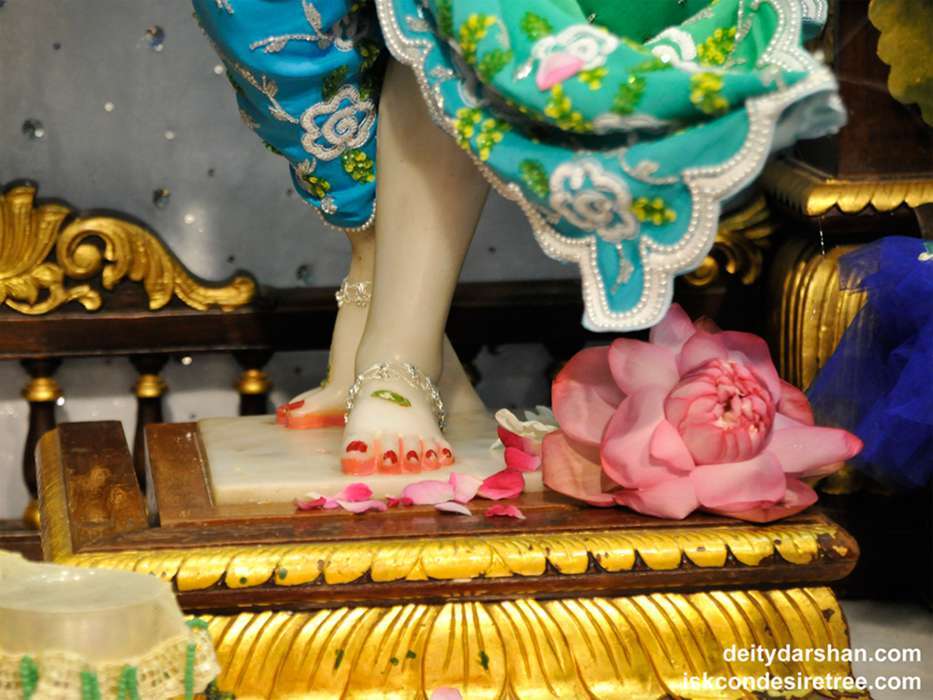
Murari Mahiti
The Puri Devotee Whom Sarvabhauma Described as Having "Nothing Other Than Your Lotus Feet"
Also known as Murari Mahati, Murari Māhiti
“This is Murari Mahiti, the brother of Shikhi Mahiti. He has nothing other than Your lotus feet.”
Sarvabhauma Bhattacharya's words introducing Murari Mahiti to Sri Chaitanya Mahaprabhu at Kashi Mishra's house, Sri Chaitanya-charitamrita, Madhya-lila 10.44
Murari Mahiti appears in Sri Chaitanya-charitamrita through a single introduction, and that introduction says almost everything the text preserves about him. When Sarvabhauma Bhattacharya presented him to Sri Chaitanya Mahaprabhu at Jagannatha Puri, two lines were enough: "This is Murari Mahiti, the brother of Shikhi Mahiti. He has nothing other than Your lotus feet." He was the youngest of three siblings in a family bound to the Jagannatha temple's own service. His elder brother, Shikhi Mahiti, held a post at the temple. His sister, Srimati Madhavi Devi, was later counted by Mahaprabhu Himself among His most confidential devotees. Krishnadasa Kaviraja Goswami describes all three together as devotees "who could not forget Him for a moment of their lives." Please note at the start that Murari Mahiti is a completely different person from the far more famous Srila Murari Gupta, the Bengali physician who wrote one of the earliest biographies of Mahaprabhu's Navadvipa years. The two men share a name and lived in the same period, but nothing else. They came from different families and different provinces, and they had different roles in the Lord's life.
| Detail | Description |
|---|---|
| Family | Younger brother of Shikhi Mahiti, an official at the Jagannatha temple; brother of Srimati Madhavi Devi |
| Region | Jagannatha Puri, Odisha - the title Mahiti marks an Odia temple-service family |
| Born / Disappeared | Not recorded |
| Association with Mahaprabhu | Named among the Puri devotees who "constantly associated with Chaitanya Mahaprabhu while He resided in Jagannatha Puri" (Chaitanya-charitamrita, Adi-lila 10.136) |
| Documented episode | Introduced by name to Sri Chaitanya Mahaprabhu by Sarvabhauma Bhattacharya at Kashi Mishra's house, after the Lord's return from South India (Madhya-lila 10.44) |
| Principal source | Sri Chaitanya-charitamrita, Adi-lila Chapter Ten and Madhya-lila Chapter Ten |
A Family in the Jagannatha Temple's Service #
"Mahiti" is not a family name in the ordinary sense. It is an Odia title for temple service, carried like Mahapatra or Pattanayaka by families who hold service posts at the Jagannatha temple in Puri, passed down within the family. Chaitanya-charitamrita shows clearly what the title meant for at least one of the siblings. When Sarvabhauma Bhattacharya introduces the Puri devotees to Mahaprabhu, he names the elder brother as "Shikhi Mahiti, who is in charge of writing" at the temple. This was a writing and record-keeping post. Among other duties, it was responsible for the Madala Panji, the temple's own record of events and calendar. No such post is recorded for Murari Mahiti himself. The text names him only through his relationship to his brother and his devotion to the Lord. Nothing survives about the family's parents, or about a birth year for any of the three siblings. Nothing survives either about Murari Mahiti's own occupation, beyond what the family title suggests. It was a household bound, by service and by name, to Purushottama Kshetra, the sacred area of Lord Jagannatha at Puri.
Introduced to the Lord by Sarvabhauma #
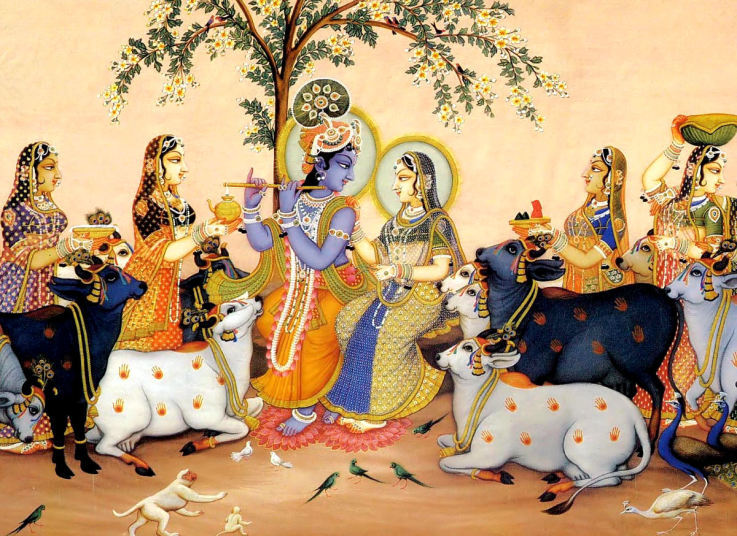
The one scene in which Murari Mahiti appears as an individual, rather than as part of a family group, takes place after Sri Chaitanya Mahaprabhu's return to Jagannatha Puri from His tour of South India. Sarvabhauma Bhattacharya, seated at the Lord's right hand at Kashi Mishra's house, brought Puri's devotees before Him one by one and named each in turn. When Murari Mahiti's turn came, Sarvabhauma needed only a single couplet: he was Shikhi Mahiti's younger brother, and he had no destination in life apart from Mahaprabhu's own feet. The fuller scene, and the row of devotees introduced alongside him, is told in full on Introduced to the Lord by Sarvabhauma.
Constant among the Lord's Puri Associates #
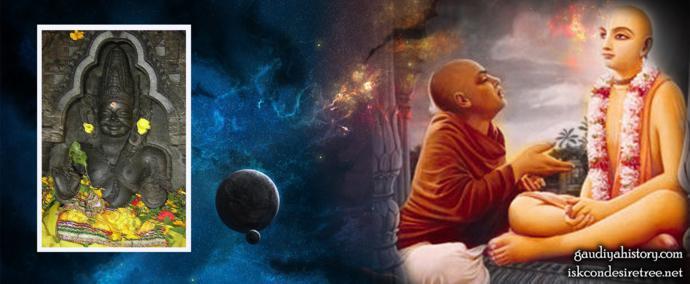
Chaitanya-charitamrita also places Murari Mahiti in a formal list of devotees who "constantly associated with Chaitanya Mahaprabhu while He resided in Jagannatha Puri". This list includes King Prataparudra, the Oriya devotees Krishnananda and Shivananda, Paramananda Mahapatra, Bhagavan Acharya, Brahmananda Bharati, and Shikhi Mahiti himself. We must be careful here, because three men who share only a first name appear in this same record. This Murari Mahiti is not Srila Murari Gupta of Navadvipa. Nor is he Murari Brahmana, a third and otherwise unrecorded devotee. The very same Sarvabhauma Bhattacharya introduces Murari Brahmana to Mahaprabhu two verses after Murari Mahiti, in the same scene at Kashi Mishra's house. Of the three Muraris in Chaitanya-charitamrita's account of the Lord's life, the Murari Mahiti described here is the one from Puri, the brother of Shikhi Mahiti.
One Household of Devotion #
Chaitanya-charitamrita rarely separates Murari Mahiti from his brother and sister. Only one detailed episode of the family's shared life is recorded. One night Shikhi Mahiti woke from an ecstatic dream of Mahaprabhu entering the Jagannatha Deity, and his brother and sister ran with him to the temple to see whether it was true. This episode is narrated in full on Madhavi Devi's own page, Life in Puri with Shikhi Mahiti. Chaitanya-charitamrita's Antya-lila goes further still. It ranks Shikhi Mahiti among the three men whom Mahaprabhu accepted as His most confidential devotees in the entire world, alongside Svarupa Damodara Goswami and Ramananda Raya. Madhavi Devi was counted as the remaining half. Murari Mahiti is not named in that particular ranking. But the text describes the three siblings together as devotees who could not forget the Lord for a moment of their lives. This suggests a household in which all three shared one devotional life, even though only two are singled out by rank.
What the Record Does Not Say #
No source gives a birth year, a disappearance year, or a native place for Murari Mahiti beyond his family's association with Jagannatha Puri. The Gaura-ganoddesha-dipika gives his brother and sister identities in Krishna's own pastimes, but not him. It names Shikhi Mahiti as Ragalekha, a former associate of Radharani, and Madhavi Devi as Kalakeli, but records nothing like this for Murari. He never speaks in his own voice anywhere in Chaitanya-charitamrita. Every word connected with him belongs to Sarvabhauma, describing him to the Lord. So in the end, the record leaves us no life story. It leaves a single, complete sentence of devotion: a man with nothing but the Lord's lotus feet. That is all we report here, and we do not invent a fuller story around it.
Scriptural evidence
প্রতাপরুদ্র রাজা, আর ওঢ্র কৃষ্ণানন্দ ।
পরমানন্দ মহাপাত্র, ওঢ্র শিবানন্দ ॥
ভগবান্ আচার্য, ব্রহ্মানন্দাখ্য ভারতী ।
শ্রীশিখি মাহিতি, আর মুরারি মাহিতি ॥
prataparudra raja, ara odhra krsnananda
paramananda mahapatra, odhra sivananda
bhagavan acarya, brahmanandakhya bharati
sri-sikhi mahiti, ara murari mahiti
Word for word
prataparudra raja: King Prataparudra of Orissa; odhra krsnananda: Krsnananda, an Oriya devotee; paramananda mahapatra: Paramananda Mahapatra; odhra sivananda: the Oriya Sivananda; bhagavan acarya: Bhagavan Acarya; brahmananda-akhya bharati: the devotee named Brahmananda Bharati; sri-sikhi mahiti: Sri Sikhi Mahiti; murari mahiti: Murari Mahiti.
King Prataparudra of Orissa, the Oriya devotees Krsnananda and Sivananda, and Paramananda Mahapatra, Bhagavan Acarya, Brahmananda Bharati, Sri Sikhi Mahiti and Murari Mahiti constantly associated with Caitanya Mahaprabhu while He resided in Jagannatha Puri.
From the purport: Śikhi Māhiti, Mādhavī and their brother Murāri Māhiti were all unalloyed devotees of Śrī Caitanya Mahāprabhu who could not forget Him for a moment of their lives.
The formal listing that places Murari Mahiti among the devotees who constantly surrounded Mahaprabhu at Puri, alongside his brother Shikhi Mahiti and King Prataparudra.
কৃষ্ণদাস-নাম এই সুবর্ণ-বেত্রধারী ।
শিখি মাহাতি-নাম এই লিখনাধিকারী ॥
krsnadasa-nama ei suvarna-vetra-dhari
sikhi mahati-nama ei likhanadhikari
Word for word
krsnadasa: Krsnadasa; nama: named; ei: this; suvarna: golden; vetra-dhari: carrier of the cane; sikhi mahati: Sikhi Mahiti; nama: named; ei: this; likhana-adhikari: entrusted with writing.
Sarvabhauma Bhattacharya continued, "This is Krsnadasa, who carries a golden cane, and here is Sikhi Mahiti, who is in charge of writing."
From the purport: Purport excerpt: "The person in charge of writing is also called deula-karana-pada-prapta karmacari. He is employed especially to write a calendar called Matala-panji."
The source for Shikhi Mahiti's actual temple post, cited here for the family background it gives Murari Mahiti's own introduction two verses later.
চন্দনেশ্বর, সিংহেশ্বর, মুরারি ব্রাহ্মণ ।
বিষ্ণুদাস, — ইঁহ ধ্যায়ে তোমার চরণ ॥
candanesvara, simhesvara, murari brahmana
visnudasa, — inha dhyaye tomara carana
Word for word
candanesvara: Candanesvara; simhesvara: Simhesvara; murari brahmana: the brahmana named Murari; visnudasa: Visnudasa; inha: all of them; dhyaye: meditate; tomara: Your; carana: on the lotus feet.
"Here are Candanesvara, Simhesvara, Murari Brahmana and Visnudasa. They are all constantly engaged in meditating on Your lotus feet."
Introduced two verses after Murari Mahiti in the very same scene, this second 'Murari' - Murari Brahmana - is a separate, otherwise unrecorded devotee.
প্রভু লেখা করে যারে — রাধিকার 'গণ' ।
জগতের মধ্যে 'পাত্র' — সাড়ে তিন জন ॥
prabhu lekha kare yare — radhikara 'gana'
jagatera madhye 'patra' — sade tina jana
Word for word
prabhu: Sri Caitanya Mahaprabhu; lekha kare: accepts; yare: whom; radhikara gana: as one of the associates of Srimati Radharani; jagatera madhye: throughout the whole world; patra: most confidential devotees; sade tina: three and a half; jana: persons.
Sri Caitanya Mahaprabhu accepted her as having formerly been an associate of Srimati Radharani. In the entire world, three and a half people were His intimate devotees.
The verse that first states the "three and a half" count of Mahaprabhu's most confidential devotees, the same ranking in which Murari Mahiti's own brother Shikhi Mahiti is named among the three (see the next verse) and his sister Madhavi Devi as the half.
স্বরূপ গোসাঞি, আর রায় রামানন্দ ।
শিখি-মাহিতি — তিন, তাঁর ভগিনী — অর্ধজন ॥
svarupa gosani, ara raya ramananda
sikhi-mahiti — tina, tanra bhagini — ardha-jana
Word for word
svarupa gosani: Svarupa Gosvami; ara: and; raya ramananda: Ramananda Raya; sikhi-mahiti: Sikhi Mahiti; tina: three; tanra bhagini: his sister; ardha-jana: half a person.
The three were Svarupa Damodara Gosvami, Ramananda Raya and Sikhi Mahiti, and the half a person was Sikhi Mahiti's sister.
Names the three most confidential devotees directly, referenced in the "One Household of Devotion" section: Murari Mahiti's own brother Shikhi Mahiti is ranked among the three, alongside Svarupa Damodara Goswami and Ramananda Raya, with their sister Madhavi Devi as the remaining half. Murari Mahiti himself is not named in this particular ranking.
- Sri Chaitanya-charitamrita, Adi-lila 10.135-136 (Bhaktivedanta VedaBase)
- Sri Chaitanya-charitamrita, Madhya-lila 10.40-45 (Bhaktivedanta VedaBase)
- Sri Chaitanya-charitamrita, Madhya-lila, Chapter Ten Summary (Bhaktivedanta VedaBase)
- Sri Chaitanya-charitamrita, Antya-lila 2.104-106 (Bhaktivedanta VedaBase)
- Gaudiya History: Murari Mahiti - Biography
- Gaudiya History: Shikhi Mahiti - Biography
- Nandgram Dham: Srimati Madhavi Devi (sister, with the shared family episode)
- Nandgram Dham: Srila Murari Gupta (a distinct figure, not to be confused with Murari Mahiti)
Frequently asked
When was Murari Mahiti born?
Murari Mahiti appeared Not recorded in Not recorded; his family was established at Jagannatha Puri, Odisha.
When and where did Murari Mahiti disappear?
Murari Mahiti disappeared Not recorded at Not recorded.
What are the main pastimes of Murari Mahiti?
The pastimes covered here include: Introduced to the Lord by Sarvabhauma.