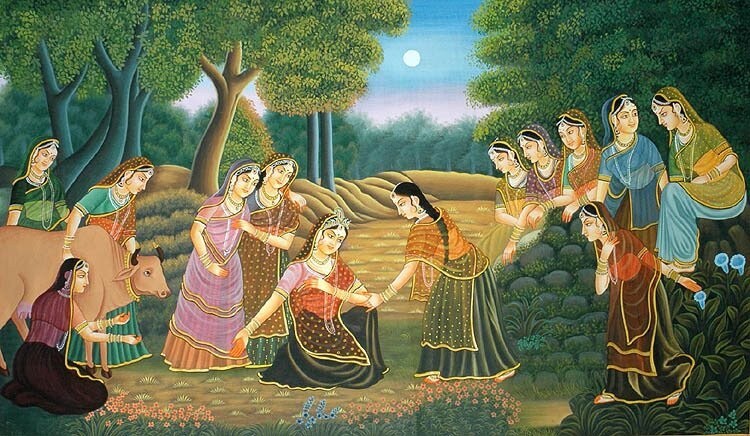
Sri Chaitanya-charitamrita speaks of Madhavi Devi, Shikhi Mahiti and Murari Mahiti together, as one family of devotion, not as three separate stories: "Shikhi Mahiti, Madhavi and their brother Murari Mahiti were all unalloyed devotees of Sri Chaitanya Mahaprabhu who could not forget Him for a moment of their lives." The three are named together wherever the text lists the devotees who constantly surrounded Sri Chaitanya Mahaprabhu at Jagannatha Puri, alongside figures such as King Prataparudra, the Oriya devotees Krishnananda and Shivananda, Paramananda Mahapatra, Bhagavan Acharya and Brahmananda Bharati. Only one episode from their shared life survives in any detail, but it is a vivid one, and Madhavi Devi is present in it from beginning to end.
A Household Among Puri's Devotees #
The siblings do not stand alone in the text. They are part of a whole circle of Oriya devotees who surrounded Mahaprabhu during His Puri years. This circle also included Ramananda Raya and his father Bhavananda Raya. Chaitanya-charitamrita lists Shikhi Mahiti and Murari Mahiti by name in that same list, and Madhavi Devi immediately after it, as devotees who "constantly associated with Chaitanya Mahaprabhu while He resided in Jagannatha Puri." So the text places this household at the heart of Puri's devotional life, not at its edge.
An Ecstatic Dream in the Night #
According to a purport in Chaitanya-charitamrita's Adi-lila, which draws on an Oriya-language work called Chaitanya-carita-mahakavya, Shikhi Mahiti had a habit of mentally serving the Lord even while falling asleep. One night, absorbed in that service, he fell into a dream so vivid that when Madhavi Devi and Murari Mahiti came to wake their elder brother, they found him in a state of full ecstasy. He told them he had dreamed of Lord Chaitanya visiting the temple of Jagannatha and, astonishingly, entering the body of the Jagannatha Deity and coming back out of it again and again. Shikhi Mahiti's voice faltered as he spoke, tears in his eyes, still uncertain whether what he had seen was a dream or something more: "I am still seeing the same dream. Do you think I have become deranged?" he asked his brother and sister. "And the most wonderful thing is that as soon as I came near Chaitanya Mahaprabhu, He embraced me with His long arms."
What the Three Found at the Temple #
The three siblings did not dismiss the dream. They went together to the temple of Jagannatha to see for themselves. There, in the Jagamohana hall where kirtana was held, they found Sri Chaitanya Mahaprabhu exactly as Shikhi Mahiti had described Him in the dream: absorbed in looking at the beauty of the Jagannatha Deity. When Mahaprabhu saw them, His response confirmed that the dream had not been an illusion. He embraced Shikhi Mahiti at once, exclaiming, "You are the elder brother of Murari!" Mahaprabhu did not name Shikhi Mahiti by his own identity, but by his relationship to his younger brother. It was a small personal touch, typical of Him, and Chaitanya-charitamrita records it with clear affection. Madhavi Devi's own reaction to the moment is not recorded, but she is named as present throughout, one of "his brother and sister" who witnessed it alongside Shikhi Mahiti.
The same purport that preserves this dream also records how the tradition understands the two siblings' eternal identity: the Gaura-ganoddesha-dipika (189) names Shikhi Mahiti as a former assistant of Srimati Radharani called Ragalekha, and Madhavi Devi as another of Radharani's assistants, named Kalakeli. A brother and sister who woke each other in the night to run together to see the Lord are, in that account, understood to have already stood together at Radharani's side.
A Family United in Purpose #
This one narrated episode shows more about the siblings' shared devotional life than any single sentence about Madhavi Devi on her own could. It shows mental service carried on late into the night. It shows a willingness to be woken and to go together to the temple, simply because of a dream. And it shows a Lord who received all three of them as one family, not as three separate devotees. This fits how the text treats them elsewhere, as a group, rarely mentioned apart from one another. It is also the only place where the record shows Madhavi Devi doing anything at all, not simply being described. The other recorded moment touching her life at Puri involved a very different kind of test, for a different devotee entirely. It is told separately on The Rice Alms and Junior Haridasa.
