Two different traditions describe Narottama Dasa Thakura's final days, and they do not fully agree. Sri Chaitanya-charitamrita was completed by Krishnadasa Kaviraja Goswami within or shortly after Narottama's own lifetime. But it does not tell the story of his life the way it tells the lives of the Six Goswamis. What is known of Narottama's final years comes instead from later biographical works, such as the Bhakti-ratnakara, compiled by Narahari Chakravarti.
Grief for Ramachandra Kaviraja and Srinivasa Acharya #
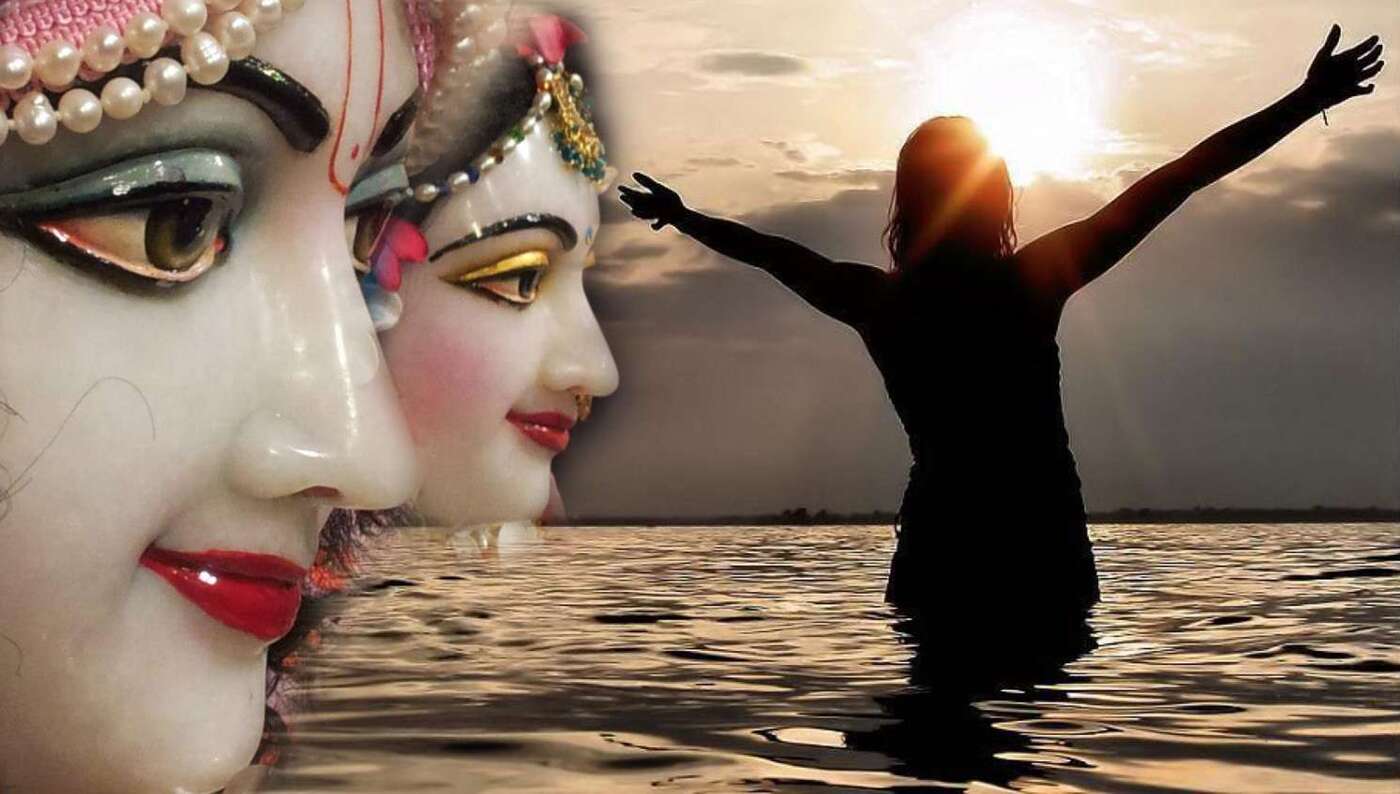
According to the Bhakti-ratnakara, Narottama's own disciple Ramachandra Kaviraja traveled to Vrindavana in his final years and passed away there. When word of this reached Srinivasa Acharya, he could not bear the separation and passed away himself shortly after. When Narottama received this news, he described himself as drowning in an ocean of separation. In this state, he is said to have composed the song ye anilo prema-dhana. Soon afterward, at a temple of Mahaprabhu in a village called Gambhila near Kheturi, Narottama asked the assembled devotees to perform sankirtana. As they chanted, he walked into the waters of the Ganges and disappeared from view while still absorbed in the holy name. His disappearance day is traditionally observed on Krishna Panchami in the month of Karttika.
A Different Telling #
A separate tradition tells the story of his final period differently. It is found in some modern retellings, including the English-language Wikipedia article on Narottama. This version links his passing to the caste controversy over his brahmana disciples. It describes a moment when brahmana critics blamed his failing health on the offense of initiating brahmanas as a non-brahmana. It adds an episode in which his grieving disciples asked him to return, so that his critics would be proved wrong. After this he is said to have lived roughly another year before finally departing "by dissolving in the river Padma." Both traditions place his departure at a river near Kheturi, and in a mood connected to sankirtana. But they do not agree on what happened just before it, and neither gives a year that can be checked against other evidence. This difference is left open here, not settled. That fits the kind of sources we have. Much of Narottama's life story rests on devotional biographies compiled generations after his lifetime, not on records made in his own time. The same limitation is true of most sources for this period of Gaudiya Vaishnava history.
The Narottama-vilasa's Own Account #
When it is read closely, the Narottama-vilasa appears to describe both of the tellings above as stages of one continuous ending, not as two rival stories. In its account, Narottama's disciples first brought him, gravely ill, to Budhari and then to a temple at Gambhila to bathe in the Ganges. There he sat silently for three days and seemingly left his body before many witnesses. At that point brahmana critics began loudly blaming his condition on the offense of a non-brahmana initiating brahmanas. Then his disciple Ganganarayana Chakravarti prayed for his master's return. It is said that Narottama's eyes then opened and his body shone with a sudden bright light, and that this silenced the criticism at once. This same account says that only later, in 1611 CE, Narottama returned to the Ganges a final time with Ganganarayana and other disciples. As he entered the water, his body is described as dissolving into milk. That milk, tradition says, was carried to Jiya Ganja near Murshidabad in Bengal. There a samadhi called Dugdha-samadhi, "the tomb of milk," was raised, and it remains a place of pilgrimage. Though this account has great devotional power, it does not easily agree with the Vrindavana samadhi described just below. No attempt is made here to force the two into agreement. Both are given as the tradition has kept them.
A Living Legacy #
What is not in dispute is the size of what Narottama left behind. His samadhi stands in the courtyard of the Radha-Gokulananda temple in Vrindavana, near that of his own guru Lokanatha Gosvami. It is among the largest in that courtyard. Tradition holds that in the eternal pastimes of Radha and Krishna he serves as the manjari Champaka Manjari. Disciples such as Ganganarayana Chakravarti and Ramakrishna Acharya carried his instruction forward in Bengal. Ganganarayana was a learned brahmana of Gambhila who took shelter of Narottama after hearing him explain the Goswamis' teachings. The community Narottama helped unite at Kheturi continued to look to his writings and those of Srinivasa Acharya as the standard for Gaudiya Vaishnava theology. Centuries later, that legacy reached far beyond Bengal. Srila Prabhupada, a spiritual descendant of Narottama through Bhaktisiddhanta Sarasvati Thakura and Bhaktivinoda Thakura, carried Narottama's songs with him to the West. Today they are sung in ISKCON temples on every continent. The prince who once walked away from a kingdom with nothing could hardly have imagined influence on such a scale.
