Srila Narottama Dasa Thakura
Poet-Saint Who United Gaudiya Vaishnavism at Kheturi
The complete life, on one page: The main biography and every pastime page, in order, in one place
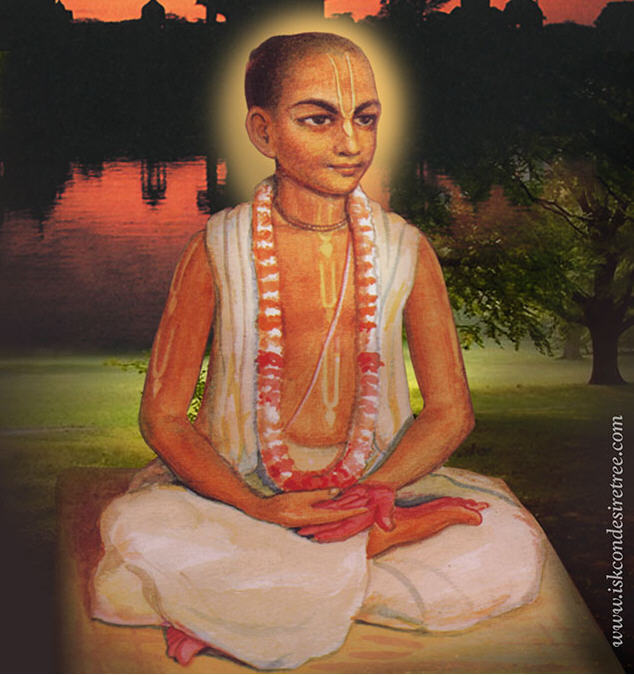
Introduction
Srila Narottama Dasa Thakura was one of three preachers, together with Srinivasa Acharya and Shyamananda Prabhu, who carried the teachings of the Six Goswamis of Vrindavana back into Bengal a generation after the disappearance of Chaitanya Mahaprabhu. He was born into a princely landholding family of Gopalpur-Kheturi, in what is now Rajshahi district, Bangladesh. He gave up a kingdom to seek Vrindavana and became the dear disciple of Lokanatha Gosvami. He is remembered above all for organizing the Kheturi festival, and for writing the devotional songs of Prarthana and Prema-bhakti-candrika, which Gaudiya Vaishnavas still sing today.
| Detail | Description |
|---|---|
| Birth | Month of Magha; exact tithi and year disputed. Narottama-vilasa, one of the four traditional biographies, places the year at 1534 CE (see below) |
| Birthplace | Kheturi, Gopalpur pargana, Rajshahi district (present-day Bangladesh) |
| Parents | Raja Krishnananda Datta and Narayani Devi |
| Diksha Guru | Lokanatha Gosvami |
| Siksha Guru | Jiva Goswami |
| Manjari identity | Champaka Manjari, assisting Rupa Manjari's service to Radha and Krishna |
| Major Works | Prarthana, Prema-bhakti-candrika |
| Disappearance | Karttika, Krishna Panchami; year not established by most sources, though Narottama-vilasa gives 1611 CE (see below) |
The biography of Srila Narottama Dasa Thakura is traditionally drawn from four Bengali works: Bhakti-ratnakara, Narottama-vilasa, Prema-vilasa, and Narottama-carita.
Chapter 1
Royal Birth and Renunciation
A prince of Kheturi hears of Gauranga's mercy and slips away from his kingdom for Vrindavana.
Narottama Dasa Thakura was born into a family that ruled the Gopalpur pargana from its seat at Kheturi, a town on the Padma River in what is now Rajshahi district, Bangladesh. His father, Raja Krishnananda Datta, and his uncle Purushottama Datta were known across the region for their wealth; his mother was Narayani Devi. Traditional biographies describe the newborn prince as bearing the physical signs of a mahapurusha: long arms reaching to the knees, a deep navel, eyes shaped like lotus petals, and a complexion of molten gold. The family's astrologers, examining the birth chart, are said to have predicted the boy would grow up to be either a great king or a mendicant preacher. His anna-prasanna, the ceremony marking a child's first taking of grain, was itself an occasion for the king to distribute charity, and townspeople are said to have gathered simply to see the boy.
| Detail | Description |
|---|---|
| Father | Raja Krishnananda Datta |
| Mother | Narayani Devi |
| Uncle | Purushottama Datta |
| Cousin (later patron) | Santosh Datta |
| Home | Kheturi, on the Padma River |
A Prodigy Who Lost Interest in Scripture #
As a boy, Narottama was said to be a shruti-dhara, able to remember anything he heard only once. He mastered Sanskrit grammar, poetry, and the scriptures in a remarkably short time, and he was also considered an expert in rhetoric and prosody. But as he grew, he found less and less use for learning that did not lead directly to the service of Krishna. Around this time he heard wandering devotees speak of the mercy of Chaitanya Mahaprabhu and Nityananda Prabhu, and his heart began to change. He began repeating their names in japa through the day and night. The biographies describe a vivid dream in which Gaurasundara Himself appeared before him with His eternal associates. Other retellings do not stress any single vision. Instead they describe a longing that simply grew, year after year, from the pilgrims and devotees who passed through his father's territory on their way to and from the holy places of Bengal. Both versions agree on the result. Narottama could no longer picture himself as heir to a kingdom. He stopped joining the other children of the household in their games, and stayed absorbed in thoughts of Vrindavana instead.
A Bath in the Padma #
The Narottama-vilasa gives a fuller account of the moment when the family's fears began to come true. It says Nityananda Prabhu appeared to the teenage Narottama in a dream and told him to bathe in the Padma at daybreak. He promised that Narottama would there receive the fullness of Gaura-prema. Narottama obeyed at once. At a spot still shown to pilgrims today as Prema-tali Ghat, Mahaprabhu Himself is said to have appeared in the water and embraced him. In that moment Narottama's complexion is described as changing to Mahaprabhu's own molten-gold hue. He returned home in tears of separation, and at first his parents could not understand why.
Watched, and Then Gone #
Narottama's parents noticed that he cared little for the pleasures and duties expected of a prince. They feared the very thing that later happened, so they set a guard to keep him close to home. According to the Narottama-vilasa, he did not get his chance to slip away until some time after the guard was set. At around sixteen he was summoned to the court of the local Jaygirdar, a Mughal-era district governor. On the way Narottama managed to break away from his escort and vanish into the forest. He went toward Vraja, not toward Navadvipa, which was nearer but too obvious. One of the search parties his father sent finally caught up with him. Narottama is said to have compared himself to a devoted wife resolved to join her husband on the funeral pyre. No well-wisher, he told them, could rightly hold back a wife so determined, and he asked to be allowed to enter the fire of his own devotion in the same way. Other traditions say his chance came earlier still, in the more general account that his father and uncle were summoned away to meet with the ruling authority of Bengal. On the full-moon night of the month of Kartika, Narottama left the palace behind and set out toward Mathura and Vrindavana as a pilgrim travelling alone. He crossed Bengal quickly and found the road to Mathura crowded with fellow pilgrims. Some of them recognized him from his bearing as a king's son, and treated him with special affection along the way. He lived on whatever milk, fruit, or roots he could find, and biographies say his hunger and thirst were forgotten in his eagerness to reach Vrindavana. As he walked he sang his own prayers for the mercy of Nityananda Prabhu: ara kabe nitai chand, karuna karibe, "when will the moon of Nitai show mercy on me," a verse still sung by Gaudiya Vaishnavas today. It expresses the same longing that carried its author out of a kingdom and onto the road.
Chapter 2
Discipleship Under Lokanatha Gosvami
Directed by Jiva Goswami to a reluctant Lokanatha Gosvami, Narottama wins initiation through a year of hidden service.
After crossing Bengal and reaching Mathura, Narottama wept at his first sight of the Yamuna. He pressed on to Vrindavana itself, where Jiva Goswami received him warmly. But Jiva Goswami did not usually give formal initiation to disciples himself. He told Narottama to seek shelter instead at the feet of Lokanatha Gosvami, the eldest of the Goswamis living there. Lokanatha Gosvami was so absorbed in separation from Chaitanya Mahaprabhu, and disliked name and fame so much, that he is said to have asked Krishnadasa Kaviraja Goswami to leave his own name out of Sri Chaitanya-charitamrita altogether.
A Guru Who Did Not Want Disciples #
When Narottama approached him, Lokanatha Gosvami refused outright. By most accounts he simply did not wish to accept anyone as a disciple. In one telling he asks how he could take on the responsibility of serving as someone else's guru, when he himself could not even properly serve Gaura and Nityananda. In another he protests that a prince, so clearly learned and refined as Narottama was, should not become the disciple of a penniless renunciant. Narottama asked again and again and was refused every time. Yet he resolved privately that he would accept initiation from Lokanatha Gosvami or from no one else.
A Year of Hidden Service #
Instead of pressing his request further, Narottama began going out secretly each night to clean the forest area where Lokanatha Gosvami relieved himself. He took care that Lokanatha Gosvami never learned who was doing it. He kept this up for close to a year before Lokanatha Gosvami discovered who he was. Moved by such quiet, humble devotion, Lokanatha Gosvami gave in and initiated Narottama on the full-moon day of the month of Shravana. This story is still told across Gaudiya Vaishnava tradition as an example of how humility, not birth or status, wins a guru's heart. The sources agree on this point. Lokanatha Gosvami performed the initiation himself, even though he was unwilling at first. He did not hand the rite over to Jiva Goswami or to anyone else. At the same time, Lokanatha Gosvami revealed Narottama's own eternal identity in Krishna's pastimes. He was Champaka Manjari, a maidservant who assists Rupa Manjari in her confidential service to Radha and Krishna. This is an inner teaching that a guru does not usually reveal so soon after initiation.
An Eternal Service Revealed in a Dream #
Soon after his initiation, tradition says, a Vaishnavi appeared to Narottama in a dream. She told him that his sincerity had earned him a confidential service. Each afternoon in the kunja, she said, the gopi Champakalata prepares a milk dish for Krishna, and Narottama would now assist her in boiling the milk. Narottama ran to tell Lokanatha Gosvami of the dream. His guru embraced him and confirmed that the Vaishnavi was Radharani Herself. She was simply giving back to Narottama a service that was already, eternally, his own. From then on, devotees say, Narottama would sometimes become so deeply absorbed in meditation on this service that, when the milk in his vision began to overflow, he would try to stop it with his bare hands. He bore the burns without complaint. Afterward he tried to keep his marked hands covered, but all of Vrindavana came to know how he had received them.
Formed by Two Goswamis at Once #
After initiation, Narottama remained in Vrindavana, living by madhukari: begging only a little food from door to door, in the manner of a bee gathering pollen, so as never to keep a stocked kitchen of his own. He continued his deeper studies of rasa-shastra under Jiva Goswami, who was his siksha-guru even after Lokanatha Gosvami had become his diksha-guru. Lokanatha Gosvami himself is remembered chiefly for his single-minded absorption in the Radha-Vinoda Deity. Tradition holds that Krishna personally gave him this Deity to carry through the forests of Vraja in a cloth bag. Narottama's regard for his guru later appeared in his verses. He wrote of Lokanatha Gosvami as "a storehouse of single-minded service to the lotus feet of Radha-Vinoda," the same Deity Lokanatha Gosvami carried through Vraja. Around this time Narottama's closest companion in study became Srinivasa Acharya, and before long they were joined by Shyamananda Prabhu, newly arrived from Gauda-desha. The three studied together under Jiva Goswami with such single-minded absorption that later biographies speak of them together as the generation that would carry the Goswamis' teaching out of Vrindavana. That moment came when Jiva Goswami called the three of them together and instructed them to take the Goswamis' writings to Bengal and preach the message of Chaitanya Mahaprabhu there (see Return to Bengal and Preaching).
Chapter 3
Return to Bengal and Preaching
Carrying the Goswamis' writings to Bengal, Narottama met both joyful reunions and bitter caste-based opposition.
Narottama, Srinivasa Acharya, and Shyamananda Prabhu left Vrindavana together, carrying with them manuscripts of the Goswamis' writings. These books would give the widely scattered Bengali Vaishnava community access to the theology that was being developed in Vrindavana. On the way, as they passed through Vishnupur, the manuscripts were stolen in the night by agents of the local ruler, who apparently mistook the chest for buried treasure. The three searched anxiously before learning that the local king held the books in his own storehouse. At that point Shyamananda Prabhu turned toward Odisha, Narottama continued on toward Kheturi, and Srinivasa Acharya stayed behind to recover the manuscripts. That mission is told mainly in Srinivasa Acharya's own biography and is only touched on here.
A Pilgrim Among Old Devotees #
Before settling at Kheturi, Narottama travelled widely through the holy places of Bengal. He visited many of the older generation of Vaishnavas who had known Chaitanya Mahaprabhu directly. At Navadvipa he is said to have met an elderly brahmana who had watched Chaitanya Mahaprabhu discuss scripture at that very spot years before. The meeting moved both men to tears. Narottama then went on to the households of Srivasa Thakura's family, Shuklambara Brahmachari, and Ishana Thakura, an old servant of Chaitanya Mahaprabhu's mother Sachi Devi. He continued to Shantipura to see Advaita Acharya's son Acyutananda, and to Ambika Kalna to meet Gauridasa Pandita's disciple Hridaya Chaitanya. He also went to Saptagram, where the devotees of the departed Uddharana Datta Thakura were still absorbed in grief at his passing. At Kharadaha he met Jahnava Devi and Vasudha, the consorts of Nityananda Prabhu. The Bhakti-ratnakara records that they personally blessed him. He went on to Shri Khanda to see Narahari Sarkara Thakura, who had known his father. Then he went to Khanakula to see Abhirama Gopala Thakura and his Gopinatha Deity, and to Ekachakra, the birthplace of Nityananda Prabhu itself. From there he traveled to Jagannatha Puri. There he visited the samadhi of Haridasa Thakura and the Gopinatha temple associated with Chaitanya Mahaprabhu's final days, before continuing to Shyamananda Prabhu's base at Nrisimhapura.
Opposition on Grounds of Caste #
Once Narottama began actively making disciples in Bengal, including brahmanas by birth, he ran into fierce resistance. Whatever its royal standing, his family was not brahmana by caste. Sources describe the family as Kulin Kayastha, a caste of scribes and administrators that had risen to zamindari rank without holding priestly status. To a number of orthodox smarta brahmanas, the idea of such a person initiating brahmanas into vaishnava mantra was intolerable.
Traditional accounts preserve more than one episode showing how this played out. In one, a brahmana who had publicly insulted Narottama as a shudra was struck with leprosy. Only after he sought forgiveness at Narottama's feet, the story goes, was he healed. In another, two young brahmana sons of a zamindar named Shivananda Acharya were sent to slaughter goats for a Durga puja. Afterwards they took initiation from Narottama and his disciple Ramachandra Kaviraja, and their father was furious. Shivananda brought in a celebrated logician from Mithila to publicly defeat Vaishnava theology, but the debate went against him instead. In a related episode, a different ruler sent the visiting scholar Rupa Narayana to defeat Narottama directly. But first, two of the scholar's own students were defeated by two of Narottama's own disciples, who were working in disguise as a potter and a betel-seller in the marketplace. The students did not know who their opponents were. A gentler episode tells of a brahmana named Jagannatha Acharya, a worshiper of Durga. He is said to have been told in a dream to seek shelter of Narottama and take up Krishna-bhajana. He did so without protest and became one of Narottama's dear disciples. This is a reminder that not every brahmana who came to him arrived in opposition.
We cannot be sure of the exact history behind these devotional stories. But they all keep the same memory. Narottama did not answer caste-based hostility by running away, or by fighting back. Instead he quietly held that surrender to Krishna, not birth, decides who may serve and who may lead. Later Gaudiya Vaishnava teaching repeats this again and again.
Chapter 4
The Kheturi Festival
At Kheturi, six Deities are installed and the scattered followers of the Six Goswamis are drawn into one Vaishnava family.
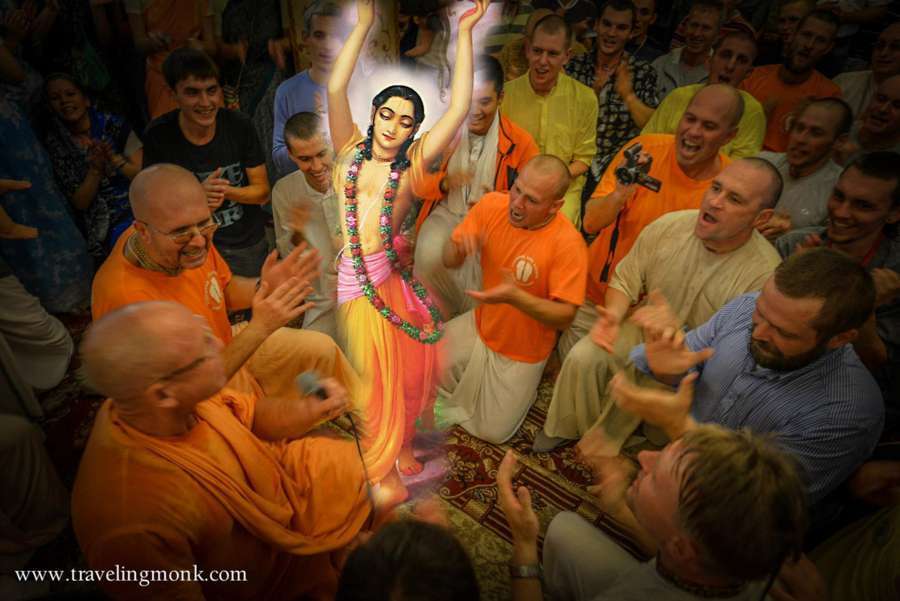
Narottama's arrival back at Kheturi after years away was itself an occasion for celebration. His father and uncle had both passed away by then, and the family estate had come to his cousin Santosh Datta. Santosh greeted Narottama with the same joy the whole town felt at his homecoming. Narottama initiated Santosh into the Radha-Krishna mantra. Santosh wanted to build something lasting, so he asked for Narottama's blessing to construct a temple at Kheturi, and received it. The complex that followed was large for its time: a temple, a storehouse, a kirtana hall, rooms for visiting devotees, a bathing pond, and a flower garden. Its dedication was timed for the appearance day of Chaitanya Mahaprabhu on the full moon of Phalguna, and it grew into the event now remembered as the Kheturi Mahotsava. Tradition also tells of a wonderful sign in the nearby village of Gopalpura. A brahmana there named Vipra Das is said to have kept a venomous snake in his household grain-bin. When Narottama visited his house, the snake is said to have vanished, and Deities of Gaura and Vishnupriya are said to have appeared in its place. Before the eyes of everyone present, the Deities climbed of their own accord into Narottama's lap. Those same Deities, the Bhakti-ratnakara records, are worshiped to this day in Gambhila.
| Detail | Description |
|---|---|
| Location | Kheturi, on the Padma River, Bengal |
| Patron | Raja Santosh Datta |
| Presiding | Jahnava Devi, consort of Nityananda Prabhu |
| Installation rites | Performed by Srinivasa Acharya |
| Deities installed | Six: Gauranga, Vallabhi-kanta, Krishna, Vrajamohana, Radha-ramana, and Radha-kanta |
| Also present | Shyamananda Prabhu, and Vaishnavas gathered from across Bengal and Odisha |
Six Deities and a Sea of Devotees #
Word of the festival went out to Vaishnavas across Bengal and beyond, and traditional accounts describe an extraordinary gathering. In these accounts Jahnava Devi arrives from Kharadaha with her own party, Shyamananda Prabhu from Nrisimhapura in Odisha, Narahari Sarkara and Raghunandana from Shri Khanda, Acyutananda from Shantipura, and Hridaya Chaitanya from Ambika Kalna, along with dozens of other named devotees. Santosh Datta arranged boats to ferry the arriving guests across the river and palanquins to carry them into Kheturi itself, where separate lodging was found for everyone. Srinivasa Acharya performed the abhisheka and installation rites for the six Deities after days of preparation. Gateways were decorated with banana leaves and auspicious symbols. Grain, ghee, milk, and vegetables were stored in such quantities that the Bhakti-ratnakara later compared them to the legendary Rajasuya sacrifice. After the installation, and again the following evening for Chaitanya Mahaprabhu's own appearance ceremony, Jahnava Devi had the assembled Vaishnavas play with colored powder in a mood recalling Holi. Narottama himself led much of the kirtana that ran through both nights. The Bhakti-ratnakara, the main traditional source for this event, describes the devotees as feeling that Chaitanya Mahaprabhu Himself had appeared within the sankirtana to join them, along with Nityananda Prabhu, Advaita Acharya, and their own eternal associates.
Healing a Divided Family of Devotees #
The festival's importance went beyond its size or its Deity installations. In the decades since Chaitanya Mahaprabhu's disappearance, different communities of His followers had slowly grown apart in their mood of worship. Those who had known Him personally in Navadvipa related to Him in the close, affectionate moods of His youth. The followers of the Six Goswamis knew Him mainly as the renounced sannyasi of His Puri years, so they related to Him with more reverence and distance. At Kheturi, Jahnava Devi presided. Narottama, Srinivasa Acharya, and Shyamananda Prabhu shared the leadership, and they were later remembered together as the first generation of acharyas after the Six Goswamis. Under them these separate streams of devotees sat, sang, and took prasadam together as one community for three days, before going back to their own homes. The temple and the Deities matter. But the Kheturi Mahotsava counts among the key events in the early history of Gaudiya Vaishnavism just as much because it drew a scattered movement together into one shared identity (see Literary and Musical Legacy).
Chapter 5
Literary and Musical Legacy
Simple Bengali songs that Vaishnavas still sing, and that Srila Prabhupada called equal to shastra.
Narottama Dasa Thakura's most lasting legacy is not a temple or an institution. It is a body of Bengali devotional songs that are still sung every day in Gaudiya Vaishnava and ISKCON temples. His two best-known collections are Prarthana and Prema-bhakti-candrika ("Moonrays of Loving Devotion"). Prarthana has thirty-three songs arranged in fifty-five sections, with 258 verses in all. More than half of them are devoted to manjari-sadhana, the confidential practice of seeing oneself, in meditation, in service to Radharani. Prema-bhakti-candrika has 120 verses in nine sections. It sums up, in simple Bengali verse that is easy to sing, the teaching on raga-bhakti that Rupa and Sanatana Goswami had set out in Vrindavana. A later commentator, Vishvanatha Chakravarti Thakura, wrote a full Sanskrit explanation of the Prema-bhakti-candrika. This shows how seriously the tradition took what might otherwise look like a simple devotional poem. Narottama is also credited with translating the Sanskrit Smaranamangala into Bengali verse. The Smaranamangala is an eleven-sloka description of Radha and Krishna's pastimes across the eight periods of the day. He is also credited with the short prose work Hatapaltana. But some question whether this piece is really his, since its account of events does not agree well with the historical record.
| Detail | Description |
|---|---|
| Prarthana | 33 songs in 55 sections, 258 verses, on humility and longing for Krishna and for Vrindavana |
| Prema-bhakti-candrika | 120 verses in 9 sections distilling Rupa and Sanatana Goswami's teaching on raga-bhakti |
| Smaranamangala (translation) | Bengali verse rendering describing Radha-Krishna's pastimes across the eight periods of the day |
| Disputed work | Hatapaltana, attributed to him though some question its authenticity |
| Kirtana style | Garanahati, developed and first sung at the Kheturi festival |
| Still sung today | "Sri Rupa Manjari Pada" and "Sri Guru-carana-padma," regularly sung in Gaudiya Math and ISKCON temples |
A Kirtana Style Born at Kheturi #
Narottama's legacy is musical as much as literary. At the Kheturi festival he brought to life what came to be known as Garanahati kirtana. It was built on the calm and majestic dhrupada style. It also used tala (rhythm), raga (melody), and abhinaya (gesture) with great skill and refinement. Later music scholars have pointed to this as something truly new within Padavali kirtana. Padavali kirtana is the form that opens with Gaura-chandrika, glorification of Chaitanya Mahaprabhu, and then turns to the pastimes of Radha and Krishna themselves. The devotees who compiled the Bhakti-ratnakara describe the effect of Narottama's kirtana at Kheturi in words that sound less like ordinary praise of music and more like scripture itself:
Who can describe the wealth of happiness felt by the devotees when, in the midst of their kirtana, appeared the munificent Sri Chaitanya Mahaprabhu Himself. Like a flash of lightning in the midst of a mass of beautiful clouds, Sri Chaitanya Himself appeared within the crowd of devotees through divine manifestation. (Bhakti-ratnakara 10.572)
How overwhelmed in ecstasy were Advaita and Nityananda! How wonderful was the circle the devotees made around Sri Chaitanya, who danced in its middle. Srinivasa Acharya and Narottama Thakura fully understood these pastimes as the wonderful manifestation of Sri Chaitanya Mahaprabhu's causeless mercy. It was an act of grace shown to Srinivasa Acharya and Narottama Thakura. With this their satisfaction was complete. (Bhakti-ratnakara 10.607)
Songs Prabhupada Called Equal to Shastra #
Srila Prabhupada often quoted Narottama's verses in his own lectures. He quoted this line most often: rupa-raghunatha-pade haibe akuti, kabe hama bujhabo se yugala-piriti ("when will my longing for the feet of Rupa and Raghunatha awaken, so that I may understand the love shared by the divine couple"). He cited it in classes on both Bhagavad-gita and Srimad-Bhagavatam, in different years and on different continents, from Vrindavana to Calcutta to Los Angeles. In a 1975 Srimad-Bhagavatam class in Vrindavana, Prabhupada recalled that Srinivasa Acharya himself had praised Narottama's songs. Srinivasa told him that although the songs were written in simple Bengali, they carried the weight of shruti, Vedic evidence. Elsewhere, commenting on Srimad-Bhagavatam 5.16.20-21, Prabhupada quoted Narottama's prayer ha ha prabhu nanda-suta ("O Lord, son of Nanda Maharaja"). He gave it as an example of the mood of a devotee who has nothing left to depend on but the Lord's lotus feet. In the early years of his mission, Prabhupada also recorded his own melody for Narottama's kirtana Hari Haraye Namah Krishna. This recording still circulates among devotees today.
A Song of Grief for Srinivasa #
Among Narottama's most personal compositions is ye anilo prema-dhana, said to have been written on receiving the news of Srinivasa Acharya's disappearance. Traditional accounts describe Narottama, already grieving the loss of his own disciple Ramachandra Kaviraja, composing the song while barely able to keep his footing in what he called an ocean of separation. Even centuries later, it is still one of the songs Gaudiya Vaishnava communities turn to especially to mourn the disappearance of a great devotee. This matches the reason the song is said to have been written (see Disappearance and Legacy). Srila Prabhupada's own love for these songs is also part of Narottama's legacy. When Srila Prabhupada carried Gaudiya Vaishnavism to the West, he carried Narottama's melodies and words along with it. So a prayer written in sixteenth-century Bengal is now sung every night in temples on almost every continent.
Scriptural evidence for this chapter (1)
hā hā prabhu nanda-suta, vṛṣabhānu-sutā-yuta,
karuṇā karaha ei-bāra
narottama-dāsa kaya, nā ṭheliha rāṅgā-pāya,
tomā vine ke āche āmāra
Word for word
hā hā: O; prabhu: my Lord; nanda-suta: son of Nanda Maharaja; vṛṣabhānu-sutā-yuta: accompanied by the daughter of Vrishabhanu (Srimati Radharani); karuṇā karaha: kindly show mercy; ei-bāra: this time; narottama-dāsa kaya: Narottama dasa says; nā ṭheliha: do not push away; rāṅgā-pāya: from Your reddened lotus feet; tomā vine: without You; ke āche āmāra: who else is mine
"O my Lord, O son of Nanda Maharaja, now You are standing before me with Your consort, the daughter of Vrishabhanu, Srimati Radharani. Kindly accept me as the dust of Your lotus feet. Please do not kick me away, for I have no other shelter."
From the purport: Purport excerpt: "The humble devotee simply prays to the Lord, 'Kindly pick me up from the material world, which is full of varieties of material opulence, and keep me under the shelter of Your lotus feet.'"
Srila Prabhupada quotes this Narottama Dasa Thakura prayer from Prarthana to illustrate the mood of a devotee who depends on Krishna alone, directly linking Narottama's own composition to Bhagavatam teaching on humility.
Chapter 6
Disappearance and Legacy
Absorbed in kirtana beside the river, Narottama Dasa Thakura departed this world leaving behind a reunited Vaishnava family.
Two different traditions describe Narottama Dasa Thakura's final days, and they do not fully agree. Sri Chaitanya-charitamrita was completed by Krishnadasa Kaviraja Goswami within or shortly after Narottama's own lifetime. But it does not tell the story of his life the way it tells the lives of the Six Goswamis. What is known of Narottama's final years comes instead from later biographical works, such as the Bhakti-ratnakara, compiled by Narahari Chakravarti.
Grief for Ramachandra Kaviraja and Srinivasa Acharya #
According to the Bhakti-ratnakara, Narottama's own disciple Ramachandra Kaviraja traveled to Vrindavana in his final years and passed away there. When word of this reached Srinivasa Acharya, he could not bear the separation and passed away himself shortly after. When Narottama received this news, he described himself as drowning in an ocean of separation. In this state, he is said to have composed the song ye anilo prema-dhana. Soon afterward, at a temple of Mahaprabhu in a village called Gambhila near Kheturi, Narottama asked the assembled devotees to perform sankirtana. As they chanted, he walked into the waters of the Ganges and disappeared from view while still absorbed in the holy name. His disappearance day is traditionally observed on Krishna Panchami in the month of Karttika.
A Different Telling #
A separate tradition tells the story of his final period differently. It is found in some modern retellings, including the English-language Wikipedia article on Narottama. This version links his passing to the caste controversy over his brahmana disciples. It describes a moment when brahmana critics blamed his failing health on the offense of initiating brahmanas as a non-brahmana. It adds an episode in which his grieving disciples asked him to return, so that his critics would be proved wrong. After this he is said to have lived roughly another year before finally departing "by dissolving in the river Padma." Both traditions place his departure at a river near Kheturi, and in a mood connected to sankirtana. But they do not agree on what happened just before it, and neither gives a year that can be checked against other evidence. This difference is left open here, not settled. That fits the kind of sources we have. Much of Narottama's life story rests on devotional biographies compiled generations after his lifetime, not on records made in his own time. The same limitation is true of most sources for this period of Gaudiya Vaishnava history.
The Narottama-vilasa's Own Account #
When it is read closely, the Narottama-vilasa appears to describe both of the tellings above as stages of one continuous ending, not as two rival stories. In its account, Narottama's disciples first brought him, gravely ill, to Budhari and then to a temple at Gambhila to bathe in the Ganges. There he sat silently for three days and seemingly left his body before many witnesses. At that point brahmana critics began loudly blaming his condition on the offense of a non-brahmana initiating brahmanas. Then his disciple Ganganarayana Chakravarti prayed for his master's return. It is said that Narottama's eyes then opened and his body shone with a sudden bright light, and that this silenced the criticism at once. This same account says that only later, in 1611 CE, Narottama returned to the Ganges a final time with Ganganarayana and other disciples. As he entered the water, his body is described as dissolving into milk. That milk, tradition says, was carried to Jiya Ganja near Murshidabad in Bengal. There a samadhi called Dugdha-samadhi, "the tomb of milk," was raised, and it remains a place of pilgrimage. Though this account has great devotional power, it does not easily agree with the Vrindavana samadhi described just below. No attempt is made here to force the two into agreement. Both are given as the tradition has kept them.
A Living Legacy #
What is not in dispute is the size of what Narottama left behind. His samadhi stands in the courtyard of the Radha-Gokulananda temple in Vrindavana, near that of his own guru Lokanatha Gosvami. It is among the largest in that courtyard. Tradition holds that in the eternal pastimes of Radha and Krishna he serves as the manjari Champaka Manjari. Disciples such as Ganganarayana Chakravarti and Ramakrishna Acharya carried his instruction forward in Bengal. Ganganarayana was a learned brahmana of Gambhila who took shelter of Narottama after hearing him explain the Goswamis' teachings. The community Narottama helped unite at Kheturi continued to look to his writings and those of Srinivasa Acharya as the standard for Gaudiya Vaishnava theology. Centuries later, that legacy reached far beyond Bengal. Srila Prabhupada, a spiritual descendant of Narottama through Bhaktisiddhanta Sarasvati Thakura and Bhaktivinoda Thakura, carried Narottama's songs with him to the West. Today they are sung in ISKCON temples on every continent. The prince who once walked away from a kingdom with nothing could hardly have imagined influence on such a scale.
Closing
A Prince Drawn to Vrindavana #
Narottama was the son of a raja who governed the Gopalpur pargana from his seat at Kheturi on the Padma River. Traditional accounts say that from birth he showed the bodily marks of a mahapurusha: long arms, a deep navel, a golden luster to his skin. The family's astrologers, the accounts say, predicted he would become either a great king or a wandering renunciant. His anna-prashana is the ceremony marking a baby's first taking of grain. During this ceremony Narottama is said to have turned away in disgust from ordinary food. He ate happily only when a Vaishnava brought grain that had first been offered to Krishna. His parents took this as proof of the child's inborn devotion. He mastered Sanskrit grammar and scripture as a boy. But he lost his taste for it on hearing wandering devotees describe the mercy of Chaitanya Mahaprabhu and Nityananda Prabhu. Sources differ on exactly what turned his longing into action. Several retellings describe a dream in which Nityananda Prabhu told him to bathe in the Padma and there receive prema. The Narottama-vilasa names the spot, Prema-tali Ghat. There Narottama is said to have entered the river as a golden-hued youth and come out transformed, his complexion taking on Mahaprabhu's own molten-gold luster. Other accounts simply describe a longing that grew for years as pilgrims passed through his father's territory. Both agree that his family grew alarmed as he cared less and less for the throne, and set a guard to keep him from leaving.
Discipleship and the Return to Bengal #
His chance came when his father and uncle traveled away to meet the ruler of Bengal. One retelling adds a further detail. It says the guard on him loosened only when, at around sixteen, he was summoned to the court of the local Jaygirdar and slipped past his escort on the way. The men sent after him asked why he would abandon a kingdom. Narottama is said to have compared himself to a devoted wife determined to join her husband on the funeral pyre, an offering no well-wisher could rightly refuse. Narottama slipped out of Kheturi on the full-moon night of Kartika and made his way toward Vrindavana as an ordinary pilgrim. There Jiva Goswami received him warmly. But Jiva Goswami did not usually give formal initiation to disciples, so he directed Narottama to seek shelter of Lokanatha Gosvami instead. At first Lokanatha refused outright. By most accounts he did not wish to accept a disciple at all. For roughly a year Narottama secretly cleaned the forest place where Lokanatha passed stool each night. Moved by this hidden service, Lokanatha at last agreed to initiate him. At the same time Lokanatha revealed Narottama's own eternal identity as Champaka Manjari, a maidservant assisting Rupa Manjari in the service of Radha and Krishna. Soon afterward, tradition says, Radharani Herself appeared to Narottama in a dream and engaged him in a confidential eternal service, boiling milk for Krishna under the direction of the gopi Champakalata. Devotees still tell how Narottama, absorbed in that meditation, caught the overflowing milk with his bare hands and bore the burns without complaint.
Narottama remained in Vrindavana afterward. He lived by madhukari begging and studied rasa-shastra under Jiva Goswami, together with his close companions Srinivasa Acharya and, later, Shyamananda Prabhu. Later Jiva Goswami instructed the three to carry the Goswamis' writings to Bengal and preach there, and they left Vrindavana together. On this mission Narottama came face to face with brahmana opposition to a non-brahmana leading vaishnava worship. He answered it less with argument than with the quiet example of his own conduct and of his disciples.
The Kheturi Festival #
Narottama later returned to his childhood home at Kheturi, where his cousin Santosh Datta had inherited the family's wealth and position. Santosh built a large temple complex there. Its dedication was timed to Chaitanya Mahaprabhu's appearance day, and it grew into the Kheturi Mahotsava, one of the most important single gatherings in early Gaudiya Vaishnavism. Six Deities were installed, Srinivasa Acharya performed the installation rites, and Jahnava Devi, the consort of Nityananda Prabhu, presided over the festival. Vaishnavas came to Kheturi from across Bengal and Odisha. Until then the followers of the Six Goswamis had been scattered, divided by distance and by different ways of devotional practice. Here, under one roof and one kirtana, they were drawn together as a single Gaudiya Vaishnava community.
Poet of Prarthana #
Narottama's lasting influence on Gaudiya Vaishnava practice comes as much from his writing as from his preaching. His Prarthana and his Prema-bhakti-candrika are still part of the daily singing in Gaudiya Vaishnava and ISKCON temples. Prarthana is a collection of thirty-three Bengali songs arranged in fifty-five sections of 258 verses. More than half of them are devoted to manjari-sadhana, the confidential practice of serving Radharani as one of her own maidservants. Prema-bhakti-candrika is a 120-verse meditation in nine sections on the path of raga-bhakti taught by Rupa Goswami and Sanatana Goswami. A later Vaishnava commentator, Vishvanatha Chakravarti Thakura, wrote a full Sanskrit explanation of the Prema-bhakti-candrika. Srila Prabhupada quoted Narottama's verses often in his own Bhagavad-gita and Srimad-Bhagavatam classes. In one 1975 lecture he recalled that Srinivasa Acharya himself had praised these simple Bengali songs as carrying the authority of shruti.
Narottama is equally remembered for the kirtana style he brought to life at Kheturi, still known as Garanahati, built on the serene, majestic dhrupada technique and marked by the sophisticated use of tala, raga, and abhinaya. Devotees who compiled the Bhakti-ratnakara describe the festival's kirtana in terms that read less like ordinary music criticism than like scripture itself:
Who can describe the wealth of happiness felt by the devotees when, in the midst of their kirtana, appeared the munificent Sri Chaitanya Mahaprabhu Himself. Like a flash of lightning in the midst of a mass of beautiful clouds, Sri Chaitanya Himself appeared within the crowd of devotees through divine manifestation. (Bhakti-ratnakara 10.572)
How overwhelmed in ecstasy were Advaita and Nityananda! How wonderful was the circle the devotees made around Sri Chaitanya, who danced in its middle. Srinivasa Acharya and Narottama Thakura fully understood these pastimes as the wonderful manifestation of Sri Chaitanya Mahaprabhu's causeless mercy. (Bhakti-ratnakara 10.607)
Disappearance and Legacy #
Accounts of Narottama's final days differ. One tradition, drawn from the Bhakti-ratnakara, describes him as overcome with grief after the deaths of his disciple Ramachandra Kaviraja and of Srinivasa Acharya. In this account he entered the river near Kheturi during sankirtana and disappeared from view. Another account, found in some modern retellings, links his final period instead to the caste controversy over his brahmana disciples. It adds an episode in which he is said to have returned briefly from apparent death at his disciples' request, before finally departing. The Narottama-vilasa itself appears to describe both of these as stages of one continuous ending. First there was a grave illness at Gambhila, from which Narottama seemingly departed. Then he revived when his disciple Ganganarayana Chakravarti prayed for his return, so as to silence the brahmana critics. Only afterward, in 1611 CE by this account, came a final entry into the Ganges, in which his body is described as dissolving into milk. His disciples are said to have carried that milk to Jiya Ganja, near Murshidabad in Bengal, where a samadhi called Dugdha-samadhi, "the tomb of milk," was raised. That place is hard to fit together with the samadhi in Vrindavana's Radha-Gokulananda temple, described below, and this account does not try to force the two to agree. Across all sources, neither the year of his birth nor the year of his disappearance is established with confidence. But the greatness of what he left behind is certain. He has a samadhi in the courtyard of Vrindavana's Radha-Gokulananda temple, beside that of his own guru. He had disciples who carried his teaching forward. And he left songs that Gaudiya Vaishnavas, ISKCON devotees among them, continue to sing every day.
Songs in the Vaishnava Song Book #
The Vaishnava Song Book carries 67 songs attributed to Srila Narottama Dasa Thakura. See the full author page here.
