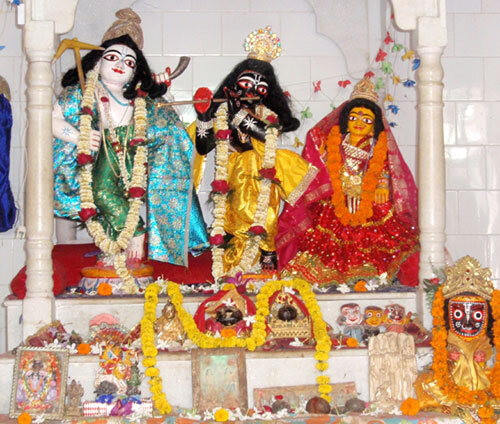
The shripat most closely tied to Parameshvara Dasa's own name stands at Atapur, formerly called Vishakhala, in the Hugli district of West Bengal. There, at the order of Jahnava Mata and with her personally present for the installation, Parameshvara Dasa installed Sri Sri Radha-Gopinatha. A separate Deity of Baladeva was added to the same altar later. Srila Bhaktisiddhanta Sarasvati Thakura's Anubhasya explains that in this tradition's transcendental mellows, Krishna, Radha and Baladeva are not ordinarily placed together on one throne. So Baladeva's presence beside Radha-Gopinatha at Atapur is a later addition, not part of Parameshvara Dasa's own installation.
| Detail | Description |
|---|---|
| Deities | Sri Sri Radha-Gopinatha, with Baladeva added later on the same altar |
| Installed by | Parameshvara Dasa, by the order of Jahnava Devi |
| Samadhi | Between two bakula trees and a kadamba tree, in front of the temple |
| Family | Vaidya (physician) lineage; titles Adhikari and Gupta; some descendants near Chanditala, Hugli |
| Disappearance festival | Full-moon day of Vaishakha (April-May) |
Family and Temple #
Parameshvara Dasa's own family belonged to the vaidya, or physician, caste. His descendants have gone on carrying the family titles Adhikari and Gupta into the twentieth century and beyond. At the time the Anubhasya was written, some of them were still living near the Chanditala post office in Hugli district. The Anubhasya says plainly that his descendants gradually took up the physician's profession themselves. It also says that they no longer worship the Deity directly, but pay brahmanas to do so. This is one of the rare details in his record that is honest and unflattering, not simple praise. Parameshvara Dasa's own samadhi stands in front of the temple, between two bakula trees and beneath a kadamba tree. This tree reportedly produces only a single flower each year, and the flower is offered to the Deity when it appears. A second temple at Atapur, known as the Radha-Govinda temple, was founded later by the Mitra family. It is separate from the Radha-Gopinatha temple that Parameshvara Dasa himself established. The two should not be confused, since both temples are in the same village and their Deity names are nearly the same.
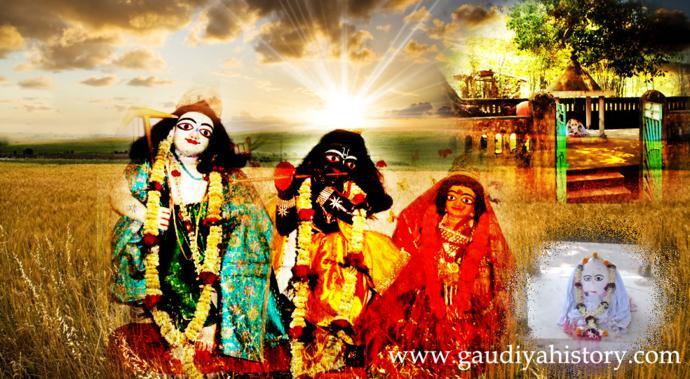
The Kadamba Tree and the Disappearance Festival #
Every year, on the full-moon day of the month of Vaishakha, Atapur observes Parameshvara Dasa's disappearance festival. His khunti is a decorated staff carried at the head of a sankirtana party. Local tradition says that it traces back to a promise the Muslim Kazi of Navadvipa once made, that no sankirtana party would ever again be disturbed. As part of the observance, the khunti is placed beside his samadhi mandira for the day. It is dressed with eyes, tilaka, garlands and cloth, and worshiped as a manifestation of Mahaprabhu Himself. This is Bengal shripat tradition, not the Chaitanya-charitamrita's own record. But it is the form in which Parameshvara Dasa is still remembered at the temple he built.
The Dead Fox at Akna Mahesh #
Only one miracle story is attached to Parameshvara Dasa's name. It is recorded on gaudiyahistory.iskcondesiretree.com, not in Chaitanya-charitamrita itself. Once there was a nama-sankirtan festival at Akna Mahesh, near Rampur, the shripat of the gopala Kamalakara Pippalai. Parameshvara Dasa was dancing there in full God-intoxication. A group of mischief-makers found a dead fox lying nearby, and to mock the devotees they threw it into the middle of the kirtan party. The account says that the assembled Vaishnavas showed no anger. But Parameshvara Dasa felt sorrow at the sight of the dead animal, and by his merciful glance he brought it back to life. The fox trotted out of the hall on its own, and the mischief-makers who had thrown it ran away in astonishment. No earlier source for this episode has been found, and no independent source confirming it has been found either. It is a devotional tradition attached to Parameshvara Dasa's memory at his own shripat. It is not an incident that Krishnadasa Kaviraja Goswami or Vrindavana Dasa Thakura themselves recorded.
