Parameshvara Dasa Thakura
The Fifth of Nityananda Prabhu's Twelve Gopalas
The complete life, on one page: The main biography and every pastime page, in order, in one place
Introduction
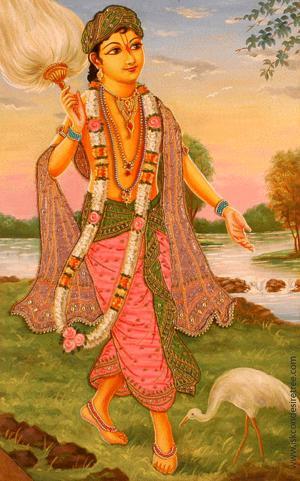
Parameshvara Dasa Thakura appears in Sri Chaitanya-charitamrita as one of the twelve gopalas. These were intimate associates bound more to Nityananda Prabhu than to Sri Chaitanya Mahaprabhu. Krishnadasa Kaviraja Goswami describes these devotees as sharing a cowherd-boy's mood of pure, open-hearted friendship. Parameshvara Dasa is remembered mainly for two things. The first is an identity in the Gaura-ganoddesha-dipika that goes back to Krishna's own Vraja pastimes. The second is a long life of practical service. He served first Nityananda Prabhu directly, and after Nityananda's disappearance, Nityananda's wife Jahnava Devi. By her order he installed the Deities still worshiped today at his shripat in Atapur. He should not be confused with Parameshvara Modaka, a Nadia confectioner who fed the boy Chaitanya sweets and later met Him at Jagannatha Puri. That was a different man, of a different generation and role, who happens to share only the name.
| Detail | Description |
|---|---|
| Role | One of the twelve gopalas (dvadasha gopala), intimate associates of Nityananda Prabhu |
| Listed as | Fifth of the twelve gopalas, per Chaitanya-charitamrita Adi-lila 11.29 and its Anubhasya |
| Identity | Arjuna, a cowherd friend of Krishna and Balarama in Vraja (Gaura-ganoddesha-dipika 132; Chaitanya-charitamrita Adi 11.29 purport) |
| Family | A vaidya (physician) family; descendants carry the titles Adhikari and Gupta |
| Residence | Lived for a time at Khadadaha; shripat and samadhi at Atapur, Hugli district |
| Deity installed | Sri Sri Radha-Gopinatha at Atapur, by the order of Jahnava Devi |
| Disappearance festival | Full-moon day of Vaishakha (April-May), at the Atapur temple |
Scriptural evidence for the introduction (2)
parameśvara-dāsa — nityānandaika-śaraṇa
kṛṣṇa-bhakti pāya, tāṅre ye kare smaraṇa
Word for word
parameśvara-dāsa - Parameśvara dāsa; nityānanda-eka-śaraṇa - completely surrendered to the lotus feet of Nityānanda; kṛṣṇa-bhakti pāya - gets love of Kṛṣṇa; tāṅre - him; ye - anyone; kare - does; smaraṇa - remembering.
Parameshvara dasa, said to be the fifth gopala of krishna-lila, completely surrendered to the lotus feet of Nityananda. Anyone who remembers his name, Parameshvara dasa, will get love of Krishna very easily.
From the purport: Purport excerpt: "The Caitanya-bhagavata states that Parameshvara dasa, known sometimes as Parameshvari dasa, was the life and soul of Sri Nityananda Prabhu."
The one verse in Chaitanya-charitamrita naming Parameshvara Dasa directly; the Anubhasya purport attached to it supplies nearly every biographical fact recorded about him.
नाम्नार्जुनः सखा प्राग्यो दासः स परमेश्वरः ।
कालः श्रीकृष्णदासः स यो लवङ्गः सखा व्रजे ॥
nāmnārjunaḥ sakhā prāg yo dāsaḥ sa parameśvaraḥ
kālaḥ śrī-kṛṣṇa-dāsaḥ sa yo lavaṅgaḥ sakhā vraje
Word for word
namna - by name; arjunah - Arjuna; sakha - the friend; prag - formerly; yah - who; dasah parameshvarah - the servant Parameshvara.
Lord Krsna's cowherd friend Arjuna appeared as Sri Paramesvara dasa in Lord Caitanya's pastimes. Lavanga, who had been Lord Krsna's cowherd friend in Vrajabhumi, appeared in Lord Caitanya's pastimes as Sri Kalakrsna dasa.
From the purport: Formerly he was Arjuna, a friend of Kṛṣṇa and Balarāma. He was the fifth among the twelve gopālas.
Kavi Karnapura's identification of Parameshvara Dasa as Arjuna, Krishna's cowherd friend in Vraja; Srila Bhaktisiddhanta Sarasvati Thakura's Anubhasya, quoted in Srila Prabhupada's purport to Chaitanya-charitamrita Adi 11.29, repeats it (purport excerpt above). Sanskrit: diacritic edition of the Gaura-ganoddesha-dipika; English translation as published at bvmlu.org.
Chapter 1
Servant of Nityananda and Jahnava Devi
A gopala's mood of pure cowherd friendship, carried from Nityananda Prabhu's own presence at Khadadaha into decades of service to Jahnava Devi.
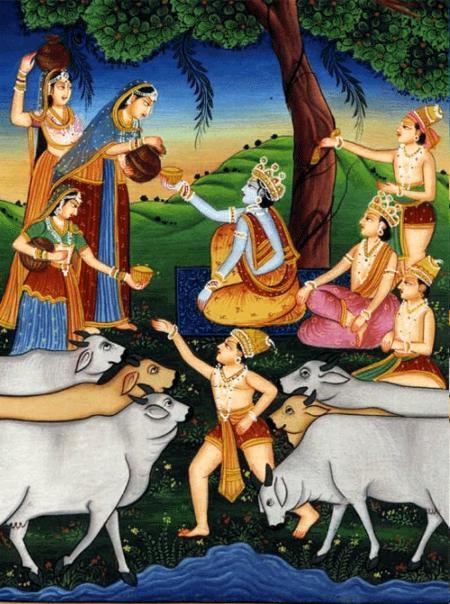
Sri Chaitanya-charitamrita gives Parameshvara Dasa only a single verse. But Srila Bhaktisiddhanta Sarasvati Thakura's Anubhasya, drawing on the Chaitanya-bhagavata, adds to that verse one of the more affectionate descriptions given to any of Nityananda Prabhu's associates. Vrindavana Dasa Thakura himself is quoted describing Parameshvara Dasa this way: "Parameshvara is the life of Lord Nityananda, and his form is the place of his pastimes. Krishna dasa and Parameshvara, being in the mood of cowherd boys, are always raising a commotion." These words are not just poetry. They name the particular mood, sakhya, in which Parameshvara Dasa is remembered. It is not formal reverence. It is the free and noisy friendship of a cowherd boy toward his closest playmate. This is exactly the mood the Gaura-ganoddesha-dipika gives him in his identity as Krishna's Vraja friend Arjuna.
Life at Khadadaha #
For a period of his life, Parameshvara Dasa lived at Khadadaha village, a place named in Chaitanya-charitamrita's account of several devotees of this generation. The Anubhasya records only that he was "always filled with the ecstasy of a cowherd boy" there - no episode, no date, simply a description of the mood that stayed with him. Later sources say that this same mood carried into his temple service at Atapur. It also carried into a later-life miracle at Akna Mahesh, which one modern source records but no earlier source confirms. Both are told on The Shripat at Atapur.
Accompanying Jahnava Devi to Kheturi #
After Nityananda Prabhu's disappearance, his wife Jahnava Mata came to occupy an unusual and important position in the Gaudiya Vaishnava community, personally directing Deity worship and presiding over major festivals. Parameshvara Dasa is recorded as one of those in her company at the great festival held at Kheturi village, where Narottama Dasa Thakura installed Deities on Sri Chaitanya Mahaprabhu's appearance day. Jahnava Devi herself supervised the cooking and made the first offering to the newly installed Deities, and tradition holds that during Narottama Dasa Thakura's own prema-nama-kirtana at the festival, Sri Chaitanya Mahaprabhu, Nityananda Prabhu and Their associates appeared before the assembled devotees. The Kheturi festival is remembered as one of the most important public events of the generation after Mahaprabhu's disappearance. Devotees came to it from across Bengal. Parameshvara Dasa was there as part of Jahnava Devi's own company. But no source gives further detail of what he personally did at the festival itself. The Bhakti-ratnakara, a later but widely used devotional history of this period, is the source for his presence in her company; Chaitanya-charitamrita itself, composed earlier, does not describe the Kheturi festival.
Escorting the Deity of Radharani to Vrindavana #
Sources describing Jahnava Devi's later years record that she sent a Deity of Radharani to Vrindavana, to stand beside Sri Govindaji there, and that Parameshvara Dasa was among those who accompanied the Deity on that journey. No source gives a date for the journey, or explains why Parameshvara Dasa in particular was chosen for it. The sources say only that he was, in their own words, her very dear servant. This journey and the Kheturi festival together place Parameshvara Dasa in Jahnava Devi's personal service for a large part of her own long period of leadership. This was a second chapter of his life. It was separate from his years with Nityananda Prabhu directly, and much longer than anything recorded of those years.
Scriptural evidence for this chapter (1)
Quoted in the text above:
- Quoted by Vrindavana Dasa Thakura, via gaudiyahistory.iskcondesiretree.com Sri Chaitanya-bhagavata
Chapter 2
The Shripat at Atapur
The temple Parameshvara Dasa built at Jahnava Devi's order, the family that has tended it since, and the one miracle later tradition attaches to his name.
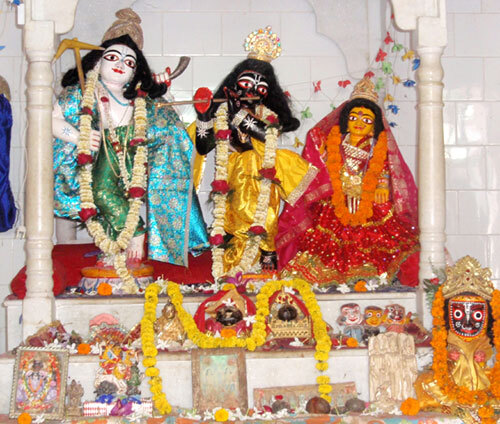
The shripat most closely tied to Parameshvara Dasa's own name stands at Atapur, formerly called Vishakhala, in the Hugli district of West Bengal. There, at the order of Jahnava Mata and with her personally present for the installation, Parameshvara Dasa installed Sri Sri Radha-Gopinatha. A separate Deity of Baladeva was added to the same altar later. Srila Bhaktisiddhanta Sarasvati Thakura's Anubhasya explains that in this tradition's transcendental mellows, Krishna, Radha and Baladeva are not ordinarily placed together on one throne. So Baladeva's presence beside Radha-Gopinatha at Atapur is a later addition, not part of Parameshvara Dasa's own installation.
| Detail | Description |
|---|---|
| Deities | Sri Sri Radha-Gopinatha, with Baladeva added later on the same altar |
| Installed by | Parameshvara Dasa, by the order of Jahnava Devi |
| Samadhi | Between two bakula trees and a kadamba tree, in front of the temple |
| Family | Vaidya (physician) lineage; titles Adhikari and Gupta; some descendants near Chanditala, Hugli |
| Disappearance festival | Full-moon day of Vaishakha (April-May) |
Family and Temple #
Parameshvara Dasa's own family belonged to the vaidya, or physician, caste. His descendants have gone on carrying the family titles Adhikari and Gupta into the twentieth century and beyond. At the time the Anubhasya was written, some of them were still living near the Chanditala post office in Hugli district. The Anubhasya says plainly that his descendants gradually took up the physician's profession themselves. It also says that they no longer worship the Deity directly, but pay brahmanas to do so. This is one of the rare details in his record that is honest and unflattering, not simple praise. Parameshvara Dasa's own samadhi stands in front of the temple, between two bakula trees and beneath a kadamba tree. This tree reportedly produces only a single flower each year, and the flower is offered to the Deity when it appears. A second temple at Atapur, known as the Radha-Govinda temple, was founded later by the Mitra family. It is separate from the Radha-Gopinatha temple that Parameshvara Dasa himself established. The two should not be confused, since both temples are in the same village and their Deity names are nearly the same.
The Kadamba Tree and the Disappearance Festival #
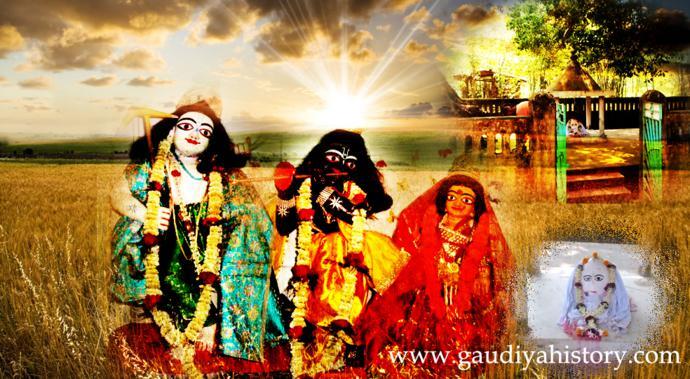
Every year, on the full-moon day of the month of Vaishakha, Atapur observes Parameshvara Dasa's disappearance festival. His khunti is a decorated staff carried at the head of a sankirtana party. Local tradition says that it traces back to a promise the Muslim Kazi of Navadvipa once made, that no sankirtana party would ever again be disturbed. As part of the observance, the khunti is placed beside his samadhi mandira for the day. It is dressed with eyes, tilaka, garlands and cloth, and worshiped as a manifestation of Mahaprabhu Himself. This is Bengal shripat tradition, not the Chaitanya-charitamrita's own record. But it is the form in which Parameshvara Dasa is still remembered at the temple he built.
The Dead Fox at Akna Mahesh #
Only one miracle story is attached to Parameshvara Dasa's name. It is recorded on gaudiyahistory.iskcondesiretree.com, not in Chaitanya-charitamrita itself. Once there was a nama-sankirtan festival at Akna Mahesh, near Rampur, the shripat of the gopala Kamalakara Pippalai. Parameshvara Dasa was dancing there in full God-intoxication. A group of mischief-makers found a dead fox lying nearby, and to mock the devotees they threw it into the middle of the kirtan party. The account says that the assembled Vaishnavas showed no anger. But Parameshvara Dasa felt sorrow at the sight of the dead animal, and by his merciful glance he brought it back to life. The fox trotted out of the hall on its own, and the mischief-makers who had thrown it ran away in astonishment. No earlier source for this episode has been found, and no independent source confirming it has been found either. It is a devotional tradition attached to Parameshvara Dasa's memory at his own shripat. It is not an incident that Krishnadasa Kaviraja Goswami or Vrindavana Dasa Thakura themselves recorded.
Closing
The Fifth Gopala, Named Arjuna in Vraja #
Sri Chaitanya-charitamrita names Parameshvara Dasa in its eleventh chapter of Adi-lila, a chapter devoted entirely to Nityananda Prabhu's own circle of associates: "Parameshvara dasa, said to be the fifth gopala of krishna-lila, completely surrendered to the lotus feet of Nityananda. Anyone who remembers his name, Parameshvara dasa, will get love of Krishna very easily." Srila Bhaktisiddhanta Sarasvati Thakura's Anubhasya, quoting the Chaitanya-bhagavata, adds a striking description: Parameshvara Dasa "was the life and soul of Sri Nityananda Prabhu. The body of Parameshvara dasa was the place of Lord Nityananda's pastimes." Kavi Karnapura's Gaura-ganoddesha-dipika, the tradition's standard reference for matching Chaitanya-era devotees to their identities in Krishna's Vraja pastimes, names him directly: the cowherd friend Arjuna, who played with Krishna and Balarama, reappeared in this life as Parameshvara Dasa. Two other gopalas from this same list, Uddharana Datta Thakura and Gauridasa Pandita, each carry their own separate Vraja identity and their own separate life of service.
The first line of the verse names him:
nāmnārjunaḥ sakhā prāg yo dāsaḥ sa parameśvaraḥ
"Lord Krsna's cowherd friend Arjuna appeared as Sri Paramesvara dasa in Lord Caitanya's pastimes." (Gaura-ganoddesha-dipika 132)
Srila Prabhupada's purport to Chaitanya-charitamrita Adi 11.29, quoting Srila Bhaktisiddhanta Sarasvati Thakura's Anubhasya, says the same: "Formerly he was Arjuna, a friend of Kṛṣṇa and Balarāma. He was the fifth among the twelve gopālas."
There is one real point of overlap. Only a few verses earlier, the same Gaura-ganoddesha-dipika identifies a different Vraja cowherd also named Arjuna as part of the identity of Ramananda Raya. This Arjuna is not the epic hero Arjuna, though he shares his name. So two separate Chaitanya-era devotees are each linked in the same text to a Vraja companion called Arjuna. Both identifications are given here as the source gives them. The source itself does not explain the overlap, and we do not invent an explanation for it.
What Remains Honestly Uncertain #
No source gives Parameshvara Dasa Thakura a birth year, and his disappearance is dated only by the recurring festival day, the full moon of Vaishakha, not by any specific year. A widely repeated story of his reviving a dead animal during nama-sankirtan at Akna Mahesh appears in gaudiyahistory.iskcondesiretree.com's biographical account. But it is not found in Chaitanya-charitamrita or the Anubhasya purport. It stands as devotional tradition at his own shripat, not as scripture. And as noted above, the Gaura-ganoddesha-dipika uses the name Arjuna for two separate identities: his own, and part of Ramananda Raya's. We give this exactly as the source presents it, and we do not invent an explanation for it.
- Sri Chaitanya-charitamrita, Adi-lila 11.29 (verse, translation and Anubhasya purport)
- Parameshvara dasa - Gaudiya History (ISKCON Desire Tree)
- Parameshvara Dasa Thakura - Biography - Gaudiya History (ISKCON Desire Tree)
- Sri Parameshvara Dasa Thakura - Gaudiya History (ISKCON Desire Tree)
- Sri Gaura-ganoddesha-dipika (summary of identifications) - Gaudiya History (ISKCON Desire Tree)
