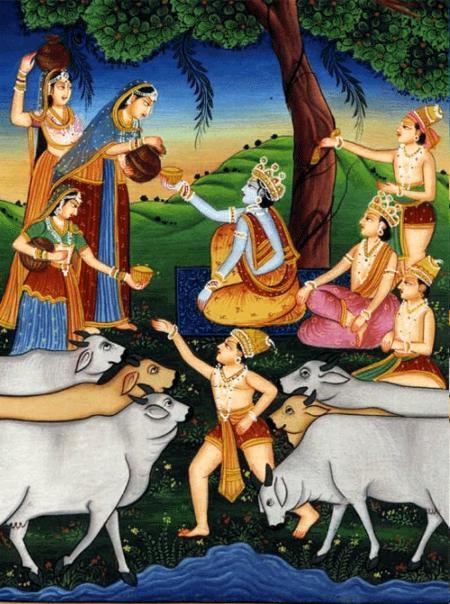
Sri Chaitanya-charitamrita gives Parameshvara Dasa only a single verse. But Srila Bhaktisiddhanta Sarasvati Thakura's Anubhasya, drawing on the Chaitanya-bhagavata, adds to that verse one of the more affectionate descriptions given to any of Nityananda Prabhu's associates. Vrindavana Dasa Thakura himself is quoted describing Parameshvara Dasa this way: "Parameshvara is the life of Lord Nityananda, and his form is the place of his pastimes. Krishna dasa and Parameshvara, being in the mood of cowherd boys, are always raising a commotion." These words are not just poetry. They name the particular mood, sakhya, in which Parameshvara Dasa is remembered. It is not formal reverence. It is the free and noisy friendship of a cowherd boy toward his closest playmate. This is exactly the mood the Gaura-ganoddesha-dipika gives him in his identity as Krishna's Vraja friend Arjuna.
Life at Khadadaha #
For a period of his life, Parameshvara Dasa lived at Khadadaha village, a place named in Chaitanya-charitamrita's account of several devotees of this generation. The Anubhasya records only that he was "always filled with the ecstasy of a cowherd boy" there - no episode, no date, simply a description of the mood that stayed with him. Later sources say that this same mood carried into his temple service at Atapur. It also carried into a later-life miracle at Akna Mahesh, which one modern source records but no earlier source confirms. Both are told on The Shripat at Atapur.
Accompanying Jahnava Devi to Kheturi #
After Nityananda Prabhu's disappearance, his wife Jahnava Mata came to occupy an unusual and important position in the Gaudiya Vaishnava community, personally directing Deity worship and presiding over major festivals. Parameshvara Dasa is recorded as one of those in her company at the great festival held at Kheturi village, where Narottama Dasa Thakura installed Deities on Sri Chaitanya Mahaprabhu's appearance day. Jahnava Devi herself supervised the cooking and made the first offering to the newly installed Deities, and tradition holds that during Narottama Dasa Thakura's own prema-nama-kirtana at the festival, Sri Chaitanya Mahaprabhu, Nityananda Prabhu and Their associates appeared before the assembled devotees. The Kheturi festival is remembered as one of the most important public events of the generation after Mahaprabhu's disappearance. Devotees came to it from across Bengal. Parameshvara Dasa was there as part of Jahnava Devi's own company. But no source gives further detail of what he personally did at the festival itself. The Bhakti-ratnakara, a later but widely used devotional history of this period, is the source for his presence in her company; Chaitanya-charitamrita itself, composed earlier, does not describe the Kheturi festival.
Escorting the Deity of Radharani to Vrindavana #
Sources describing Jahnava Devi's later years record that she sent a Deity of Radharani to Vrindavana, to stand beside Sri Govindaji there, and that Parameshvara Dasa was among those who accompanied the Deity on that journey. No source gives a date for the journey, or explains why Parameshvara Dasa in particular was chosen for it. The sources say only that he was, in their own words, her very dear servant. This journey and the Kheturi festival together place Parameshvara Dasa in Jahnava Devi's personal service for a large part of her own long period of leadership. This was a second chapter of his life. It was separate from his years with Nityananda Prabhu directly, and much longer than anything recorded of those years.
