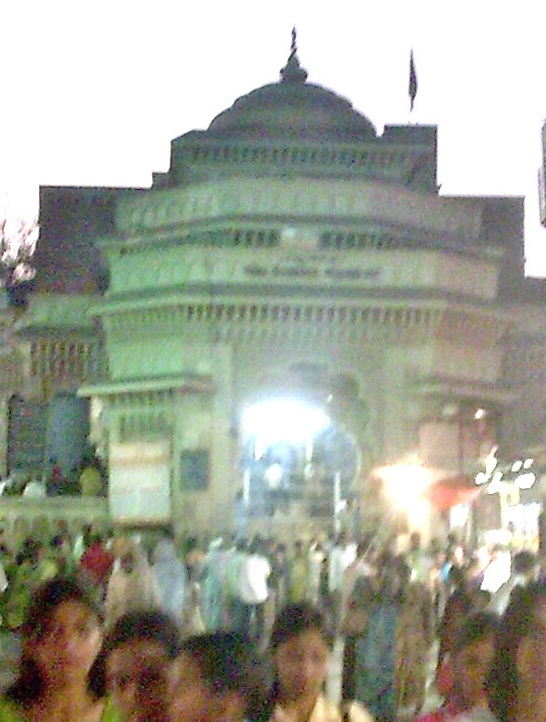
By the time anyone in Chaitanya Mahaprabhu's family learned what had actually become of Vishvarupa, Chaitanya was no longer the schoolboy who had once been carried off in a vision. He had taken sannyasa Himself in 1510, left Bengal, settled for a time in Jagannatha Puri, and then set out on a long tour of pilgrimage sites across South India. It was during this tour, in the pilgrim town of Pandharpur on the bank of the Bhima River in what is now Maharashtra, that the news finally reached Him.
An Unexpected Godbrother #
Word reached Chaitanya Mahaprabhu that Sri Ranga Puri was staying in the town at a brahmana's house. Ranga Puri was a disciple of Sri Madhavendra Puri, and therefore a godbrother of Chaitanya's own diksha-guru, Ishvara Puri. Chaitanya went to see him at once. The moment He set eyes on him, He fell flat on the ground in ecstatic obeisance. He was weeping and trembling, and His body showed every outward sign of transcendental emotion. Ranga Puri was startled by such a greeting from a stranger. He asked Him to get up, and remarked that anyone capable of such love must surely be connected to Madhavendra Puri himself. The two embraced, both in tears. Once they had composed themselves, they sat down and talked about Krishna continuously for five to seven days.
A Curry of Banana Flowers #
During their conversation Ranga Puri asked where Chaitanya had been born. When he heard the answer, Navadvipa, a flood of old memories came back to him. He had travelled to Nabadwip once before, years earlier, with Madhavendra Puri, and had eaten at the very home of Jagannatha Mishra. He remembered, with real fondness, an unusual curry made of banana flowers that Chaitanya's mother, Sachi Devi, had cooked for the visiting sannyasis. He also remembered Sachi Devi herself, her devotion and her motherly warmth, "exactly like the mother of the universe." Chaitanya-charitamrita is full of small, human details like this one. Here a simple meal, remembered decades later, links the deep theological meeting of the two sannyasis back to an ordinary Bengali kitchen.
Word of Shankararanya #
Then Ranga Puri turned to a piece of news of his own. He recalled that one of the "deserving sons" of the Nabadwip household had himself accepted sannyasa at a very young age, taking the name Shankararanya. He told Chaitanya plainly that this same sannyasi, Shankararanya, had attained perfection right here in Pandharpur. Ranga Puri may not even have realized what he was telling Chaitanya. Chaitanya's reply confirmed it: "In My previous ashrama, Shankararanya was My brother, and Jagannatha Mishra was My father." Years had passed since Vishvarupa walked out of the household to become a wandering sannyasi. Years had also passed since the strange vision that had once brought his voice back into his brother's life for a moment. Now, from a stranger's fond memory of a curry, Chaitanya Mahaprabhu learned that His brother had already left this world at the very place where He now stood.
Eleven Days at Vitthala's Temple #
Chaitanya remained in Pandharpur for eleven days in all. After Ranga Puri set out again for Dvaraka, Chaitanya stayed on four more days. He bathed in the Bhima River and visited the temple of Vitthala, the local form of Krishna worshiped at Pandharpur, before continuing His own tour southward. Chaitanya-charitamrita and later Gaudiya tradition both describe Vishvarupa's disappearance there in the same terms used elsewhere for his identity. It was not simply death. It was a return: an incarnation of Sankarshana passing back into the source from which he had never really been separate. Vishvarupa appears in only a handful of verses across the whole of Chaitanya-charitamrita. But he was, quite literally, the brother Chaitanya Mahaprabhu never stopped remembering.
