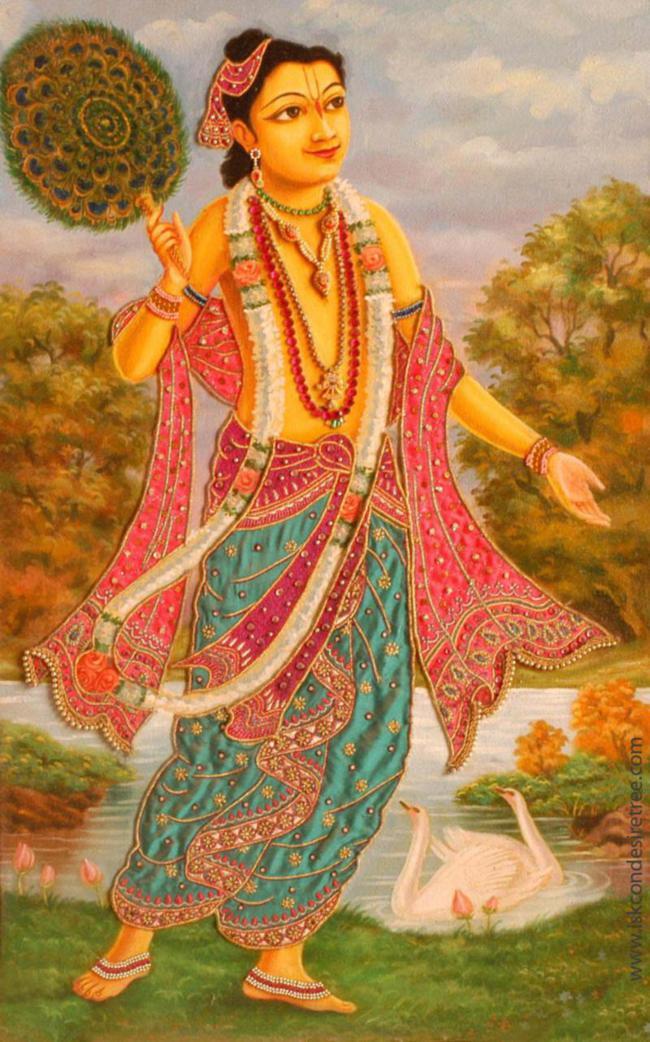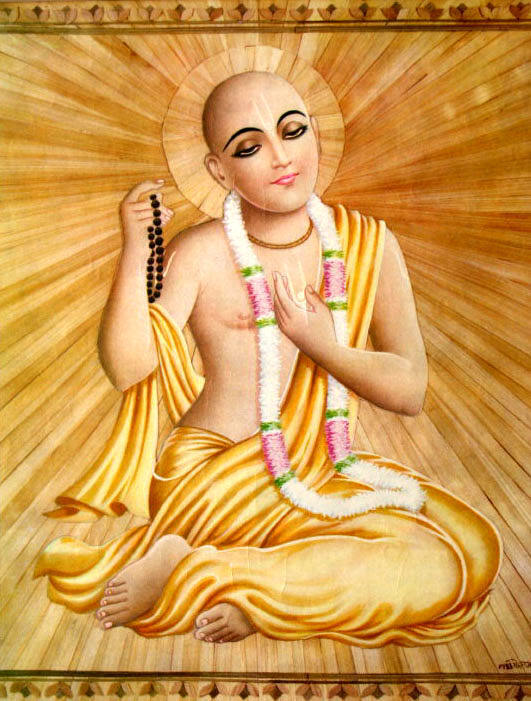
Sri Vishvarupa (Shankararanya)
Elder Brother of Sri Chaitanya Mahaprabhu, Renounced as Shankararanya
Also known as Vishvarupa, Visvarupa, Sankararanya, Sankararanya Svami, Shankararanya Swami
“Offer thousands and thousands of obeisances unto My mother, Sachidevi.”
Chaitanya Mahaprabhu reported that in a vision Vishvarupa (Shankararanya) had asked Him to carry these words back to their mother. Chaitanya described the vision after He regained consciousness (Sri Chaitanya-caritamrita, Adi-lila 15.21).
Shankararanya was the sannyasa name taken by Vishvarupa, the elder brother of Sri Chaitanya Mahaprabhu. He was born in Nabadwip to Jagannatha Mishra and Sachi Devi, the only one of their children besides Chaitanya Himself (born Vishvambhara) to survive infancy. While still very young, and while his parents were arranging his marriage, Vishvarupa left home, accepted sannyasa under the monastic name Shankararanya, and spent the rest of his life travelling to places of pilgrimage. He passed away at Pandharpur in western India, years before Chaitanya Mahaprabhu's own public mission of sankirtana had even begun.
He should not be confused with two other figures who have a similar name. He has nothing to do with the philosophical order founded by the eighth-century teacher Adi Shankaracharya, even though he carried one of that order's traditional sannyasa titles. He is also a completely different person from Shankara Pandita, an unrelated Vaishnava associate of Mahaprabhu. Only a little is recorded about Shankararanya, and he is a quiet figure, but he was a real one: Chaitanya Mahaprabhu's own brother. He is remembered in Sri Chaitanya Mahaprabhu's own life story mainly through a handful of verses in Krishnadasa Kaviraja Goswami's Chaitanya-charitamrita.
| Detail | Description |
|---|---|
| Birth name | Vishvarupa |
| Sannyasa name | Shankararanya (also written Sankararanya, Sankararanya Svami) |
| Birth place | Nabadwip, Bengal |
| Parents | Jagannatha Mishra and Sachi Devi |
| Disappearance | 1431 or 1432 Shakabda (A.D. 1509 or 1510; sources differ by one year) |
| Disappearance place | Pandharpur (Pandarapura), on the bank of the Bhima River, Sholapur district |
| Identity | An incarnation of Baladeva, non-different from Sankarshana of the catur-vyuha (Chaitanya-charitamrita Adi 13.74 and purport; Gaura-ganoddesha-dipika 58) |
The Elder Brother of Gaurahari #
Jagannatha Mishra and Sachi Devi lost eight daughters in infancy before Vishvarupa was born, and Vishvarupa himself was several years older than his younger brother, who would grow up to be Chaitanya Mahaprabhu. Chaitanya-charitamrita records the two as the only surviving children of the household. Vishvarupa is described as unusually serious and detached even as a boy, and when his parents began looking for a bride for him he chose instead to leave home and accept the renounced order of sannyasa. He never saw his brother's later life as Chaitanya Mahaprabhu, the sannyasi and sankirtana preacher of Nabadwip and Puri, because he had already passed away by the time Chaitanya took sannyasa Himself in 1510.
Not the Order of Adi Shankaracharya #
The name Shankararanya can mislead a reader who does not know Gaudiya Vaishnava history. "Aranya" is one of ten traditional monastic titles (along with Puri, Bharati, Giri, Vana, Sagara, Tirtha, Ashrama, Parvata and Sarasvati) used across the Dashanami sannyasa order historically associated with Adi Shankaracharya's Advaita tradition. Later, Chaitanya Mahaprabhu's own sannyasa gave rise to a clearly Vaishnava sannyasa lineage in Bengal. But in Vishvarupa's time, before that, this Dashanami order was simply the usual formal way for anyone, of any philosophy, to enter the renounced order. Later Gaudiya Vaishnava tradition (the Gaudiya Vaishnava Abhidana) records that Vishvarupa received sannyasa from a sannyasi named Krishna Bharati in Varanasi at about the age of sixteen. This detail does not appear in Chaitanya-charitamrita itself. So it should be treated as a little less certain than the verses that do appear there.
Taking a Dashanami name did not make Vishvarupa a philosophical Mayavadi. Chaitanya-charitamrita clearly says that Vishvarupa's sannyasa pleased Chaitanya, who said it had delivered "both his father's family and his mother's family" (Adi-lila 15.14). Srila Prabhupada's purport to that verse makes a careful difference. Real sannyasa, taken to serve Krishna, is one of the four honest stages of varnashrama-dharma. But the "so-called Mayavadi sannyasis" who imagine themselves to have become Narayana are a later, fallen version of the same outward form. Vishvarupa's sannyasa belongs to the first kind. He is quite different from the various Mayavadi sannyasis, such as Prakashananda Sarasvati, whom Chaitanya Mahaprabhu later met and defeated in debate at Kashi and elsewhere. Vishvarupa was never Chaitanya's opponent; he was His brother.
Leaving Home Rather Than Marry #
The decision came suddenly. As soon as Vishvarupa learned that a marriage was being arranged for him, he left the house the same day and set out to accept sannyasa and wander from tirtha to tirtha. His parents were shattered, and it fell to the young Chaitanya to console them. The full episode, including Chaitanya's own words to his grieving mother and father, is told on Leaving Home Rather Than Marry.
The Vision That Consoled Gaurahari #
Some time later, after His father Jagannatha Mishra had also passed away, Chaitanya fell into an unusual trance. In this trance He described being taken away by Vishvarupa and asked to accept sannyasa Himself. The account, and Chaitanya's reply, is told in full on The Vision at Nabadwip.
Word From Pandharpur #
Chaitanya Mahaprabhu did not learn what had become of His brother until years afterward, during His own tour of South India as a sannyasi. In the pilgrim town of Pandharpur He met Sri Ranga Puri, a godbrother of His own diksha-guru Ishvara Puri, who told Him that a sannyasi named Shankararanya had attained perfection at that very place. The meeting, and what it meant for Chaitanya, is told on Word From Pandharpur.
Sankarshana in a Sannyasi's Robe #
Chaitanya-charitamrita does not present Vishvarupa as an ordinary renunciate. Krishnadasa Kaviraja Goswami calls him an incarnation of Baladeva (Adi 13.74), and Srila Prabhupada's purport to that verse calls him an incarnation of Sankarshana. Sankarshana is the four-armed expansion of Krishna who is both the ingredient and the moving cause of the material creation. The purport also adds that the part (amsa) and the whole (amsi) are never really separate. Elsewhere (Adi-lila 5.6-8), the Chaitanya-charitamrita makes clear that Sri Nityananda Prabhu, Chaitanya's own eternal companion, is the original, complete manifestation of Sankarshana in the Lord's own pastimes. Vishvarupa's disappearance is described as a merging back into that same source. His role is small and quiet in the larger drama of Krishna and Balarama's descent as Chaitanya and Nitai. But the Chaitanya-charitamrita still counts him among the branches of the great tree that grew from Chaitanya Mahaprabhu: in Srila Prabhupada's translation of Adi 10.106, "The ācārya Śaṅkarāraṇya was considered the forty-eighth branch of the original tree."
Kavi Karnapura's Gaura-ganoddesha-dipika (verse 58) states the same truth:
aṁśāṁśinor abhedena vyūha ādyaḥ śacī-sutaḥ
baladevo viśvarūpo vyūhaḥ saṅkarṣaṇo mataḥ
"The original form of the Supreme Lord is considered not different from the Lord's direct expansions. For this reason it is considered that Lord Caitanya Mahaprabhu, the son of Srimati Saci-devi, is non-different from His expansion Lord Vasudeva, the first member of the Catur-vyuha. In the same way Sri Visvarupa is considered non-different from the incarnation Lord Sankarsana, the second member of the Catur-vyuha." (Gaura-ganoddesha-dipika 58)
The point about the part and the whole comes from Srila Prabhupada's purport to Chaitanya-charitamrita Adi 13.74: "He is nondifferent from Śrī Caitanya Mahāprabhu, for the aṁśa and the aṁśī, or the part and the whole, are not different. As an incarnation of Saṅkarṣaṇa, Viśvarūpa belongs to the quadruple manifestation of catur-vyūha."
Scriptural evidence
Quoted in the text above:
- Verse 58 Gaura-ganoddesha-dipika
Further verses:
শঙ্করারণ্য—আচার্য–বৃক্ষের এক শাখা ।
মুকুন্দ, কাশীনাথ, রুদ্র,—উপশাখা লেখা ॥ ১০৬ ॥
sankararanya — acarya-vrksera eka sakha
mukunda, kasinatha, rudra — upasakha lekha
Word for word
sankararanya: Sankararanya; acarya-vrksera: of the tree of acaryas; eka sakha: one branch; mukunda, kasinatha, rudra: Mukunda, Kasinatha and Rudra; upasakha lekha: they are known as subbranches.
The acharya Shankararanya was considered the forty-eighth branch of the original tree. From him proceeded the subbranches known as Mukunda, Kashinatha and Rudra.
From the purport: Purport excerpt: "It is said that Śaṅkarāraṇya was the sannyāsa name of Śrīla Viśvarūpa, who was the elder brother of Viśvambhara (the original name of Śrī Caitanya Mahāprabhu)."
This is the verse that first identifies Shankararanya, in Bhaktisiddhanta Sarasvati Thakura's enumeration of the branches of the Chaitanya tree, as the monastic name of Chaitanya's own brother Vishvarupa.
তবে পুত্র জনমিলা ‘বিশ্বরূপ’ নাম ।
মহা–গুণবান্ তেঁহ–‘বলদেব’–ধাম ॥ ৭৪ ॥
tabe putra janamila 'visvarupa' nama
maha-gunavan tenha — 'baladeva'-dhama
Word for word
tabe: thereafter; putra: son; janamila: took birth; visvarupa nama: named Vishvarupa; maha-gunavan: highly qualified; tenha: He; baladeva-dhama: incarnation of Lord Baladeva.
After this, Jagannatha Mishra got a son of the name Vishvarupa, who was most powerful and highly qualified because He was an incarnation of Baladeva.
From the purport: He took the sannyāsa name of Śaṅkarāraṇya. In 1431 Śakābda Era (A.D. 1509), He disappeared in Pāṇḍarapura, in the district of Sholapur. As an incarnation of Saṅkarṣaṇa, He is both the ingredient and immediate cause of the creation of this material world. He is nondifferent from Śrī Caitanya Mahāprabhu, for the aṁśa and the aṁśī, or the part and the whole, are not different. As an incarnation of Saṅkarṣaṇa, Viśvarūpa belongs to the quadruple manifestation of catur-vyūha. In the Gaura-candrodaya it is said that Viśvarūpa, after His so-called demise, remained mixed within Śrī Nityānanda Prabhu.
Gives Vishvarupa's birth into the family and states one of the two disappearance dates found across Prabhupada's own purports (see note on Madhya 9.300 for the one-year discrepancy).
(Prabhupada's summary verse; no separate Bengali original supplied for this concluding explanatory text)
Because Maha-sankarshana is the ingredient and efficient cause of the cosmic manifestation, He is present in every detail of it. Lord Chaitanya therefore called Him His elder brother. The two brothers are known as Krishna and Balarama in the spiritual world, but at the present moment they are Chaitanya and Nitai. Therefore the conclusion is that Nityananda Prabhu is the original Sankarshana, Baladeva.
Clarifies the theology behind calling Vishvarupa an incarnation of Sankarshana: the complete, original Sankarshana in Chaitanya's own pastimes is Nityananda Prabhu, of whom Vishvarupa's identity is a reflection.
यदा श्रीविश्वरूपोऽयं तिरोभूतः सनातनः ।
नित्यानन्दावधूतेन मिलित्वापि तदा स्थितः ॥६२॥
yadā śrī-viśvarūpo’yaṁ tirobhūtaḥ sanātanaḥ |
nityānandāvadhūtena militvāpi tadā sthitaḥ ||62||
When the eternal Personality of Godhead Lord Visvarupa disappeared from home, He entered the body of Lord Nityananda Avadhuta.
Kavi Karnapura's statement that at his disappearance Vishvarupa entered Nityananda Prabhu, the source behind the page's account of his merging back into Sankarshana. Sanskrit: diacritic edition of the Gaura-ganoddesha-dipika; English translation as published at bvmlu.org.
- Sri Chaitanya-caritamrita, Adi-lila 10.106 (text and purport)
- Sri Chaitanya-caritamrita, Adi-lila 13.74 (text and purport)
- Sri Chaitanya-caritamrita, Adi-lila 13.78 (text and purport)
- Sri Chaitanya-caritamrita, Adi-lila 15.11-21
- Sri Chaitanya-caritamrita, Madhya-lila 9.299-301
- Shankararanya - Gaudiya History (ISKCON Desire Tree)
- Sri Visvarupa Mahotsava - ISKCON Desire Tree
- Sri Visvarupa Mahotsava - Vaisnava Calendar
- About Visvarupa (Lord Caitanya's brother) - ISVARA.org
Frequently asked
When was Sri Vishvarupa (Shankararanya) born?
Sri Vishvarupa (Shankararanya) appeared Year not recorded (elder brother of Chaitanya Mahaprabhu, b. 1486) in Nabadwip, Bengal.
When and where did Sri Vishvarupa (Shankararanya) disappear?
Sri Vishvarupa (Shankararanya) disappeared 1431 or 1432 Shakabda (A.D. 1509 or 1510; sources differ by one year) at Pandharpur (Pandarapura), Sholapur district, Maharashtra.
What are the main pastimes of Sri Vishvarupa (Shankararanya)?
The pastimes covered here include: Leaving Home Rather Than Marry, The Vision at Nabadwip, Word From Pandharpur.