Aṣṭa-sakhī Mandira (Vṛndāvana)
अष्ट-सखी मन्दिर (वृन्दावन) Hindi name proposed
Also called Aṣṭa Sakhī Temple, Aṣṭa Sakī
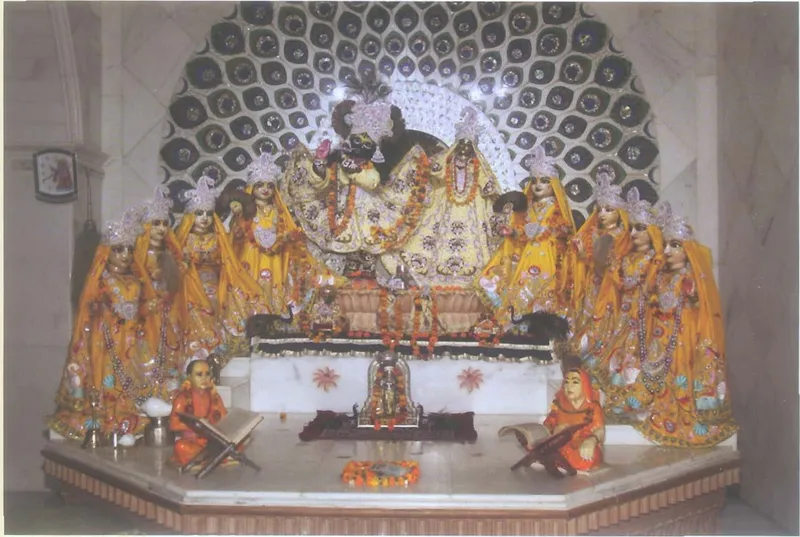
- What it is
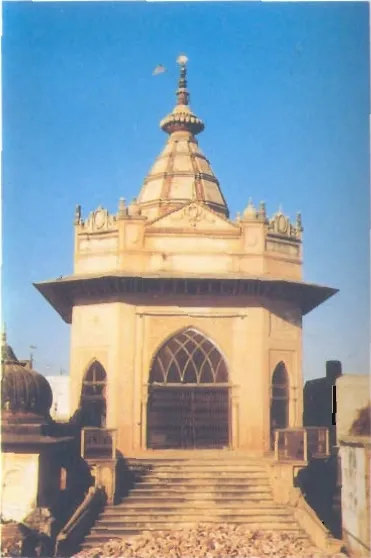
- The Aṣṭa-sakhī Mandira, the temple of the eight sakhīs, stands beside the old Madana-mohana temple in Vṛndāvana.
- Visiting
- The temple is near the old Madana-mohana temple; Vṛndāvana, the Playground of God says that the former small temple stood on top of the hill next to Dvādaśāditya-ṭīlā.
In short
The Aṣṭa-sakhī Mandira, the temple of the eight sakhīs, stands beside the old Madana-mohana temple in Vṛndāvana.[1 +4] On its altar Rādhā and Kṛṣṇa, worshipped as Rādhā-Rāsabihārī, stand in the centre with Śrī Rādhā's eight principal sakhīs, Her closest friends, four on each side.[1 +4] A Bengali book of 1920 says that Mahārāja Rāmarañjana Cakravartī of Hetampur and his queen Padmāsundarī Devī installed the Deities in 1889.[1 +4] In 1972 Śrīla Prabhupāda pointed his disciples to "one Asta Sakhi Temple" in Vṛndāvana as a model altar.[7]
Key facts
| Kind | temple |
|---|---|
| Region · area | Vṛndāvana |
Why it is glorified
Śrīla Rūpa Gosvāmī names the eight sakhīs of this altar in his Ujjvala-nīlamaṇi: Lalitā, Viśākhā, Citrā, Campakalatā, Tuṅgavidyā …
The eight sakhīs
Śrīla Rūpa Gosvāmī names the eight sakhīs of this altar in his Ujjvala-nīlamaṇi: Lalitā, Viśākhā, Citrā, Campakalatā, Tuṅgavidyā, Indulekhā, Raṅgadevī and Sudevī. He calls them Rādhā's dearest friends and the foremost of all the groups of gopīs (summarised here, not translated).[3 +1] In his Rādhā-Kṛṣṇa-gaṇoddeśa-dīpikā he describes each of them: her age compared with Rādhā, her nature, complexion and dress, her parents and her husband. Lalitā, for example, is twenty-seven days older than Rādhā, and Viśākhā was born at the same moment as Her.[3 +1] Neither work mentions the temple.[3 +1]
Traditional accounts
According to the local tradition recorded in The Color Guide to Vṛndāvana (2000), the temple was built after the king's wife dreamt that Kṛṣṇa asked her to build a temple of the eight sakhīs. No other source tells the dream, and it is not certain.[2]
Śrīla Prabhupāda
In a letter of 25 April 1972 about the altar of the new temple in Vṛndāvana, Śrīla Prabhupāda wrote …
In a letter of 25 April 1972 about the altar of the new temple in Vṛndāvana, Śrīla Prabhupāda wrote:[7]
Names this placeif possible, you can have all 8 Gopis of 42" height, but it may be cumbersome. There is one Asta Sakhi Temple there in Vrindaban, you may see how this is arranged there.
Śrīla Prabhupāda, Letter to Gurudasa and Yamuna, Letters, 25 April 1972 · vedabase.io
He gives no location or founder. No other temple of the eight sakhīs in Vṛndāvana town appears in the sources, so he probably meant this one.[7]
Visiting today
The temple is near the old Madana-mohana temple; Vṛndāvana, the Playground of God says that the former small temple stood on top of the hill next to Dvādaśāditya-ṭīlā.[1 +4] The Color Guide names the sakhīs on the altar from the left as Sudevī, Tuṅgavidyā, Indulekhā, Viśākhā, Lalitā, Citrā, Campakalatā and Raṅgadevī.[1 +4] In 2000 the same guide gave the darśana times as maṅgala-ārati at 5 am, darśana from 7 to 11:30 am (12:30 in winter) and from 4 to 8 pm; they may have changed.[2]
Location
| Where it is | 'on top of the hill next to Dvādaṣāditya-tilā'[10] near to the Madana-mohana temple[11] |
|---|
Nearby places
Rādhā-Madana-mohana Mandira (Vṛndāvana, old) · Dvādaśāditya-ṭīlā
Pictures
4 pictures
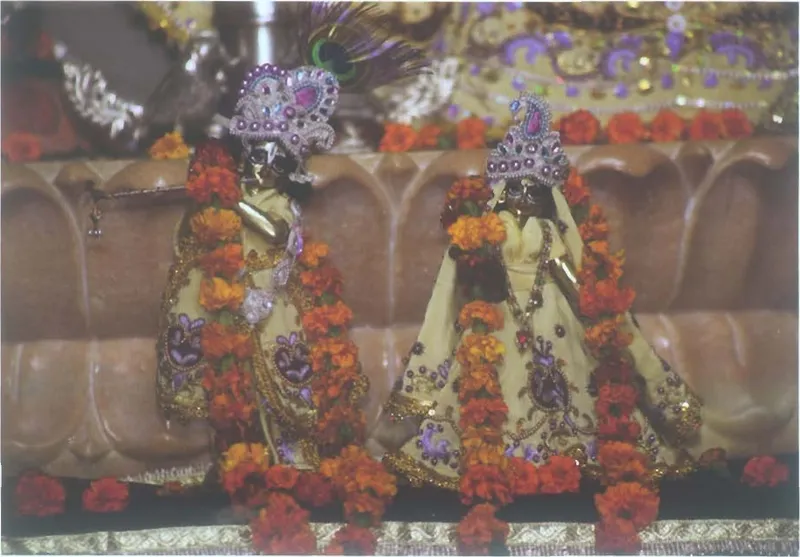
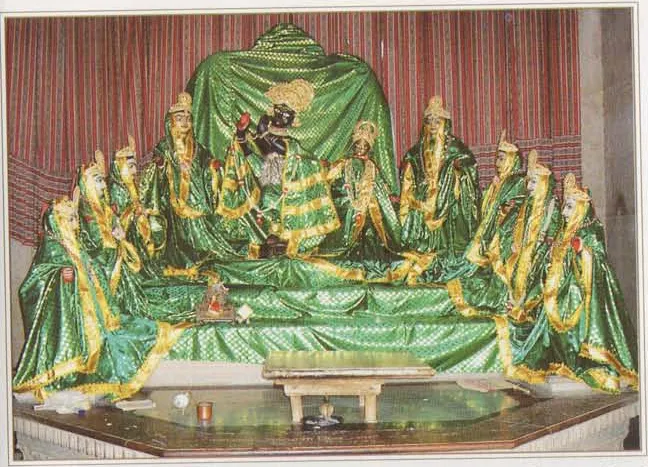
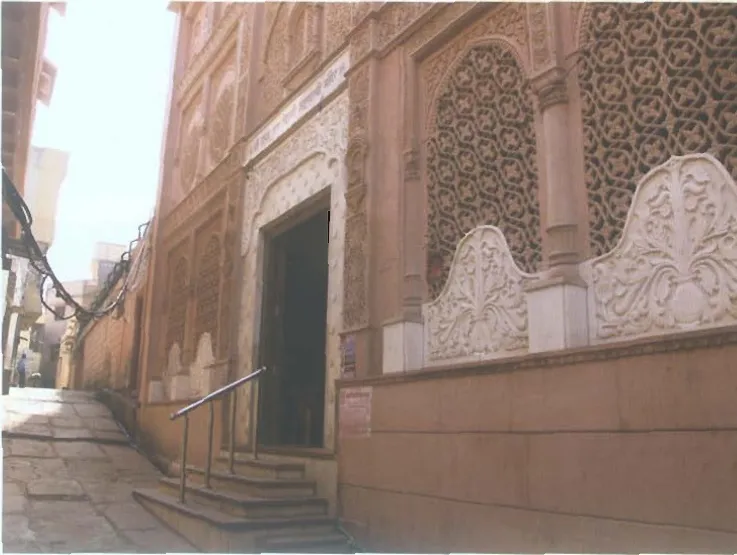
History
The oldest dated description found is in the Bengali Vṛndāvana-kathā (1920). It places the temple beside the gate of the Madana-mohana temple and says that Mahārāja Rāmarañjana Cakravartī of Hetampur and his wife Rāṇī Padmāsundarī Devī installed it on Rāsa-pūrṇimā, the full moon of Kārttika, in the Bengali year 1296, which fell in October or November 1889. It describes eight white-marble sakhīs about one and a half cubits high, and white-marble images of the king and queen in another courtyard.[1 +4] The historian A. W. Entwistle (1987) also gives 1889 and says that the building of his time was put up nearly forty years later.[5] The guidebooks agree on the royal founders but give the date differently; see below.[1 +4]
Vṛndāvana, the Playground of God (2010) says that devotees from Bombay had recently acquired the temple and replaced the small old building with a large two-storey one; it gives no year.[3]
Where the sources differ
When the Aṣṭa-sakhī temple was built.
Accounts differ When the Aṣṭa-sakhī temple was built.
- Śrī Vraja-maṇḍala Parikramā (2007)'In 1296 AD, the Mahārāja of Hetamapura, Rāmarañjana Cakravartī, and his wife Padmāsundarī had this temple built'.
- Vṛndāvana, the Playground of God (2010)Built by a Bengali king 'around the end of the 19th century'.
- The Color Guide to Vṛndāvana (2000)No date; the founder, Rāja Ramranjan Cakravartī of Hetambur, was an initiated disciple of Śrīla Bhaktisiddhānta Sarasvatī Gosvāmī.
- Vṛndāvana-kathā (1920; p. 253)Installed on Rāsa-pūrṇimā of Kārtika in the Bengali year (sāl) 1296, i.e. October–November 1889, by Mahārāja Rāmarañjana Cakravartī of Hetampur and Rāṇī Padmāsundarī Devī.
References
11 references
- Śrī Vraja-maṇḍala Parikramā (2007), PDF p. 338
- The Color Guide to Vṛndāvana (2000), Written and Photographed by Rājaśekhara dāsa Brahmacārī, PDF p. 66
- Vṛndāvana, the Playground of God (2010), Bhakti Caitanya Svāmī, PDF p. 139
- Vṛndāvana-kathā, chapter 20 (viṁśa pariccheda), list of temples, item 17 'অষ্ট সখীর কুঞ্জ', printed p. 253
- A. W. Entwistle, gazetteer of Vrindaban, sub-entry '3 Madanmohan', printed p. 402, Egbert Forsten, Groningen, 1987
- Vṛndāvana, the Playground of God (2010), Bhakti Caitanya Svāmī, PDF p. 140
- Śrīla Prabhupāda, Letter to Gurudasa and Yamuna, Letters, 25 April 1972 · vedabase.io
- Śrīla Rūpa Gosvāmī, Ujjvala-nīlamaṇi, 4.54 (śrī-rādhā-prakaraṇa; GRETIL), GRETIL
- Śrīla Rūpa Gosvāmī, Rādhā-Kṛṣṇa-gaṇoddeśa-dīpikā, part 1 (bṛhad-bhāga) vv.78–81: the eight sakhīs; Lalitā
- Vṛndāvana, the Playground of God (2010), Bhakti Caitanya Svāmī, p. 139
- The Color Guide to Vṛndāvana (2000), Written and Photographed by Rājaśekhara dāsa Brahmacārī, p. 52