Dvādaśāditya-ṭīlā
द्वादशादित्य-टीला Hindi name proposed
Also called Dvadasaditya Teela (Hill)
- What it is
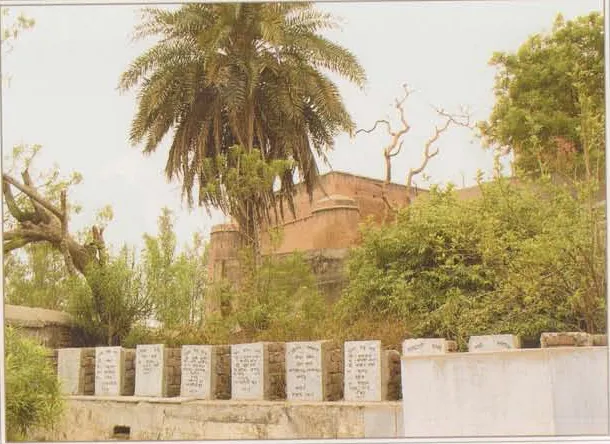
- Dvādaśāditya-ṭīlā, the Hill of the Twelve Suns, is the hill in Vṛndāvana on which the old Madana-mohana Mandira stands, near Kāliya's lake by the Yamunā.
- Visiting
- Vṛndāvana, the Playground of God (2010) reports a small shrine dedicated to the twelve suns behind the old Madana-mohana temple, on raised ground looking over the parikramā path and what was Kāliya's …
- Places here
- Rādhā-Madana-mohana Mandira (Vṛndāvana, old), Shrine at Dvādaṣāditya-ṭilā, Sanātana Gosvāmī's samādhi, Yogapīṭha (Dvādaśāditya-ṭīlā)
In short
Dvādaśāditya-ṭīlā, the Hill of the Twelve Suns, is the hill in Vṛndāvana on which the old Madana-mohana Mandira stands, near Kāliya's lake by the Yamunā.[1 +9] Śrīla Raghunātha dāsa Gosvāmī glorifies the tīrtha of the Twelve Suns, where twelve suns warmed Kṛṣṇa when He was cold, and the Bhakti-ratnākara says that this happened on this hill after Kṛṣṇa subdued Kāliya.[11 +1] Śrī Caitanya Mahāprabhu visited Dvādaśāditya, and the Caitanya-caritāmṛta tells that Śrīla Sanātana Gosvāmī prepared a place for Him here.[13 +5] The Śrīmad-Bhāgavatam tells the Kāliya pastime without naming the hill or the suns.[19 +3]
Key facts
| Kind | hill |
|---|---|
| Region · area | Vṛndāvana |
| Ācāryas | Śrīla Sanātana Gosvāmī, Śrī Caitanya Mahāprabhu, Śrīla Raghunātha dāsa Gosvāmī, Śrīla Narahari Cakravartī Ṭhākura, Śrīla Murāri Gupta |
Why it is glorified
The Varāha Purāṇa names a sun-tīrtha in Vṛndāvana called Dvādaśāditya, where Kāliya sported in the water of the Yamunā and was …
The Varāha Purāṇa names a sun-tīrtha in Vṛndāvana called Dvādaśāditya, where Kāliya sported in the water of the Yamunā and was subdued, and where the Lord established the Ādityas, the sun-gods. Merely bathing there, it says, frees one from all sins (summarised here, not translated). It speaks of a bathing place, not of a hill.[23 +1] In the Padma Purāṇa, which describes Vṛndāvana as a lotus, Dvādaśāditya is the fifth petal, in the north, called the best of all petals; Kālī-hrada is the sixth.[25]
उत्तरे पंचमं प्रोक्तं दलं सर्वदलोत्तमम् ॥ 30 ॥ द्वादशादित्यमत्रैव दलं च कर्णिकासमम् । वायव्यां तु दलं षष्ठं तत्र कालीह्रदः स्मृतः ॥ 31 ॥
uttare paṁcamaṁ proktaṁ dalaṁ sarvadalottamam
dvādaśādityamatraiva dalaṁ ca karṇikāsamam
vāyavyāṁ tu dalaṁ ṣaṣṭhaṁ tatra kālīhradaḥ smṛtaḥ
Śrīla Rūpa Gosvāmī's Mathurā-māhātmya gives Dvādaśāditya a section of its own, with verses that it quotes from the Ādi-varāha and the Saura Purāṇa: one who bathes at this sun-tīrtha and sees the sun reaches the sun's abode, and the mere sight of the tīrtha destroys sin (summarised here, not translated).[26 +2] According to the Bhakti-ratnākara, Śrīla Rāghava Paṇḍita Gosvāmī of Govardhana quoted the same verses when he showed the tīrtha to Śrīla Śrīnivāsa Ācārya.[26 +2]
Divine pastimes
Kāliya and the twelve suns
Śrīmad-Bhāgavatam 10.16–17 tells how Kṛṣṇa subdued the serpent Kāliya in his lake within the Yamunā and came out wearing divine garlands, fragrances and garments, and how that night the Vrajavāsīs slept near the bank of the river. It says nothing of Kṛṣṇa being cold, of a hill or of the sun; it neither tells nor denies the pastime of the twelve suns.[19 +8]
kṛṣṇaṃ hradād viniṣkrāntaṃ divya-srag-gandha-vāsasam / mahā-maṇi-gaṇākīrṇaṃ jāmbūnada-pariṣkṛtam
upalabhyotthitāḥ sarve labdha-prāṇā ivāsavaḥ / pramoda-nibhṛtātmāno gopāḥ prītyābhirebhire //
[Resuming his description of Kṛṣṇa’s chastisement of Kāliya, Śukadeva Gosvāmī continued:] Kṛṣṇa rose up out of the lake wearing divine garlands, fragrances and garments, covered with many fine jewels, and decorated with gold. When the cowherds saw Him they all stood up immediately, just like an unconscious person’s senses coming back to life. Filled with great joy, they affectionately embraced Him.
Translation: Śrīla Prabhupāda's disciples (BBT)The Canto 10 commentators set the Kāliya pastime in the hot season. Śrīla Jīva Gosvāmī and Śrīla Viśvanātha Cakravartī Ṭhākura say that Kṛṣṇa passed lightly over the surface of the water, not drenched, and Śrīla Viśvanātha Cakravartī Ṭhākura that Kāliya and his wives had anointed His limbs, hot from the venom, with cool sandal paste (summarised here, not translated).[20 +4] Śrīla Viśvanātha Cakravartī Ṭhākura and Śrīla Baladeva Vidyābhūṣaṇa explain that He crossed the water lightly on His feet, since with wet limbs He could not be described as wearing divine garlands and garments; they say nothing of cold or the sun.[36] Read more: How Kṛṣṇa subdued the serpent Kāliya →
The pastime of the twelve suns comes from the Gosvāmīs and later works. In verse 82 of his Vraja-vilāsa-stava, Śrīla Raghunātha dāsa Gosvāmī takes shelter of the tīrtha called Dvādaśa-sūrya, Twelve Suns, where Kṛṣṇa, suffering from cold, was served with love by twelve suns blazing with heat (summarised here, not translated). The verse names neither Kāliya nor a hill.[3 +7] The Bhakti-ratnākara tells it on this spot: after subduing Kāliya, Kṛṣṇa came from the lake to this ṭīlā (hill), very cold, and the suns took away the cold with fierce heat.[3 +5] In the next verse Śrīla Raghunātha dāsa Gosvāmī tells that drops of perspiration fell from Kṛṣṇa's body in that heat and became the Praskandana tīrtha.[3 +4]
Two lives of Śrī Caitanya Mahāprabhu, Śrīla Murāri Gupta's Kṛṣṇa-caitanya-caritāmṛta and Śrīla Locana dāsa Ṭhākura's Caitanya-maṅgala, tell that His guide showed Him the bathing place where Kṛṣṇa came up from the water and twelve suns rose in the sky, so that it is called the Dvādaśāditya-ghāṭa; Śrīla Locana dāsa Ṭhākura adds that Kṛṣṇa was afflicted by cold (summarised here, not translated). Neither mentions a hill.[46 +1]
Rādhā goes to worship the sun
In Śrīla Rūpa Gosvāmī's drama Vidagdha-mādhava (Act 2), Śrī Rādhā goes with Viśākhā to the Dvādaśāditya-tīrtha to worship the sun, and at Praskandana, where japā flowers dear to the sun bloom, Kṛṣṇa meets Her (summarised here, not translated). The Bhāgavatam does not tell this pastime.[48 +2]
Traditional accounts
The Bengali Vṛndāvana-kathā (1920) says that in ancient times a temple of the twelve Ādityas stood on the hill and that its image …
The Bengali Vṛndāvana-kathā (1920) says that in ancient times a temple of the twelve Ādityas stood on the hill and that its image of the sun was later lost; the author names no source, so this is not certain.[51 +1] The same book says that a small temple with footprints on the highest point of the hill may keep the memory of Śrī Caitanya Mahāprabhu's sitting place.[53] It also reports, from the Advaita-prakāśa, that Śrī Advaita Prabhu found the Deity Madana-gopāla near the hill, and adds that the Vrajavāsīs do not accept this account, so it is not certain.[54 +1]
The Gosvāmīs and ācāryas
On His journey through Vṛndāvana, Śrī Caitanya Mahāprabhu bathed at Kāliya's lake and Praskandana and then went to Dvādaśāditya …
Śrī Caitanya Mahāprabhu
On His journey through Vṛndāvana, Śrī Caitanya Mahāprabhu bathed at Kāliya's lake and Praskandana and then went to Dvādaśāditya, and from there to Keśī-tīrtha.[12 +4]
‘দ্বাদশ-আদিত্য’ হৈতে ‘কেশীতীর্থে’ আইলা ।
রাস-স্থলী দেখি’ প্রেমে মূর্চ্ছিত হইলা ॥ ৭২ ॥
‘dvādaśa-āditya’ haite ‘keśī-tīrthe’ āilā
rāsa-sthalī dekhi’ preme mūrcchita ha-ilā
After seeing the holy place called Praskandana, Śrī Caitanya Mahāprabhu went to Dvādaśāditya. From there He went to Keśī-tīrtha, and when He saw the place where the rāsa dance had taken place, He immediately lost consciousness due to ecstatic love.
Translation: Śrīla A.C. Bhaktivedanta Swami PrabhupādaŚrīla Sanātana Gosvāmī
Later Mahāprabhu sent word through Śrīla Jagadānanda Paṇḍita that He too was coming to Vṛndāvana and that Śrīla Sanātana Gosvāmī should arrange a place for Him.[16 +3] Śrīla Sanātana Gosvāmī obtained a maṭha, a temple, on Dvādaśāditya-ṭīlā, kept it clean and in repair, and put up a small hut in front of it. The Caitanya-caritāmṛta does not say whose temple it had been.[3 +6]
প্রভুর নিমিত্ত একস্থান মনে বিচারিল ।
দ্বাদশাদিত্য-টিলায় এক ‘মঠ’ পাইল ॥ ৬৯ ॥
prabhura nimitta eka-sthāna mane vicārila
dvādaśāditya-ṭilāya eka ‘maṭha’ pāila
Soon afterward, Sanātana Gosvāmī selected a place where Śrī Caitanya Mahāprabhu could stay while in Vṛndāvana. It was a temple in the highlands named Dvādaśāditya-ṭilā.
Translation: Śrīla A.C. Bhaktivedanta Swami PrabhupādaAccording to the Bhakti-ratnākara, Śrīla Sanātana Gosvāmī stayed on this hill by Mahāprabhu's order and made a place for Him in a secluded spot; when he became anxious, Mahāprabhu appeared to him here in a dream, embraced him and disappeared.[12] The same work says that Madana-gopāla liked Śrīla Sanātana Gosvāmī's hut and was served in a hut of leaves.[12 +2]
Śrī Caitanya Mahāprabhu's temple
Śrī Vraja-maṇḍala Parikramā (2007), citing the Bhakti-ratnākara, speaks of a temple that Śrīla Sanātana Gosvāmī built for Śrī Caitanya Mahāprabhu in the southern part of the old Madana-mohana temple. The older books tell it differently. The Caitanya-caritāmṛta says that he obtained a maṭha and put up a small hut in front of it; it does not say that he built the temple, and it does not connect the spot with the Madana-mohana temple. The Bhakti-ratnākara speaks of a place, not a temple, and the passage that the guidebook cites has not been found.[12 +5] Mahāprabhu's message through Śrīla Jagadānanda Paṇḍita, that He too was coming and that Sanātana should make a place for Him, is this:[16 +3]
আমিহ আসিতেছি, — কহিহ সনাতনে ।
আমার তরে একস্থান যেন করে বৃন্দাবনে ।।” ৪০ ।। ॥ ৪০ ॥
āmiha āsitechi, — kahiha sanātane
āmāra tare eka-sthāna yena kare vṛndāvane”
“Inform Sanātana Gosvāmī that I am coming to Vṛndāvana for a second time and that he should therefore arrange a place for Me to stay.”
Translation: Śrīla A.C. Bhaktivedanta Swami PrabhupādaAll agree that Mahāprabhu never came back to Vṛndāvana: the Caitanya-caritāmṛta says that He spent His remaining eighteen years without a break in Jagannātha Purī.[66 +1]
The Bengali Vṛndāvana-kathā (1920) says that the two old temples stand side by side because Śrī Caitanya had told Śrīla Rūpa Gosvāmī and Śrīla Sanātana Gosvāmī to keep a secret place for Him; the other temple is for Madana-mohana. The book does not say which of the two was the Lord's, so this is not certain.[68] The Muttra district gazetteer (1911) describes a chapel crowned with a tower attached to the south side of the old temple's sanctuary, but names no Deity and no builder. No source says that this chapel is the temple of Śrī Caitanya Mahāprabhu; it may only be a lead for a check on the spot.[69]
Śrīla Raghunātha dāsa Gosvāmī
Besides the Vraja-vilāsa-stava, Śrīla Raghunātha dāsa Gosvāmī's Madana-gopāla-stotra places the Deity Madana-gopāla on an altar of gold and jewels in the grove of the Dvādaśāditya tīrtha on the Yamunā. It speaks of a grove and an altar, not of a temple.[11 +2]
Śrīla Prabhupāda
Śrīla Prabhupāda names Dvādaśāditya among the places Śrī Caitanya visited in Vṛndāvana.
Śrīla Prabhupāda names Dvādaśāditya among the places Śrī Caitanya visited in Vṛndāvana.[13 +2] Speaking in Vṛndāvana in 1972, he said that Śrīla Sanātana Gosvāmī lived under a tree at the place of the old temple, with his Madana-mohana hanging in the tree:[2 +5]
Names this place“And Madana Gopāla's temple you have seen, old. He was living there underneath a tree. There was no temple at that time. The temple was constructed later on.”
Śrīla Prabhupāda, Lecture, Kṛṣṇadāsa Kavirāja Gosvāmī's Appearance Day, Vṛndāvana, 19 October 1972 · vedabase.io
He also told how Madana-mohana asked for salt with the dry bread that Śrīla Sanātana Gosvāmī offered, and how Sanātana answered that he could not go to ask for salt.[2 +4] In a letter of 1973 he wrote that the original Madana-mohana temple stood on high ground and could still be seen beside the new one:[1 +5]
Names this place“During Krsnadasa' time there was no Radharani deity, Madan Mohan was alone. Radharani was later introduced. The temple of Madan Mohan was formerly on high level, that is, the original old temple. It is still existent and can be seen side by side with the new Madan Mohan temple.”
Śrīla Prabhupāda, Letter to Jadurani, letter 73-06-28, 28 June 1973 · vedabase.io
Songs
The opening verse of Śrīla Raghunātha dāsa Gosvāmī's Madana-gopāla-stotra places Madana-gopāla in the grove of the Dvādaśāditya …
The opening verse of Śrīla Raghunātha dāsa Gosvāmī's Madana-gopāla-stotra places Madana-gopāla in the grove of the Dvādaśāditya tīrtha.[42 +1]
Visiting today
The shrine of the twelve suns
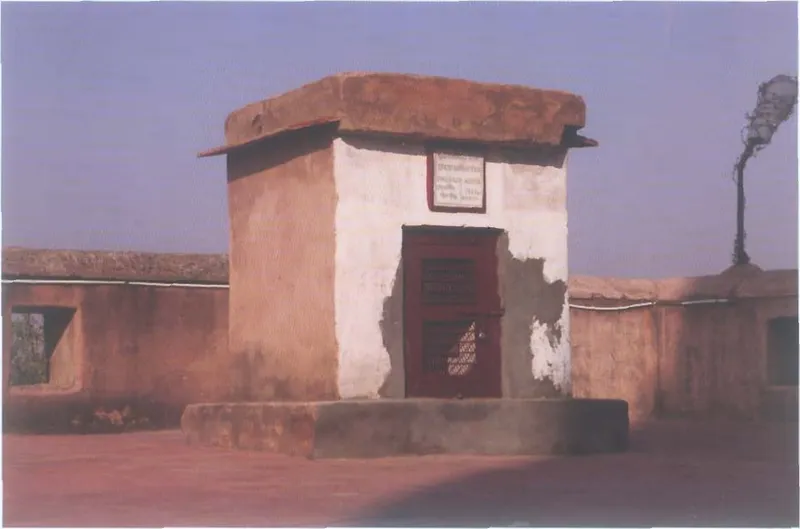
Vṛndāvana, the Playground of God (2010) reports a small shrine dedicated to the twelve suns behind the old Madana-mohana temple, on raised ground looking over the parikramā path and what was Kāliya's lake, with a view across to Bilvavana. Its photograph shows a small square whitewashed shrine with a heavy flat stone roof on a raised platform and a barred door; what it contains, and what its signboard says, the book does not tell.[39 +1] Śrīla Raghunātha dāsa Gosvāmī and the Bhakti-ratnākara, who tell the pastime of the twelve suns, mention no shrine, and no Deity, builder or date is recorded for it.[11 +1]
According to the local tradition recorded in the same book, Kṛṣṇa came up the hill to dry and warm Himself, and the sun-god Sūrya, wishing to serve Him, expanded himself into twelve suns. In another entry the book says that Śrīmatī Rādhārāṇī prayed to Sūrya to warm Kṛṣṇa. It names no source for either, and neither detail is in the two older texts, so they are not certain.[39 +3]
The historian A. W. Entwistle (1987) reports archaeological evidence that the mound of the Madana-mohana temple was the site of a Gupta-period temple, presumably of Sūrya, and a small shrine beside the Madana-mohana temple marking the place of the original Dvādaśāditya, or Sūrya, temple. He gives no date, builder or Deity for that shrine and does not say that it is the one described in 2010.[76 +1] The Color Guide to Vṛndāvana (2000) marks a "Yogapitha of Dvadaśaditya" in an annex of the Madana-mohana compound on its plan, without describing it. It may be the same shrine, but neither book says so.[39 +2]
Around the hill
The guidebooks place Praskandana, now dry, and Advaitavaṭa just below the hill, Sūrya-ghāṭa at its foot, and the Aṣṭa-sakhī Mandira on the neighbouring hill. From the northern side one can see where the Praskandana lake must have been.[3 +4] The town map of Śrī Vraja-maṇḍala Parikramā (2007) groups the hill with the old temple, Praskandana-kṣetra and Śrīla Sanātana Gosvāmī's samādhi, and The Color Guide to Vṛndāvana (2000) in its plan of the temple marks a Yogapīṭha of Dvādaśāditya in an annex reached by a stairway.[1 +3]
Places at Dvādaśāditya-ṭīlā
5 places
- ↳Rādhā-Madana-mohana Mandira (Vṛndāvana, old)temple›
- ↳Shrine at Dvādaṣāditya-ṭilāshrine›
- ↳Sanātana Gosvāmī's samādhisamādhi›
- ↳Yogapīṭha (Dvādaśāditya-ṭīlā)›
Also described on this page
Nearby places
Kāliya-ghāṭa · Yamunā · Advaitavaṭa · Praskandana-ghāṭa
Pictures
1 pictures
History
The historian A. W. Entwistle (1987) reports some Gupta-period finds from the mound, from which, he says, it may be argued that an older temple stood here, probably of the sun.[52] The guidebooks say that Śrīla Sanātana Gosvāmī brought Madana-mohana to this hill and that the old Madana-mohana temple stands on it.[1 +5] According to the Bhakti-ratnākara, a wealthy merchant who came to Śrīla Sanātana Gosvāmī began the temple, and Śrīla Prabhupāda says that Śrīla Sanātana Gosvāmī asked him to build it.[2 +5] Śrī Vraja-maṇḍala Parikramā (2007) calls the hillock above Sūrya-ghāṭa Āditya-ṭīlā and says that the temple of Madana-mohana stands on it.[1 +2]
Where the sources differ
Where Kāliya was subdued, in relation to Dvādaśāditya, the sources tell differently; their accounts are set out on the page of …
Where Kāliya was subdued, in relation to Dvādaśāditya, the sources tell differently; their accounts are set out on the page of Kāliya-ghāṭa.[20 +5]
Accounts differ The season, the time of day and Kṛṣṇa's condition at the end of the Kāliya pastime, which the Bhakti-ratnākara and the guidebooks continue with His warming by the twelve suns on this hill.
- Śrīmad-Bhāgavatam 10.15.48 and 10.17.21On the day of the pastime the cows and cowherd boys were distressed by the glaring summer sun (nidāgha-ātapa); that night's fire arose in the 'śuci' forest, the dry forest of the hot season (vedabase: 'the dry summer forest').
- Śrīla Sanātana Gosvāmī, Śrīla Jīva Gosvāmī, Śrīla Viśvanātha Cakravartī and Śrīla Baladeva Vidyābhūṣaṇa (on ŚB 10.15.47 and 10.17.21)The pastime took place in the hot season (grīṣma, nidāgha); the forest of that night's fire was the forest of the hot season.
- Śrīla Prabhupāda, Kṛṣṇa book ch. 15 and 17'Gradually, the summer season arrived …'; Kṛṣṇa came out of the lake decorated and 'smeared all over with candana pulp'; 'it was almost night' when all lay down to rest on the riverbank.
- Śrīmad-Bhāgavatam 10.17.13; Śrīla Jīva Gosvāmī, Śrīla Viśvanātha Cakravartī and Śrīla Baladeva Vidyābhūṣaṇa on it; Śrīla Sanātana Gosvāmī on 10.17.20The Bhāgavatam: Kṛṣṇa came out of the lake wearing divine garlands, fragrances and garments. Jīva and Viśvanātha: He passed lightly over the surface of the water (Viśvanātha: mounted on an unseen serpent sent by Kāliya; Baladeva gives this as what 'some' say); Viśvanātha and Baladeva: otherwise, with His limbs drenched, divine garlands, fragrances and garments would not fit. …
The wording of these accounts is our summary of the sources, not a published translation.
Accounts differ Why and how the twelve suns came to warm Kṛṣṇa (the pastime to which the shrine is dedicated).
- Vraja-vilāsa-stava 82 (Śrīla Raghunātha dāsa Gosvāmī)Twelve suns, full of devotion and love, served the cold Kṛṣṇa with intense heat; no one is said to have asked them, and neither Kāliya nor a hill is mentioned.
- Bhakti-ratnākara, Fifth Wave, printed p. 303After subduing Kāliya Kṛṣṇa came to this hill; the suns, knowing Him to be very cold, dispelled the cold with intense heat.
- Śrī Vraja-maṇḍala Parikramā (2007)Kṛṣṇa, shivering after the Kāliya pastime, basked on the hill; to serve Him 'the devotee Sūryadeva' shone with the full heat of the sun in its twelve aspects (dvādaśa kalā).
- Vṛndāvana, the Playground of God (2010)'It is said' that Sūrya, wanting to serve Kṛṣṇa, expanded himself into twelve suns (the shrine's pastime); elsewhere, that Rādhārāṇī prayed to Sūrya and as a result he manifested his twelve forms.
A third record asks what happened when Kṛṣṇa came out of Kāliya's lake, for the shrine of the twelve suns; it sets the Bhāgavatam and its commentators beside the tradition of the twelve suns, as the two accounts above already do.[19 +4]
What Śrīla Sanātana Gosvāmī prepared for Śrī Caitanya Mahāprabhu, and where, is told differently by the Caitanya-caritāmṛta, the Bhakti-ratnākara and the guidebooks.[12 +4]
Accounts differ What Śrīla Sanātana Gosvāmī prepared for Śrī Caitanya Mahāprabhu's expected visit, and where.
- Śrī Caitanya-caritāmṛta, Antya-līlā 13.69-70He obtained a maṭha (temple) on Dvādaśāditya-ṭilā, kept it clean and in repair, and put up a small hut in front of it.
- Bhakti-ratnākara, Fifth Wave, printed p. 303He made a place (sthāna) for the Lord in this secluded spot on the hill, where the Lord appeared to him in a dream.
- Śrī Vraja-maṇḍala Parikramā (2007), citing the Bhakti-ratnākaraHe built a temple for Śrī Caitanya Mahāprabhu in the southern part of Śrī Madana-mohana's temple.
The wording of these accounts is our summary of the sources, not a published translation.
More on this place
How Kṛṣṇa subdued the serpent Kāliya
References
81 references
- Śrī Vraja-maṇḍala Parikramā (2007), PDF p. 342
- Vṛndāvana, the Playground of God (2010), Bhakti Caitanya Svāmī, PDF p. 16
- The Color Guide to Vṛndāvana (2000), Written and Photographed by Rājaśekhara dāsa Brahmacārī, PDF p. 56
- Vṛndāvana-Dhāma Ki Jaya! (c. 1986), by Dhruva Mahārāja dāsa, PDF p. 64
- the undated parikramā notes Mahāvana, ¶59
- Govardhana Hill: India's Most Sacred Mountain (2001), Rajasekhara dasa Brahmacari, PDF p. 84
- Śrī Vraja-maṇḍala Parikramā (2007), PDF p. 341
- Śrī Vraja-maṇḍala Parikramā (2007), PDF p. 299
- Vṛndāvana, the Playground of God (2010), Bhakti Caitanya Svāmī, PDF p. 126
- The Color Guide to Vṛndāvana (2000), Written and Photographed by Rājaśekhara dāsa Brahmacārī, PDF p. 55
- Śrīla Raghunātha dāsa Gosvāmī, Vraja-vilāsa-stava, verse 82
- Śrīla Narahari Cakravartī, Bhakti-ratnākara, Fifth Wave, 1912 ed. p. 303, 2nd ed., 1912
- Śrīla Kṛṣṇadāsa Kavirāja Gosvāmī, Śrī Caitanya-caritāmṛta, Madhya-līlā 18.72, online edition · vedabase.io
- Śrīla Prabhupāda, Śrīmad-Bhāgavatam, Canto 1, Introduction, Introduction (life of Śrī Caitanya Mahāprabhu) · vedabase.io
- Śrīla Prabhupāda, Śrī Caitanya-caritāmṛta, Madhya-līlā 18, chapter summary, Madhya-līlā chapter 18, summary (from Bhaktivinoda Ṭhākura's Amṛta-pravāha-bhāṣya) · vedabase.io
- Śrīla Kṛṣṇadāsa Kavirāja Gosvāmī, Śrī Caitanya-caritāmṛta, Antya-līlā 13.65, online edition · vedabase.io
- Śrīla Kṛṣṇadāsa Kavirāja Gosvāmī, Śrī Caitanya-caritāmṛta, Antya-līlā 13.69, online edition · vedabase.io
- Śrīla Kṛṣṇadāsa Kavirāja Gosvāmī, Śrī Caitanya-caritāmṛta, Antya-līlā 13.70, online edition · vedabase.io
- Śrīmad-Bhāgavatam 10.16.1, GRETIL
- Śrīmad-Bhāgavatam 10.17.13–14, GRETIL
Show all 81 references
- Śrīmad-Bhāgavatam 10.17.20, GRETIL
- Śrīla Prabhupāda, Kṛṣṇa, the Supreme Personality of Godhead (Kṛṣṇa book), Chapter 17 (Extinguishing the Forest Fire) · vedabase.io
- Varāha Purāṇa, adhyāya 156, verses 14–17, Sanskrit Wikisource
- Varāha Purāṇa, adhyāya 168, verse 17, Sanskrit Wikisource
- Padma Purāṇa, Pātāla-khaṇḍa 69.30–31, Sanskrit Wikisource
- Śrīla Rūpa Gosvāmī, Mathurā-māhātmya, v.394–396
- Śrīla Narahari Cakravartī, Bhakti-ratnākara, Fifth Wave (pañcama taraṅga), 1912 ed. p. 302, 2nd ed., 1912
- Śrīla Narahari Cakravartī, Bhakti-ratnākara, Fifth Wave, 1912 ed. p. 303, lines 1-4, 2nd ed., 1912
- Śrīmad-Bhāgavatam 10.16.4, GRETIL
- Śrīmad-Bhāgavatam 10.15.48, GRETIL
- Śrīmad-Bhāgavatam 10.16.29, GRETIL
- Śrīmad-Bhāgavatam 10.16.62, GRETIL
- Śrīmad-Bhāgavatam 10.17.20, Bhagavata Vidya Pith edition, ed. Bhagavata Rishi and Krishna Shankar Shastri, 1996
- Śrīla Sanātana Gosvāmī: commentary on ŚB 10.15.47, Bhagavata Vidya Pith edition, ed. Bhagavata Rishi and Krishna Shankar Shastri, 1996
- Śrīmad-Bhāgavatam 10.17.21, GRETIL
- Śrīla Viśvanātha Cakravartī Ṭhākura: commentary on ŚB 10.17.13, Bhagavata Vidya Pith edition, ed. Bhagavata Rishi and Krishna Shankar Shastri, 1996
- Śrīla Viśvanātha Cakravartī Ṭhākura: commentary on ŚB 10.16.65, Bhagavata Vidya Pith edition, ed. Bhagavata Rishi and Krishna Shankar Shastri, 1996
- Śrī Vraja-maṇḍala Parikramā (2007), PDF p. 302
- Vṛndāvana, the Playground of God (2010), Bhakti Caitanya Svāmī, PDF p. 17
- Vṛndāvana-Dhāma Ki Jaya! (c. 1986), by Dhruva Mahārāja dāsa, PDF p. 63
- Śrīla Raghunātha dāsa Gosvāmī, Vraja-vilāsa-stava, verse 83
- Śrīla Raghunātha dāsa Gosvāmī, Śrī Madana-gopāla-stotra, verse 1
- Śrīla Narahari Cakravartī, Bhakti-ratnākara, Fifth Wave (pañcama taraṅga), 1912 ed. p. 303, 2nd ed., 1912
- the undated parikramā notes Vṛndāvana, ¶51
- Vṛndāvana, the Playground of God (2010), Bhakti Caitanya Svāmī, PDF p. 137
- Kṛṣṇa-caitanya-caritāmṛta, prakrama 4, sarga 7, verses 9–10 (4.7.9–10), PDF page 569
- Śrīla Locana dāsa Ṭhākura, Caitanya-maṅgala, Śeṣa-khaṇḍa, 1903 ed. p. 173: left column, last line; right column, lines 1–6
- Śrīla Rūpa Gosvāmī, Vidagdha-mādhava, Act 2 (dvitīyo 'ṅkaḥ, 'Manmatha-lekhā'), Rādhā's words after v.42 … after v.42'; the text follows the verse numbers of the Chowkhamba edition, 1970)
- Śrīla Rūpa Gosvāmī, Vidagdha-mādhava, Act 2 (dvitīyo 'ṅkaḥ, 'Manmatha-lekhā'), prose after v.40: Kṛṣṇa and Madhumaṅgala … v.41')
- Śrīla Rūpa Gosvāmī, Vidagdha-mādhava, Act 2 ('Manmatha-lekhā'): Rādhā's words after v.42 and the prose before v.44 (Viśākhā; Kṛṣṇa's entrance) … after v.42' and '(2) … v.44')
- Vṛndāvana-kathā, ch. 14, 'Sūryya mandira', printed p. 169
- A. W. Entwistle, ch. 4 §15 'Finds in and around Vrindaban', printed p. 130, Egbert Forsten, Groningen, 1987
- Vṛndāvana-kathā, ch. 3, printed pp. 68–69
- Vṛndāvana-kathā, ch. 3, printed pp. 67–68
- Vṛndāvana-kathā, ch. on Advaita Prabhu, printed pp. 184–186
- Śrīla Narahari Cakravartī, Bhakti-ratnākara, Second Wave (dvitīya taraṅga), 1912 ed. p. 93, 2nd ed., 1912
- Śrīla Narahari Cakravartī, Bhakti-ratnākara, Second Wave, 1912 ed. p. 94, 2nd ed., 1912
- Śrīla Prabhupāda, Lecture on Śrīmad-Bhāgavatam 1.2.8, Bombay, 26 December 1972 · vedabase.io
- Śrīla Prabhupāda, Lecture on Śrīmad-Bhāgavatam 1.8.26, Māyāpur, 6 October 1974 · vedabase.io
- Śrī Vraja-maṇḍala Parikramā (2007), PDF p. 327
- Śrī Vraja-maṇḍala Parikramā (2007), PDF p. 298
- Śrī Vraja-maṇḍala Parikramā (2007), PDF p. 345
- Śrīla Kṛṣṇadāsa Kavirāja Gosvāmī, Śrī Caitanya-caritāmṛta, Antya-līlā 13.40, online edition · vedabase.io
- Śrīla Prabhupāda, Lecture, Kṛṣṇadāsa Kavirāja Gosvāmī's Appearance Day, Vṛndāvana, 19 October 1972 · vedabase.io
- Vṛndāvana, the Playground of God (2010), Bhakti Caitanya Svāmī, PDF p. 24
- Śrīla Kṛṣṇadāsa Kavirāja Gosvāmī, Śrī Caitanya-caritāmṛta, Ādi-līlā 13.13, online edition · vedabase.io
- Śrī Vraja-maṇḍala Parikramā (2007), PDF p. 328
- Vṛndāvana-kathā, ch. 3, printed pp. 63–64
- D. L. Drake-Brockman, Muttra: A Gazetteer
- the undated parikramā notes Vṛndāvana, ¶50
- Śrī Vraja-maṇḍala Parikramā (2007), PDF p. 326
- The Color Guide to Vṛndāvana (2000), Written and Photographed by Rājaśekhara dāsa Brahmacārī, PDF p. 60
- Madana Gopāla Stotra (vana-bhuvi ravikanyā) (Raghunātha dāsa Gosvāmī (as the song book credits it; agrees with the Stavāvalī colophon on sanskritdocuments)) · song book
- Vṛndāvana, the Playground of God (2010), Bhakti Caitanya Svāmī, PDF p. 18
- Vṛndāvana, the Playground of God (2010), Bhakti Caitanya Svāmī, PDF p. 139
- A. W. Entwistle, ch. 8 §66.2 'Praskandan Ghat', printed p. 401, Egbert Forsten, Groningen, 1987
- A. W. Entwistle, ch. 8 §66.3 'Madanmohan', printed p. 402, Egbert Forsten, Groningen, 1987
- The Color Guide to Vṛndāvana (2000), Written and Photographed by Rājaśekhara dāsa Brahmacārī, PDF p. 165
- the undated parikramā notes Vṛndāvana, ¶53
- Śrī Vraja-maṇḍala Parikramā (2007), p. 658-659
- Śrī Vraja-maṇḍala Parikramā (2007), p. 578-579