Bilvamaṅgala Ṭhākura's samādhi
बिल्वमंगल ठाकुर की समाधि Hindi name proposed
Also called Samadhi of Bilvamangala Ṭhakura
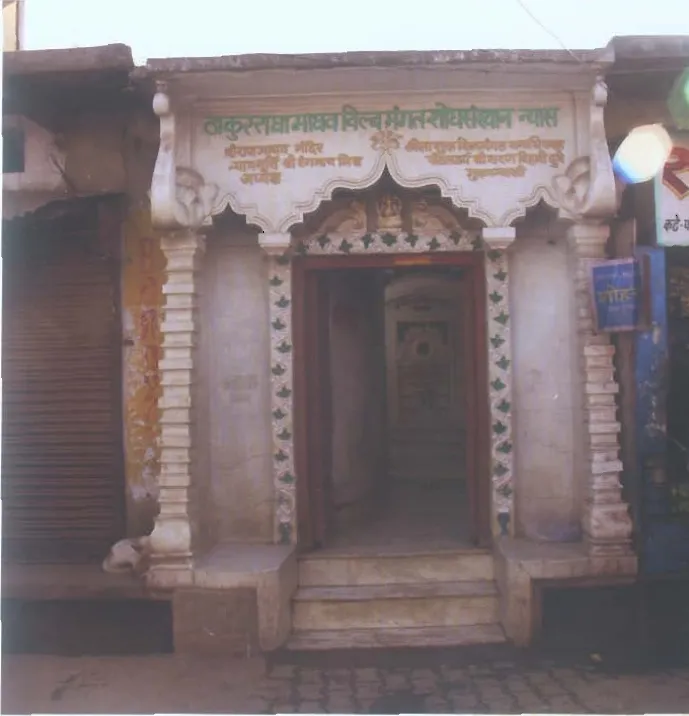
- What it is
- This is the samādhi, the tomb or memorial shrine, of Śrīla Bilvamaṅgala Ṭhākura, the author of the Kṛṣṇa-karṇāmṛta, in the Gopīnātha Bazaar of Vṛndāvana, just before the Amiya Nimāi Mandira.
- Visiting
- Vṛndāvana, the Playground of God (2010) places the samādhi in the Gopīnātha Bazaar, just before the Amiya Nimāi temple, which it says was opened in 1956; The Color Guide to Vṛndāvana (2000) lists it …
In short
This is the samādhi, the tomb or memorial shrine, of Śrīla Bilvamaṅgala Ṭhākura, the author of the Kṛṣṇa-karṇāmṛta, in the Gopīnātha Bazaar of Vṛndāvana, just before the Amiya Nimāi Mandira.[1 +7] The Caitanya-caritāmṛta tells that Śrī Caitanya Mahāprabhu especially liked to hear his book.[4 +4] Śrīla Prabhupāda tells how Kṛṣṇa came to the blind saint in Vṛndāvana to bring him milk.[1 +4] No older text mentions the samādhi; where in Vṛndāvana he lived, and for how long, the sources tell differently.[1 +3]
Key facts
| Kind | samādhi |
|---|---|
| Region · area | Vṛndāvana · Gopīnātha Bazaar |
| Ācāryas | Śrīla Bilvamaṅgala Ṭhākura |
The Gosvāmīs and ācāryas
Śrīla Bilvamaṅgala Ṭhākura
Śrīla Prabhupāda writes that Śrīla Bilvamaṅgala Ṭhākura was the chief disciple of Viṣṇu Svāmī and was initiated by Somagiri, whom the Kṛṣṇa-karṇāmṛta names in its first verse.[4 +3] Śrīla Kṛṣṇadāsa Kavirāja Gosvāmī, in his commentary on that book, gives his story as the account handed down through the line of gurus (summarised here, not translated). A learned brāhmaṇa from the bank of the Kṛṣṇa-veṇvā river, he was attached to the courtesan Cintāmaṇi until her words turned him to Kṛṣṇa. He took the Gopāla mantra from Somagiri, wrote of Kṛṣṇa's pastimes, took sannyāsa and set out for Vṛndāvana. There he saw Kṛṣṇa face to face, and the verses he spoke were written down by the Vaiṣṇavas with him. He lived in Vṛndāvana for some days, and then Kṛṣṇa took him into His own pastimes.[8]
Śrīla Sanātana Gosvāmī, commenting on the Bhāgavatam (10.39.37), reports an explanation of some Vaiṣṇavas that begins from great devotees such as Śrī Bilvamaṅgala, who even now see Kṛṣṇa's pastimes in Vṛndāvana: that in one of His manifestations Kṛṣṇa always plays in Vṛndāvana. He gives this explanation without rejecting it (summarised here, not translated). The passage names no residence and no samādhi.[16]
In the Caitanya-caritāmṛta, the Kṛṣṇa-karṇāmṛta is among the books Śrī Caitanya Mahāprabhu most liked to hear:[4 +4]
কর্ণামৃত, বিদ্যাপতি, শ্রীগীতগোবিন্দ ।
ইহার শ্লোক-গীতে প্রভুর করায় আনন্দ ॥ ২৭ ॥
karṇāmṛta, vidyāpati, śrī-gīta-govinda
ihāra śloka-gīte prabhura karāya ānanda
The Lord especially liked to hear Bilvamaṅgala Ṭhākura’s Kṛṣṇa-karṇāmṛta, the poetry of Vidyāpati, and Śrī Gīta-govinda, by Jayadeva Gosvāmī. Śrī Caitanya Mahāprabhu felt great pleasure in His heart when His associates chanted verses and sang songs from these books.
Translation: Śrīla A.C. Bhaktivedanta Swami PrabhupādaŚrīla Prabhupāda
According to Śrīla Prabhupāda's purport to Caitanya-caritāmṛta Ādi 1.57 and his lectures, Kṛṣṇa, as a cowherd boy, used to come …
According to Śrīla Prabhupāda's purport to Caitanya-caritāmṛta Ādi 1.57 and his lectures, Kṛṣṇa, as a cowherd boy, used to come to Bilvamaṅgala to talk with him and bring him milk. He names no spot in Vṛndāvana and does not mention the samādhi.[1 +4] In Vṛndāvana in 1976 he said (general, about the saint):[1 +4]
General teaching (does not name the place)“In Vṛndāvana, Bilvamaṅgala Ṭhākura, he was blind. He was sitting in one place, and Kṛṣṇa used to come and supply him milk.”
Śrīla Prabhupāda, Śrīmad-Bhāgavatam 5.5.32 lecture, Vṛndāvana, 19 November 1976 · vedabase.io
Visiting today
Vṛndāvana, the Playground of God (2010) places the samādhi in the Gopīnātha Bazaar, just before the Amiya Nimāi temple, which it says was opened in 1956; The Color Guide to Vṛndāvana (2000) lists it with the Soṇā Gaurāṅga Mandira and gives the hours as 4:30 am to 12 noon and 4:30 to 9 pm.[1 +5]
Location
| Where it is | 'in the Gopīnātha Bazaar, just before the Amiya Nimāi temple'[18] |
|---|
Nearby places
Amiya Nimāi Mandira · Soṇā Gaurāṅga Mandira · Brahma-kuṇḍa (Vṛndāvana)
Pictures
3 pictures
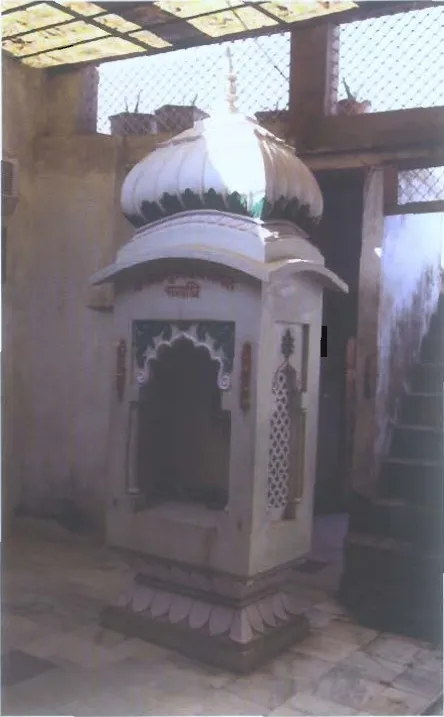
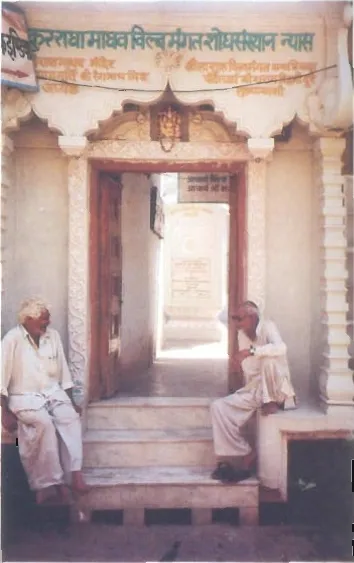
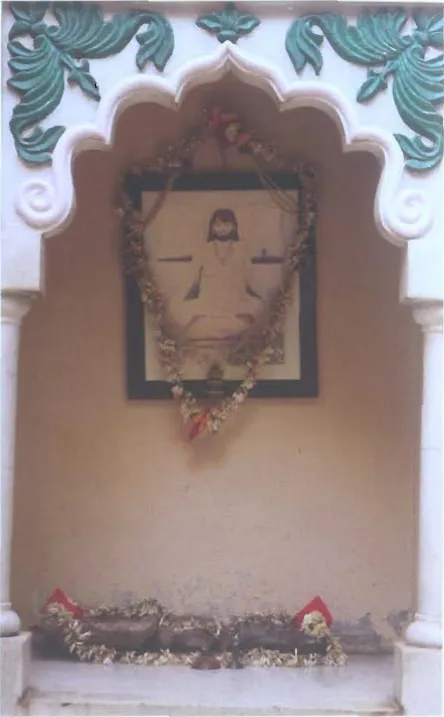
History
The guidebooks name and place the samādhi but do not say who built it, when, or whether it holds relics.[1 +5] The Bengali Vṛndāvana-kathā (1920) describes a house called "Bilvamaṅgala's kuñja" at the entrance of the Gopīnātha Bazaar. Its author had seen it almost in ruins ten or twelve years before; it had since been rebuilt, and beside its courtyard there was only a small platform of new stone in the shape of a temple, called the samādhi of Śrīla Bilvamaṅgala Ṭhākura. One or two learned men told him that the name was given to keep the saint's memory alive and that there is no proof he built a kuñja there (summarised here, not translated).[6]
Where the sources differ
Where Śrīla Bilvamaṅgala Ṭhākura lived in Vṛndāvana, how long he stayed, and where he left the world.
Where Śrīla Bilvamaṅgala Ṭhākura lived in Vṛndāvana, how long he stayed, and where he left the world. Śrīla Prabhupāda writes that he lived seven hundred years near Brahma-kuṇḍa, and the guidebooks of 2000 and 2010 agree; Śrīla Kṛṣṇadāsa Kavirāja Gosvāmī's commentary says "some days"; Śrī Vraja-maṇḍala Parikramā (2007) places his bhajana and departure at Kāliya-daha (Bilvamaṅgala's place of bhajana), which may not be so.[4 +6]
Accounts differ Where Bilvamaṅgala lived and did bhajana in Vṛndāvana, how long he stayed there, and where he departed.
- Śrīla Prabhupāda, CC Ādi 1.57 purportHe lived at Vṛndāvana for seven hundred years in the vicinity of Brahma-kuṇḍa.
- Vṛndāvana, the Playground of God (2010), The Color Guide to Vṛndāvana (2000), the undated parikramā notes VṛndāvanaLived 'here' (Vṛndāvana) about 700 years, mainly at / performing bhajana at Brahma-kuṇḍa; his samādhi is in the Gopīnātha Bazaar.
- Śrī Vraja-maṇḍala Parikramā (2007)After staying at Govardhana he resided near Kālīya-daha, did bhajana there and 'performed his disappearance pastime here'.
- Śrīla Kṛṣṇadāsa Kavirāja Gosvāmī, Sāraṅga-raṅgadā (commentary on the Kṛṣṇa-karṇāmṛta)As the account handed down through the line of gurus: having come to Vṛndāvana and seen Kṛṣṇa face to face, he lived there for some days (katicid dināni), and then Kṛṣṇa took him into His own pastimes; no place in Vṛndāvana and no samādhi is named.
The wording of these accounts is our summary of the sources, not a published translation.
When he lived: the eighth century of the Śaka era, according to Śrīla Prabhupāda, or about 700 AD, according to two guidebooks; the date is not certain.[2 +4]
Accounts differ When Bilvamaṅgala lived.
- Śrīla Prabhupāda, CC Ādi 1.57 purportAppeared in the eighth century of the Śaka era in Draviḍa.
- Śrīla Prabhupāda, conversation 13 May 1969Asked the century, he first agrees with a guest's 'fourteenth century', then corrects himself: 'Fourteenth century, not Bilvamaṅgala. Bilvamaṅgala Ṭhākura, some time before.' No date is given for Bilvamaṅgala.
- The Color Guide to Vṛndāvana (2000), the undated parikramā notes VṛndāvanaMoved/came to Vṛndāvana around 700 A.D.
- Vṛndāvana, the Playground of God (2010)Appeared in South India 'in the 700's'.
Whether Cintāmaṇi, whose words turned him to Kṛṣṇa, was a devotee.[15]
Accounts differ Whether Cintāmaṇi, whose words turned Bilvamaṅgala to Kṛṣṇa, was a devotee.
- Śrīla Prabhupāda, SB 1.11.19 purportA prostitute 'who happened to be a devotee of the Lord'; he later accepted her as his spiritual master.
- Vṛndāvana, the Playground of God (2010)'Cintāmaṇi was not a devotee, so it is understood that she was speaking words inspired by Bilvamaṅgala's spiritual master from his previous lifetime.'
- Śrīla Kṛṣṇadāsa Kavirāja Gosvāmī, Sāraṅga-raṅgadā (commentary on the Kṛṣṇa-karṇāmṛta)Seeing what Bilvamaṅgala had risked to reach her, Cintāmaṇi rebuked herself and him, resolved to give up everything the next day and worship Śrī Kṛṣṇa alone, and that night sang with her friends songs of Śrī Kṛṣṇa's pastimes with Śrī Rādhā; hearing her words and songs he turned to Kṛṣṇa.
References
18 references
- Vṛndāvana, the Playground of God (2010), Bhakti Caitanya Svāmī, PDF p. 191
- Vṛndāvana, the Playground of God (2010), Bhakti Caitanya Svāmī, PDF p. 189
- The Color Guide to Vṛndāvana (2000), Written and Photographed by Rājaśekhara dāsa Brahmacārī, PDF p. 124
- The Color Guide to Vṛndāvana (2000), Written and Photographed by Rājaśekhara dāsa Brahmacārī, PDF p. 125
- the undated parikramā notes Vṛndāvana, ¶132
- Pulinbihārī Datta, ch. 15 (pañcadaśa pariccheda), on Bilvamaṅgala Ṭhākura, printed pp. 173–174: the last paragraph of p. 173 and the first of p. 174
- Śrīla Prabhupāda, Śrī Caitanya-caritāmṛta, Ādi-līlā 1.57, purport · vedabase.io
- Kṛṣṇadāsa Kavirāja Gosvāmī, introductory account before the comment on verse 2 after v.2', parts 1-2 of 3)
- Śrīla Kṛṣṇadāsa Kavirāja Gosvāmī, Śrī Caitanya-caritāmṛta, CC Antya-līlā 15.27, online edition · vedabase.io
- Vṛndāvana, the Playground of God (2010), Bhakti Caitanya Svāmī, PDF p. 190
- the undated parikramā notes Vṛndāvana, ¶245
- Śrīla Prabhupāda, Śrīmad-Bhāgavatam 1.2.5 lecture, Glasgow, 31 July 1972 · vedabase.io
- Śrīla Prabhupāda, Śrīmad-Bhāgavatam 5.5.32 lecture, Vṛndāvana, 19 November 1976 · vedabase.io
- Śrīla Prabhupāda, Room Conversation with Allen Ginsberg, Columbus, 13 May 1969 · vedabase.io
- Śrīla Prabhupāda, Śrīmad-Bhāgavatam, 1.11.19, purport · vedabase.io
- Śrīla Sanātana Gosvāmī: commentary on ŚB 10.39.37, Bhagavata Vidya Pith edition, ed. Bhagavata Rishi and Krishna Shankar Shastri, 1996
- Śrī Vraja-maṇḍala Parikramā (2007), PDF p. 341
- Vṛndāvana, the Playground of God (2010), Bhakti Caitanya Svāmī, p. 189